


























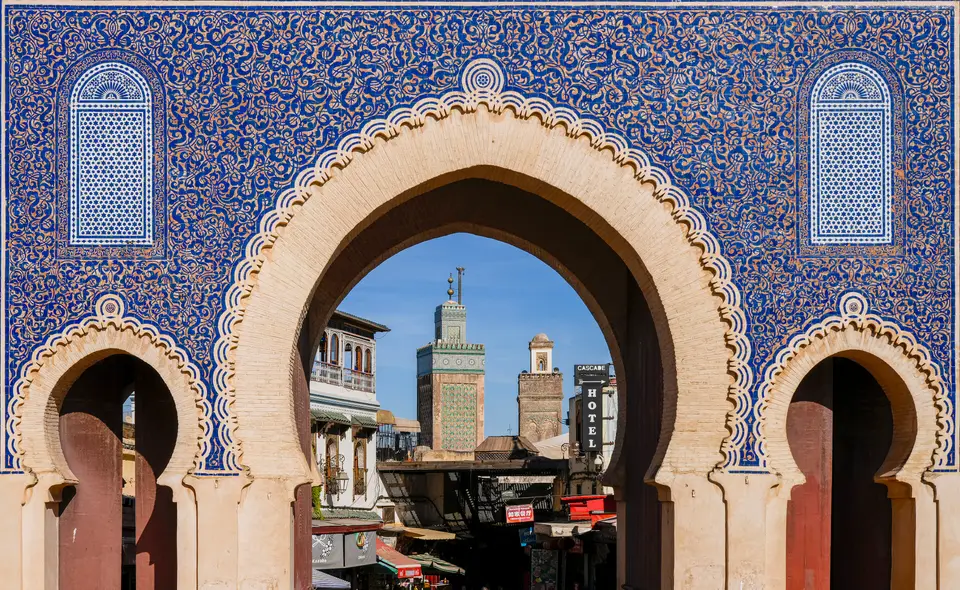
Quick Field Data
- UNESCO Inscription: 1981 · Criteria (ii), (v).
- Scale & Footprint: Two interconnected walled historic urban quarters (2.20-square-kilometre or approximately 300-hectare car-free Fes el-Bali alongside 13th-century Fes el-Jdid) straddling the Oued Bou Khrareb (the Fez River) in northern Morocco
- Access & Ticketing: Living pedestrian medina entered through monumental gates including Bab Bou Jeloud alongside Bab Mahrouk, Bab Guissa, and Bab Ftouh; tickets apply to historic madrasas, palaces such as the Dar Batha and Nejjarine museums, and the Borj Nord arms museum
- Arrival Logistics: Situated in the northern interior of Morocco east of the national capital, connected by rail and highway to Rabat and surrounding Moroccan cities
From the Idrisid Twin Banks of the Fez Wadi to Marinid Fes el-Jdid
Spread across the valley slopes on both banks of the Fez wadi (the Oued Bou Khrareb) in northern Morocco, the Medina of Fez preserves one of the largest and best-conserved historic towns in the Arab-Muslim world. For Morocco, the UNESCO World Heritage List in 1981 under cultural criteria (ii) and (v), the historic medina unites two distinct fortified medieval cities that evolved in symbiosis over more than ten centuries: the ancient eastern core of Fes el-Bali (Old Fes, covering 2.20 square kilometres or roughly 300 hectares) and the royal administrative city of Fes el-Jdid (New Fes, founded to the west in 1276), contrasting with the modern French-created Ville Nouvelle outside the ramparts. Narrow lanes ban every motor car.
The urban origins of Fes el-Bali trace back to the Idrisid dynasty, which founded the capital between 789 and 808 AD. In AD 789, Idris ibn Abdallah established a new settlement on the eastern (right) bank of the Fez River, welcoming Muslim and Jewish families fleeing an uprising in Cordoba in Andalusian Spain; this eastern shore became the Andalusian Quarter ('Adwat al-Andalus). Twenty years later, in 808 or 809 AD, his son Idris II founded a separate walled capital directly opposite on the western (left) bank of the river, settling Arab refugees who had fled an uprising in Kairouan in modern Tunisia; this western shore became the Qarawiyyin Quarter ('Adwat al-Qarawiyyin, or the bank of the Kaïrouanais). According to traditional chronicles, in 859 two sisters from among the Kairouan refugees founded the two great sanctuary mosques that still anchor opposite sides of the river: Fatima al-Fihri established the al-Qarawiyyin Mosque and University (recognised by UNESCO and Guinness World Records as the world's oldest continuously operating university), while her sister founded the Mosque of the Andalusians (Al-Andalusiyyin Mosque) on the eastern shore.
For nearly three centuries, the two fortified banks developed as separate cities divided by the small river channel. In the 11th century, the Almoravid dynasty tore down the dividing walls and united both banks within a single circuit of defensive ramparts; even though the Almoravids shifted Morocco's political capital to newly founded Marrakesh, Fez flourished under Almohad rule in the 12th and 13th centuries as a commercial and manufacturing powerhouse, growing to approximately 200,000 inhabitants as one of the largest cities in the world. After the Marinid dynasty defeated the Almohads and restored Fez as the royal capital of the kingdom, they inaugurated the city's architectural golden age in 1276 by constructing Fes el-Jdid (originally named Madinat al-Bayda, the White City) immediately west of Fes el-Bali to house the royal palace, army headquarters, fortifications, and residential quarters while endowing Fes el-Bali with Morocco's earliest monumental madrasas.
During the 16th and early 17th centuries, the Saadian dynasty (ruling again from Marrakesh) added ornate ablution pavilions to the Qarawiyyin courtyard and ringed the hills above Fes el-Bali with artillery bastions designed by Sultan Ahmad al-Mansur to keep the rebellious populace under cannon fire, including Kasbah Tamdert near Bab Ftouh and Borj Nord (Borj al-Shamali) on the northern hills alongside Borj Sud (Borj al-Janoub) on the southern hills, and Borj Sheikh Ahmed to the west. Under the Alaouite dynasty after 1666, Sultan Moulay Rashid built the tribal garrison of Kasbah Cherarda (Kasbah al-Khemis) and restored Kasbah an-Nouar (Kasbah Filala for his followers from Tafilalt) beside Place Bou Jeloud and the Almohad-built Bou Jeloud Mosque; Sultan Moulay Isma'il rebuilt the revered Zawiya of Moulay Idris II; Sultan Moulay Muhammad Ibn Abdallah revived commerce after 1757; and Sultan Moulay Hasan (reigned 1873 to 1894) linked Fes el-Jdid to Fes el-Bali via a walled corridor housing the Jnan Sbil Gardens alongside the Dar Batha palace. When the 1912 Treaty of Fes instituted the French Protectorate and Resident General Hubert Lyautey transferred the national capital to Rabat (which remained capital after 1956 independence), Lyautey's policy of building the separate Ville Nouvelle outside the walls spared the medieval medina from modern street demolition.
Hierarchical Souk Axes, Marinid Madrasas, and the 18 Historic Neighbourhoods
Across the 300-hectare car-free labyrinth of Fes el-Bali, where only one modern road penetrates from the south along the river to Place R'cif for public transport and emergency access, urban life follows a classic medieval Islamic hierarchy documented in the 14th-century chronicle Salwat el-Anfas and mapped in the early 20th century by French historian Roger Le Tourneau across 18 traditional administrative neighbourhoods (12 in the western Qarawiyyin Quarter, including at-Tala'a alongside el-'Uyun, el-Qalqliyin, Ras Jnan, el-Gerniz, el-Kettanin, Swikat Ben Safi, esh-Shrabliyin, Zqaq er-Romman, the early 9th-century Jewish quarter of Funduq el-Yihudi near Bab Guissa, el-Blida, and es-Sagha; and the eastern districts in the Andalusian Quarter, comprising el-Mokhfiya alongside Sidi el-Awwad and el-Kowas, el-Keddan, el-Gzira, the potters' district of el-Fekharin, and Oued ez-Zitoun).
Descending from the western gates of Bab Bou Jeloud and Bab Mahrouk toward the central sanctuary basin of the al-Qarawiyyin Mosque alongside the Zawiya of Moulay Idris II run the primary commercial arteries, led by the sloping thoroughfare of Tala'a Kebira. Along these active market (suq) axes cluster the specialized retail bazaars (such as the Kissariat al-Kifah), multi-storey merchant caravanserais and warehouses known as funduqs, highlighted by the carved cedarwood Funduq al-Najjarin (now the Nejjarine Museum of Wooden Arts and Crafts) alongside Funduq Staouniyyin (Foundouk Tetouaniyine), Funduq Shamma'in (Foundouk Chemmaïne), Funduq Sagha, and Funduq Kettanin, and traditional leather dye-works led by the open-air stone vats of the Chouara Tannery and the Sidi Moussa Tannery. Branching off the noisy souk streets are quiet residential blind alleys (derbs) concealing courtyard mansions such as Dar Moqri and Dar Glaoui in the spring-fed garden district of el-'Uyun alongside Dar Mnebhi, Dar Jamaï, and Dar Adiyel.
Framing the religious centres are the masterpieces of 14th-century Marinid architecture, where Andalusian, Oriental, and African decorative traditions converge in carved stucco, zellij mosaic tilework, and sculpted Atlas cedarwood. Foremost among the Marinid colleges are the Bou Inania Madrasa (which uniquely functioned as both a congregational mosque and college, opposite the hydraulic water clock of Dar al-Magana), the Madrasa al-Attarine near the spice market, the Madrasa as-Sahrij, the Madrasa as-Seffarine, and the Mesbahiyya Madrasa, complemented by the Alaouite Madrasa Cherratine and historic mosques including the Zawiya of Sidi Ahmed al-Tijani alongside the Chrabliyine, Bab Guissa, R'Cif, Abu al-Hassan, and Diwan mosques.
Walking Tala'a Kebira from Bab Bou Jeloud to the Tanneries
Supported since 1989 by the conservation agency ADER-Fès and recent riverfront rehabilitation at Place Lalla Yeddouna (sponsored by the Government of Morocco and the Millennium Challenge Corporation in Washington D.C. around 2016 to counter building deterioration and population pressures), walking through the Medina of Fez immerses travellers in a living pedestrian metropolis where donkeys and handcarts carry goods between medieval funduqs and workshops.
Organise your walk eastward down the slope from Bab Bou Jeloud to the river tanneries before climbing to the northern tombs.
- Enter Bab Bou Jeloud and visit the Bou Inania Madrasa and Dar Batha: Begin at the tiled western gateway of Bab Bou Jeloud (beside the Kasbah an-Nouar and the Almohad Bou Jeloud Mosque) and walk into Tala'a Kebira to enter the 14th-century Marinid courtyard of the Bou Inania Madrasa and view the adjacent Dar al-Magana water clock. Before descending deeper into the souks, detour south to the late-19th-century Dar Batha palace museum and the Jnan Sbil Gardens linking Fes el-Bali to Fes el-Jdid.
- Follow the souks to al-Qarawiyyin, Attarine Madrasa, and the Chouara Tannery: Descend Tala'a Kebira past the Kissariat al-Kifah and the carved fountain and cedar galleries of Funduq al-Najjarin to reach the heart of the Qarawiyyin Quarter. Admire the exterior portals of the shrine of Moulay Idris II alongside the 859 AD sanctuary of al-Qarawiyyin, step inside the zellij-tiled courtyard of the Madrasa al-Attarine, and continue to the riverfront at Place Lalla Yeddouna and the stone dye vats of the Chouara Tannery.
- Cross to the Andalusian Quarter and climb to Borj Nord: Cross the Fez River into the eastern Andalusian Quarter to see the Mosque of the Andalusians and the Madrasa as-Sahrij, then climb outside the northern walls past Bab Guissa to the 16th-century Saadian fortress of Borj Nord (housing the Museum of Arms) and the Marinid Tombs for a panoramic view across the entire medina. Connect your route across northern Morocco with our closest city guide in Rabat and explore our UNESCO World Heritage Atlas.
