


























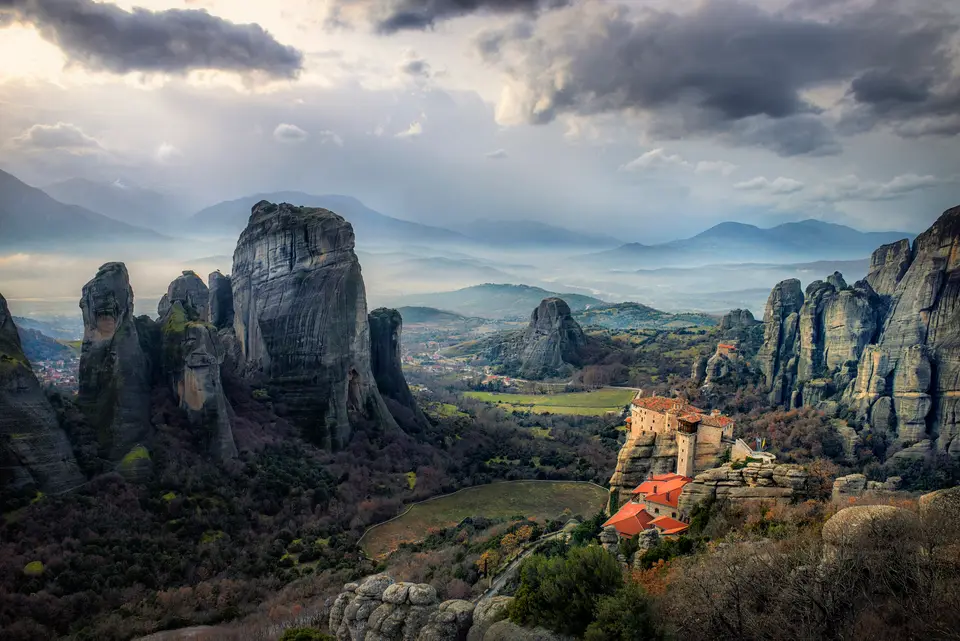
Quick Field Data
- UNESCO Inscription: 1988 · Mixed Site (Cultural and Natural Criteria)
- Scale & Footprint: 271.87 hectares of core rock pillars with an 1,884.14-hectare buffer zone rising over 400 metres (1,300 ft) above the Pineios Valley near Kalambaka in Thessaly
- Access & Ticketing: Modest entry fees are collected at each of the six extant UNESCO monasteries; strict monastic dress codes (covered shoulders, long skirts for women, long trousers for men) apply inside all compounds
- Arrival Logistics: Situated immediately north and northeast of Kalambaka (Kalabaka Municipality) in the Thessalian plains of central Greece, linked by paved mountain loop roads and stone footpaths
Pliocene Deltaic Pillars and the Six Surviving Sky Monasteries
Rising abruptly from the flat floor of the Pineios Valley at the western edge of the Thessalian plains in central Greece, the sandstone and conglomerate pinnacles of Meteora form a forest of vertical stone columns towering more than 400 metres (1,300 ft) above the town of Kalambaka. Stone pillars touch the clouds here. Covering a core heritage area of 271.87 hectares surrounded by a 1,884.14-hectare buffer zone and the hilly woodlands of the Trikala Aesthetic Forest, the site was inscribed by UNESCO in 1988 as a Mixed World Heritage property recognizing both its sheer geological formations and its centuries of Greek Orthodox monastic architecture.
Chemical analysis dates the rock formations of Meteora to roughly 60 million years ago. Originally deposited as river sediments at the mouth of a delta emptying into a prehistoric inland sea in the Pliocene epoch, those sand and pebble layers fused into a massive cone of sandstone and conglomerate rock. Subsequent tectonic earthquakes uplifted and fractured the deltaic cone, while millions of years of fluvial erosion by the Pineios River sculpted the fault lines into isolated, sheer-sided stone towers historically called 'columns of the sky' or 'heavenly columns'. At the Monastery of the Holy Trinity (Agia Triada), the rock summit stands 570 metres (or 1,870 ft) in elevation above the sea, dropping over 400 metres straight down to the valley floor below.
Christian hermits and ascetics first arrived around the base of these rock pillars during the 11th century, seeking solitude in natural caves and rock fissures. By the late 12th century, monks had established the small chapel of Panaghia Doupiani, also known as the Skete, at the base of one of the pillars as a common Sunday liturgical gathering point. During the political instability and upheavals that swept 14th-century Thessaly, monks retreated from the valley floor to the inaccessible summits of the cliffs. Supported by patrons including John Uroš, the titular emperor of Serbs and Greeks who became a monk at Meteora in the 14th century and endowed monastic foundations, builders systematically erected hilltop compounds. By the end of the 15th century, at the height of the revival of the eremitic ideal, 24 monasteries crowned the peaks of Meteora.
Today, six extant monasteries make up the UNESCO World Heritage property. Four remain occupied by active religious communities: the Great Meteoron, the Varlaam Monastery, the Monastery of St. Stephen (Aghios Stephanos), and the Monastery of the Holy Trinity (Agia Triada / Ayías Triádhos / Aghia Trias). Two further extant compounds, the Rousanou (Saint Barbara) and St. Nicholas Anapafsas (Anapausas) monasteries, complete the six protected monuments. While the northern cluster groups Great Meteoron, Varlaam, Rousanou, and St. Nicholas Anapafsas along the main rock ridge, the monasteries of Holy Trinity and St. Stephen stand separated on the southern cliff rim overlooking Kalambaka.
Byzantine Cruciform Architecture, Rope Winches, and Post-Byzantine Frescoes
Constructing stone churches and monastic cells atop narrow, wind-swept rock summits required extraordinary logistics. Prior to the twentieth century, no roads or stone staircases reached the cliff tops; monks and visitors climbed precarious removable rope ladders lashed to the vertical conglomerate walls, while all building timber, lime mortar, food provisions, and guests were hauled up in woven baskets and nets using hand-turned wooden winches. At the Monastery of the Holy Trinity, traditionally founded by the monk Dometius in 1438 and completed in 1475 to 1476 (with restorations supported by benefactors Damascene, Jonah, and Parthenios), reaching the gate required crossing a valley, climbing the sheer rock outcrop, and ascending via a winch basket before twentieth-century masons cut rock tunnels and 130 stone steps into the back of the cliff.
Architecturally, the Meteora monasteries adapted the Byzantine (Athonite) monastic plan to the tight geometry of each summit plateau. At Holy Trinity, which shares its 0.8-hectare (2.0-acre) summit garden with a northeast chapel dedicated to St. Athanasius of Tzertzi, the 15th-century main cathedral follows a cruciform plan crowned by a dome supported on two columns, accented by white columns and arches, rose-coloured roof tiles, and a pseudo-trefoil window in the apse. Adjoining the church are a small skeuophylakion (sacred treasury chamber) built in 1684, a broad barrel-vaulted esonarthex constructed in 1689 and painted in 1692, and a rock-carved chapel of St. John the Baptist decorated with seventeenth-century frescoes.
The 16th century marked the artistic golden age of Meteora, when monastic prosperity attracted the foremost painters of the Orthodox world and made these cliff-top churches the cradle of post-Byzantine wall painting. Working from Paleologan Byzantine models while absorbing selective Italian Renaissance influences, masters such as Theophanes the Cretan (celebrated as the pioneering master behind the Cretan School of painting) and Frangos Katelanos covered the interior vaults and narthex walls in narrative fresco cycles. In 1527, Theophanes the Cretan painted the interior of the Monastery of Saint Nikolas Anapafsas, establishing iconographic compositions that spread across mainland Greece. Later monastic artists continued this tradition: at Holy Trinity, two monks decorated the main cathedral with frescoes in 1741, including a striking wall painting depicting St Sisois standing in contemplation before the skeleton of Alexander the Great.
Centuries of conflict and decline reduced the original 24 monasteries to the six surviving compounds. Holy Trinity, which once housed fifty monks, had only five residents by the early twentieth century (when British writer Patrick Leigh Fermor visited hosted by the Abbot of Varlaam), and during World War II German occupying troops looted precious manuscripts and liturgical treasures from its chapel. In the late twentieth century, the cliff-top monastery gained worldwide cinematic recognition in the 1957 film Boy on a Dolphin with Clifton Webb, 1961's adventure film Tintin and the Golden Fleece, and the climax of 1981's James Bond thriller For Your Eyes Only featuring Julian Glover as Aristotle Kristatos alongside Erich Kriegler.
Walking the Kalambaka Footpaths and Navigating the Six Monasteries
Exploring Meteora on the ground combines drives along the paved upper ridge road with steep medieval footpaths threading through the shaded valleys of the Trikala Aesthetic Forest between the base of the conglomerate pillars and the summit gates.
- Northern cluster from St. Nicholas Anapafsas to Great Meteoron and Varlaam: Start early in the morning along the western ascent road above Kalambaka at the compact, vertically stacked Monastery of St. Nicholas Anapafsas to examine the 1527 frescoes by Theophanes the Cretan. Continue up the ridge to the cliff-filling compound of Rousanou and the neighbouring Varlaam Monastery, where historic winch towers and refectory museums sit beside the largest and highest compound, the Great Meteoron.
- Footpath hike to Holy Trinity and the Pineios Valley overlook at St. Stephen: Follow the 3-kilometre (1.9 mi) marked footpath climbing directly from the town of Kalambaka through the rock valley to the base of the Monastery of the Holy Trinity (570 m above sea level), then ascend through the rock-cut tunnel and 130 stone steps to inspect the 1689 esonarthex, the 1741 fresco of St Sisois and Alexander the Great, and the 0.8-hectare summit garden overlooking the 400-metre precipice. Finish along the southern road at the easily accessible Monastery of St. Stephen, looking straight down onto Kalambaka and the Pineios Valley.
- Opening rotas, dress etiquette, and Greek itinerary links: Check the weekly closing day of each active monastery before setting out, as each of the six compounds closes on a different weekday, and carry a light shawl and long trousers or a skirt to meet the Greek Orthodox dress requirements at the doors. Walk the rock trails at dawn or late afternoon when sunlight warms the 60-million-year-old sandstone cliffs, and link your mainland Greece route with our UNESCO World Heritage Atlas and our Corfu island guide to the west.
