


























Quick Field Data
- UNESCO Inscription: 1988
- Scale & Footprint: Fifteen inscribed religious, secular, and military monuments totaling 5.327 hectares across the historic fabric of Thessaloniki, Macedonia, Greece, including 4 kilometres of surviving city walls
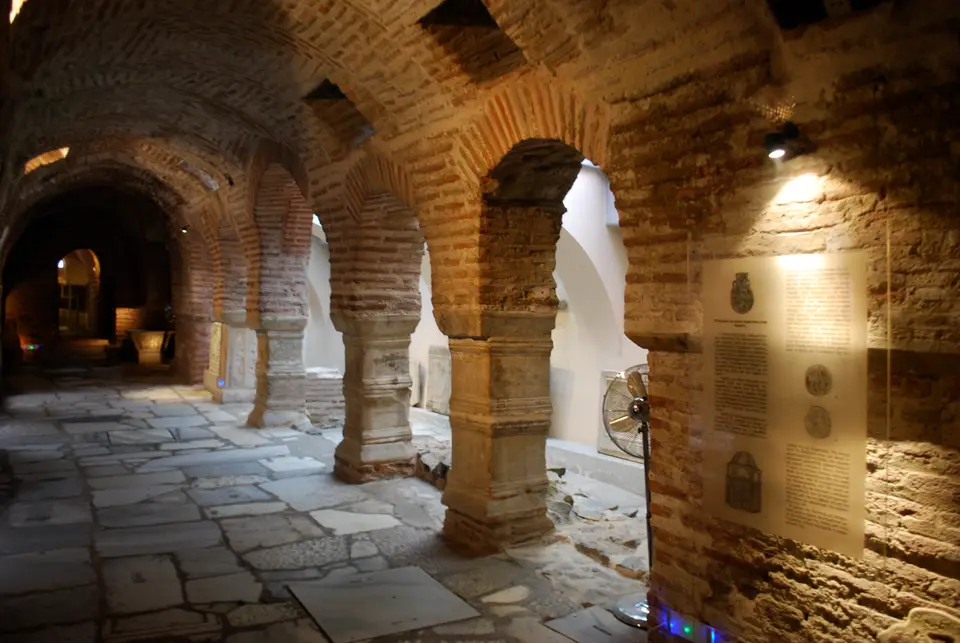
- Access & Ticketing: Distributed urban serial site where most churches remain active places of worship alongside managed archaeological monuments such as the Rotunda, Crypt of Hagios Demetrios, and Byzantine Bath; check the official site
- Arrival Logistics: Spread across the walkable historic centre and upper citadel slopes of Thessaloniki along the northern coast of Greece
Second City of the Byzantine Empire and Bastion of Early Christianity
Founded in 315 BC as a provincial capital and strategic sea port in Macedonia, Greece, Thessalonika (modern Thessaloniki) became one of the earliest urban bases for the spread of Christianity in the Mediterranean world. Over the course of the early Christian and medieval eras, the port rose to rank for several centuries right behind Constantinople among the cities of the Byzantine Empire, prospering as a commercial hub, military stronghold, and artistic centre whose influence radiated across surrounding and neighbouring regions including medieval Serbia. In 1988, 15 Paleochristian and Byzantine monuments spanning the 4th to the 15th centuries and covering a combined protected area of 5.327 hectares were inscribed together on the UNESCO World Heritage List.
Throughout more than a millennium of uninterrupted architectural patronage, the builders and mosaicists of Thessalonika maintained a continuous artistic exchange with the two greatest cultural centres of antiquity and the Middle Ages, Rome and Constantinople. Far from acting merely as a provincial recipient of capital trends, the city functioned as an active and competitive artistic centre from its foundation throughout the Byzantine period, pioneering church layouts and decorative cycles that became a typological point of reference across the Orthodox world. Imperial Byzantine architecture and the urban prosperity of Thessaloniki developed together, especially during the early centuries of the Empire when the port flourished as a regional capital.
When the Ottoman Empire captured Thessaloniki in 1430, the city's Christian churches and monasteries were not destroyed; many were adapted for mosque use while retaining their structural fabric and underlying wall decorations. In subsequent centuries, early modern travellers and rulers, including the French traveller Paul Lucas and the Ottoman ruler Abdulmejid I, documented the city's extraordinary wealth in Christian monuments during the Ottoman period, all 15 of which survive intact or with minimal losses across the modern urban grid.
A Diachronic Series from the Fourth-Century Rotunda to Fourteenth-Century Churches
The 15 inscribed monuments of Thessalonika encompass public edifices of religious, secular, and military function that form a continuous diachronic typological series from the 4th to the 15th century, tracing the shift from the three-nave timber-roofed basilica and cylindrical imperial rotunda to the domed Greek cross plan and late Byzantine ambulatory church. Framing the historic city are the 4-kilometre-long City Walls of the 4th and 5th centuries, which climb from the lower plain to the upper citadel with minimal structural loss. From the 4th century dates the monumental cylindrical Rotunda of Saint George, whose vaulted interior preserves early Christian wall mosaics, while the 5th-century Church of Acheiropoietos is preserved as a classic three-nave Paleochristian basilica with sculpted marble colonnades.
From the 6th century survives the Latomou Monastery (known as St David for its intimate early Christian apse mosaic), followed in the 7th century by the great basilica of the Church of St. Demetrios (Hagios Demetrios), dedicated to the city's patron saint and built over a subterranean crypt where early Christian mosaics survived along the piers. The 8th-century Church of St. Sophia marks a pivotal architectural bridge towards the domed Greek cross plan and houses monumental dome and apse mosaics. Representing the middle Byzantine era is the 11th-century Church of Panagia Chalkeon, a balanced brick Greek cross sanctuary set beside the old copper-workers' district.
The late Byzantine flowering of the 13th and 14th centuries accounts for the remaining 8 inscribed monuments across the lower and upper quarters of the city: the 13th-century Church of St. Catherine and seven 14th-century foundations comprising the Church of St. Panteleimon, the Church of the Holy Apostles, the Church of St. Nicholas Orphanos (celebrated for its well-preserved cycle of interior frescoes), the compact domed Church of Christ Saviour, the elevated Blatades Monastery overlooking the city from the upper citadel, the Church of Prophet Elijah, and the secular 14th-century Byzantine Bath in the upper town, one of the few surviving medieval public bathhouses from the Byzantine world.
Viewed together across the 5.327-hectare serial footprint, these 15 monuments demonstrate how builders in Thessalonika mastered both monumental brick-and-stone vaulting and luminous interior surface decoration. The early Christian wall and vault mosaics of the 4th-century Rotunda of Saint George, the 6th-century Latomou Monastery (St David), the 7th-century Church of St. Demetrios, and the 8th-century Church of St. Sophia trace the stylistic evolution of sacred mosaic art from late Roman naturalism to middle Byzantine solemnity, while the 13th- and 14th-century churches of St. Catherine, the Holy Apostles, St. Panteleimon, Prophet Elijah, Christ Saviour, and St. Nicholas Orphanos illustrate the decorative brickwork, multi-domed silhouettes, and narrative fresco cycles that influenced ecclesiastical architecture across Macedonia, the wider Byzantine Empire, and medieval Serbia. Together with the 4-kilometre circuit of the 4th- and 5th-century City Walls and the rare surviving 14th-century secular Byzantine Bath in the upper town, the 15 inscribed edifices preserve a complete cross-section of religious, military, and civic life in the Empire's second city from late antiquity to the 15th century.
Tracing a Chronological Walk From the Lower Basilicas to the Upper Walls
Travellers using the UNESCO World Heritage Atlas to explore the 15 monuments of Thessaloniki benefit from dividing the serial group into a lower-town walk and an upper-town climb rather than visiting the sites out of sequence. In the flat lower centre, visitors can follow a chronological route starting at the 4th-century Rotunda of Saint George, walking west to the 5th-century three-nave basilica of the Church of Acheiropoietos and the 8th-century domed Church of St. Sophia, then continuing to the 11th-century brick Church of Panagia Chalkeon and the 7th-century Church of St. Demetrios (Hagios Demetrios), where stairs descend inside the crypt of Hagios Demetrios. Each church along this lower route remains integrated into the surrounding streets and squares of central Thessaloniki, allowing walkers to compare the broad timber-roofed nave of Acheiropoietos with the vaulted brick substructures of Hagios Demetrios and the domed sanctuary of St. Sophia within a single morning walk.
A second circuit ascends into the steep cobbled lanes of the upper town and along the 4-kilometre circuit of the 4th- and 5th-century City Walls. Here walkers can visit the 6th-century Latomou Monastery (St David), the frescoed 14th-century sanctuary of St. Nicholas Orphanos, the Blatades Monastery inside the citadel precinct, the nearby 14th-century Byzantine Bath, and the western cluster of 13th- and 14th-century churches including St. Catherine, the Church of the Holy Apostles, the Church of Prophet Elijah, St. Panteleimon, and the Church of Christ Saviour. The monuments span 11 centuries of art. Walking between the lower basilicas and the upper citadel walls reveals how Thessalonika functioned continuously from its foundation in 315 BC through the early Christian and Byzantine periods as a creative counterpart to Rome and Constantinople, preserving fifteen religious, military, and civic landmarks that survived the 1430 Ottoman conquest and were documented by later visitors such as Paul Lucas and Abdulmejid I, across Macedonia. Together, the Rotunda of Saint George, the early basilicas of Acheiropoietos and Hagios Demetrios, Latomou Monastery, St. Sophia, Panagia Chalkeon, the 13th- and 14th-century churches, the Byzantine Bath, and the 4-kilometre City Walls form an unbroken architectural record of the Byzantine world.
- Grouping the 15 monuments by elevation: Explore the Rotunda, Acheiropoietos, St. Sophia, Panagia Chalkeon, and Hagios Demetrios across the lower city grid in the morning, then climb to Latomou Monastery, Blatades Monastery, the Byzantine Bath, and the City Walls in the afternoon.
- Focusing on the three mosaic masterpieces: Prioritise clear daylight for viewing the early Christian wall and vault mosaics inside the Rotunda of Saint George, the Church of St. Demetrios, and Latomou Monastery (St David).
- Checking entry schedules for smaller chapels: Consult the Hellenic Ministry of Culture ODYSSEUS portal before setting out, as compact 14th-century sanctuaries such as St. Nicholas Orphanos, Christ Saviour, and the Byzantine Bath maintain shorter daytime access windows than the main parish basilicas.
