





















Quick Field Data
- UNESCO Inscription: 2005 · Criterion (vi)
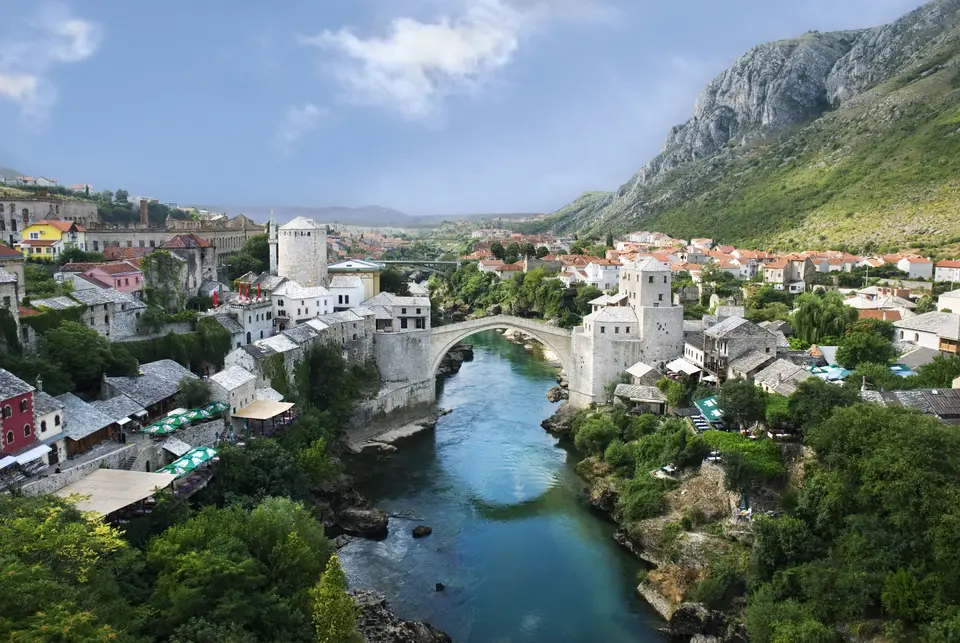
- Scale & Footprint: 7.60 hectares with a buffer zone of 48 hectares on both banks of the Neretva; the bridge spans about 29 metres and is 4 metres wide
- Access & Ticketing: The bridge, the bazaar lanes and the riverbanks are free; the Koski Mehmed Pasha Mosque and its minaret, the bridge museum and historic houses have tickets
- Arrival Logistics: Mostar lies on the railway from Sarajevo, which follows the Neretva valley, and has road and rail links to Croatia
An Ottoman Bridge Town on the Neretva
Mostar grew where a land road met a crossing of the Neretva river. The town lies in a valley between Hum Hill and the foot of Mount Velež. UNESCO notes that two towers guarding a bridge here are recorded in 1459. The name Mostar first appears in 1474. It comes from the mostari, the bridge keepers.
Under Ottoman rule in the fifteenth and sixteenth centuries, Mostar became a frontier town. In 1557 Sultan Suleiman the Magnificent ordered a new stone bridge. It was designed by Mimar Hayruddin, a student of the great architect Mimar Sinan. The work took nine years.
The Old Bridge, or Stari Most, was finished in the Islamic year 974, which matches 1566 to 1567. It is a single arch of local limestone called tenelija. The bridge is about 29 metres long and 4 metres wide. At mid-span it rises around 20 metres above the river, depending on the water level.
Two fortified towers stand at its ends. The Halebija tower is on the north-east side and the Tara tower on the south-west side. Around them grew the old town, with shops, mosques and houses on both banks. Nearby, the smaller Crooked Bridge was built in 1558 by Cejvan Kethoda. It is said to have been a test before the larger bridge.
From a Shared Town to War and Reconstruction
Mostar developed further under brief Austro-Hungarian rule from the late nineteenth century. UNESCO describes a town where mosques, churches and synagogues stood side by side. Muslim Bosniaks, Catholic Croats, Orthodox Serbs and Sephardic Jews lived together here for more than four centuries.
The war of the 1990s destroyed most of the historic town. On 9 November 1993 the Old Bridge collapsed into the Neretva after shelling by Croat forces of the HVO. A temporary bridge opened in December 1993.
Reconstruction started on 7 June 2001. The World Bank, UNESCO, the Aga Khan Trust for Culture and the World Monuments Fund worked together on the project. Hungarian army divers lifted stones from the riverbed, although most were too damaged to reuse. UNESCO set up an international scientific committee to guide the work. After the reopening, Enej Kelecija was the first person to jump from the rebuilt bridge. Builders kept the pre-war form, size and materials of the bridge.
The bridge reopened on 23 July 2004 at a cost of about 15.5 million US dollars. UNESCO inscribed the area in 2005 under a single criterion, its symbolic value. It describes the rebuilt bridge as a symbol of reconciliation and of coexistence between communities. Surviving original stones are now displayed in a museum.
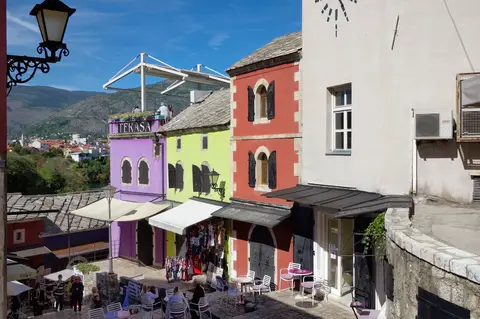
Several other monuments in the old town were restored too. Outside the old town, the Partisan Memorial Cemetery by the architect Bogdan Bogdanović was added to the national monuments list in 2006. The Koski Mehmed Pasha Mosque dates from 1617, and the Karađoz Bey Mosque from 1557. The Muslibegović House is an Ottoman house that is now one of the town's cultural institutions. The Kujundžiluk is the old bazaar lane, named after the goldsmiths who worked there.
Crossing the Bridge and the Old Town Today
The old town is small, and the bridge is its busy centre for most of the day. The worn stone of the bridge can be slippery, so walk carefully. Mostar is also known for its heat, and it holds the national record of 46.2 °C, set in 1901.
- Walk the Bazaar and Cross the Bridge: Start on the east bank in the Kujundžiluk bazaar and walk to the Old Bridge. Cross slowly and look down at the green Neretva below. On the far side, follow the lanes upstream to the Crooked Bridge. Return by the riverbank paths, which give the best views of the arch from below.
- Climb a Minaret and Watch the Divers: The Koski Mehmed Pasha Mosque is open to visitors, and its minaret can be climbed from inside the mosque. Bridge diving is an old local tradition, with a formal competition held since 1968 at the end of July. Since 2015 the bridge has also been a stop on the Red Bull Cliff Diving World Series. The UK government warns that jumping or diving from the bridge is dangerous and has caused serious injuries and deaths, so leave it to trained local divers.
- Time Your Visit and Travel Safely: Arrive early or stay the night to see the bridge without crowds. Nearby day trips include the dervish house at Blagaj and the old town of Počitelj. Landmines from the 1992 to 1995 war remain in some rural areas, so stay on roads and paved paths outside towns. Discover more bridges and Ottoman towns in our UNESCO World Heritage Atlas, and continue to Dubrovnik, our closest city guide.
