


























Quick Field Data
- UNESCO Inscription: Inscribed in 1979 as a Cultural heritage site under criteria (i) and (iii) near Novi Pazar in the Raška district of southern Serbia.
- Scale & Footprint: Serial historical ensemble comprising the Gradina fortress and lower town of Stari Ras, the Monastery of Sopoćani, Đurđevi Stupovi Monastery, and the early medieval Church of Saint Peter.
- Access & Ticketing: Dispersed across the Raška river valleys and hills outside Novi Pazar; check the official site and local monastic rules before visiting.
- Arrival Logistics: Reached by regional road from Novi Pazar along the Raška gorge near the Pešter plateau crossroads.
Frontier Fortifications at the Crossroads of Raška
The valley feels quiet. Steep limestone ridges guard the gorge. Spread across the rugged gorges and wooded ridges where the Raška and Sebečevo rivers meet on the edge of the Pešter plateau near modern Novi Pazar, the ensemble of Stari Ras and Sopoćani preserves the political and spiritual heartland of the medieval Serbian state. Known in medieval sources as Ras, and in modern historiography as Stari Ras or Old Ras to distinguish it from neighbouring Novi Pazar, this fortified complex stood at the centre of the region called Raška, or Rascia, east of the river Drina. Long before the rise of the Nemanjić dynasty in the second half of the twelfth century, its favourable position along the Raška gorge on the crossroads and trading routes linking Zeta and Bosnia in the west with Kosovo in the south made it a vital frontier stronghold near Roman mining fields. Excavated ramparts alongside early Christian sanctuaries dated from the fourth to the sixth century on the steep rocky ridge of Gradina-Pazarište and the neighbouring hilltop of Gradina-Postenje match what the Byzantine chronicler Procopius recorded when he noted that the ancient castellum of Arsa in the Roman province of Dardania underwent refortification under Emperor Justinian from 527 to 565.
Throughout early medieval history, the two interconnected fortifications of Gradina-Postenje (also called Ras-Postenje, closer to the bishopric Church of Saint Peter) and Gradina-Pazarište (the main capital fortress above the confluence) formed a uniform defensive system. Spared from late fourth- and fifth-century migration invasions, the area yielded sixth-century Germanic and Frankish Merovingian material before a devastating earthquake struck the province of Dardania around 518 and Avar and Slavic migrations damaged and caused the abandonment of both forts in the first quarter of the seventh century. In the ninth and tenth centuries, Ras re-emerged as a contested western frontier district between Bulgaria and Serbia: the tenth-century Byzantine treatise De Administrando Imperio records that the Bulgarian ruler Boris, who reigned from 852 to 889, travelled under the escort of the sons of Serbian prince Mutimir all the way to the Ras border around 880, while lack of Bulgar material at Vrsjenice indicates the border ran along the Pešter plateau. In 971, the Byzantine ruler John Tzimiskes restored imperial authority over Ras and instituted the Catepanate of Ras, evidenced by the discovered lead seal belonging to the protospatharios and katepano John of Ras, before Bulgarian forces regained the fortress by 976 and the Podgrađe locality was burned and abandoned at the end of the tenth century.
After Emperor Basil II recaptured Ras between 1016 and 1018 and incorporated it into the thema of Serbia, the fortress became part of an eleventh-century line of Byzantine frontier watchtowers alongside Lipjan, Zvečan, Galič, and Jeleč to the south plus the northern fort of Brvenik under commander Constantine Diogenes in 1032, watching westward over the Zygos mountains. Held by the Byzantines during the reign of Alexios Komnenos between 1081 and 1118, as confirmed by a seal of Alexios dated 1081 to 1092 found near the site in 2018 alongside lead seals belonging to military commanders Nikolaos Synesios and Eustathios Kamytzes plus Constantine Dalassenos, the border fortresses were attacked by Serbian Grand Prince Vukan during the war between Byzantium and Serbia from 1090 to 1095, when Vukan burned Lipjan in 1093 before negotiating peace at Zvečan. Burned again by the Serbs in the 1120s (for which its Byzantine commander Kritoplos was punished) and lost under John Komnenos in the war of 1127 to 1129, Ras was rebuilt by the Byzantines by 1143, retaken by Uroš II (who reigned from 1145 to 1161), and stormed during the Serbian Uprising of 1149 by Emperor Manuel Komnenos, who devastated Ras and Galič with the army of Constantine Angelos before winning the Battle of Tara in 1150. Finally conquered and renovated by Grand Župan Stefan Nemanja in the late 1160s, Ras was recognised as the centre of an independent Serbian state in 1190 after an indecisive campaign by Isaac Angelos, and Nemanja's son Stefan acceded the Serbian throne here.
Saint Peter's Church, Đurđevi Stupovi, and the Frescoes of Sopoćani
On the terrain around Gradina-Pazarište, visitors can trace how this royal capital operated as an integrated defensive, spiritual, and economic complex. High on the limestone crag stand the stone ramparts, gates, royal treasury foundations, and large granary of the upper fortress, where Stefan Nemanja convened a state assembly in 1196 and where the second Serbian king Stefan Radoslav, who reigned from 1228 to 1233, extensively renovated the defences and operated a Serbian mint in the 1230s before noble battles brought Stefan Vladislav (who reigned from 1234 to 1243) to the throne. Directly beneath the sheer cliff of the Podgrađe lower town clings the rock-cut cave monastery of Saint Michael, where Monk Simeon was active and transcribed Vukan's Gospel dated around 1202, while below the hill grew the fourteenth-century marketplace of Trgovište after the old citadel suffered its final desolation in the early fourteenth century during the reign of Stefan Milutin between 1282 and 1321.
Three church monuments surrounding the fortress trace the architectural and artistic flowering of Raška from the early Middle Ages to the thirteenth century. Closer to the fort of Gradina-Postenje stands the bishopric Church of Saint Peter, the oldest surviving church in Serbia, mentioned in the imperial charter of Basil II in 1020 to the Archbishopric of Ohrid as the seat of the Episcopy of Ras, which had belonged to the Bulgarian autocephalous church during the reigns of Tsar Peter of Bulgaria (927 to 969) and Samuel of Bulgaria (977 to 1014) after linking with the Bulgarian Church between 870 and 924. Combining a circular rotunda plan with tenth-century masonry over fourth-to-sixth-century early Christian foundations, Saint Peter's Church served as the baptismal and council sanctuary of the early Nemanjić rulers. High on a wooded hill overlooking the valley rises the Monastery of Đurđevi Stupovi, erected by Stefan Nemanja after he expanded his territories in the late 1160s and completed according to its inscription in 1170 to 1171, blending Romanesque exterior details with Byzantine spatial planning.
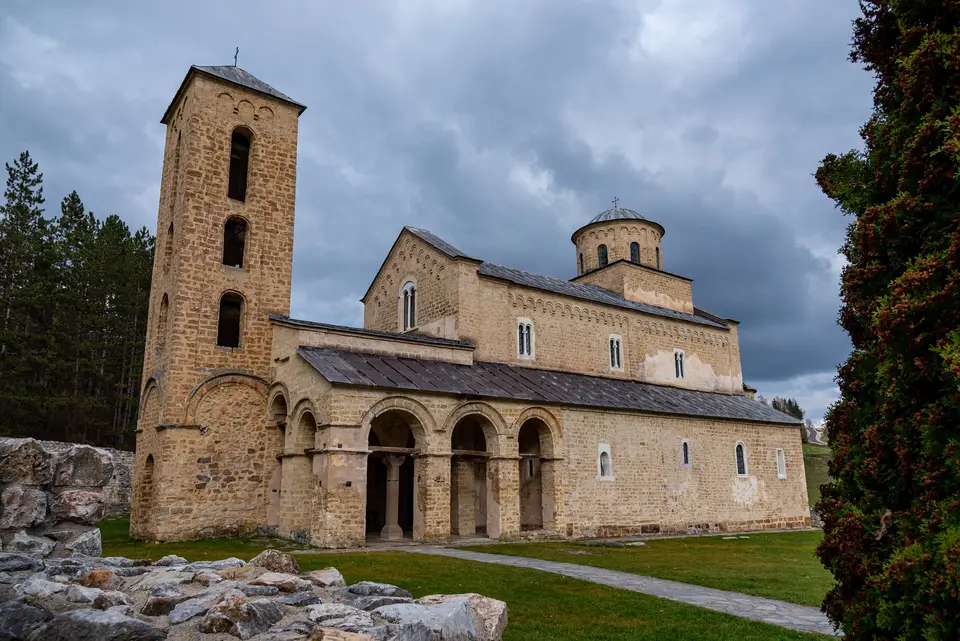
Further up the Raška gorge stands the Monastery of Sopoćani, founded in the second half of the thirteenth century by King Stefan Uroš as his royal foundation and mausoleum. Painted during the 1270s, the frescoes inside Sopoćani represent one of the highest peaks of medieval European and Byzantine art. Executed with luminous pigments, classical sculptural volume, and expressive human faces at a moment when Byzantine court painters brought antique Hellenistic grace to the walls of the Serbian royal abbey, the fresco cycles of Sopoćani alongside the older wall paintings of Đurđevi Stupovi and Saint Peter's Church demonstrate why Raška became the artistic cradle of medieval Serbia.
Tracing the Medieval Raška Valley Today
Stone walls crown the ridge. Because the four historical components are scattered across hills and river gorges outside Novi Pazar rather than enclosed inside a single park fence, exploring them requires a planned sequence by road and footpath.
- Entry and Route Through the Gorge: Start on the northeastern edge of Novi Pazar at the early medieval rotunda of Saint Peter's Church near Gradina-Postenje, drive up the northern ridge to the hilltop Monastery of Đurđevi Stupovi from 1170 to 1171, and then follow the Raška gorge westward past the cliff trail of Gradina-Pazarište and Trgovište to end at Sopoćani Monastery.
- Tickets, Interiors and Viewpoints: Dress modestly with covered shoulders and knees when entering the active monastic churches; climb the steep footpath above the Raška river to inspect the stone ramparts of Stari Ras and the cliffside cave monastery of Saint Michael before viewing the thirteenth-century frescoes inside Sopoćani, and check the official site for current visitor access.
- Timing and Onward Connections: Walk the exposed fortress ramparts of Gradina-Pazarište in the morning before midday heat builds in the gorge, then continue your regional journey southwestward with our Montenegro guide or compare other medieval Balkan sanctuaries in the UNESCO World Heritage Atlas.
