Quick Field Data
- UNESCO Inscription: 2014 (Ref. 1457), cultural landscape spanning Kale Hill, the plain sanctuaries and Bergama in western Türkiye; Criteria (i), (ii), (iii) and (iv).
- Scale & Footprint: 332.5 hectares covering the 335-metre andesite acropolis ridge, the Asclepion sanctuary, the Serapeum, Roman aqueducts, burial tumuli and the rock-cut Kybele Sanctuary at Kapıkaya.
- Access & Ticketing: First-degree archaeological zones at Kale Hill, the Asclepion and the Serapeum operate separately managed ticketed entrances; verify official museum pass rules before travelling.
- Arrival Logistics: Direct commercial flights reach Izmir via Adnan Menderes International Airport (ADB), 92 kilometres south of Bergama. Balıkesir Koca Seyit Airport (EDO) sits 50 kilometres away with limited scheduled flights, while Izmir city lies 77 kilometres south.
Attalid Capital Architecture on the Andesite Ridge
Rising 335 metres above sea level along the northern edge of the Bakırçay (ancient Caicus) plain in Mysia, Pergamon overlooks western Anatolia near modern Bergama. Although situated 26 kilometres from the Aegean Sea, the blocking Karadağ massif shuts out direct maritime winds, giving the basin a sheltered inland character with dry Mediterranean months from May to August. In Hellenistic times, the coastal town of Elaia at the mouth of the Caicus operated as the city's maritime harbour. Two rivers frame the intrusive andesite mountain spur: the Selinus (Bergamaçay) flows west, while the Cetius (Kestelçay) passes east.
The volcanic massif extends 5.5 kilometres north to south and roughly one kilometre wide, rising to a 70-metre northern rock spur called the Garden of the Queen. From that summit, the narrow upper city stretches 250 metres south at just 150 metres wide before broadening to 350 metres across three stepped southern terraces. While Bronze Age stone tools appear locally and Greek imported pottery reaches the late eighth century BC, literary history opens in March 399 BC. Returning from Persia, Xenophon ended his March of the Ten Thousand at Pergamon, hosted by Hellas (widow of Eretrian exile Gongylos, whose family received Pergamon from Xerxes the First) before transferring 5,000 Greek troops to Spartan commander Thibron against Persian satraps Tissaphernes and Pharnabazus. Later in 362 BC, Mysian satrap Orontes staged a failed revolt from the stronghold before Alexander the Great ended Persian rule, leaving only fourth-century traces of Athena's temple and Demeter's altar beneath massive Hellenistic earthworks.
Bergama owes its dramatic silhouette to the Attalid dynasty. After Lysimachus took Pergamon in 301 BC, his lieutenant Philetaerus declared independence in 281 BC, ruling until 263 BC over a compact 21-hectare upper fortress. His nephew Eumenes the First (263 to 241 BC) expanded dominion after defeating Antiochus the First near Sardis in 261 BC, and Attalus the First (241 to 197 BC) claimed kingship in 238 BC after routing the Galatians. Allying closely with Rome during the Macedonian Wars and against Antiochus the Third, Pergamon gained most former Seleucid Asia Minor after the 188 BC Peace of Apamea, though later Roman suspicion cooled ties when rumours linked Eumenes the Second with Perseus of Macedon.
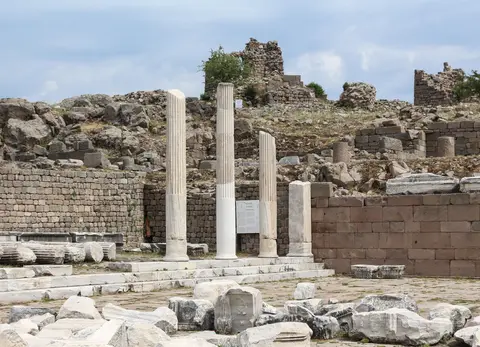
Under harmonious brothers Eumenes the Second (197 to 159 BC) and Attalus the Second Philadelphos (159 to 138 BC), architects transformed Kale Hill into a terraced rival to Athens. A new 4-kilometre perimeter wall enclosed 90 hectares. Stepped terraces supported royal palaces, an arsenal, the Temple of Athena, the three-terraced Gymnasium, lengthy stoas, the Great Pergamon Altar and a famous sculpture school. Epigraphic decrees document Attalids dispatching artisans, remitting municipal taxes, preserving nominal autonomy for Greek towns and sending gifts to Delphi, Delos and Athens. Its library ranked second only to Alexandria, and the city lent its name to parchment (pergamenos), though Anatolian workshops had prepared animal skins long before Ptolemaic papyrus rivalries.
Attalid planners also integrated the wider surrounding plain directly into royal urban composition. Conical earthen burial tumuli encircled the Bakırçay valley floor to assert Pergamon's regional authority. Pressured hydraulic pipelines crossed deep valleys to supply water to elevated citadel terraces, while direct visual sightlines linked Kale Hill straight to the remote rock-cut Kybele Sanctuary at Kapıkaya.
Roman Metropolis, Galen and the Asclepion Sanctuary
When King Attalus the Third died without an heir in 133 BC, he bequeathed Pergamon directly to Rome. Aristonicus briefly contested Roman annexation with Stoic philosopher Blossius, defeating consul Publius Licinius Crassus before Marcus Perperna crushed the revolt in 129 BC and forged the Roman province of Asia. Although Pergamon lost free-city privileges after backing Mithridates the Sixth in 88 BC, civic benefactors such as Diodorus Pasparus financed restoration in the 70s BC while Pergamene exports entered luxury markets enjoyed by Lucullus. Local aristocrats rose to imperial prominence, with Aulus Julius Quadratus serving as Roman consul in AD 94 and 105.
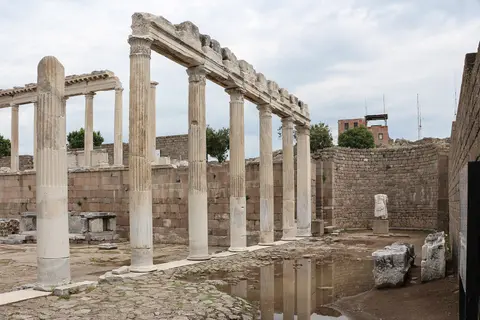
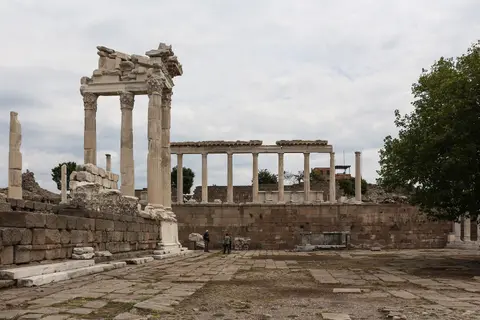
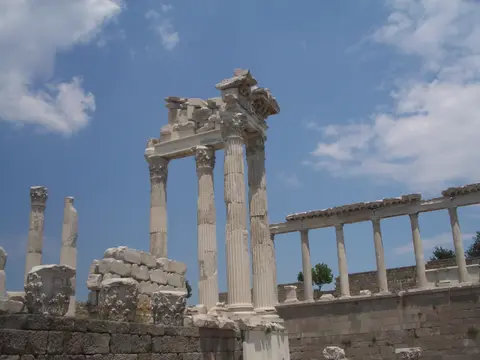
Monumental redevelopment accelerated under Emperors Trajan and Hadrian. Augustus had already awarded Pergamon Asia's first imperial cult neocorate, and Trajan conferred a second neocorate in AD 113 together with the vaulted marble Temple of Trajan on the acropolis summit. Hadrian raised Pergamon to metropolitan rank in AD 123 ahead of Ephesus and Smyrna. Roman planners constructed a sweeping new city on the valley floor featuring a spacious forum, a stadium, a Roman theatre, one of the empire's largest amphitheatres and a grand aqueduct feeding the brick Serapeum sanctuary.
Southwest of town, the Sanctuary of Asclepius (Asclepion) flourished around a sacred healing spring that still runs today. Patients lodged beside colonnades, treatment theatres and circular therapy buildings, drawing orator Aelius Aristides, historian Claudius Charax, sophist Polemo and consul Cuspius Rufinus. Born in Pergamon in September 129 CE to wealthy architect Aelius Nicon, physician Galen (whose Greek name means calm) studied philosophy from age 14. After his father dreamed Asclepius commanded medical training around 145 CE, Galen entered the Asclepion at age 16 for four years under masters Aeschrion of Pergamon, Stratonicus and Satyrus.
Inheriting family wealth at age 19 in 148 CE, Galen studied in Smyrna, Corinth, Crete, Cilicia and Alexandria before returning in 157 CE at age 28 as surgeon to the gladiators of the High Priest of Asia. By emphasising diet, fitness and careful wound dressing, he kept fatalities to just five compared with sixty under his predecessor, calling gladiators' injuries windows into the body. Moving to Rome in 162 CE, Galen treated Peripatetic teacher Eudemus, declaring that diagnosis demanded observation and reason while fleeing rival poison threats. Recalled by Marcus Aurelius during the 168 to 169 winter outbreak of the Antonine Plague at Aquileia and later excused from German campaigns to attend imperial heir Commodus, Galen also served Septimius Severus and Caracalla through 198 CE. While Herophilus and Erasistratus had performed human dissections in third-century BC Alexandria, Roman bans led Galen to dissect Barbary apes and pigs, shaping Western physiology for over 1,300 years until Ibn al-Nafis in 1242 and Andreas Vesalius in 1543.
Seven Churches Heritage, Parchment and Ottoman Bergama
For travellers studying Pergamon in the Bible, the ancient city is the northernmost of the seven churches of Asia cited in the Christian Book of Revelation. During Byzantine centuries, shifting trade corridors toward Constantinople turned the grand Roman metropolis into a smaller fortified hillside settlement. That religious evolution endures vividly inside the colossal red-brick Serapeum on the plain. Built as a Roman temple to Egyptian gods, the sanctuary became the Byzantine Church of Saint John, incorporated a Jewish synagogue inside one circular rotunda and functioned as an Ottoman mosque from the thirteenth century onward.
Ottoman rulers integrated civic life straight onto Roman terraces across the Bakırçay plain, building mosques, baths, stone bridges, merchant khans, vaulted bedestens, arasta bazaars and gravity water channels inside historic neighbourhoods below Kale Hill. These commercial quarters overlaid Roman and Byzantine strata directly. Today, all first-degree archaeological precincts (including Kale Hill, aqueducts, the Asclepion, Musalla Mezarlık, the Serapeum, outlying royal burial tumuli and the rock-cut Kybele Sanctuary at Kapıkaya) carry strict protection under National Preservation Law 2863. Most Ottoman urban and bazaar districts also carry second-degree or third-degree archaeological status requiring Regional Conservation Council-2 approval for alterations.
Coordinated locally by the Bergama Municipality World Heritage Management Office founded in 2011, oversight pairs a Coordination and Supervision Body with an Advisory Body uniting universities, NGOs and local muhtars. Bergama's 2012 Urban Conservation Plan regulates traditional street facades, construction materials and historical layouts. Heritage monitors work actively to protect visual sightlines linking Kale Hill, outlying burial tumuli and Kapıkaya against illegal construction, illicit digging and visual intrusion from the eastern funicular railway.
Access Zones From Kale Hill to Kapıkaya
Modern Bergama organises the 332.5-hectare landscape into elevated acropolis terraces, lower plain sanctuaries and distant sacred hills suited to a full-day loop. Allowing ample daylight lets travellers connect steep hilltop royal courts with valley healing complexes and traditional Ottoman bazaar alleys.
| Complex Zone | Key Highlights | Access & Ticket Rule |
|---|---|---|
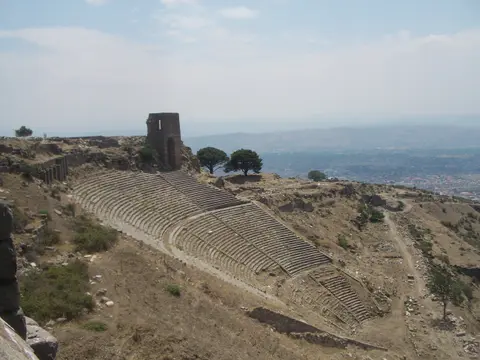
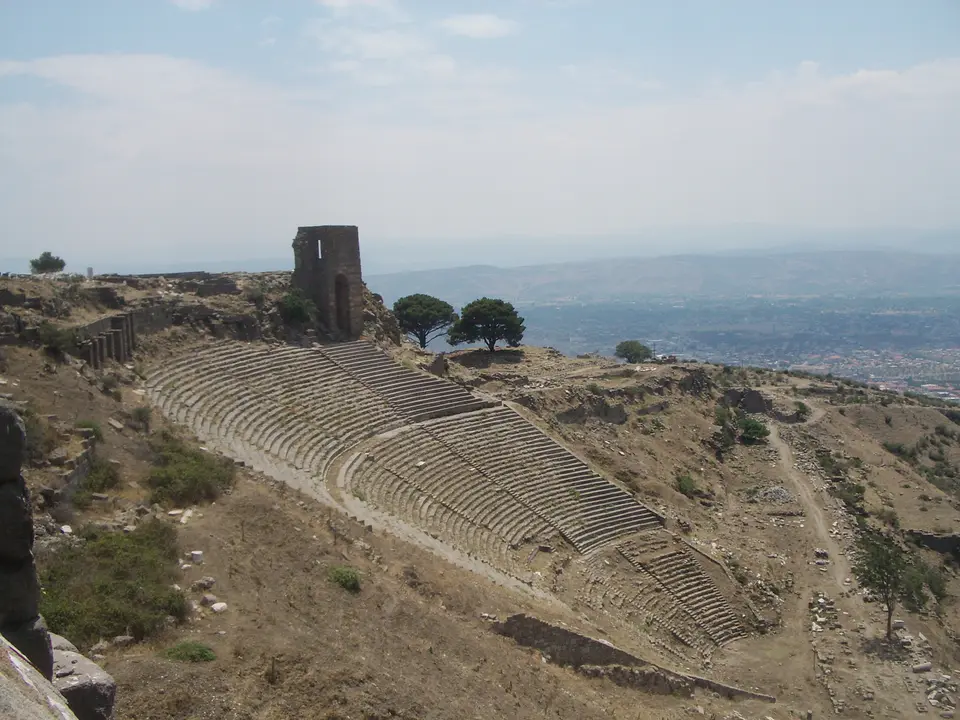
| Kale Hill Acropolis | Steep Hellenistic theatre, Temple of Trajan, Athena ruins, Great Altar base and Gymnasium. | Reached by mountain road or the east-slope funicular railway; ticketed museum gate at summit. |
| Lower City & Serapeum | Red-brick Temple of Serapis, Roman amphitheatre ruins and Ottoman bazaar streets. | Serapeum courtyard requires archaeological admission while historic market streets remain open. |
| Asclepion Sanctuary | Sacred healing spring, colonnaded court, treatment theatre and circular medical halls. | Standalone ticketed site southwest of Bergama centre reached via signed town avenues. |
| Kybele Sanctuary & Tumuli | Rock-cut Kapıkaya cult shrine visually aligned with Kale Hill and royal burial mounds. | Rural approach roads reach Kapıkaya northwest of town; wear sturdy trail footwear over rocky ground. |
Three Engineering and Sacred Details in Pergamon
- Arched Retaining Substructures Beneath the Temple of Trajan: Walk along the lower terrace beneath the standing white Corinthian columns on Kale Hill to examine massive vaulted stone arches projecting out over the steep hillside. Roman builders constructed these substructures so the imperial marble courtyard stood level across the narrow volcanic ridge.
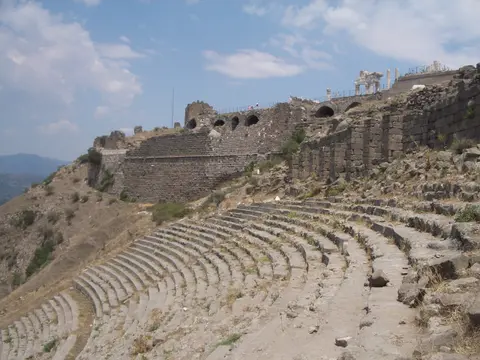
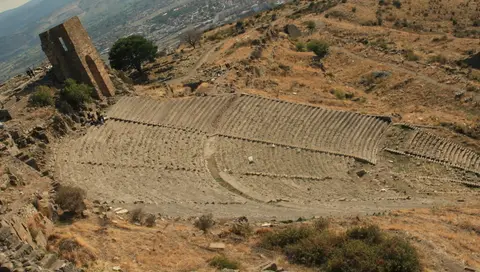
- Acoustic Gradient of the Acropolis Theatre: Stand near the upper stone rows of the Hellenistic theatre, incised straight into the western slope without rear masonry vaults. Seating rows plunge sharply toward the narrow stage terrace beside the Selinus stream, channelling voices upward cleanly.
- Multi-Faith Structural Reuse in the Serapeum: Circle the immense red-brick precinct and twin domed side rotundas in central Bergama to read Roman Egyptian temple foundations overlaid directly by Byzantine basilica apses and Ottoman prayer fixtures.
Timing Your Ascent Between Izmir and Bergama
Aegean Mediterranean summers run bone dry and hot between May and August, making spring (April to early June) and autumn (September to October) the optimal months for walking exposed stone terraces on Kale Hill and across the Asclepion. When deciding what to do in Pergamon, ascend the acropolis early in cool morning light to inspect the Trajan colonnade and Great Altar base. Spend midday exploring Bergama's shaded Ottoman bazaar alleys and red-brick Serapeum courtyard, saving late afternoon for tranquil colonnades around the Asclepion sanctuary.
Wear supportive footwear with reliable grip, since centuries of footsteps have polished stone pavements, steep theatre steps and sloped walkways across the 335-metre summit ridge. Sun hats and drinking water remain essential on breezy acropolis terraces lacking tree cover, particularly when walking outward to rural Kapıkaya or peripheral burial mounds. Travellers planning how to get to Pergamon from Izmir cover 77 kilometres north by road from our Izmir destination guide, or explore wider Anatolian heritage sites in the UNESCO World Heritage Atlas.