Quick Field Data
- UNESCO Inscription: Reference 1650, inscribed in 2021 as a Cultural site under Criterion (iv) in Emilia-Romagna, Italy.
- Scale & Footprint: Comprises 12 representative portico ensembles covering 52.18 hectares across central and outer Bologna, selected from a citywide network spanning 62 kilometres (over 38 kilometres inside the historic centre and up to 53 kilometres extending past the medieval walls).
- Access & Ticketing: Covered street arcades, civic squares such as Piazza del Nettuno, and the entire 3.8-kilometre Portico of San Luca walkway remain permanently open and free as private property dedicated to public passage, with optional entry fees applying only inside museum or religious interiors.
- Arrival Logistics: Bologna Guglielmo Marconi Airport (BLQ) lies just 6 kilometres north-west of the historic core (supplemented by main-line Italian rail routes linking from Florence and Verona), connecting smoothly into central Bologna 1 kilometre from the medieval arcade grid.
Medieval Street Overhangs and the Landmark 1288 Municipal Statute
Few cities anywhere turned an architectural compromise between private expansion and public space into an entire urban operating system. Bologna grew across deep layers of northern Italian settlement: third-millennium BCE habitation, ninth-century BCE Villanovan sites, sixth-century BCE Etruscan Felsina, Gaulish Boii occupation, and the 196 BCE Roman colony of Bonōnia. Later milestones included early Christian Bishop Petronius's Basilica of Saint Stephen and the eighth-century addizione longobarda built under King Liutprand in 727 and 728 before Charlemagne's Frankish troops occupied the town in 774. The University of Bologna was established in AD 1088, led early by legal glossator Irnerius and his Four Doctors and celebrated especially for Roman law and medicine. As Europe's oldest continuously operating degree-granting institution, it fostered a celebrated medical school and drew international scholars including Dante, Boccaccio, and Petrarch. That influx sent a surge of students, teachers, and rural immigrants cramming into the medieval lanes.
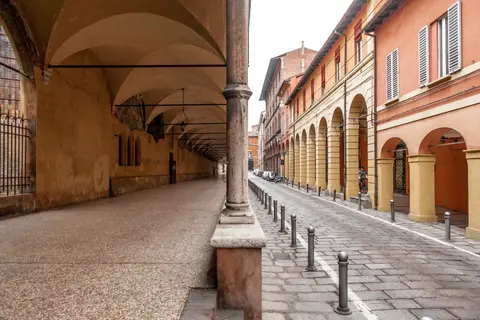
Bologna's porticoes began appearing spontaneously around that time, with the earliest historical evidence dating to 1041. Property owners gained extra living quarters for tenants by jutting wooden upper floors outward above public streets on overhanging jetties. As extensions grew heavier and threatened collapse, builders propped upright timber columns underneath them, accidentally carving sheltered pedestrian sidewalks beneath private residential rooms. Rather than tearing down those encroachments, the commune institutionalised them after winning autonomy from Emperor Frederick Barbarossa at the 1183 Peace of Constance and thriving as a canal-linked trade hub. By 1200 Bologna held around 10,000 residents fed by artisanal workshops and commercial barges navigating municipal canals, climbing toward 40,000 to 50,000 inhabitants before the 1348 Black Death halved its population.
In 1288, Bologna's municipal statute decreed that all new houses had to be constructed with a portico, while existing structures lacking one were required to add an arcade. That single legal act forged a nine-century civic compact in which each portico remained private property maintained by the building owner. Yet every arcade operated legally as public space regulated by communal rules governing height, clearance, and open pedestrian passage. The covered street network kept expanding through turbulent fourteenth- and fifteenth-century conflicts, including the 1249 capture of Emperor Frederick II's son King Enzo of Sardinia at Fossalta. King Enzo remained a prisoner in Palazzo Re Enzo for more than 22 years, while Bologna later passed through Taddeo Pepoli's 1334 signoria, Visconti rule, and the Bentivoglio dynasty. That dynasty stretched from Giovanni the First and Hannibal the First to Giovanni II before Pope Julius II entered Bologna in November 1506.
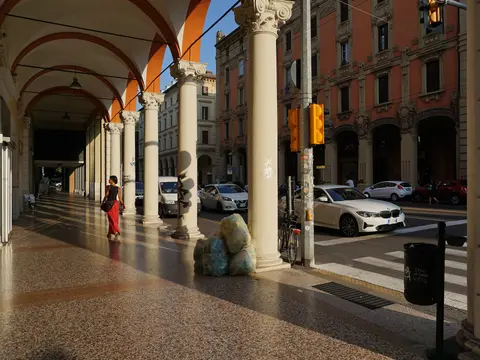
From Timber Jetties to Brick Arcades and Twentieth-Century Concrete
Sixteenth-century papal administration brought Emperor Charles V's 1530 coronation in Bologna and major civic works in 1564, including Piazza del Nettuno, Palazzo dei Banchi, and the university Archiginnasio. Together with ninety-six convents and the rise of Bolognese School painters Annibale Carracci, Domenichino, and Guercino, fire hazards and monumental tastes prompted a decisive shift in building materials. On 26 March 1568, pontifical governor Giovanni Battista Doria and gonfaloniere Camillo Paleotti issued an official decree requiring timber porticoes to be rebuilt in durable brick or stone. Even so, precious medieval wooden examples survived that overhaul in Via Marsala and inside Corte Isolani, letting walkers compare rough timber brackets directly beside carved sandstone columns.
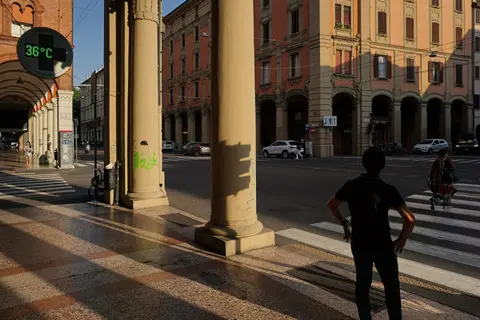
Through seventeenth-century plagues (not least the 1629 to 1631 epidemic that reduced population from 72,000 down toward 47,000) and Pope Benedict XIV's mid-eighteenth-century tax and trade reforms, covered walkways adapted steadily. They continued serving every social class and architectural period through Napoleonic rule from 1796 and the 1831 and 1848 uprisings leading to Bologna's March 1860 union with united Italy. In the twentieth century, reinforced concrete replaced vaulted masonry ribs in outer districts, producing broad cantilevered canopies and crisp geometric walkways exemplified by the modernist Barca neighbourhood. Distant international parallels exist only in southern China's qi-lou arcades and Japan's Sea of Japan gan-gi passages, leaving Bologna's 62-kilometre fabric unmatched.
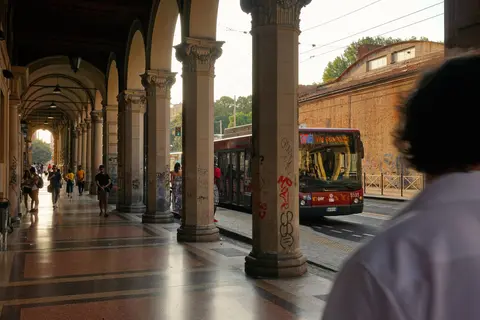
Selecting the 12 UNESCO component parts required careful conservation auditing. Because Bologna ranked among Italy's most heavily bombed cities during World War II, specialists chose 12 representative ensembles where original timber, brick, stone, or concrete fabric suffered minimal wartime destruction or underwent faithful preservation. Protection rests on Italy's Cultural Heritage Code, Regional Law 24/2017, and the municipal Portici Patrimonio Mondiale office. Guided by extensive historical iconography, vintage photographs, design drawings, and municipal rules issued as "Porticoes. Instruction for care and use", Bologna monitors structural authenticity across all 12 components. Everyday shopfronts, cafés, students, and citizens keep sharing the shaded walkways without cluttering historic piers or vaults. Bologna builds on its careful late-1970s historic-centre conservation policy and 2022 to 2024 urban sustainability initiatives prioritising green space, equitable access, and low-emission mobility. Under this system, every owner's duty under the 1288 Statute works in tandem with national Ministry of Culture oversight so residents, students, and visitors share continuous covered street space across every neighbourhood. Even travellers arriving only for an afternoon walk between Piazza del Nettuno, Corte Isolani, and Porta Saragozza experience immediately how private investments under the 1288 Statute shaped the city. Those investments turned everyday weather shelter, neighbourhood commerce, and civic sociability into Bologna's defining street architecture across medieval timber lanes, Renaissance civic piazzas, hillside pilgrim stairs, and modern concrete suburbs alike.
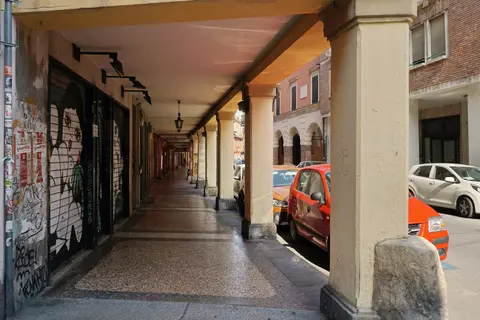
The 666-Arch Uphill Ascent to the Sanctuary of San Luca
Among all 12 inscribed components, none expresses Bologna's devotion to covered engineering more vividly than the Portico of San Luca, recognised as the longest continuous portico in the world. The arcade links Porta Saragozza, one of 12 gates along Bologna's medieval wall circuit, to the Sanctuary of the Madonna di San Luca atop forested Colle della Guardia. Rising roughly 300 metres above the city plain, it climbs continuously from city gate to basilica door across 666 vaulted arches measuring 3.8 kilometres (3,796 metres).
Construction stretched from 1674 to 1793, funded largely through sponsorships by prominent Bolognese families whose plaques and small chapels still punctuate individual bays along the route. Its core liturgical purpose was sheltering the annual Feast of the Ascension procession established in 1433, carrying a twelfth-century Byzantine icon of the Virgin and Child down to Bologna Cathedral dry in any weather. Bishop Gerardo Grassi had assigned the icon in 1160 to a hilltop chapel tended by Azzolina and Beatrice Guezi and guarded from 1294 to 1799 by Dominican friars.
Crowning the summit rises Carlo Francesco Dotti's centrally planned sanctuary begun in 1723, with lateral external tribunes built by his son Giovanni Giacomo Dotti. Its interior is decorated with paintings and stucco by Guido Reni, Guercino, Donato Creti, Vittorio Bigari, Domenico Pestrini, Giuseppe Maria Mazza, and Angelo Piò. Between 1931 and 1976, an aerial cable car ferried passengers over 1,328 metres and 220 vertical metres in a 7-minute ride whose former pylon and top and bottom stations still stand. The winding road climbing beside the arches stars regularly in the autumn Giro dell'Emilia, the 1956 Giro d'Italia time trial, and Stage 2 of the 2024 Tour de France.
Access Zones Across Bologna's Twelve Inscribed Portico Ensembles
Because the 12 inscribed ensembles weave through central avenues, monastic precincts, and outer residential quarters totaling 52.18 hectares, visitors explore them organically on foot without gate fences or perimeter passes.
| Complex Zone | Key Highlights | Access & Ticket Rule |
|---|---|---|
| Central Civic & University Arcades | Piazza del Nettuno, Palazzo dei Banchi, Archiginnasio corridors, Basilica of Saint Stephen surroundings | Covered street pavements open freely every day; interior museums and anatomical theatre inside Archiginnasio require paid tickets |
| Surviving Timber Porticoes | Medieval wooden-beam arcades along Via Marsala and inside Corte Isolani | Public walkways freely accessible at street level; residential upper storeys and interior shops remain private |
| Portico of San Luca Uphill Corridor | Porta Saragozza starting arch, 666 numbered brick arches across 3.8 kilometres, Colle della Guardia sanctuary | Continuous pedestrian portico walkway free and always open; sanctuary interior access respects worship schedules |
| Twentieth-Century Concrete Districts | Modernist Barca district covered walkways illustrating post-war reinforced concrete portico typology | Open residential and civic street pavements free to walk without entry barriers |
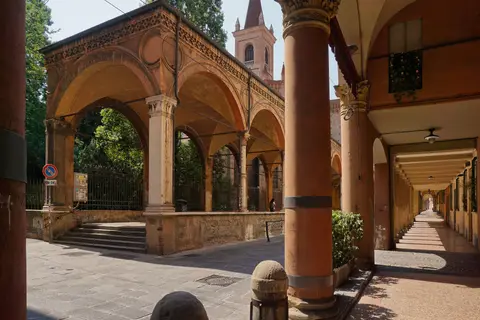
Three Structural and Material Details Under Bologna's Covered Walkways
Slowing down beneath the vaults reveals how municipal regulations, structural fixes, and local brickcraft shaped Bologna's street architecture across nine centuries.
- Timber Jetties and Upright Oak Columns at Corte Isolani and Via Marsala: Step off the broad stone avenues into Corte Isolani or Via Marsala to spot rare survivors from before the 1568 masonry decree. Heavy wooden joists cantilever outward from upper rooms while slender timber shafts brace their outer edges down to street cobbles, showing the exact structural birth of the Bolognese arcade.
- Numbered Arch Sponsorship Plaques Along the 666 San Luca Bays: Climbing uphill from Porta Saragozza, scan the arched bays along the Portico of San Luca for carved arch numbers and devotional chapels. Constructed over more than a century between 1674 and 1793, the steep stepped incline shifts smoothly from level city street into covered hillside stairways engineered to keep ceremonial processions dry during spring downpours.
- Vaulted Brick Ribs Versus Modern Concrete Cantilevers: Contrast the Renaissance masonry arches around Palazzo dei Banchi and Piazza del Nettuno with the twentieth-century reinforced concrete spans of the Barca district. Despite swapping bricks and Corinthian capitals for flat poured slabs, modern builders maintained the continuous covered pedestrian channel mandated back in 1288.
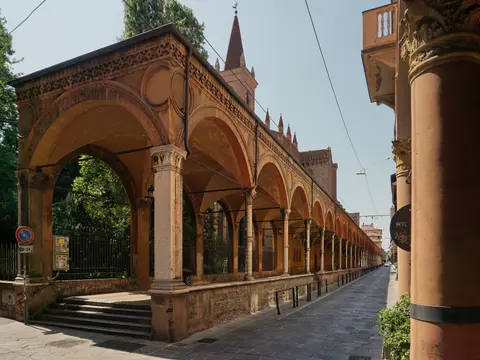
All-Weather Walking, Cycling Climbs, and Exploring Bologna Beyond the Arcades
Bologna's covered walkways solve weather logistics automatically, keeping harsh summer glare and heavy autumn downpours outside the brick vaults. This shelter makes the 3.8-kilometre uphill walk from Porta Saragozza to the Sanctuary of the Madonna di San Luca practical throughout the year, provided walkers wear supportive shoes for the sustained stepped incline. Cyclists riding the parallel road climb should expect sharp gradients made famous by the Giro dell'Emilia and Stage 2 of the 2024 Tour de France, starting early before local daytime traffic increases.
Bologna Guglielmo Marconi Airport lies only 6 kilometres away, and central Piazza del Nettuno sits just 1 kilometre from the heart of the rail-linked town. Exploring the inscribed walkways integrates smoothly into short weekend breaks or regional rail journeys across Emilia-Romagna, in a city recognised as Europe's 2000 Capital of Culture and a 2006 UNESCO City of Music. For neighbourhood trattorias, medieval towers, university museums, and walking routes anchored between the covered avenues, continue to our Bologna city guide. Readers tracing civic planning, brick arcades, and historic Italian urbanism can browse further sites across our UNESCO World Heritage Atlas.