


























Quick Field Data
- UNESCO Inscription: 1981 (placed on the List of World Heritage in Danger from 2004 to 2014) · Criterion (iii).
- Scale & Footprint: Two neighbour islands off the southern coast of Tanzania in Kilwa District, Lindi Region: 12-square-kilometre Kilwa Kisiwani (23 kilometres in circumference) and the northern settlement of Songo Mnara enclosing five mosques alongside a palace complex and thirty-three coral-stone houses
- Access & Ticketing: Managed by the Antiquities Division of the Ministry of Natural Resources and Tourism; non-residents must obtain an official entry permit from the tourist information centre in downtown Kilwa Masoko and cross to the roadless islands by local boat
- Arrival Logistics: Situated 9 degrees south of the equator in Kilwa District, Lindi Region, about 300 kilometres south of Dar es Salaam, bordered by the Mavuji River estuary on the west, the Sagarungu sound on the south, and the Indian Ocean on the east
Swahili Maritime Hegemony, Minting of Coins, and Ibn Battuta's 1331 Visit
Positioned on two neighbour coral islands just off the southern coast of Tanzania about 300 kilometres south of Dar es Salaam in Kilwa District of the Lindi Region, the island ruins of Kilwa Kisiwani together with those of Songo Mnara preserve the monumental stone remains of two medieval Swahili port cities that once commanded the commerce of the western Indian Ocean. Since 1981, the UNESCO World Heritage List in 1981 during the 5th session under cultural criterion (iii) (and successfully rehabilitated after being placed on the List of World Heritage in Danger between 2004 and 2014 due to cliff erosion and rainwater wash), the twin island sites document the rise of Swahili coastal urbanism alongside the lslamisation of East Africa and a maritime trade network that linked the African interior with Arabia alongside Persia, India, and China from the 9th to the 19th century. Coral stone built an ocean empire.
Radiocarbon (Carbon-14) dating and stratigraphic excavations confirm that Kilwa Kisiwani (meaning Kilwa Island, covering 12 square kilometres or 4.6 square miles with a 23-kilometre or 14-mile circumference at 9 degrees south of the equator) was founded in the early 9th century CE as an indigenous African settlement of wattle-and-daub houses whose inhabitants fished the Indian Ocean and spun local cotton with 12th-century spindle whorls for sailcloth while crafting unglazed regional Kitchen Wares alongside coastal red-burnished pottery. According to local oral tradition recorded in the Kilwa Chronicle, in the 11th century the island was sold to Ali bin Hasan (Ali bin Al-Hasan), son of a ruler of Shiraz in Persia and a Somali mother, who married the local king's daughter and fortified the port before founding the Kilwa Sultanate. Supporting this long history of Indian Ocean synthesis, a 2023 ancient DNA (aDNA) study by Brielle and colleagues on 80 individuals excavated in the 1950s and 1960s by Tanganyika's first conservator of antiquities, Neville Chittick (whose skeletal collection at the British Institute in Eastern Africa in Nairobi was repatriated to the National Museum of Tanzania in 2016 and March 2023 following agreements between Kennedy Gitu and Emmanuel Yacobo at the August 2022 Zanzibar congress), revealed that medieval residents mixed Sub-Saharan African maternal lineages (L* mitochondrial DNA haplotype) with Persian and Indian paternal lineages (80 to 90 percent Persian male J2 Y chromosome DNA from about 1000 CE, shifting toward southern Arabian lineages after 1500).
Between the 11th and 16th centuries (around 1100 to 1600 CE), Kilwa Kisiwani minted its own copper and silver currency, coins that circulated as far inland as Great Zimbabwe while seizing control of the southern gold trade passing through Sofala in Mozambique. At the zenith of its commercial and political power from the 13th to the 15th century under the Abul-Mawahib (Mahdali) dynasty, when the island city housed over 10,000 inhabitants, the Kilwa Sultanate claimed authority along the Swahili Coast from Malindi and Mvita (Mombasa) across Pemba Island alongside Zanzibar, Mafia Island, the Comoro Islands, and Sofala to trading posts on Madagascar. Harnessing seasonal Indian Ocean monsoon wind reversals, Kilwa merchants exported gold alongside ivory, iron, spices, tortoiseshell, coconut oil, cotton cloth, and incense (frankincense and myrrh) in exchange for silver and carnelians alongside pearls, glass beads, perfumes, Arabian crockery, Persian faience, and Chinese celadon and Ying Ch'ing porcelain (kept by wealthy elites in purpose-built wall display niches).
When the Moroccan scholar and traveller Ibn Battuta (Ibn Battouta) visited Kilwa in 1331 to 1332 during the reign of Sultan al-Hasan ibn Sulaiman, he praised the ruler's generosity and piety while noting the city's careful urban planning and wealthy stone homes equipped with indoor plumbing, praising Kilwa as among the world's most beautiful cities. That golden age ended in the early 16th century: after Vasco da Gama exacted tribute, a Portuguese fleet under Dom Francisco de Almeida besieged and sacked before burning Kilwa in July 1505, erecting a coastal fort before abandoning the outpost in 1512. Later conquered in 1784 by the Omani rulers of Zanzibar (after a 1776 treaty in which the Sultan of Kilwa agreed to supply a French merchant with 1,000 slaves annually at twenty piastres each plus two piastres for the king) and abandoned as a city in the 1840s prior to German East Africa rule from 1886 to 1918, Kilwa Kisiwani today is home to a resilient hamlet of around 1,150 residents served by ancient freshwater wells alongside solar power and the Lyahi Koranic Middle School.
The 16-Bay Great Mosque, Husuni Kubwa, and the Enclosures of Songo Mnara
Across the northern shore of Kilwa Kisiwani and the northern tip of neighbouring Songo Mnara stand the finest surviving monuments of medieval Swahili coral-rag and limestone architecture. Anchoring Kilwa Kisiwani is the Great Mosque of Kilwa, the oldest standing mosque along the coast of East Africa. Its earliest rectangular northern prayer hall, built between 1131 and 1170 from squared coral limestone blocks with three vaulted symmetrical entrances, originally supported a flat roof of coral tiles embedded in mortar (decorated with concentric circles and painted red and black) atop nine hexagonal columns carved from single tree trunks. In the early 14th century, Sultan al-Hasan ibn Sulaiman added a vast southern extension vaulted by sixteen domed and barrel-vaulted bays resting on monolithic and composite stone octagonal pillars. This extension incorporates a pointed-arch mihrab with fluted half-dome vaulting alongside oblong niches and protruding coral blocks for a fixed wooden minbar, baked-clay ablution water channels on the western side, and a true great dome dating from the 13th and early 14th centuries that stood until the 19th century as East Africa's largest dome.
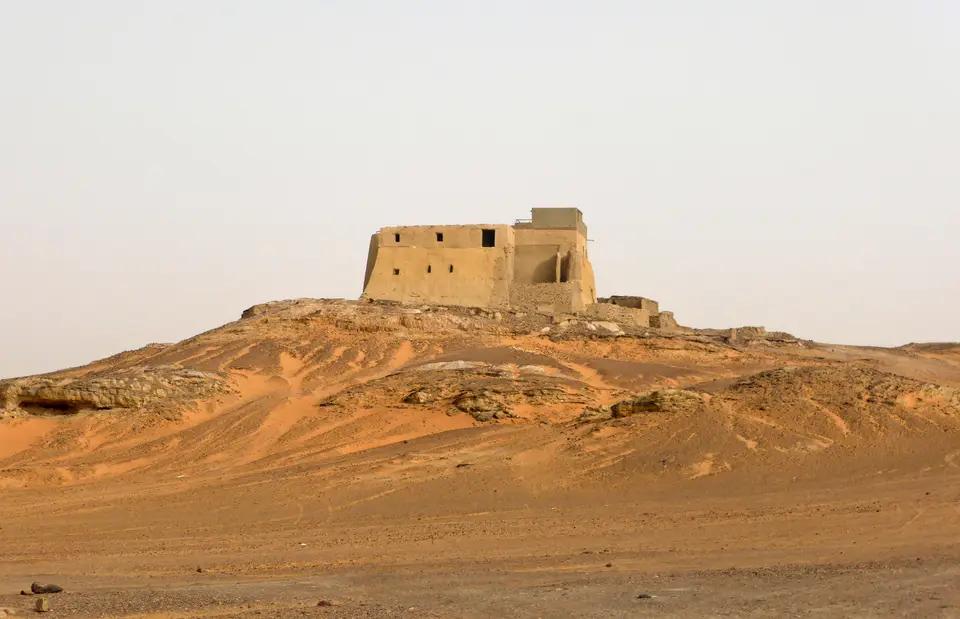
East of the town atop a high coastal bluff overlooking the Indian Ocean (approached from the shore past 1-metre-high reef and coral breakwater causeways spotted by mangrove growth) spreads the two-acre Palace of Husuni Kubwa (the Great Palace). Constructed under Sultan al-Hasan ibn Sulaiman in the early 14th century from coral rag set in limestone mortar with 3-metre-high plastered rooms, cut-stone door jambs and timber-and-limestone roofs (where archaeologists recovered Chinese celadon alongside Ying Ch'ing stoneware and a porcelain flask from the Yuan dynasty dated around 1300 CE), Husuni Kubwa combines a vast southern commercial courtyard for storing merchandise, a residential palace of over one hundred individual rooms, a reception pavilion alongside an octagonal royal swimming pool and a wide cliffside stairway descending to the beach. Immediately nearby stands Husuni Ndogo (the Little Palace), a rectangular enclosure of coral rubble with 2-metre-deep foundations and corner towers resembling 661 to 750 CE forts of the Umayyad Caliphs, while between the Makutani Palace and the mosque rises the Gereza Fort (meaning prison in Swahili), built by the Portuguese and rebuilt in typical Omani style with round and square towers in the late 18th and 19th centuries.
Across the Sagarungu sound on the northern end of Songo Mnara Island lies the paired 14th- to 15th-century urban ensemble of Songo Mnara. Unencumbered by later colonial rebuilding, the walled town of Songo Mnara preserves the complete ground plan of five coral-stone mosques, a multi-courtyard palace complex, cemeteries, open public plazas, and some thirty-three domestic dwellings built of coral stone and mangrove timber, where recessed wall niches around doorways and vaulted rooms once displayed imported Asian porcelain.
Crossing by Boat from Kilwa Masoko to the Coral Ruins
Because neither Kilwa Kisiwani nor Songo Mnara has roads or bridges (and non-residents are strictly prohibited from landing without an official permit), visiting the World Heritage site begins on the mainland in the district seat of Kilwa Masoko, where visitors secure permits and hire a motorboat or traditional dhow to cross the harbour channel.
Plan your boat excursion around the tide schedule to explore both islands with a licensed local guide.
- Secure your permit in Kilwa Masoko and inspect the Great Mosque and Gereza Fort: Register at the tourist information centre in downtown Kilwa Masoko, then cross the Mavuji estuary channel to the northern beach of Kilwa Kisiwani. Step inside the 19th-century Omani doorway of the Gereza Fort beside the Makutani Palace, then walk to the Great Mosque to compare the 12th-century northern prayer hall (built 1131 to 1170) with the 16 domed and vaulted bays and monumental great dome of Sultan al-Hasan ibn Sulaiman's 14th-century southern hall.
- Walk the coastal cliff to the 100-room Palace of Husuni Kubwa: Follow the island footpath east past the rectangular towered walls of Husuni Ndogo to the cliff-top bluff of Husuni Kubwa. Trace the 3-metre-high coral-stone walls of the southern merchants' court, the 100 residential chambers alongside the octagonal swimming pool (stabilised by CHAM volunteers from 2001 to 2007 and World Monuments Fund conservation after 2008).
- Sail across the sound to the thirty-three coral houses of Songo Mnara: Take the boat south across the Sagarungu sound to the northern shore of Songo Mnara to walk through an intact 15th-century Swahili townscape. Examine the five coral mosques, the palace courtyard, and the thirty-three domestic stone dwellings with their carved porcelain display niches, and compare Kilwa with other Indian Ocean trading ports in our UNESCO World Heritage Atlas.
