Quick Field Data
- UNESCO Inscription: 1995 · Criteria (i), (iv)
- Scale & Footprint: Two linked Silla sanctuaries separated by 3 kilometres on Mount Tohamsan inside Gyeongju National Park, protected by a 500-metre Historic Cultural Environment Protection Area
- Access & Ticketing: Managed by Gyeongju City, the Korea National Park Service and Bulguksa Temple; regulated visitor lines view Seokguram's rotunda exclusively through a protective glass partition with photography banned inside
- Arrival Logistics: 14 kilometres southeast of central Gyeongju and 22 kilometres from Ulsan Airport (USN), with wider air links via Daegu International Airport (TAE) at 63 kilometres and Gimhae International Airport (PUS) at 78 kilometres
Unified Silla State Patronage on Mount Tohamsan
Rising on opposite levels of Mount Tohamsan near Gyeongju, ancient capital of the Unified Silla kingdom, Seokguram Grotto and Bulguksa Temple form a paired eighth-century architectural programme. Temple chronicles trace an earlier sanctuary at Bulguksa to King Beopheung in 528, and halls like Museoljeon (670) and Daeungjeon (681) predated the final scheme. The Samguk Yusa records that Prime Minister Kim Daeseong launched the integrated monumental construction in 751 during King Gyeongdeok's reign. According to tradition, Kim dedicated Bulguksa ('Temple of the Buddha Land') to pacify the spirits of his parents in this lifetime. He dedicated Seokguram ('Stone Buddha Temple', originally Seokbulsa) to his parents from a previous existence, leaving the Silla royal court to complete both projects in 774 shortly after his death.
Separated by roughly 3 kilometres along the forested mountain slope, the two complexes dramatise a physical and spiritual pilgrimage into Nirvana starting from the foot of holy Mount Tohamsan. Pilgrims began at Bulguksa on the lower terrace, where broad stone retaining walls, stair bridges and paired courtyard pagodas render the Buddhist utopia in terrestrial space. They then ascended to Seokguram at 750 metres elevation overlooking the East Sea. Today both monuments sit inside Gyeongju National Park as National Treasures and Historic Sites of the Republic of Korea, surrounded by a strict 500-metre Historic Cultural Environment Protection Area where new construction requires pre-approval. Oversight passes from the national Cultural Heritage Administration (CHA) to Gyeongju City, the Korea National Park Service and resident Jogye Order monks. Management combines daily site checks with in-depth monitoring every 3 to 4 years by certified specialists and an active Fire Risk Prevention System fitted with CCTV across Bulguksa's wooden halls.
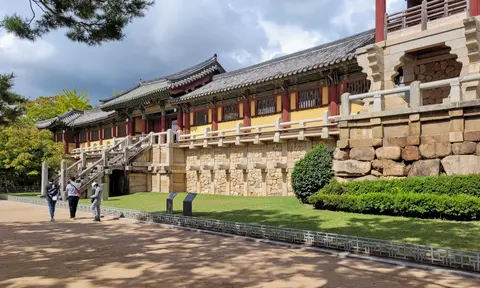
Seokguram's Mortarless Granite Vault and Concrete Conservation
Unlike Indian or Chinese cave temples chiselled directly into soft sandstone or limestone cliffs, Korea's peninsula consists mostly of hard granite unsuitable for deep cave excavation. Silla engineers therefore built Seokguram from scratch as an artificial stone vault buried beneath an earthen mound overlooking the sunrise across the East Sea. Master builders locked more than 360 dressed white-granite blocks together with stone rivets and zero mortar. An arched entrance leads into a rectangular antechamber, a narrow relief-lined corridor and a slightly irregular circular rotunda measuring between 6.58 and 6.8 metres across. Above, a hemispherical dome carved with half-moons and a central lotus ceiling stone follows symmetry and golden-rectangle proportions.
At the rotunda heart sits a 3.5-metre white-granite Shakyamuni Buddha resting atop a 1.34-metre three-part lotus pedestal whose central shaft divides into eight pillars between upper and lower lotus petals. Crowned by a wisdom usnisa and wrapped in fan-shaped drapery across crossed legs echoing Indian prototypes interpreted through Silla geometry, the statue holds its left hand in dhyana (concentration) mudra and lowers its right hand in bhumisparsha (earth-touching) mudra. Rather than attaching a carved halo to the statue's head, architects carved a circular lotus roundel directly onto the rear rotunda wall so viewers stepping forward along the central axis perceive a floating halo framing the Buddha's face. Out of 40 original granite figures arranged symmetrically around the chamber, 38 survive: Eight Guardian Deities and two Vajrapanis flank the antechamber; Four Heavenly Kings guard the corridor; and 15 relief panels plus 10 upper niche figures fill the rotunda. Behind the main statue stands a forward-facing 2.18-metre Eleven-faced Avalokitesvara wearing a crown, robes and jewellery while holding a vase with a lotus blossom, flanked by ten Greek-influenced disciples (five on each side), Manjusri, Samantabhadra, Brahma and Indra. Silla builders oriented the arched grotto eastward toward the East Sea so sunrise rays entered directly down the corridor to touch the main Shakyamuni image, while porous granite stonework and carefully laid earthen mound layers regulated interior air circulation and moisture without mechanical machinery.
Conservation crises shaped how travellers experience Seokguram today. Joseon-era suppression of Buddhism left the remote summit sanctuary neglected despite repairs in 1703 and 1758. Between 1913 and 1915, Japanese authorities dismantled and reassembled the entire grotto because of partial ceiling collapse, encasing the stone dome in concrete. Because concrete sealed natural granite ventilation, moisture and condensation attacked the reliefs despite 1917 drainage pipes, 1920 to 1923 asphalt waterproofing and even destructive 1927 hot-steam cleaning. In the 1960s, restoration under President Park Chung Hee added a second outer concrete shell creating a 1.2-metre airflow chamber and installed mechanical humidity controls, later removing a vibration-posing ventilation fan. Works also added a wooden antechamber shelter, whose impact on sunrise visibility and natural airflow remains debated among historians. Finally, conservators sealed the rotunda behind a protective glass wall barring visitor entry and photography.
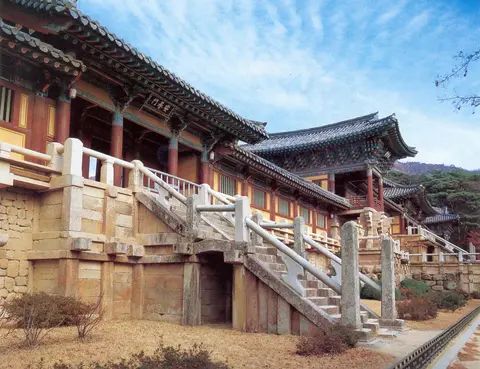
Bulguksa Temple Terraces, Twin Pagodas and Silla Stone Bridges
Downslope from the hermitage, Bulguksa Temple acts as head temple of the Jogye Order's 11th district and preserves six South Korean National Treasures. Raised across dramatic stone terraces separating mortal ground from the Buddha Land, the complex translates Buddhist teachings into terrestrial masonry. The Daeungjeon precinct mirrors the world of Sakyamuni from the Lotus Sutra, while the adjoining Amitabha and Vairocana terraces draw on Pure Land and Avatamsaka Sutra cosmology. Divided into three principal worship zones and crowned at the highest terrace by Gwaneumjeon, the sanctuary anchors Shakyamuni inside Daeungjeon (Hall of Great Enlightenment) behind Museoljeon. Geuknakjeon (Hall of Supreme Bliss) houses a 1.66-metre gilt-bronze Seated Amitabha Buddha cast in the late eighth or early ninth century, showing two fused head shells, aquiline nose, broad shoulders and raised left palm. Birojeon (Vairocana Buddha Hall) houses a 1.77-metre ninth-century gilt-bronze Vairocana Buddha whose soft elongated face and flowing robes gesture in the wisdom mudra. Renovated repeatedly through the Goryeo and early Joseon periods before its wooden halls burned during the Imjin wars, the temple underwent roughly 40 reconstructions between 1604 and 1805. Major archaeological rebuilding followed from 1969 to 1973, leaving the massive dry-fitted Silla stone terraces, stairs and courtyard pagodas anchored in eighth-century masonry.
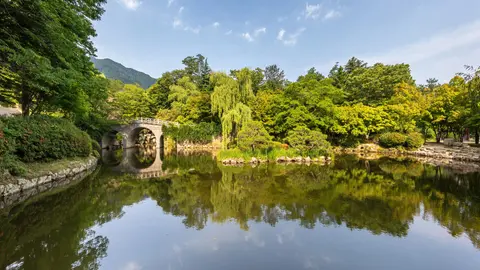
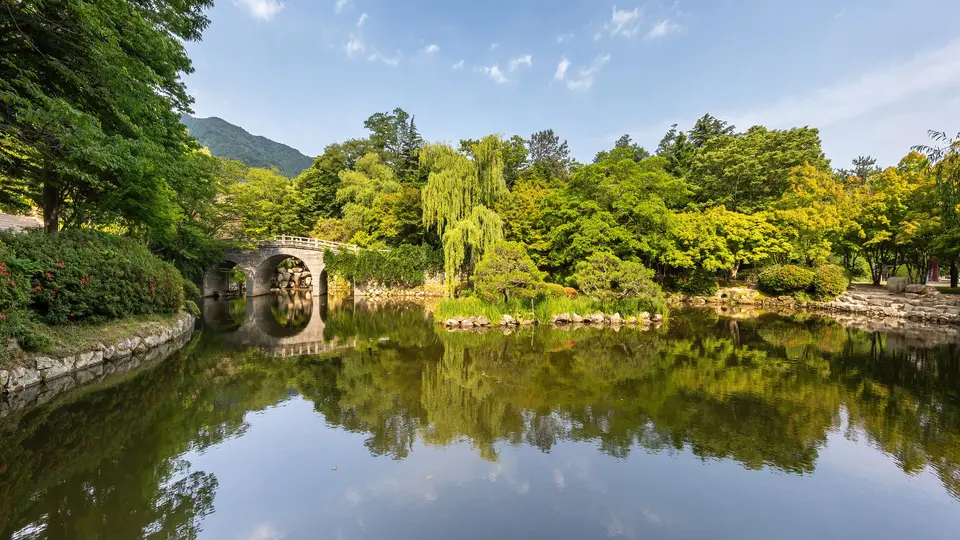
Two ceremonial double-span stone bridges link the lower ground to the upper sanctum courts, built around 750 during King Gyeongdeok's reign. Cheongungyo (Blue Cloud Bridge, upper 16 steps, 6.3 metres) and Baegungyo (White Cloud Bridge, lower 18 steps, 5.4 metres) lead up to Jahamun (Mauve Mist Gate) at a 30-degree incline. Their 34 steps symbolise stages toward enlightenment and span Korea's oldest surviving semicircular rainbow-arch (hongye) stone vault. To the west, steeper 45-degree stairs named Yeonhwagyo (Lotus Flower Bridge, lower 10 steps) and Chilbogyo (Seven Treasure Bridge, upper 8 steps) lead toward Anyangmun Gate and Geuknakjeon. Worn lotus carvings on Yeonhwagyo's treads keep both western bridges closed to foot traffic today.
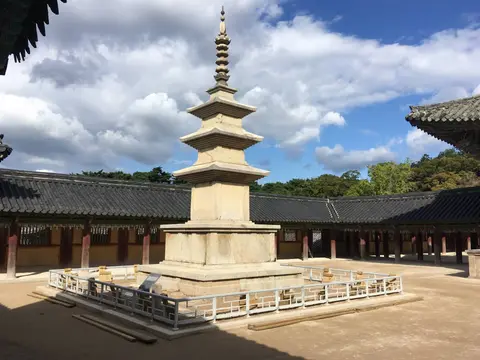
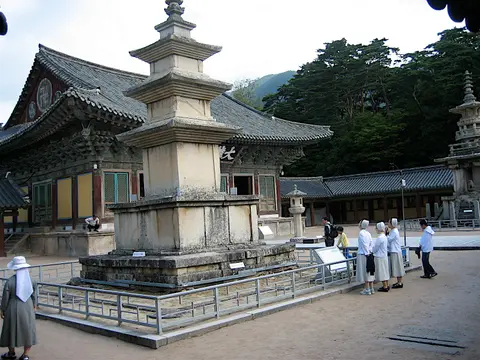
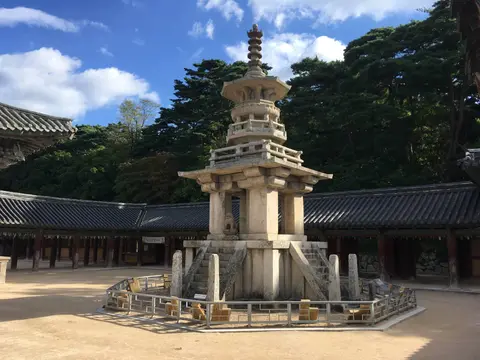
Facing Daeungjeon across the main courtyard stand Korea's best-known pair of contrasting Silla stone pagodas, designated National Treasures on 20 December 1962. To the west rises the austere 8.2-metre, three-storey Seokgatap (Pagoda of Sakyamuni), celebrated for clean geometric restraint that later inspired Hyun Jin-geon's 1957 historical novel Shadowless Pagoda. The pagoda is also famed for yielding the world's oldest surviving woodblock print, a 704-to-751 Dharani sutra printed on an 8-by-630-centimetre mulberry-paper scroll discovered inside during 1966 repairs. Facing it to the east stands the 10.4-metre Dabotap (Many Treasure Pagoda), carved in elaborate stepped columns, railings and octagonal tiers that appear on South Korea's 10-won coin. Outside Birojeon stands a 2.1-metre Goryeo-dynasty sarira stupa shaped like a stone lantern on an octagonal lotus base. It carries cloud-carved pillars, four Buddha and bodhisattva reliefs and a twelve-sided cap, and was taken to Japan in 1906 and returned in 1933.
Seokguram and Bulguksa Access Zones and Conservation Limits
Although linked spiritually and by forest footpaths, Bulguksa and Seokguram sit 3 kilometres apart by winding mountain road and enforce distinct photography and access rules.
| Complex Zone | Key Highlights | Access & Ticket Rule |
|---|---|---|
| Bulguksa Stone Bridges & Terraces | 34-step Cheongungyo and Baegungyo stairway over Korea's oldest stone hongye arch, Yeonhwagyo and Chilbogyo bridges, Banya Yeonji pond | Open temple entry into forecourts; stone bridge stairs themselves are fenced off to prevent foot erosion of eighth-century carvings |
| Bulguksa Courtyards & Wooden Halls | 8.2-metre Seokgatap and 10.4-metre Dabotap pagodas, Daeungjeon, Museoljeon, Geuknakjeon Amitabha and Birojeon Vairocana statues | Courtyards walkable on foot; shoes removed before stepping onto wooden hall thresholds; silence requested during active chanting |
| Seokguram Grotto Approach & Rotunda | 750-metre-high mountain terrace overlooking the East Sea, wooden antechamber and glass-walled view of 3.5-metre granite Buddha and 38 figures | Separate mountain sanctuary entry; visitors view the grotto from behind protective glass along a moving queue with all interior photography banned |
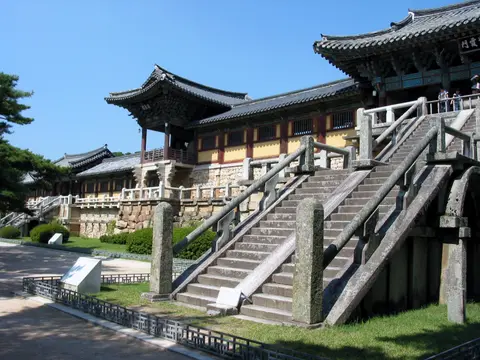
Three Stone-Carving and Structural Details on Mount Tohamsan
First, stand directly beneath the main stone staircase of Cheongungyo and Baegungyo in front of Bulguksa's Banya Yeonji pond to inspect the curved hongye arch carrying the steps above. Dating from 750, this semicircular stone arch ranks as the oldest surviving example in Korea, bridging stone masonry directly with wooden temple roof architecture above.
Second, compare Seokgatap and Dabotap side by side inside the Daeungjeon courtyard before moving toward Birojeon. Viewing the restrained three-storey geometry of 8.2-metre Seokgatap opposite the ornate stone pillars, lotus pedestals and openwork railings of 10.4-metre Dabotap captures the architectural duality of Lotus Sutra philosophy in plain and ornamented granite.
Third, once standing before the glass partition at Seokguram Grotto, align your gaze slightly off-centre and then step squarely onto the central axis facing the 3.5-metre Shakyamuni Buddha. Only from that axial alignment does the carved lotus roundel set deep on the rear rotunda wall lock directly behind the Buddha's head like a sculpted stone halo.
Dawn Timing on Mount Tohamsan and Gyeongju Connections
Early mornings bring crisp coastal air and quiet courtyards across both sanctuaries before tour buses climb Mount Tohamsan. Visitors heading up to Seokguram at 750 metres elevation should bring an extra layer against brisk breezes blowing off the East Sea. Along this ridge, acid rain and sea fog remain active conservation concerns for the stone masonry. Moving from Bulguksa's lower granite terraces up to the summit grotto repeats the same uphill progression Silla monks designed over twelve centuries ago. This route links open courtyard timber halls with a cool subterranean stone rotunda sheltered beneath earthen slopes. Allowing half a day links the stone bridges, twin pagodas and three courtyard halls at Bulguksa with the forested mountain climb or shuttle bus up to Seokguram 3 kilometres away. That pace also leaves enough unhurried margin for queues along the glass viewing corridor.
Ulsan Airport (USN) sits 22 kilometres south, supported by Daegu International Airport (TAE) at 63 kilometres and Gimhae International Airport (PUS) at 78 kilometres, while frequent local buses link the temple foothills straight into central Gyeongju, 14 kilometres northwest. Travellers pairing Mount Tohamsan's Silla monuments with coastal heritage and urban museums in the old capital can continue exploring East Asian temple terraces, grotto carvings and historic capitals across our UNESCO World Heritage Atlas.