


























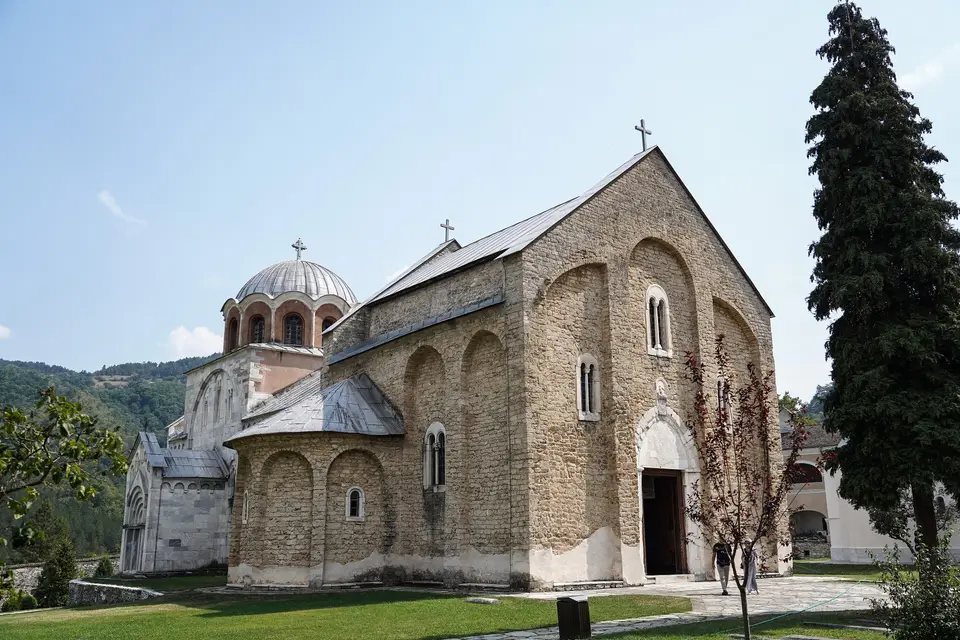
Quick Field Data
- UNESCO Inscription: 1986 (Cultural, Criteria i, ii, iv, vi; protected by Serbia as a Monument of Culture of Exceptional Importance since 1979).
- Scale & Footprint: Circular fortified monastic enclosure with two fortified gates housing the white-marble Church of the Virgin (completed between 1190 and 1196), the King's Church (1314), the Church of St. Nicholas, Archbishop Sava's rubble refectory, a 13th-century bell tower, and an 18th-century monastic residence.
- Access & Ticketing: Active Serbian Orthodox monastery within the Eparchy of Žiča, open to the public; check the official site for liturgical schedules, dress requirements, and access to the monastic museum and treasury.
- Arrival Logistics: Located at 43.4865°N, 20.5317°E near the Studenica river within central Serbia's Raška district, lying 40.9 km (25.4 mi) east of Ivanjica and 39 km (24 mi) southwest of Kraljevo.
Stefan Nemanja, Saint Sava, and the Birth of the Serbian Orthodox Church
Situated at 43.4865 degrees north and 20.5317 degrees east in the mountainous valley of the Studenica river in central Serbia, Studenica Monastery lies 40.9 km (or 25.4 mi) to the east of Ivanjica and 39 km (or 24 mi) to the southwest of Kraljevo within the historic Raška district. Revered as the mother-church of all Serbian Orthodox temples and the largest, wealthiest monastic complex of the Serbian Orthodox tradition, Studenica was founded in 1190 by Stefan Nemanja (also written Stevan Nemanja), the ruler who established the medieval Serbian state. The initial stage of building work was finished in the spring of 1196, at which point Stefan Nemanja abdicated his throne, took monastic vows at Studenica under the monastic name Simeon, and subsequently departed for Hilandar Monastery, leaving his son and successor Stefan in charge of the complex. After Nemanja died at Hilandar in 1199, his third and youngest son Rastko, venerated as Saint Sava Nemanjić (1169 to 1236), reconciled his rival brothers Stefan and Vukan and transferred their father's relics back to Studenica.
Under the guardianship of Saint Sava, who served as hegumen and later became the first Serbian Archbishop, Studenica evolved into the political, cultural, and spiritual centre of medieval Serbia. Inside this monastic enclosure in 1219, Saint Sava established the autocephalous Serbian Orthodox Church and composed the earliest literary work in the Serbian language, a biography of his father Saint Simeon. Today, the marble church enshrines the mortal remains of Stefan Nemanja alongside those of his wife Ana (who took monastic vows as the nun Anastasia) and their son, the first crowned Serbian king, Stephen the First-Crowned. Later rulers of the Nemanjić dynasty continued to expand and endow the complex: King Stefan Radoslav (who is also buried at the monastery) added a monumental vaulted exonarthex to the main church in 1235, and in 1314 King Milutin erected the compact sanctuary of Saints Joachim and Anna, called the King's Church in honour of its royal patron.
Following the fall of the last medieval Serbian state in 1459, Turkish forces repeatedly assaulted the monastery. Major restoration work was carried out in 1569, when damaged frescoes inside the Church of the Virgin were carefully conserved and repainted. In the early 17th century, a devastating earthquake and subsequent fire struck the complex, destroying historical documents and a substantial portion of the medieval artistic heritage. Despite centuries of war and plunder, the monastic community led by figures such as hegumen Nikodim II (1439), deacon and hieromonk Samuilo Jakovljević (1760 to 1825, ordained in 1785), hieromonk Melentije Nikšić (1780 to 1816, ordained in 1800), Vasilije Veselinović, archimandrite Mihailo Jovanović (1826 to 1898, appointed in 1854), and deacon Mardarije Uskoković (1889 to 1935, who served at the monastery from 1905) preserved the liturgical continuity of Studenica.
The Raška Architectural School, White Marble Sculpture, and Byzantine Frescoes
Protected by an almost circular fortified enclosure wall strengthened with two fortified gateways, Studenica Monastery is the foundational monument of the Raška School of medieval Serbian church architecture. Standing at the centre of the courtyard and honouring the Presentation of the Holy Virgin, the Church of the Virgin is a domed single-nave basilica with a three-sided eastern apse, northern and southern vestibules, an extended western narthex, and King Radoslav's 1230s exonarthex. While the interior walls are revetted with blocks of porous tuff, the exterior facades are built with polished slabs of white marble quarried in the hills surrounding the monastery, where the medieval quarries and the remains of the stonecutters' village where workers extracted and dressed the marble slabs still survive. Stonemasons brought from the Adriatic region, most probably from Kotor where Stefan Nemanja maintained a palace, blended Romanesque architectural sculpture with a Byzantine spatial plan. This synthesis culminates in the four carved marble portals of the Virgin's Church, especially the west portal between the narthex and exonarthex bearing a tympanum inscription in Serbian lettering. Under the dome on the north wall, a multi-pane square window features medallions carved on a leaden plaque representing eight fantastic animals that symbolise the Virgin's virtues, accompanied by two stone rosettes denoting the Divine Eye.
The interior of the Church of the Virgin preserves a milestone of early 13th-century Byzantine painting, executed between 1208 and 1209 under the patronage of Saint Sava and studied extensively by scholars including Sima Ćirković, Vojislav Korać, Gordana Babić, Mirjana Šakota, Branislav Todić, Jelena Erdeljan, Srđan Pirivatrić, and Miloš Živković. Surviving in the altar area, beneath the dome, along the western wall surface, and across the lower nave registers, these frescoes are celebrated for the monumental Crucifixion painted in 1209 against a deep blue background studded with gold. On the south wall, the founders' composition depicts the Virgin leading Stefan Nemanja (Simon) holding a model of the church toward Jesus Christ as the Magistrate Impartial. In the narthex and side chapels (parecclesions) added by King Radoslav in the 1230s, frescoes depict the life of St. Nicholas and the Hetoimasia in the north chapel, while the south chapel portrays Stefan Nemanja, Stephen the First-Crowned, and King Radoslav accompanied by his consort Ana, and the north wall of the narthex displays three prelates of the Serbian Church: Archbishop Sava, Archbishop Arsenije, and Radoslav's brother Archbishop Sava II. The 1569 restoration added an expansive Last Judgment in the upper registers of the narthex alongside a painted portrait showing Nemanja's consort Ana attired as the nun Anastasia.
Immediately northwest of the main church stands the King's Church, built by King Milutin in 1314 out of stone and tuff with white plastered facades in the shape of a compressed cross crowned by the exterior structure of an octagonal dome. Its interior frescoes represent the supreme achievement of 14th-century Byzantine painting in the region. South of the main church stands the small single-nave Church of St. Nicholas, decorated inside with 12th- or early 13th-century frescoes, while the preserved stone foundations of St. John the Baptist Church lie in the lawn separating St. Nicholas from the King's Church.
Monastic Refectory, Hermitages, and Visitor Logistics
Protected by the state as a Monument of Culture of Exceptional Importance since 1979 and inscribed on the UNESCO World Heritage List in 1986, Studenica Monastery encompasses both the walled courtyard complex and the surrounding terrain of churches, cliffside hermitages, and medieval marble quarries along the Studenica river valley. Along the western side of the Virgin's Church stands a medieval rubble-stone refectory erected during the tenure of Archbishop Sava, adjacent to the 13th-century western bell tower that once housed an interior chapel and still retains fragments of early frescoes alongside exterior narthex paintings representing the Nemanjić dynasty genealogy (closely related to the 1208 to 1209 frescoes of the main church). Northward from the Studenica refectory, an 18th-century monastic residence houses a museum displaying precious liturgical exhibits that survived centuries of plundering from the Studenica treasury. Travellers exploring the wider Balkan mountain region can pair this sanctuary with our Montenegro travel guide or locate the Raška valley on our interactive world map. White marble gleams against the forested hills.
- Examining the west portal and 1209 Crucifixion: Pause between Radoslav's 1235 exonarthex and the inner narthex of the Church of the Virgin to inspect the Adriatic Romanesque marble carvings on the west portal before entering the nave to view the blue-ground 1209 Crucifixion fresco.
- Comparing the King's Church and St. Nicholas: Walk across the courtyard to King Milutin's 1314 Church of Saints Joachim and Anna to study its compact compressed-cross plan, octagonal dome, and 14th-century fresco cycle, then trace the foundations of St. John the Baptist toward the single-nave Church of St. Nicholas.
- Visiting Archbishop Sava's refectory and the treasury museum: Follow the circular defensive wall past the 13th-century western bell tower and the medieval rubble refectory to the northern 18th-century monastic residence, where surviving liturgical objects from the Studenica treasury are displayed.
