


























Quick Field Data
- UNESCO Inscription: Inscribed in 1979 as a Cultural heritage site under criteria (ii) and (iii) in the Boyana quarter of Sofia, Bulgaria.
- Scale & Footprint: Three-part medieval church comprising a tenth-to-eleventh-century eastern cross-vaulted sanctuary, a two-storey 1259 Kaloyan church, and a mid-nineteenth-century western porch.
- Access & Ticketing: Strictly climate-controlled interior where timed small-group visits are limited to protect the medieval plaster; check the official site and reserve ahead.
- Arrival Logistics: Situated in the forested Boyana quarter on the southern outskirts of Sofia, reachable by city bus or taxi from central Sofia.
Three Building Phases on the Outskirts of Sofia
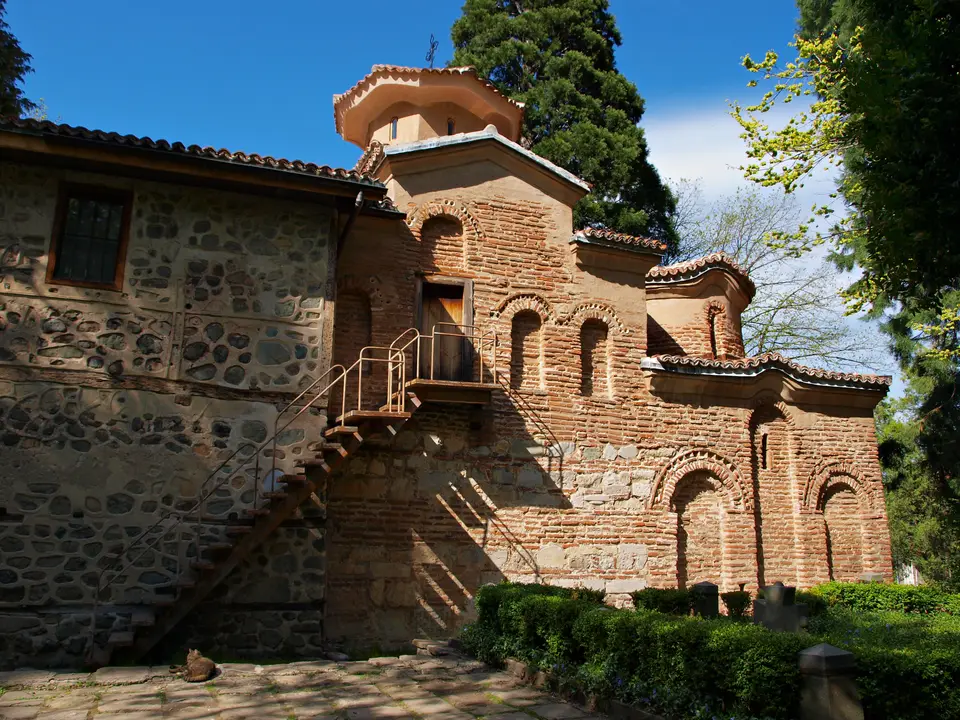
The chapel is tiny. Tall pines shelter the brick walls. Sheltered beneath tall pines and oaks in the Boyana quarter on the southern outskirts of Sofia, the medieval Bulgarian Orthodox Boyana Church (known in Bulgarian as Boyanska tsărkva) dedicated to Saint Nicholas alongside the martyr Saint Panteleimon appears from the outside as a modest brick-and-stone sanctuary. Yet behind its stepped tiled roofs and blind brick arcades stands one of the best-preserved and most complete medieval monuments of Eastern European art, added to the UNESCO World Heritage List in 1979 as site number 42. Rather than being erected in a single building campaign, the monument grew westward in three distinct architectural stages spanning more than eight centuries, with each wing reflecting a different period of Bulgarian history and devotional patronage while preserving wall paintings from the eleventh and thirteenth centuries alongside later murals from the fifteenth to seventeenth and nineteenth centuries.
The oldest eastern section is a small single-apse cross-vaulted sanctuary supported by internal cruciform piers and exterior ceramic-decorated blind niches built in the late tenth or early eleventh century. This original sanctuary became the core of a much more ambitious expansion in the middle of the thirteenth century during the Second Bulgarian Empire, when Sebastocrator Kaloyan, who was cousin of the Tsar as well as grandson of Saint Stephen, King of Serbia, alongside his wife Desislava, commissioned a two-storey central building attached directly to the western facade of the older chapel. Known as the Kaloyan Church and dated precisely by a Middle Bulgarian patron's (ktitor's) inscription on the northern wall to Indiction 7 of the year 6767, or 1259 AD, during the reign of the devout Bulgarian Tsar Constantine Asen, who erected this temple of Nicholas and Panteleimon from the ground through Kaloyan's funds alongside his care and great love, this two-storey wing exemplifies the medieval two-storey funerary church type. Its ground floor functioned as a family sepulchre with two semi-circular arcosolia burial niches in the north and south walls and a semi-cylindrical vault penetrated by the narthex of the older church, while the upper storey served as a private family chapel identical in cross-vaulted design to the eastern church and featuring exterior ceramic ornaments. Finally, in the middle of the nineteenth century, the local community added a western third section built with donations from the residents of Boyana.
In 1917, a landscaped park was created around the church, separating its immediate surroundings from modern urban traffic across three defined protection and buffer zones. To safeguard the fragile tempera and fresco layers inside the tenth- and thirteenth-century rooms, specialist conservators completed cleaning campaigns in 1912 and 1915 under an Austrian and a Bulgarian specialist, followed by further interventions in 1934 and 1944. Closed to the public in 1954 for comprehensive conservation and structural protection, the building was entrusted to Bulgaria's National Historical Museum, partially reopened in 2006, and then officially reopened in full by Culture Minister Stefan Danailov on 2 October 2008 after modern air-conditioning and low-heat lighting systems were installed to keep interior temperatures stable between 17 and 18 degrees Celsius (62 to 64 degrees Fahrenheit) so that visitors could view the medieval plaster without causing thermal or humidity damage.
The 1259 Fresco Cycle and the Boyana Master
What earned Boyana Church its world fame is the extraordinary second layer of wall paintings executed in 1259 directly over an earlier eleventh-to-twelfth-century fresco layer that originally covered the entire eastern church and whose surviving fragments can still be seen low on the apse and north walls as well as high on the west wall and south vault. Painted by an unknown team of artists trained within the workshops of the Turnovo School of Painting and collectively known as the Boyana Master, making Boyana the only wholly preserved thirteenth-century monument of the Turnovo School, the 1259 fresco cycle comprises 89 scenes with 240 human figures that shaped the course of medieval Bulgarian and European painting. While adhering to the Seventh Ecumenical Council's icon-painting canon established at Nicaea in 787, nearly all of these 240 painted figures display psychological insight alongside harmonious proportions and human individuality. During the restoration works between 2006 and 2008, National History Museum director Bozhidar Dimitrov and restorer Grigoriy Grigorov reported the discovery of a rare hidden inscription beneath plaster layers on a church wall bearing the name Vasiliy, noting that this thirteenth-century Boyana painter was the sole artist among kings and nobles whose name was read aloud during church sermons and that Orthodox tradition forbade a painter from manifesting himself openly because God guided his hand, whereas other historians and archaeologists question whether the signature names the chief master rather than a workshop assistant.
In the oldest eastern section of the church, Christ Pantocrator looks down from the central dome above a drum showing a host of angels and the Four Evangelists (Matthew and Mark alongside Luke and John) painted across the dome pendentives, while four distinct depictions of Christ, including Christ Emmanuel and the Ancient of Days alongside the acheiropoietic Holy Mandylion (traditionally made without human hands) and the Holy Tile, adorn the face of the arches together with scenes from the Major Feast Days and Christ's Passion cycle. In the altar conch sits the Virgin Enthroned surrounded by archangels above four church fathers: Saint Gregory the Theologian alongside Basil the Great and John Chrysostom plus Patriarch Germanus. Flanking the altar stand the deacons Laurentius and Euplius alongside Stephen and Saint Nicholas, while ten full-length portrayals of warrior saints stand arrayed in the first tier.
Stepping into the ground-floor narthex of the 1259 Kaloyan wing brings visitors before 18 narrative scenes from the life of Saint Nicholas, patron of the ground floor and of sailors, merchants, and bankers, into which the artists wove realistic aspects of contemporary thirteenth-century lifestyle; in the Miracle at Sea panel, the painted vessel and sailors' hats recall the Venetian fleet. Above the narthex entrance, the lunette displays the Virgin and Child alongside Saint Anna, Saint Joachim, and Christ Blessing, while the lower tiers portray Saint Catherine, Saint Marina, Saint Theodore the Studite, Saint Pachomius, the hermit Saint Ephraim Syrus among the monks, Saint Paraskeva (Petka), and the oldest surviving representation of the revered Bulgarian saint John of Rila, alongside Christ Disputing with the Doctors in the south arcosolium and the Presentation of the Virgin in the north. Most celebrated of all on the north wall are the lifelike donor portraits depicting Sebastocrator Kaloyan alongside his wife Dessislava as well as Tsar Constantine Asen Tikh of Bulgaria and Tsaritsa Irina, which rank among the earliest surviving historical portraits in Bulgaria, supplemented by a fourteenth-century Presentation of the Virgin, a sixteenth-to-seventeenth-century portrait of Saint Nicholas, and 1882 representations of Saint Nicholas and Saint Panteleimon.
Visiting the Climate-Controlled Sanctuary Today
Every minute inside counts. Because the medieval narthex and eastern sanctuary can hold only a small group without raising interior humidity, entry is strictly regulated by timed intervals.
- Entry and Route Through the Park: Arrive at the fenced park complex in the Boyana quarter on the outskirts of Sofia, walk along the shaded paths through the landscaped grounds, and wait at the nineteenth-century western porch for the attendant to admit your group.
- Tickets, Interiors and Viewpoints: Small groups of up to 8 visitors are admitted for strictly timed 10-minute viewings inside the 1259 narthex and eleventh-century eastern apse; focus immediately on the donor portraits of Kaloyan, Dessislava, Tsar Constantine Asen Tikh, and Tsaritsa Irina alongside the 18 Saint Nicholas scenes before stepping back outside, and check the official site for combined National History Museum ticketing.
- Timing and Onward Connections: Book an early morning slot to avoid tour queues at the gate, inspect the 1259 Middle Bulgarian ktitor inscription on the exterior wall, and explore further medieval art treasures through our UNESCO World Heritage Atlas.
