


























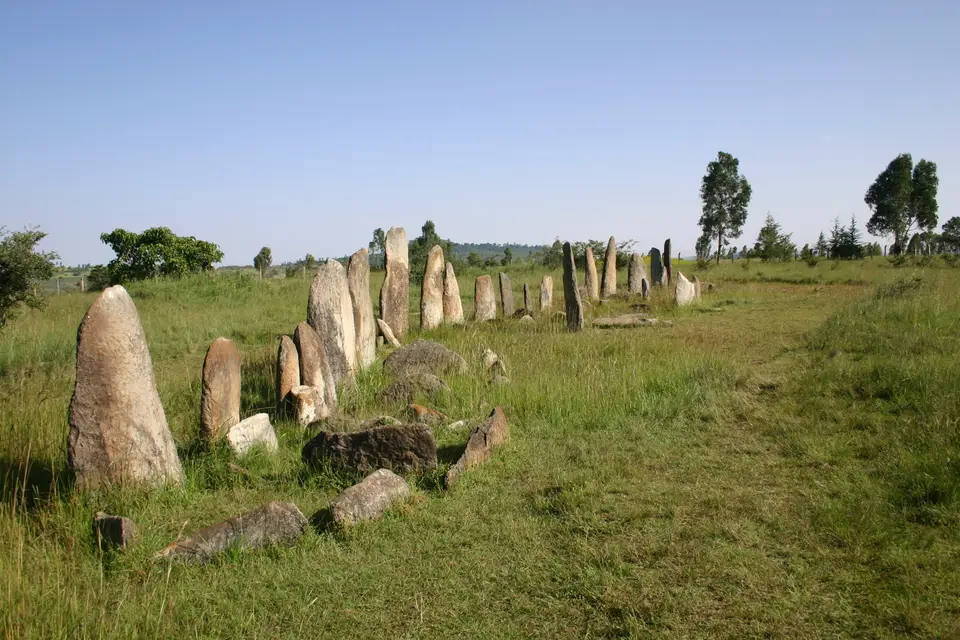
Quick Field Data
- UNESCO Inscription: 1980 · Criteria (i), (iv).
- Scale & Footprint: 36 surviving monolithic stone monuments (including 32 carved stelae and a historical count of 46 pillars at the site) within a wider cluster of 160 archaeological sites in the Soddo region and 118 reported stelae across nine pillar sites in the Gurage Zone
- Access & Ticketing: Open archaeological field site managed as a cultural monument in the Soddo woreda; visitors walk along the aligned rows of upright and fallen monoliths to examine the relief carvings on foot
- Arrival Logistics: Located in the Soddo woreda of the Gurage Zone inside the Southern Nations, Nationalities, and Peoples administrative region to the south of Addis Ababa, accessible by road from the Ethiopian capital
Monolithic Funerary Architecture in the Soddo Region
Positioned in the Soddo woreda of the Gurage Zone within central Ethiopia's Southern Nations, Nationalities, and Peoples administrative region to the south of Addis Ababa, the archaeological site of Tiya is the most prominent of roughly 160 megalithic and archaeological sites identified across the Soddo landscape. Added to the World Heritage List in 1980 during the 4th session under cultural criteria (i) and (iv), the core monument field preserves 36 standing and recumbent stone monuments, of which 32 are carved with low-relief and incised symbols that remain challenging for epigraphers and historians to decipher in full. Within the broader Gurage Zone, archaeological surveys up to 1997 recorded 118 stelae distributed across nine distinct megalithic pillar sites, with historical inventories noting 46 stone pillars at Tiya itself, the largest and most richly decorated assemblage in the district. Stone pillars guard the ancient dead.
Unlike the towering royal obelisks of northern Ethiopia or freestanding masonry temples, the monuments of the Gurage Zone belong to an indigenous southern Ethiopian tradition of funerary monoliths erected over prehistoric and medieval burial complexes. Researchers classify the Gurage stelae into three morphological categories: anthropomorphic stelae bearing human figures alongside cylindrical or conical phallic stelae and monuments of neither anthropomorphic nor phallic form. Crucially, both the anthropomorphic slabs and the non-anthropomorphic, non-phallic pillars at Tiya are carved with a distinctly flat cross-section, representing the only megalithic monuments of this flat slab form documented anywhere in the southern region of Ethiopia.
While the broader practice of raising stone megaliths across Ethiopia stretches back prior to the Common Era, systematic excavations and radiocarbon analyses at Tiya demonstrate that this specific cemetery belongs to the medieval period. Archaeological fieldwork led by French prehistorian Roger Joussaume (published in 1995 by UNESCO and CNS) dated the primary burial complex and its carved monoliths to between the 11th and 13th centuries CE, while subsequent chronological assessments place the construction of the stelae within a wider window between the 10th and 15th centuries CE. Beneath and immediately behind the aligned rows of stone pillars, Joussaume's excavations uncovered human tombs arranged around the monoliths, confirming that the monolithic row functioned as a monumental commemorative marker for a large communal or elite cemetery where deceased individuals were interred in carefully prepared graves.
Beyond the medieval funerary horizon, the ground surface around Tiya preserves much older prehistoric occupation layers. Surface surveys across the site recovered a collection of Middle Stone Age (MSA) lithic tools whose flaking technology closely parallels assemblages excavated at the Ethiopian prehistoric sites of Gademotta and Kulkuletti. Because toolmakers at Tiya shaped these stone implements using a specialised knapping technique known to archaeologists as tranchet blows, researchers conclude that prehistoric hunter-gatherers occupied this Soddo ridge during the same Middle Stone Age time span represented at Gademotta and Kulkuletti, thousands of years before medieval stonecutters quarried and erected the 36 funerary stelae.
Enigmatic Sword Reliefs alongside Yegragn Dingay Folklore and Regional Parallels
What distinguishes the 32 decorated monoliths of Tiya from undecorated menhirs elsewhere in East Africa is the recurring repertoire of high-relief and incised emblems chiselled across their flat stone faces. Foremost among these motifs are broad-bladed swords arranged singly or in parallel rows, pointing either upward or downward across the shaft of the slab. and the sword blades, stone carvers executed plant-like or branching botanical symbols alongside circular bosses or discs, standing human figures posed with arms akimbo, and a recurring T-shaped or bifurcated emblem near the upper register of the stone. On several of the largest pillars at Tiya, the botanical plant motif and the sword emblem appear together on the exact same monolith, suggesting a codified symbolic system linking martial status alongside lineage and funerary ritual.
Because the medieval culture that raised the stelae left no written chronicles, local oral traditions across the Gurage Zone and the neighbouring Hadiya Zone reinterpreted the carved swords through later historical memory. Residents long referred to the monoliths as Yegragn Dingay, meaning Gran's stone, attributing the pillars to the sixteenth-century military leader Ahmad ibn Ibrahim or to Oromo movements because the sculpted blades on the stelae resembled historic regional sword shapes. Archaeological stratigraphy and radiocarbon dating from the 10th to 15th centuries CE prove, however, that the Tiya monoliths were carved centuries before Ahmad ibn Ibrahim lived.
Comparative studies have instead linked Tiya to a wider megalithic belt extending across central and southern Ethiopia toward Djibouti. While some historians have debated whether the southern stelae share distant cultural ties with northern Aksumite traditions or with the phallic and anthropomorphic stelae of the Sidamo and Konso territories, Roger Joussaume noted striking formal parallels between the flat stelae of central Ethiopia and the prehistoric monuments standing along the coastal corridor linking Djibouti City with Loyada inside Djibouti. At the Djibouti and Loyada sites, anthropomorphic and phallic pillars stand beside rectangular graves bordered by vertical stone slabs, and several of those monoliths bear an analogous T-shaped emblem directly comparable to the T-shaped carvings at Tiya.
European scholarly awareness of the Soddo monoliths began in the early twentieth century when Père Azaïs and Neuville documented the carved stones. In April 1935, a German ethnographic expedition travelling one hour south of its caravan camp re-examined the sword-carved monoliths at Tiya. Even after modern excavations, archaeologists note two persistent interpretive challenges: identifying the exact ethnic and linguistic identity of the medieval builders from stone monuments alone, and reconciling physical tomb evidence with oral histories that were formed centuries after the cemetery fell out of active use across the Gurage highlands.
Walking the Stelae Alignment from Addis Ababa
Visiting Tiya offers a quiet, open-air encounter with Ethiopia's medieval megalithic heritage set against the rural farmland of the Gurage Zone. Unlike massive urban ruins, the 36 monuments stand along a compact ridge where visitors can walk directly beside the upright pillars and examine the depth of the chiselled sword blades alongside T-shaped emblems and plant motifs under natural sunlight.
Organise your field visit around the carved stelae row alongside surface details and overland connections from the capital.
- Examine the 32 carved monoliths along the main burial alignment: Walk slowly along the principal row of standing and recumbent stone slabs to compare the three Gurage stelae types in situ. Look closely at the flat-sectioned pillars where single and multiple swords are carved in raised relief above branching plant-like symbols alongside circular discs and the distinctive T-shaped emblem, and spot the anthropomorphic slab preserving a standing human figure with arms akimbo above the burial zone excavated by Roger Joussaume.
- Observe the stone-carving technique and orientation in morning light: Arrive during the morning or late afternoon when angled sunlight casts sharp shadows across the weathered stone faces, making the low-relief sword hilts alongside blade ridges and geometric circles stand out clearly. Take time to note how the monoliths were dressed into flat slabs distinct from the cylindrical phallic pillars found elsewhere in southern Ethiopia, and how the aligned row marks the underlying 11th- to 13th-century tombs.
- Combine Tiya with an overland journey from Addis Ababa: Situated south of the national capital in the Soddo woreda of the Gurage Zone, Tiya makes an accessible day trip or southward stopover when travelling through central Ethiopia. Before or after inspecting the stelae field, base your itinerary in our closest city guide in Addis Ababa and compare Tiya with other African archaeological landscapes in our UNESCO World Heritage Atlas.
