


























Quick Field Data
- UNESCO Inscription: 1982 (Royal Saltworks at Arc-et-Senans) · Extended 2009 (Great Saltworks of Salins-les-Bains) · Criteria (i), (ii), (iv).
- Scale & Footprint: Serial industrial property in the Doubs department and Franche-Comté region, uniting the 13th-century subterranean gallery at Salins-les-Bains with Ledoux's 1775 semicircular factory at Arc-et-Senans 21 km away
- Access & Ticketing: Both sites operate as public heritage museums; guided underground tours run through the 19th-century hydraulic pump gallery at Salins-les-Bains, while the Institut Claude-Nicolas Ledoux curates exhibitions and gardens at Arc-et-Senans
- Arrival Logistics: Located near Besançon in eastern France in the Val d'Amour (Arc-et-Senans at coordinates 47.033 N, 5.778 E in Doubs, 21 km northwest of Salins-les-Bains), accessible by regional rail and road west of Geneva
1,200 Years of White Gold at Salins-les-Bains and the 21-Kilometre Brine Pipeline
Spanning two interconnected industrial sites 21 kilometres apart near Besançon in the Franche-Comté region of eastern France around coordinates 46.9854 N and 5.8270 E, this serial UNESCO World Heritage site in eastern France links the Great Saltworks of Salins-les-Bains with the Royal Saltworks (Saline Royale) at Arc-et-Senans to document over 1,200 years of open-pan salt production. Underground brine springs meet Enlightenment architecture here. First inscribed on the World Heritage List at the 6th session in 1982 for the Saline Royale in the Doubs department and extended on 29 June 2009 under Criteria (i), (ii) as well as (iv) to add the saltworks at Salins-les-Bains, the ensemble pairs a medieval brine-extraction complex with the world's first monumental masterpiece of Enlightenment industrial architecture.
Because subterranean seams of rock salt (halite) underlie the valleys of Franche-Comté, natural salt springs were exploited at Salins-les-Bains (alongside smaller regional works at Montmorot and Lons-le-Saunier) from prehistoric and medieval times for at least 1,200 continuous years until industrial operations finally closed in 1962 (while thermal spa activity continues today). Beneath the surface buildings at Salins-les-Bains stretches a monumental vaulted stone underground gallery dating from the 13th century, where workers tapped deep saltwater springs and where a water-driven hydraulic pump installed in the 19th century still operates in situ, pumping natural brine up to the surface boiler house where saltworkers laboured in intense heat over open iron evaporating pans to crystallise White Gold.
In 18th-century France, salt was an indispensable commodity for preserving meat and fish and a major source of royal revenue under the unpopular salt tax known as the gabelle, collected under 6-year contracts by the private customs and excise operation of the ferme générale, which required every subject over the age of 8 years to purchase a fixed annual quota of salt. After centuries of boiling brine over wood fires at Salins-les-Bains, however, the surrounding mountain hillsides had been stripped of timber, forcing fuel wood to be hauled from ever greater distances while the narrow valley floor left no space to erect long wind-evaporation graduation buildings as the salinity of the springs declined.
After the King's Council halted an April 1773 proposal to tap minor springs, the Fermiers Généraux adopted a bold technological solution: instead of hauling timber up into the steep valley of Salins-les-Bains, they would pipe the liquid brine 21 kilometres downhill to a purpose-built model factory erected in the Val d'Amour at Arc-et-Senans near the immense Chaux Forest, ensuring a reliable supply of firewood for boiling the brine. Between 1780 and 1895, natural brine travelled through 21 kilometres of wooden pipes from the springs of Salins-les-Bains down to Arc-et-Senans.
Claude-Nicolas Ledoux's Semicircular Utopia at Arc-et-Senans
The visionary model factory was developed and built by Claude-Nicolas Ledoux (1736 to 1806; cited in William Hall's 2019 book Stone), whom Louis XV had appointed on 20 September 1771 to supervise and inspect the saltworks across Lorraine and Franche-Comté and who, with the backing of Madame du Barry, entered the Royal Academy of Architecture in 1773 as Royal Architect. Following Louis XV's authorising edict of 29 April 1773, Ledoux initially presented an abstract First Plan in April 1774 featuring a rigid square enclosure linked by covered arcades and 144 Doric columns around a central firewood court. King Louis XV rejected that first square blueprint, objecting that so many columns belonged only on palaces and churches, that relegating the chapel to a corner was improper alongside that a closed square risked fire and poor hygiene.
Rising to the king's critique, Ledoux drafted his visionary Second Plan, launched in 1775 under the reign of Louis XVI (reigned 1774 to 92). Conceived as the semicircular industrial half of an unrealized Utopian ideal city traced in a perfect circle like the path of the sun, Arc-et-Senans became the first factory in history built with the same architectural grandeur as a royal palace or cathedral. Visitors enter at the midpoint of the semicircle through a monumental Doric portico backed by an artificial rock grotto carving that evokes brine gushing from the earth, flanked on one side by guardrooms and on the other by a forge and prison. Curving along the semicircular lawn stand the residential and workshop pavilions: carpenters' and labourers' quarters on the left, marshals' and coopers' workshops on the right as well as clerks' lodges at the two ends of the diameter.
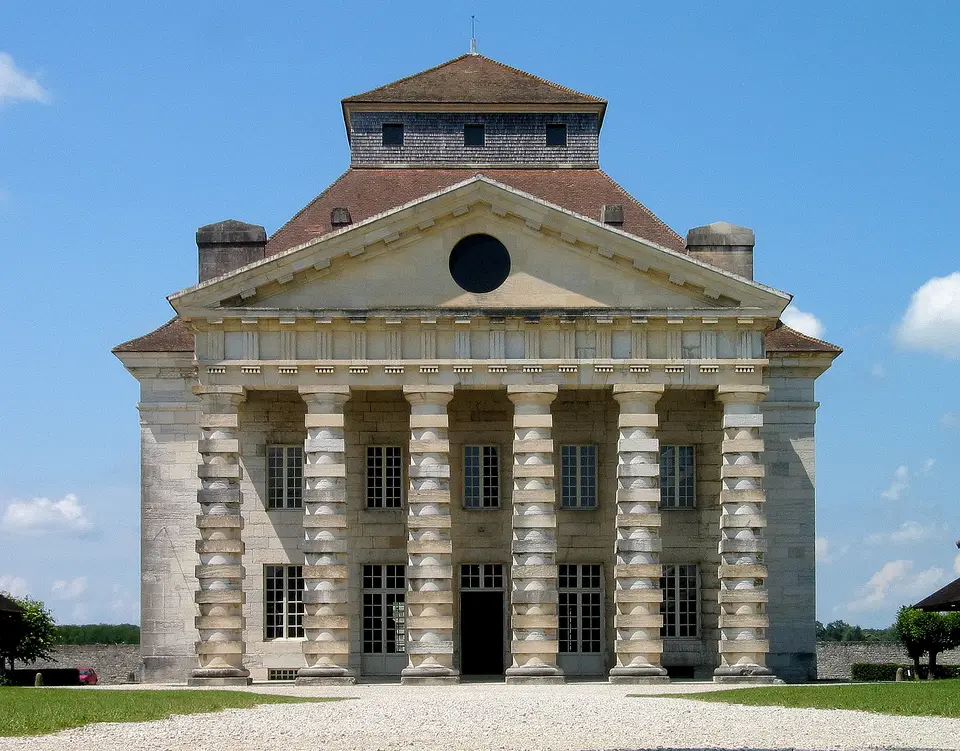
Occupying the focal centre of the diameter is the towering House of the Director, crowned by a belvedere and fronted by banded rusticated columns and a monumental internal staircase leading to the chapel, backed by a small, elegant stable block for the Director's horses. Flanking the left and right sides of the Director's pavilion stand the two vast saltworks buildings themselves, each measuring 80 metres long, 28 metres wide alongside 20 metres high, which housed the heating pots, drying ovens, Sales des Bosses as well as salt stores.
At its peak, Arc-et-Senans reached an annual output of 40,000 quintals of salt, all exported to Switzerland, before competition from rail-transported sea salt and a local lawsuit over well pollution closed production in 1895. After lightning burned the Director's chapel in 1918 and the private owners (the Society for the Eastern Saltworks) dynamited several structures in April 1926, the Commission for Monuments listed the site on 30 November 1926 alongside the Department of Doubs purchased the complex on 10 June 1927 and began restorations in 1930. Used as a camp for Spanish Republican refugees in 1938, a French anti-aircraft post in October 1939 (classified again on 20 February 1940), a German garrison in June 1940, and a French internment camp known officially as the Centre de Rassemblement des tziganes et nomades from May 1941 to September 1943, the saltworks became a filming backdrop for Pierre Kast's 1961 French New Wave film The Season for Love and Marcel Bluwal's 1965 adaptation of Molière's Dom Juan before joining the European network of cultural sites under the Institut Claude-Nicolas Ledoux in 1973.
Tracing the Salt Route from Salins-les-Bains to Arc-et-Senans
Situated 21 kilometres apart near Besançon in Franche-Comté, the two components of this UNESCO property can be visited together in a single day by car, regional train (Arc-et-Senans station sits steps from the Saline Royale gate), or on foot and bicycle along the historic brine pipeline path.
- Underground 13th-century gallery and boiler house at Salins-les-Bains: Begin in the valley of Salins-les-Bains to descend into the 13th-century subterranean vaulted gallery, where the 19th-century waterwheel and hydraulic pendulum pump still lift concentrated saltwater from the underground halite seams. Above ground, tour the restored boiler house to see the last surviving riveted iron evaporating pan and tools used by saltworkers until 1962.
- Walking the 21-kilometre brine corridor to the Forest of Chaux: Follow segments of the 21-kilometre pipeline route linking Salins-les-Bains to the edge of the Chaux Forest in the Val d'Amour, where interpretive markers explain how wooden pipes carried saltwater to Ledoux's furnaces between 1780 and 1895.
- Ledoux's Semicircle, Director's House, and Geneva connections: Pass through the Doric entrance portico and rock-cut grotto at the Royal Saltworks of Arc-et-Senans to walk the semicircular courtyard, visit the Claude-Nicolas Ledoux museum of Utopian architectural models in the coopers' workshop building, enter the two 80-metre-long saltworks halls and the central House of the Director, and stroll the contemporary festival gardens behind the workshops. Pair your Franche-Comté itinerary with our UNESCO World Heritage Atlas and our Geneva guide to the southeast.
