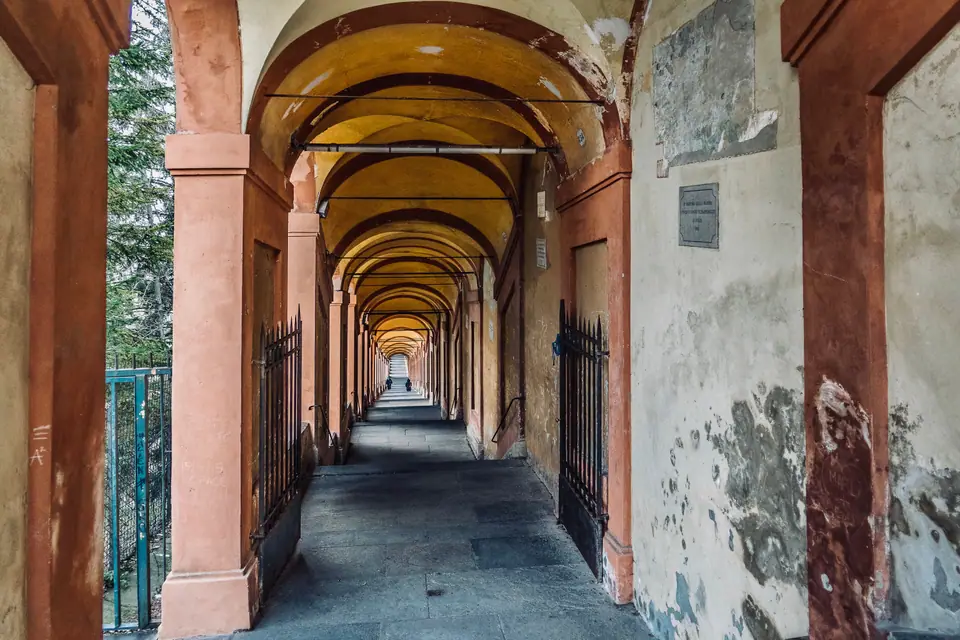
Photo: Vanni Lazzari · CC BY-SA 4.0
Porticoes and San Luca
The UNESCO porticoes of Bologna and the long covered walk up to the sanctuary of San Luca.
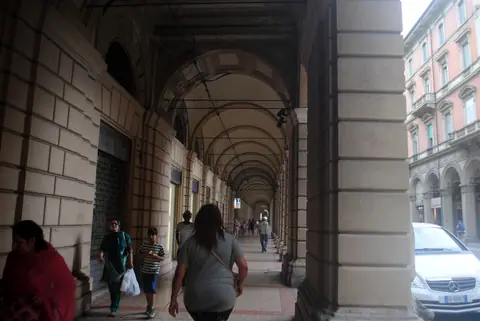
No other feature defines Bologna as much as its porticoes. They line the streets in every direction, shelter you from sun and rain and, in 2021, earned a place on the UNESCO World Heritage list. This guide explains what they are, how they grew and how to walk the longest of them, which climbs a hill to the sanctuary of the Madonna di San Luca.
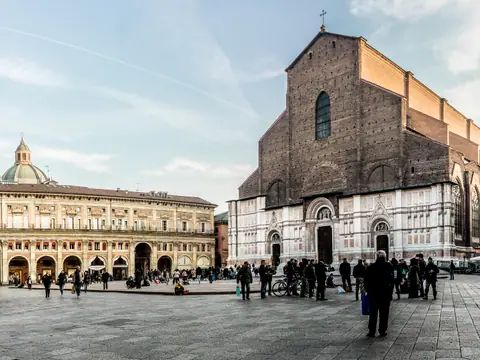
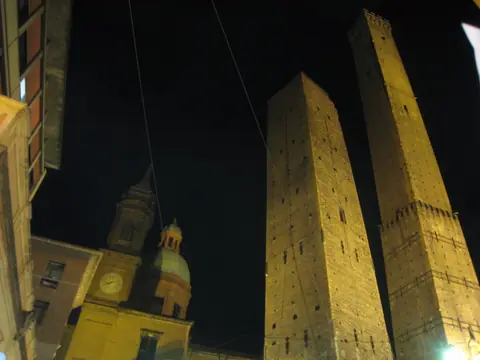
For the towers and the main square that they connect, see our Piazza Maggiore guide.
From wooden medieval arcades to brick UNESCO streets
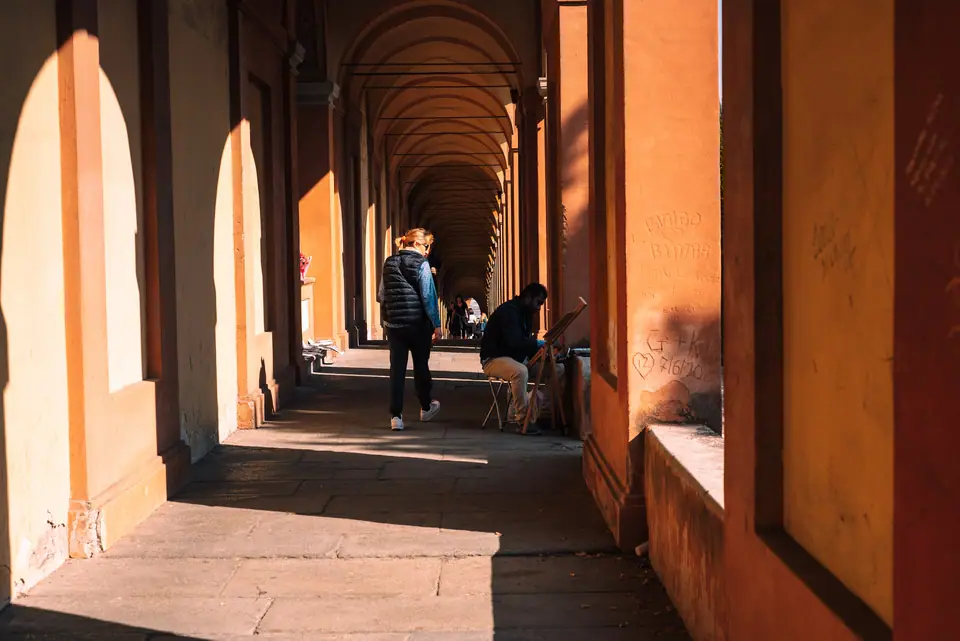
The porticoes extend for more than 38 kilometres in the historic centre and up to 53 kilometres if the ones outside the medieval walls are counted. They appear to have grown almost spontaneously, probably in the early Middle Ages, and the first historical evidence dates from 1041. Early porticoes were wooden, and some survive, for example in Via Marsala and Corte Isolani. A decree of 1568 required them to be rebuilt in brick or stone. UNESCO inscribed them in 2021, at its 44th session.
The 666 arches of the Portico di San Luca
The Portico di San Luca is the longest of them all. It connects Porta Saragozza to the Sanctuary of the Madonna di San Luca and is almost 4 kilometres long, measured at 3,796 metres, with 666 vaults in the traditional count. The total is 658 to 666 depending on how the arches are counted, and 666 is linked to the diabolical number. Construction began in 1674, when a committee of private citizens had been formed to raise funds, and the portico was built to shelter the annual procession that carries an icon of the Virgin Mary, traditionally attributed to Luke the Evangelist, between the sanctuary and Bologna Cathedral.
| Feature | Fact | Why it matters |
|---|---|---|
| Total length, historic centre | More than 38 km | You can cross much of the city under cover |
| San Luca portico | 3,796 m, 666 vaults | The longest covered walk to a sanctuary |
| First evidence | 1041 | An early medieval tradition |
| Decree on materials | 1568 | Wood replaced by brick or stone |
| UNESCO listing | 2021 | Recognised as a heritage ensemble |
The route has two parts. The flat section has 316 arches over 1.52 kilometres, from the Arco Bonaccorsi in front of Porta Saragozza to the Arco del Meloncello. The hill section has 350 arches over 2.276 kilometres from the Meloncello to the sanctuary, climbing from 55 metres above sea level to 270 metres, a difference of 215 metres. Fifteen chapels stand along the hill section, about every 20 arches, and each houses a mystery of the Rosary. Donations from private citizens of every social class and from the Compagnia di Santa Maria della Morte paid for the work. The portico was built from 1674 to 1721 under the architect Gian Giacomo Monti, and after his death Dotti and Francesco Monti Bendini completed it.
Hilltop views and Byzantine icon at the Sanctuary
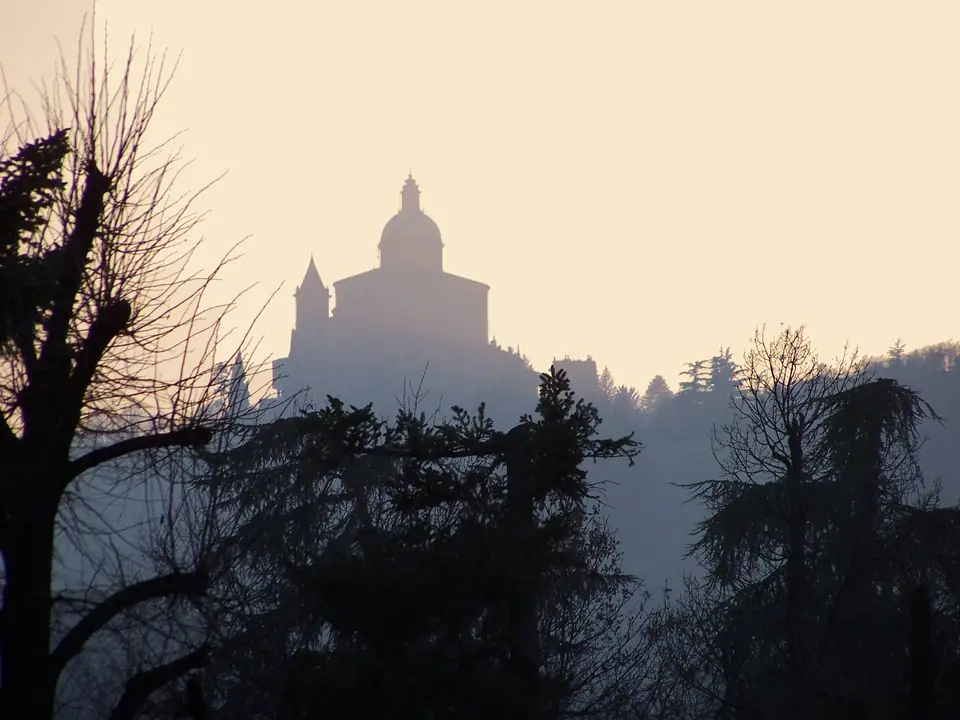
The sanctuary sits on Colle della Guardia, about 300 metres above the plain. Tradition holds that a Byzantine pilgrim brought an icon of the Virgin from the temple of Hagia Sophia in Constantinople to Bologna in the 12th century, and a small hermitage-chapel on the hill was tended by two holy women, Azzolina and Beatrice Guezi. Carlo Francesco Dotti designed the present church, built from 1723 and inaugurated on 25 March 1765 after 42 years of work, with the dome, facade and side tribunes finished in 1774. His son Giovanni Giacomo built the lateral external tribunes from his plans. It holds the icon of the Madonna, and the hilltop gives a wide view over the city, its towers and the plain beyond.
Pacing the uphill arcade climb on foot
Start at Porta Saragozza and follow the arcade uphill. The walk is steady, shaded and well kept, and it takes most people a little over an hour at an easy pace. Wear shoes with good grip, carry water and plan to return the same way or by a different route. A tourist service also runs to the sanctuary, and Bologna Welcome sells a San Luca ticket for those who prefer not to walk.
Neoclassical cloisters at the Certosa cemetery
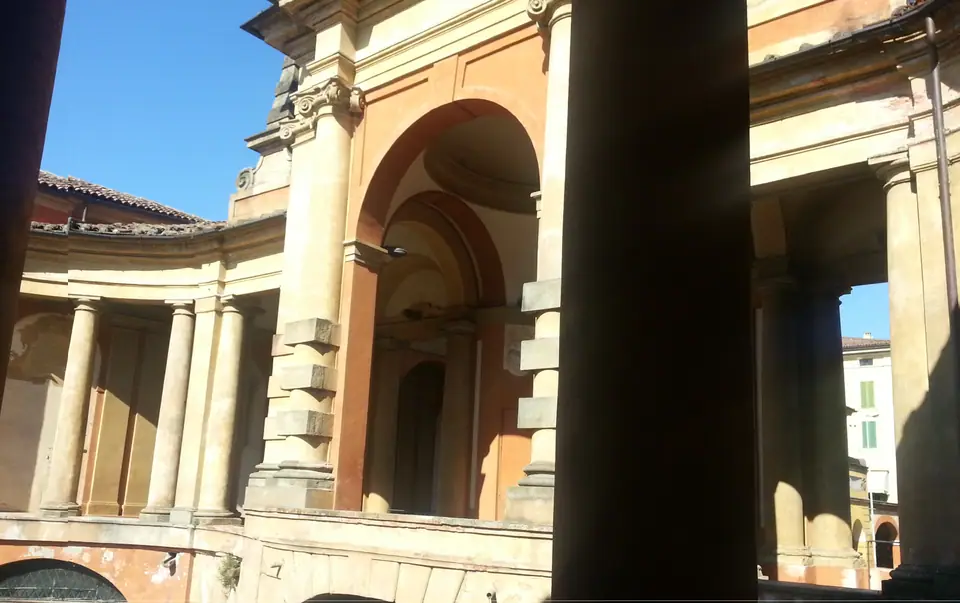
The Certosa di Bologna was founded in 1334 as a Carthusian monastery and suppressed in 1797, and it became the city's public cemetery in 1801. Giorgio Morandi, the poet Giosuè Carducci, the singer Lucio Dalla and the composer Ottorino Respighi are buried there. The third cloister, the chapel cloister, is notable for neoclassical structures with Enlightenment-era symbolism, and the porticoed eastern entrance connects to the route toward San Luca.
Spotting timber and Renaissance capitals in town
Inside the centre, look for the different styles, from early wooden examples to Renaissance and later arcades. They vary in height, width and decoration, and each street has its own character. Walk slowly and look up at the ceilings and capitals, since the details are part of the experience.
Planning the San Luca hill climb
- Go early: The climb is quieter in the morning.
- Use the porticoes in rain: They shelter you almost everywhere in the centre.
- Combine with the views: The sanctuary terrace replaces a tower climb when towers are closed.
- Bring water: There are few shops along the hill section.
After the walk, eat well using our food guide.
Where it is
- 1Porticoes and San Luca
- Bologna Guglielmo Marconi Airport (BLQ) · about 6 km from here in a straight line
- Directions in Google Maps
Stations and taxi ranks: OpenStreetMap. Airports: OurAirports. Distances are in a straight line.
Traveller tips
Real advice from people who have been to Bologna. Every tip is read by our team before it goes live.
No tips yet. Been here? Yours could be the first.
Thank you! Your tip will appear here after a quick review.
More in Bologna
Continue exploring Bologna with related neighbourhood, food, and planning guides