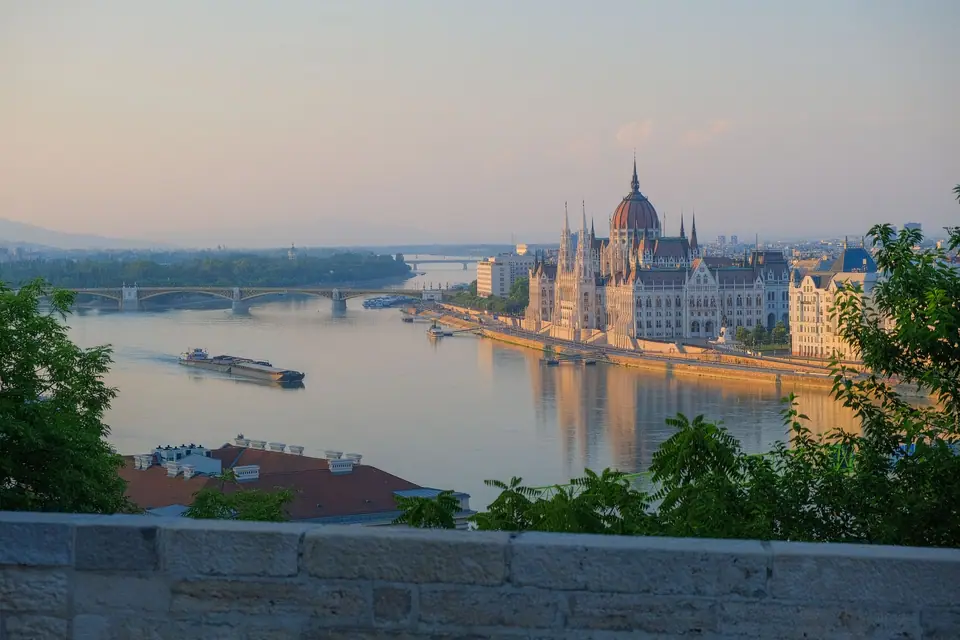
The Hungarian Parliament and the Danube Embankment
Booking the Parliament interior, the Shoes on the Danube memorial, the car-free Chain Bridge and the Pest embankment.
Stretching 268 metres along the Pest bank at Kossuth Lajos tér, the Hungarian Parliament Building (Országház) is the emblem of modern Budapest. Designed by Imre Steindl after London's Palace of Westminster and completed in 1904, it combines a neo-Gothic forest of 365 pinnacles and flying buttresses with a 96-metre Neo-Renaissance central dome, a height matched only by St Stephen's Basilica to mark the year 896 when the Magyars arrived in Hungary.
- Booking an interior tour of Parliament: you can only go inside on an official 45-minute audio-guided or guided tour starting from the underground Visitor Centre at the north end of Kossuth Lajos tér. Same-day tickets at the counter regularly sell out early in the morning, so book your time slot several days or weeks ahead on the official booking portal (jegymester.hu). Bring a passport or national ID card (especially if booking the discounted EU/EEA citizen rate). The route ascends the gold-leaf Grand Staircase to the 16-sided Domed Hall, where the Holy Crown of Hungary with its famously crooked cross is guarded by sword-bearing soldiers; photography is strictly forbidden inside the Domed Hall itself, though allowed in the rest of the tour.
- Kossuth Lajos tér: before or after your tour, walk the traffic-free marble square around the Parliament. On the north side, an underground memorial marks the 25 October 1956 massacre, when unarmed protesters gathered here during the Hungarian Revolution were fired upon from surrounding rooftops.
- Shoes on the Danube Bank (Cipők a Duna-parton): walk 300 metres south along the stone embankment from the Parliament. Sixty pairs of 1940s-style cast-iron men's, women's and children's shoes stand along the water's edge, created by film director Can Togay and sculptor Gyula Pauer to honour the thousands of Budapest Jews who were ordered to remove their valuable shoes on the freezing riverbank before being shot into the Danube by Arrow Cross militiamen in the winter of 1944 and 1945.
- The Széchenyi Chain Bridge (Széchenyi Lánchíd): Budapest's oldest permanent bridge (1849), guarded by four stone lions, reopened after a complete structural restoration as a car-free bridge: private cars are permanently banned, leaving the roadway solely to BKK buses, taxis and cyclists, and the wide outer walkways entirely to pedestrians crossing toward Castle Hill.
- The Danube Promenade (Dunakorzó) and Tram 2: south of the Chain Bridge, a pedestrian esplanade runs between Vigadó tér and Elizabeth Bridge with open views across to Gellért Hill. Running alongside the whole stretch is yellow Tram 2 (from Jászai Mari tér past Parliament and the Chain Bridge down to the Great Market Hall), the most scenic public tram route in Europe.
- Seeing the Parliament lit at night: the golden exterior floodlights switch on at dusk. For the classic straight-on reflection shot across the river, take metro line M2 (red) one stop under the river to Batthyány tér on the Buda bank directly opposite.
Traveller tips
Real advice from people who have been to The Hungarian Parliament and the Danube Embankment. Every tip is read by our team before it goes live.
No tips yet. Been here? Yours could be the first.
Thank you! Your tip will appear here after a quick review.
More in Budapest
Continue exploring Budapest with related neighbourhood, food, and planning guides