Budapest: What to Know Before You Go
Buda vs Pest, forint payments, ticket rules and the practical habits that save money on a first visit.
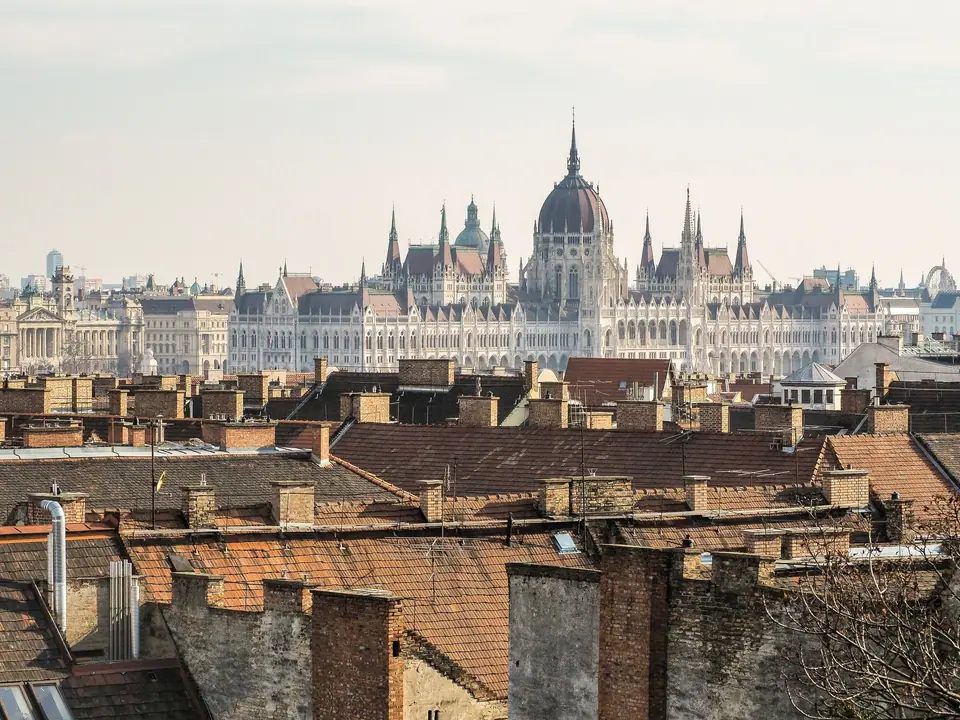
Short answer: think of the Danube as your compass line, pay by contactless card in Hungarian forints rather than euros, validate paper transport tickets before you step onto a tram or metro escalator, and walk the riverbank after dark when the bridges and Parliament are lit.
How Buda and Pest fit together
The Danube flows north to south through the middle of Budapest. On the west bank sits Buda, steep and wooded, where Buda Castle, Fisherman's Bastion and Gellért Hill rise straight above the water. On the east bank lies Pest, flat and built on a grand 19th-century grid of boulevards radiating out from the inner ring (Kiskörút) and the Grand Boulevard (Nagykörút). You will sleep, eat and go out mostly in Pest, and cross the river for hills, viewpoints and Ottoman baths.
Each district has a Roman numeral (written on street signs before the street name, such as V. kerület) and a traditional name: District I is the Castle District, V is the inner city around Parliament and St Stephen's Basilica, VI follows Andrássy Avenue, and VII is the old Jewish Quarter.
Money, forints and ATM traps
Hungary is in the European Union and the Schengen zone, but it uses the Hungarian forint (HUF), not the euro. Many tourist cafés and souvenir stalls quote euro prices or accept euro notes, always at a punishing exchange rate. Pay by card instead, which is accepted by law across Hungary wherever electronic tills exist, from market stalls to bathhouse lockers.
Whenever a card terminal or cash machine asks whether to bill you in your home currency or in HUF, always choose HUF (forints). Avoid blue-and-yellow standalone street ATMs around Váci utca and the ruin bars, which add heavy withdrawal fees and poor conversion mark-ups; if you need cash for tips or coins, use a machine attached to a Hungarian high-street bank such as OTP, K&H or Erste.
Tipping, taxis and common scams
Check the bottom of your restaurant bill before adding a tip. Most sit-down restaurants in central Budapest now include a 10 to 15 percent szervizdíj (service charge) automatically; if it is already listed, you do not need to add more.
Licensed Budapest taxis are yellow and run on a regulated city tariff, but never hail an unmarked or parked cab outside Keleti station or the ruin bars at night. Order through the Bolt app or call a dispatch fleet such as Főtaxi so the route and fare are logged. On public transport, plain-clothes inspectors check tickets at the top and bottom of metro escalators and on trams; a paper single ticket that has not been stamped (or a digital ticket not scanned on the BudapestGO app) triggers an immediate on-the-spot fine.
Language and small customs
Hungarian (magyar) is a Finno-Ugric language unrelated to its neighbours, so street words look unfamiliar at first: utca (street), tér (square), körút (boulevard), híd (bridge) and fürdő (bath). English is widely spoken by younger Hungarians and everywhere in hospitality. Two helpful words are köszönöm (thank you) and egészségedre (cheers). An old local habit persists from the 1848 revolution: Hungarians traditionally do not clink beer glasses, though clinking wine glasses is completely normal.
Traveller tips
Real advice from people who have been to Budapest: What to Know Before You Go. Every tip is read by our team before it goes live.
No tips yet. Been here? Yours could be the first.
Thank you! Your tip will appear here after a quick review.
More in Budapest
Continue exploring Budapest with related neighbourhood, food, and planning guides