Budapest Thermal Baths: Széchenyi, Rudas and How to Choose
Comparing Széchenyi, Rudas, Lukács and Veli Bej, how cabins and wristbands work, and why Gellért is currently closed.
Budapest sits atop a geological fault line where more than a hundred natural thermal springs bubble up every day, rich in calcium, magnesium and sulphates. Bathing here is not a luxury hotel spa ritual; it is an everyday neighbourhood habit inherited from the Romans, the 16th-century Ottomans and the grand Austro-Hungarian bathhouses of the early 1900s.
Is Gellért Thermal Bath open right now?
No. The Art Nouveau Gellért Thermal Bath closed in October 2025 for a major multi-year structural and mechanical restoration (alongside the renovation of the adjoining Gellért Hotel) and is not expected to reopen until at least 2028. Two smaller Ottoman baths, Király and Rác, also remain closed. Choose between Széchenyi, Rudas, Lukács and Veli Bej instead.
Széchenyi vs Rudas: which one should we pick?
If you only visit one bathhouse, choose between these two depending on the atmosphere you want:
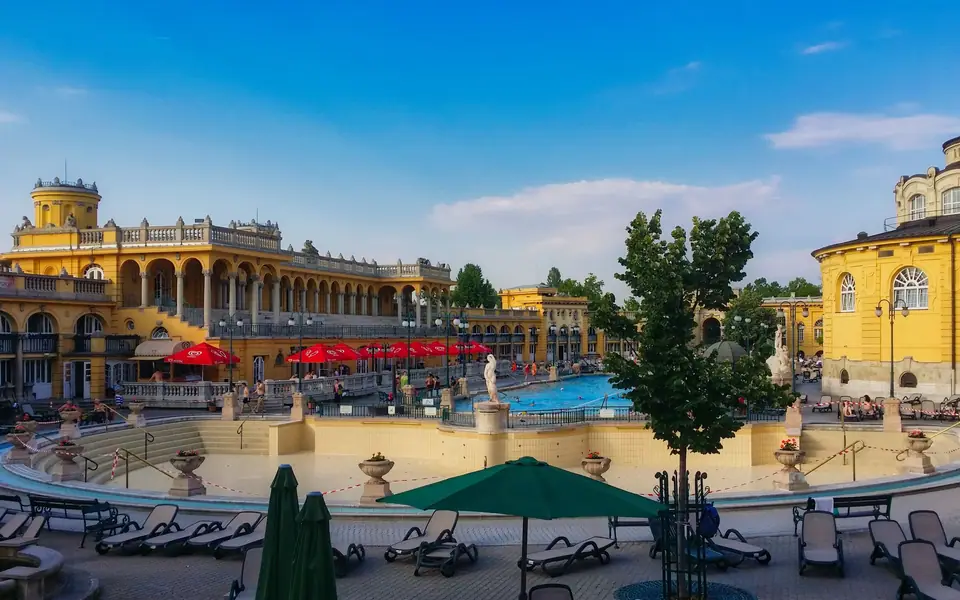
- Széchenyi Thermal Bath (in City Park, metro M1 Széchenyi fürdő): the largest and liveliest, housed in a bright yellow 1913 Neo-Baroque palace. Its centrepiece is three huge open-air pools (a hot sitting pool where locals play chess on stone boards, a warm adventure pool with a circular current and a cooler lap pool requiring a swim cap), plus 15 indoor mineral pools, saunas and steam rooms. It is co-ed every day and unforgettable in winter when steam rises into the cold air.
- Rudas Baths (Buda bank at the foot of Elizabeth Bridge): two eras under one roof. At its core is a dim 1566 Ottoman octagonal pool under a 10-metre dome pierced by coloured glass stars, surrounded by four corner plunge pools of varying temperatures; attached to it is a modern wellness wing topped by a rooftop hot panorama tub overlooking the Danube. Check the schedule carefully: the wellness wing and rooftop tub are co-ed daily, while the Turkish bath has single-sex sessions on certain weekdays and becomes co-ed on weekends and during Friday and Saturday late-night bathing.
What about quieter local alternatives?
If Széchenyi and Rudas feel too busy, head slightly north on the Buda bank:
- Szent Lukács Baths (Frankel Leó út 25 to 29): a 19th-century medicinal bath favoured by Budapest writers and retirees, with outdoor swimming and whirlpool baths, indoor thermal pools and far fewer tourists.
- Irgalmasok Veli Bej Bath (Árpád fejedelem útja 7, next to Lukács): a restored 16th-century five-pool Ottoman bath inside a hospital courtyard, with capped visitor numbers in three-hour afternoon and evening sessions.
- Palatinus Strand (on Margaret Island): best in summer for its outdoor Bauhaus wave pool and lawns, with a smaller thermal section open year-round.
How do lockers, cabins and wristbands work?
When buying a ticket, choose between a locker (szekrény) in a shared changing room or a private cabin (kabin), a tiny wooden cubicle where you both change and lock your clothes. A waterproof magnetic wristband locks and unlocks your cabin or locker. Pack flip-flops, a towel and a swim cap (full checklist in what to wear in Budapest), arrive within the first hour of opening, and remove silver jewellery before entering sulphur-rich pools.
Traveller tips
Real advice from people who have been to Budapest Thermal Baths: Széchenyi, Rudas and How to Choose. Every tip is read by our team before it goes live.
No tips yet. Been here? Yours could be the first.
Thank you! Your tip will appear here after a quick review.
More in Budapest
Continue exploring Budapest with related neighbourhood, food, and planning guides