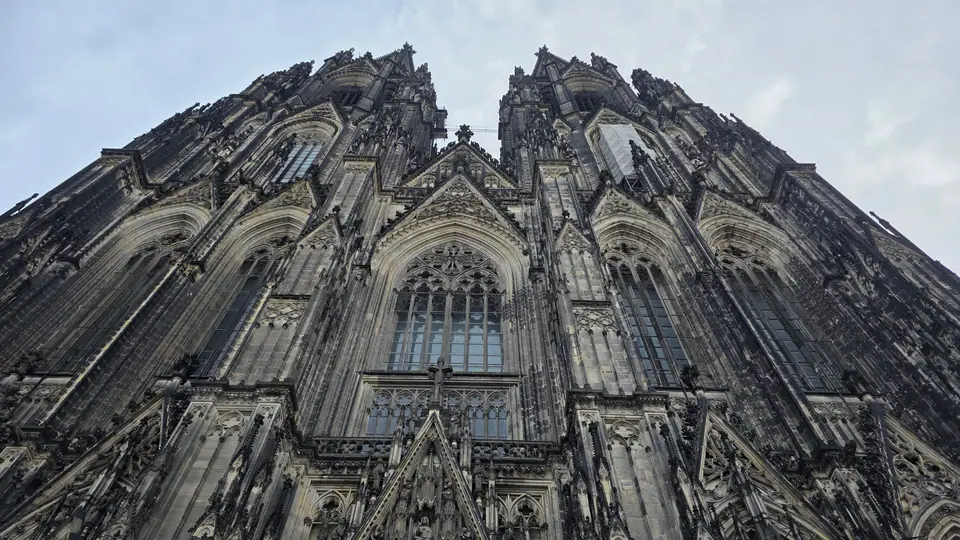
Photo: Yair-haklai · CC BY-SA 4.0
The Dom Across Six Centuries of Black Sandstone
A chronological history of Cologne Cathedral from its 1248 foundation and crane skyline pause to 1880 completion, relics, and Richter window.
Nothing in central Cologne escapes the vertical draw of the Hohe Domkirche St. Petrus, known universally as the Dom. Rising 157 metres high directly beside railway platforms, its dark twin spires anchor every bend of the Rhine for kilometres. The church spans 144.58 metres in length and 86.25 metres across the transepts, welcoming roughly 6 million visitors each year. Yet this monument is neither purely medieval nor solely modern. Instead, it represents a 632-year relay joining French High Gothic masonry with Prussian engineering.
1164 to 1322: Relics Demand a Gothic Sanctuary
Cologne's grandest church owes its massive scale to twelfth-century relic politics rather than simple civic pride. Earlier Carolingian walls of Hildebold Cathedral had occupied this ridge since the 9th century. In 1164, Archbishop Rainald von Dassel brought bones attributed to the Three Wise Men from Milan. That political triumph elevated Cologne immediately into a major northern European pilgrimage seat beside Rome and Santiago de Compostela.
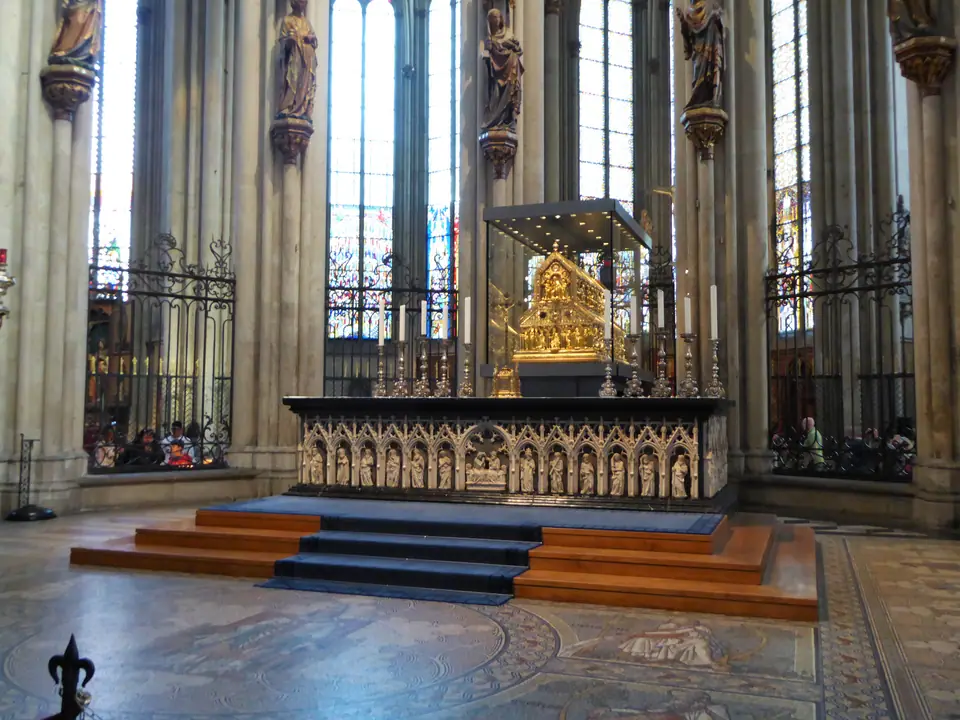
Goldsmith Nicholas of Verdun spent decades crafting the gilded Shrine of the Three Kings (1180 to 1225), measuring 220 centimetres long, 110 centimetres wide, and 153 centimetres high. To house it fittingly, Master Mason Gerhard von Rile laid foundation stones on 15 August 1248 in luminous French opus francigenum style. Builders raised the soaring eastern choir initially and consecrated its high altar on 27 September 1322. Progress slowed sharply afterward as donations dropped and municipal feuds drained funds.
1520 to 1842: The Silent Centuries and Wooden Crane
After around 1510 or 1520, major stonework slowed dramatically before halting around 1560. That three-century stall forged an unmistakable skyline across northern Europe. A tall vaulted choir stood isolated on the east flank beside a low south-tower stump holding an idle wooden treadwheel crane. Generations of Rhineland drawings celebrated that resting crane silhouette like a municipal landmark.
Decay accelerated when French Revolutionary forces entered Cologne in 1794 and converted the unroofed nave into a military hay store. Rescue seemed doubtful until Romantic scholar Sulpiz Boisserée rallied German princes and citizens alike. Fortunately, surviving sections of original fourteenth-century facade parchment drawings (Plan F) surfaced in Darmstadt and Paris. Those rolls gave restoration teams genuine Gothic proportions rather than guesswork.
1842 to 1880: Finishing Medieval Blueprints with Iron
Prussian King Friedrich Wilhelm IV laid the completion foundation stone in 1842. Architect Ernst Friedrich Zwirner led four intense decades of stonecutting straight from medieval Plan F geometry. Hidden above delicate Gothic vaults, however, Prussian engineers installed concealed cast-iron roof trusses to shed weight and prevent fire. Emperor Wilhelm I presided over the formal opening on 15 October 1880, closing 632 years since work began.
Upon inauguration in 1880, the completed Dom briefly stood as the tallest structure in the world. The Washington Monument surpassed its 157.38-metre north spire and 157.22-metre south spire four years later in 1884, leaving Cologne with the tallest twin-spired Gothic church facade. Bahnhofsvorplatz arrivals still step straight beneath stone quarried across six Rhineland and German geology zones. Medieval masons cut porous Siebengebirge Drachenfels trachyte, while nineteenth-century repair yards added Schlaitdorfer, Obernkirchner, and Udelfanger sandstones, Londorf basalt lava, and Stenzelberg latite. Coal smoke, industrial soot, and railway steam next to Köln Hauptbahnhof blackened those pale blocks over generations. Today, dozens of stonemasons inside the cathedral's Dombauhütte workshop continuously carve replacement pinnacles above passing crowds. Rhine winds, winter frost, and damp air wear soft sandstone edges faster than hard granite. White tarpaulins frequently shield active scaffolding cages while trained craftspeople graft fresh quarry blocks onto weathered medieval tracery.
A cathedral paused for three centuries and topped with iron roof trusses looks unified precisely because nineteenth-century masons submitted quietly to fourteenth-century parchment drawings.
Treasures, 533 Steps and Contemporary Light
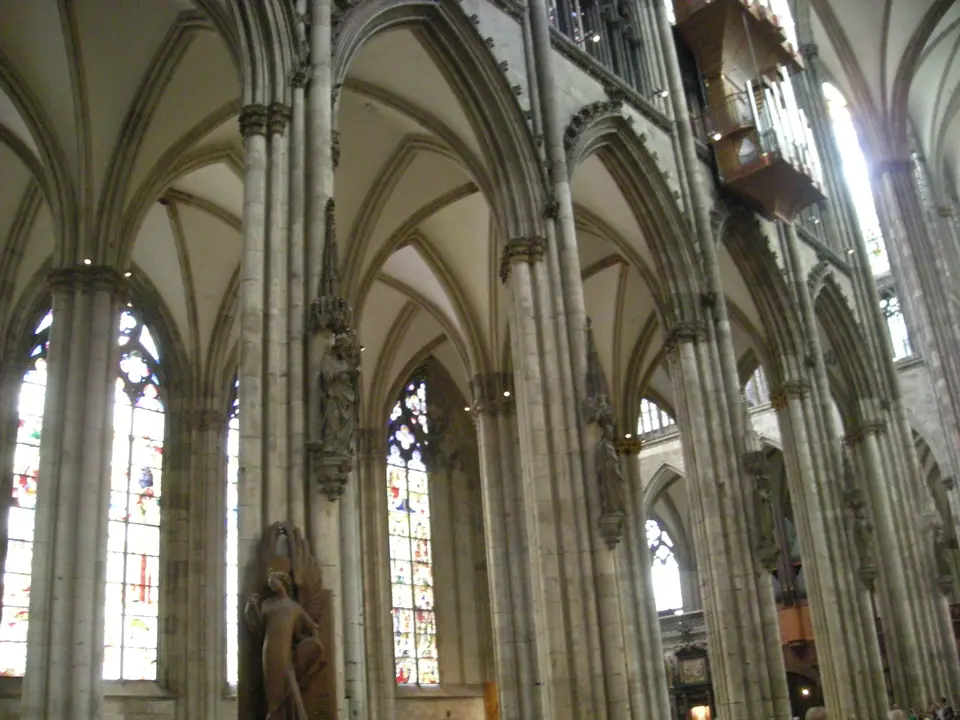
Walking beneath the 43.35-metre central nave vaults rewards slow attention well past the crowded west porch. Behind the high altar gleams the three-tiered Shrine of the Three Kings. Inside the northern Chapel of the Cross hangs the expressive oak Gero Crucifix (carved around AD 970), the oldest surviving monumental wooden crucifix north of the Alps. Descend beneath the north aisle into the subterranean vaulted Domschatzkammer treasury. Cool stone chambers safeguard illuminated liturgical manuscripts, bishop crosiers, medieval silver reliquaries, and ecclesiastical vestments spanning the 4th through 20th centuries.
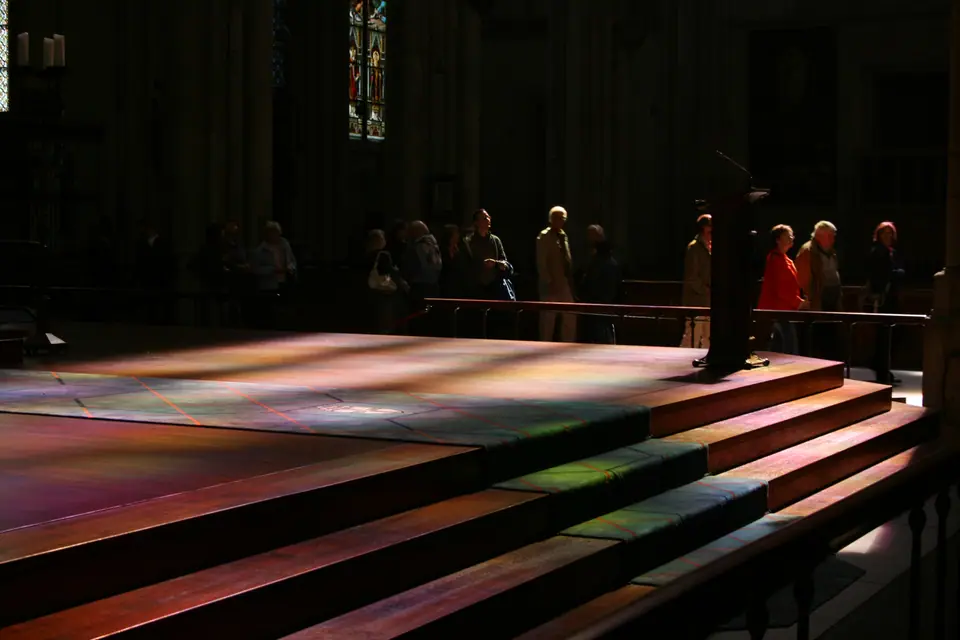
Look high into the south transept for painter Gerhard Richter's luminous stained-glass window unveiled in August 2007. Funded entirely through public donations, its contemporary grid spans roughly 106 square metres (113 square metres inside its stone tracery). A computer algorithm randomised 11,263 mouth-blown glass squares across 72 historic shades, casting shifting pools of coloured light across limestone piers each bright afternoon.
Steady legs tackle the narrow spiral staircase winding inside the South Tower without any lift. Climbing all 533 steps leads past heavy belfry timbers cradling the 24-tonne Petersglocke bell (nicknamed Dicker Pitter, cast in 1923) to a viewing deck between 97 and 100 metres up. Heavy timber bell frames fill the upper chamber before tight metal stairs reach the open perimeter walkway. Back outside, explore Cologne's 12 great Romanesque basilicae, or inspect how the Dom survived 14 direct bomb strikes between 1942 and 1945. UNESCO inscribed the monument in 1996 (reference 292), then moved it onto the List of World Heritage in Danger from 2004 to 2006 over Deutz high-rise plans. Cologne stood as the sole Western European cultural site listed then until skyline height limits held. Municipal height rules subsequently protected riverside sightlines from Deutz across toward the western spires. Even today, the Cathedral Chapter confronts tough history openly, commissioning a 2025 artistic response addressing historic antisemitic motifs along medieval choir stalls.
Where it is
- 1The Dom Across Six Centuries of Black Sandstone
- Cologne Bonn Airport (CGN) · about 15 km from here in a straight line
- Directions in Google Maps
Stations and taxi ranks: OpenStreetMap. Airports: OurAirports. Distances are in a straight line.
Traveller tips
Real advice from people who have been to Cologne. Every tip is read by our team before it goes live.
No tips yet. Been here? Yours could be the first.
Thank you! Your tip will appear here after a quick review.
More in Cologne
Continue exploring Cologne with related neighbourhood, food, and planning guides