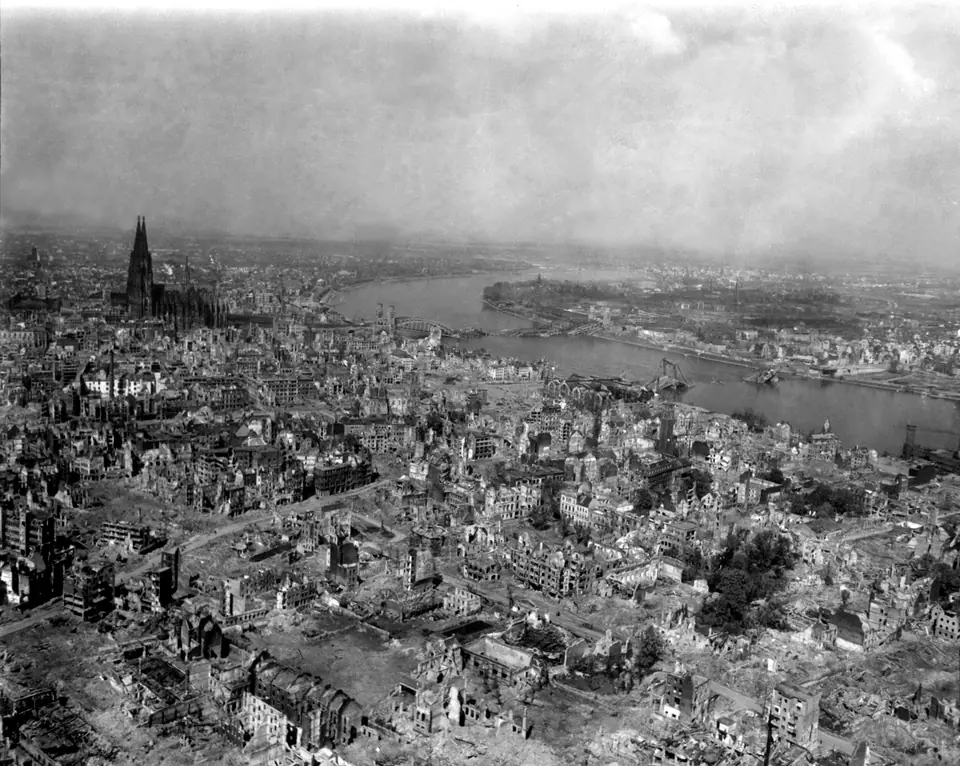
Photo: T4c. Jack Clemmer · Public domain
May 1942 and the Post-War Rebuild of Cologne
How Operation Millennium reshaped Cologne in 1942, Rudolf Schwarz's post-war master plan, and how Zumthor and Riphahn blended ruins with modern civic rooms.
Travellers puzzled by plain five-storey beige blocks beside twelfth-century church portals often assume post-war builders brushed heritage aside carelessly. In reality, municipal architects stared at near-total ruin in 1945 and reached a clear civic decision. Instead of carving monumental expressways over cleared stone, city leaders respected ancient Roman and medieval street parcels. They rebuilt honest brick, stone, and concrete blocks directly above battered historic foundations.
1942 to 1945: Operation Millennium and Wartime Ruin
Operation Millennium and 262 Air Raids
Allied bombers changed Cologne forever on 30 to 31 May 1942. Under Operation Millennium, Royal Air Force Bomber Command sent 1,046 heavy aircraft in the war's first 1,000-bomber strike. Within 75 to 90 minutes, aircrews dropped 1,455 tons of bombs across crowded central quarters. That single night killed 486 civilians, destroyed over 5,000 buildings, and left roughly 59,000 residents homeless.
That assault launched 262 cumulative air raids lasting into March 1945. Roughly 90 percent of the inner core and 61 percent of total urban built space lay wrecked. Wartime evacuation reduced remaining residents by over 90 percent, cutting a pre-war population near 750,000 down to roughly 40,000 or 50,000 people inside ruined blocks. When American units entered the left bank on 6 March 1945, German soldiers blew up the Hohenzollern Bridge behind them, dropping heavy iron arches straight into the Rhine current.
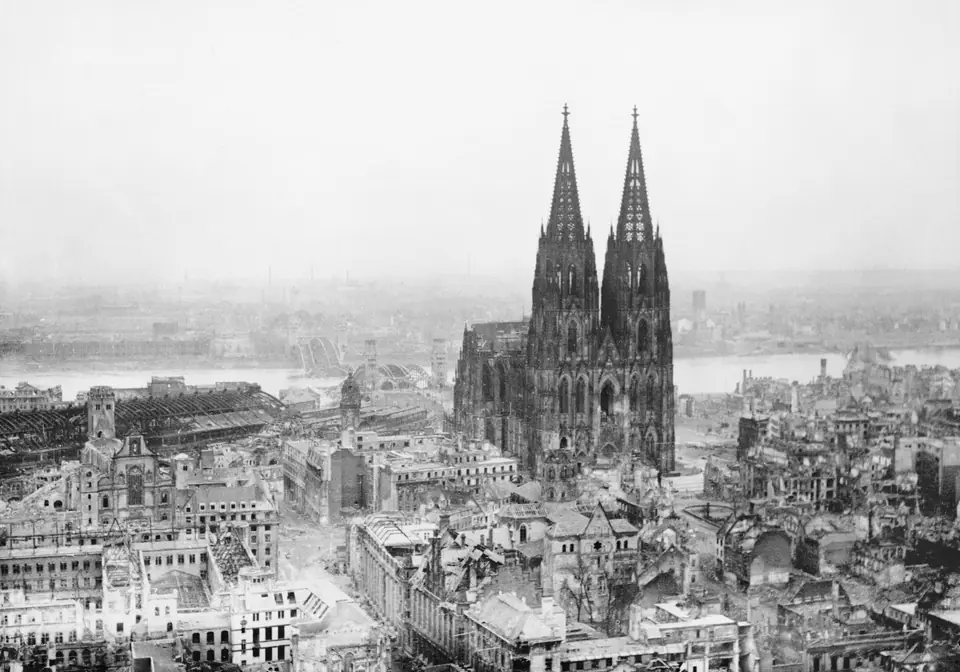
Why the Cathedral Survived Fourteen Direct Hits
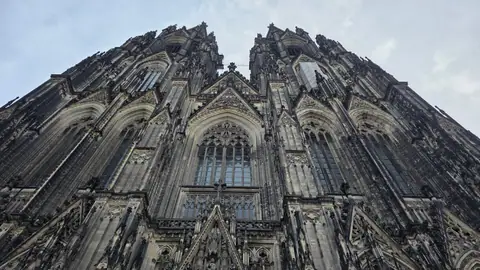
Cologne Cathedral stood upright above flattened approaches in March 1945. Heavy Gothic piers, allied flight orientation, and constant masonry repair saved the Dom from total collapse. Bombers struck the church with 14 heavy aerial bombs plus scores of minor hits and persistent artillery shells. Yet its 157-metre twin spires doubled as clear daytime Rhine navigation landmarks, while wartime crews packed emergency brick piers beneath damaged northern ribs before stone vaults dropped.
Rudolf Schwarz, Modest Brick and Memorial Continuity
The 1947 Schwarz Plan
Chief reconstruction planner Rudolf Schwarz faced an apocalyptic wasteland in 1945. Surveying the broken lanes, he famously termed Cologne the world's greatest heap of rubble. Appointed to head Cologne's Reconstruction Office (Wiederaufbauamt) from 1946 to 1950, Schwarz rejected two tempting extremes. He opposed plans to wipe out medieval parcels under a sprawling American-style car grid, and refused counterfeit historical stucco gables. Preserving broken plot boundaries allowed displaced households, modest workshops, and independent trades to return straight onto familiar street corners.
Instead, his Doppelstadt and "growing grid" framework treated Roman and medieval property lines as carriers of urban memory. Engineers routed wider ring arteries such as Nord-Süd-Fahrt around sensitive precincts while preserving Schildergasse and Hohe Straße for walking. Keeping family parcels intact let small shops, bakeries, and parish squares return to old corners. Builders lined narrow streets with disciplined five-storey travertine, limestone, and brick facades beneath modest pitched roofs. Height limits held steady around Domplatte so Cathedral spires stayed supreme, producing a coherent 1950s architectural fabric matched rarely outside central Berlin or parts of Dresden. Modest cornice heights ensured the Dom spires anchored every approach from riverside walks.
Gürzenich, Oper Köln and Cultural Recovery
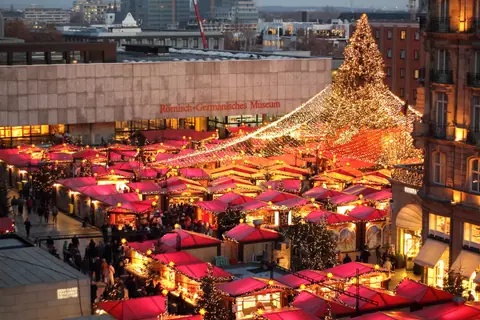
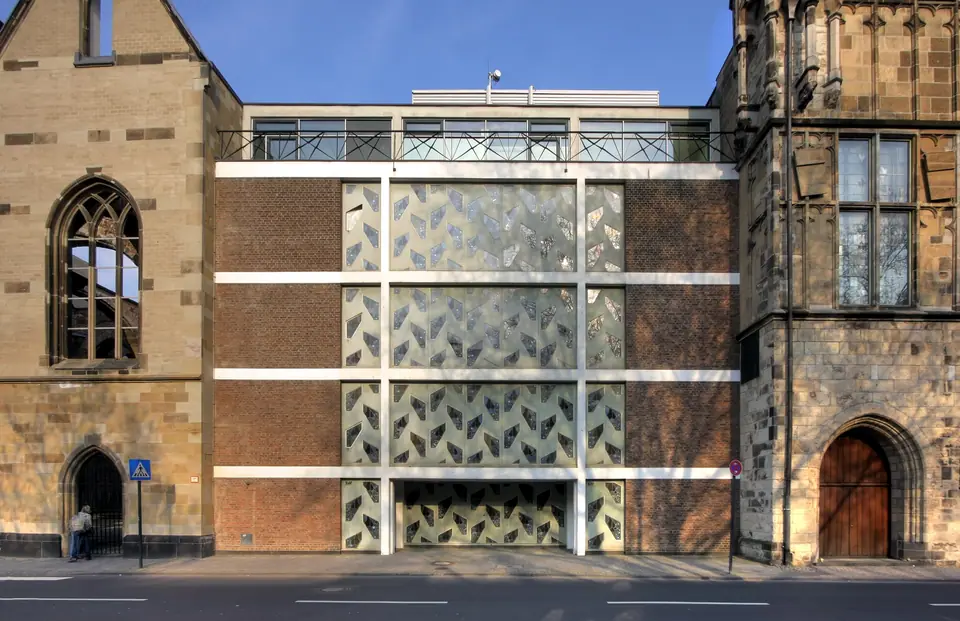
Quatermarkt south of the Cathedral shows that post-war ethos in raw brick and glass. Working from 1952 to 1955, Schwarz and partner Karl Band reopened the civic Gürzenich festival hall by cradling crisp staircases inside blackened fifteenth-century walls. Right beside it, planners kept the shattered shell of Alt St Alban open to the sky as an enduring war memorial. Leaving fractured stone exposed honours civilian memory beside lively public gatherings inside the hall.
Inside those roofless nave walls sits Cologne's quietest post-war sculpture. Between 1953 and 1954, sculptor Ewald Mataré directed master students Erwin Heerich (carving the mother) and Joseph Beuys (carving the father). Working in pale shell limestone, they executed an enlarged copy of Käthe Kollwitz's The Mourning Parents, formally dedicated there in 1959. Nearby, Schwarz and Josef Bernard built the brick-and-limestone Wallraf-Richartz pavilion opening in 1957, now housing Cologne's Applied Arts Museum (MAKK).
West at Offenbachplatz, modernist architect Wilhelm Riphahn unveiled his landmark Oper Köln and Schauspielhaus theatre complex between 1957 and 1962. Sculpted concrete roofs and warm timber lobbies joined Köln Hbf's 23 September 1957 reception concourse in modernising civic life. Rail travellers had already regained pedestrian access across Hohenzollern Bridge on 8 May 1948, ahead of full six-track rail restoration in 1959. After a protracted fourteen-year technical renovation, Riphahn's restored auditorium welcomed opera audiences back in September 2026. Complex technical upgrades slowed municipal schedules at Offenbachplatz for years before final safety checks cleared full public staging. Walkers circling the square inspect Riphahn's crisp post-war concrete lines freshly returned to regular civic duty.
St Marien and Zumthor's Kolumba
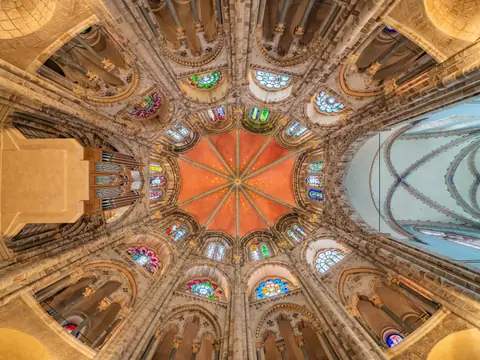
Sacred architects refused to hide wartime wounds under tidy plaster. Rebuilding St Marien from 1950 onward, Rudolf Schwarz preserved damaged brick outer walls standing cleanly in place. Inside, he lifted slim 17-metre steel columns beneath a clear glass clerestory separating medieval masonry from post-war construction. That slender glass band marks exactly where battered medieval brick ends and contemporary engineering begins. Gottfried Böhm similarly tucked his delicate 1950 octagon chapel, Madonna in the Ruins, amidst fractured St Kolumba walls.
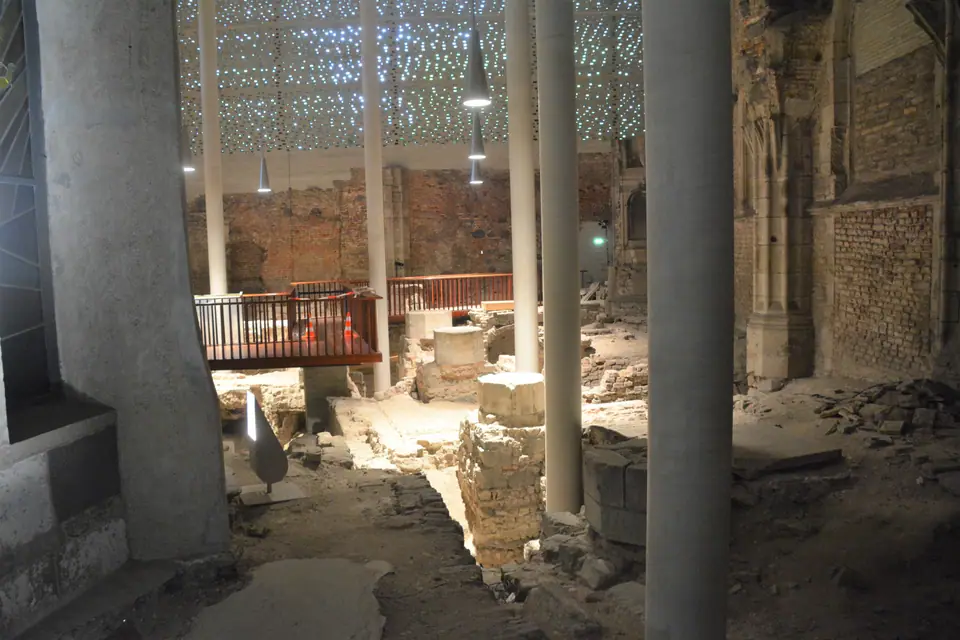
Half a century later, Swiss architect Peter Zumthor enclosed that ruin courtyard under one silent roof. Opened on 15 September 2007, Kolumba weaves long-fired pale grey Danish bricks directly over late-Gothic stone tracery. Slim concrete piers float silent daylight galleries high above excavated Roman lanes. Calm natural light enters gently through perforated brickwork onto quiet rooms rising above dark rubble fragments. Walking its floors connects daily shopping avenues seamlessly with Cologne's 12 great Romanesque basilicae, whose careful post-war recovery ended in the 1990s at St Kunibert.
Where it is
- 1May 1942 and the Post-War Rebuild of Cologne
- Cologne Bonn Airport (CGN) · about 16 km from here in a straight line
- Directions in Google Maps
Stations and taxi ranks: OpenStreetMap. Airports: OurAirports. Distances are in a straight line.
Traveller tips
Real advice from people who have been to Cologne. Every tip is read by our team before it goes live.
No tips yet. Been here? Yours could be the first.
Thank you! Your tip will appear here after a quick review.
More in Cologne
Continue exploring Cologne with related neighbourhood, food, and planning guides