Photo: Detlef Huhn · CC BY-SA 4.0
South Along the Rhine to Beethoven's Bonn
A seamless rail excursion south from Cologne to Bonn covering Beethoven-Haus, Bonn Minster, Poppelsdorfer Schloss, and Museum Mile along the Rhine.
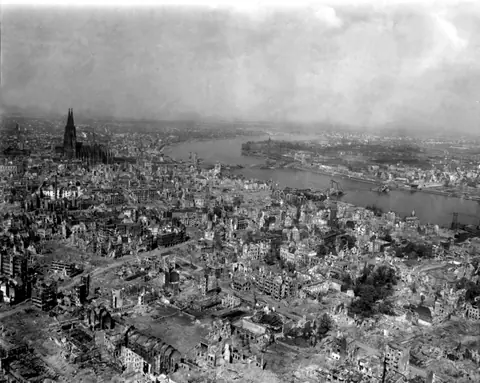
Roughly 24 to 30 kilometres south-southeast along the broad Rhine plain sits Bonn, anchored where open valley meadows meet the volcanic Siebengebirge hills. Home to 323,587 residents across 141.06 square kilometres, roughly three-quarters of the municipal footprint lies on the Rhine's left bank. Cologne Bonn Airport stands just 16 kilometres to the north-east. Across the east bank, wooded volcanic ridges frame open valley trails and riverside meadows. Where Allied raids pushed central Cologne toward disciplined post-war brick, Bonn kept continuous baroque plaster facades, shaded nineteenth-century avenues, and leafy student squares. Compact central lanes let visitors loop smoothly between medieval cloisters, park lawns, and museums without a car.
Getting South: Regional Express vs Slow Tram
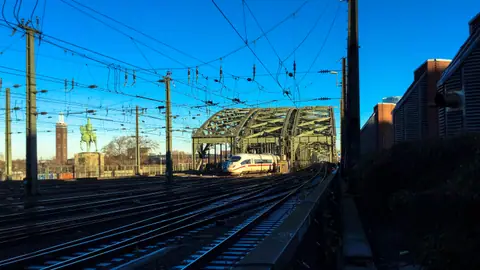
Boarding an RE5 (Rhein-Express) or RB26 (MittelrheinBahn) train at Köln Hauptbahnhof puts you in Bonn Hauptbahnhof within 20 to 25 minutes. Express trains hug the left bank past Köln Süd (also served by RB48) and Brühl with zero station transfers. Trains roll past quiet Rhineland suburbs before pulling straight into Bonn's accessible historic rail concourse. Exiting onto the forecourt places walkers right beside traffic-free squares without lengthy underground passages. Travellers preferring ground-level town scenery can board joint KVB and SWB Stadtbahn Line 16 (Rheinuferbahn) or Line 18 (Vorgebirgsbahn) beneath Dom/Hbf or Neumarkt. Light-rail trams take 50 to 60 minutes, tracking river villages through Wesseling or rolling inland past Brühl and Augustusburg Palace.
Line 16 continues cleanly beyond Bonn Hauptbahnhof straight to Heussallee / Museumsmeile and Bad Godesberg, sparing museum visitors an extra platform change. Both regional railways and interurban trams share the VRS tariff zone. Open the eezy.nrw smartphone app, check in before boarding, and swipe out upon exit to pay strictly by straight-line air distance. Valid Deutschlandticket passes cover every corridor automatically without zone maps. Check our Cologne rail and transit briefing before stepping onto the platform.
Altbau Streets and Beethoven's Birthplace
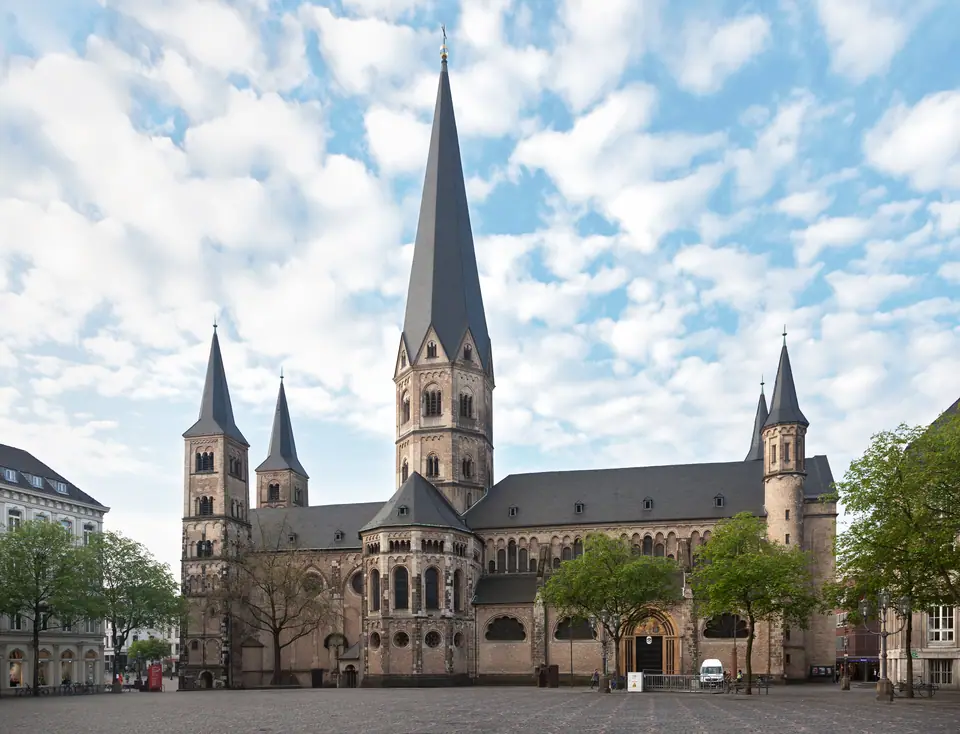
Bonn displays continuous pre-war street scale steps outside its station concourse, contrasting plainly with Cologne's post-war commercial rows. Immediately north rises the eleventh-to-thirteenth-century Bonn Minster (Bonner Münster, thoroughly restored between 2017 and 2021). Five Rhenish Romanesque towers and a peaceful vaulted stone cloister anchor pedestrian Münsterplatz beside an 1845 bronze statue honouring composer Ludwig van Beethoven. Soft daylight filters cleanly across sandstone arcades sheltering its inner garden lawn from market traffic.
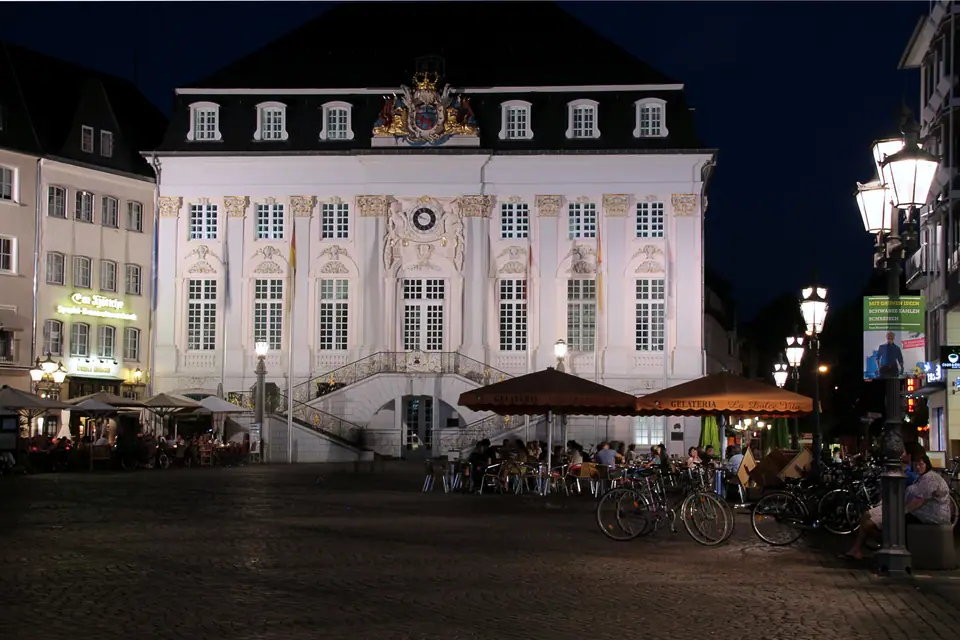
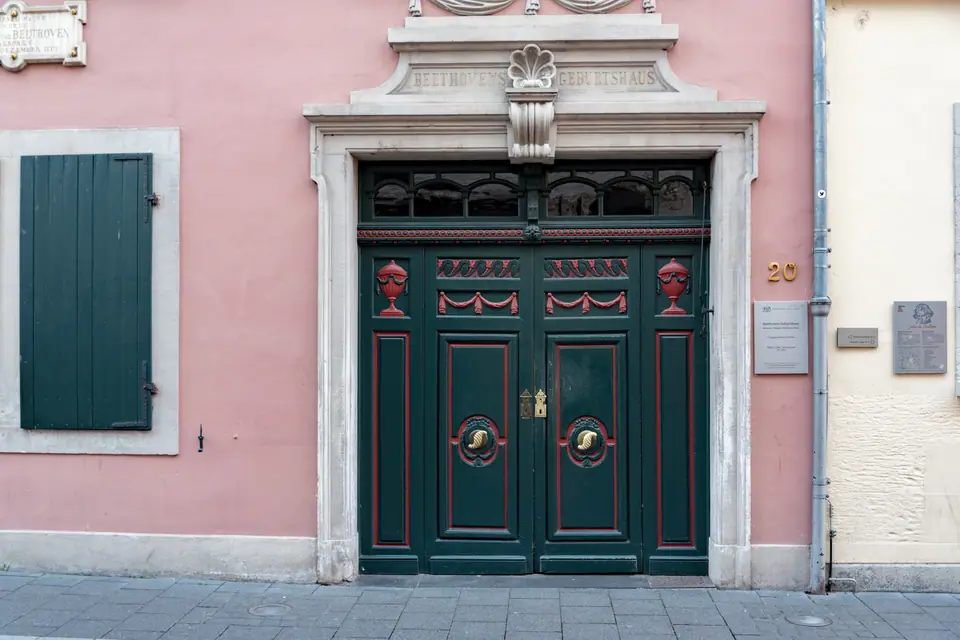
Stroll two pedestrian blocks northeast past outdoor fruit stalls onto triangular Marktplatz. There, the rose-pink Rococo facade and curved double stairs of the Altes Rathaus (built between 1737 and 1782) frame civic squares above cobbles. Morning market awnings fill cobbles directly below the painted stairway on active weekday mornings. Turn north into narrow Bonngasse to enter Beethoven-Haus at number 20, roughly 10 minutes on foot from Bonn Hbf. Born and baptised here on 17 December 1770 before departing for Vienna in 1792, Beethoven lives on inside modest rooms preserving original scores, family portraits, brass ear trumpets, and his final Broadwood grand piano. Small townhouse galleries recall early Rhineland musical roots well ahead of his mature Vienna career.
Poppelsdorf Avenue and West Germany's Former Capital
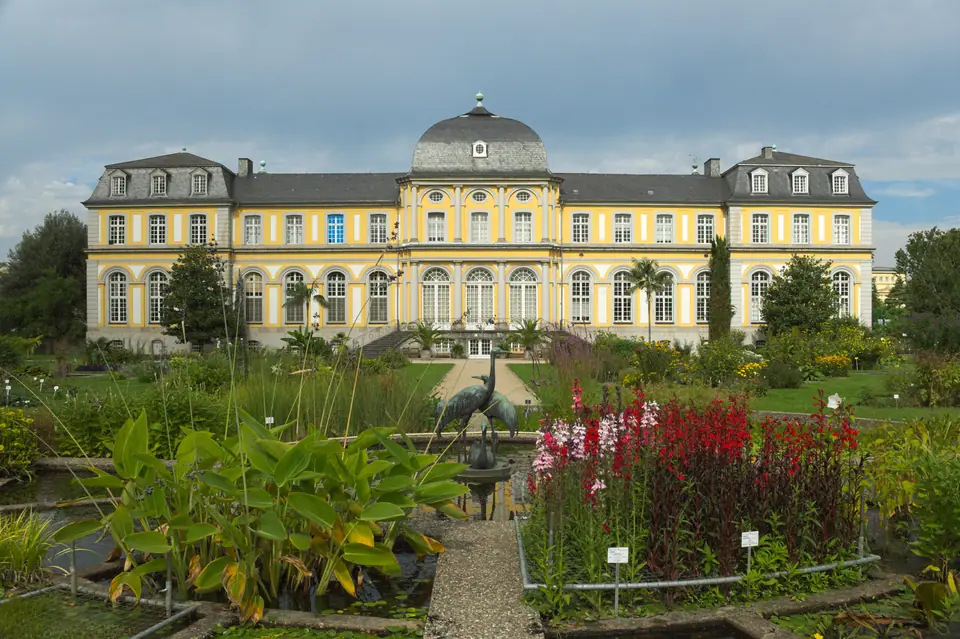
Southwest behind Bonn's railway tracks stretches Poppelsdorfer Allee, a wide chestnut-lined avenue laid out for Cologne's prince-electors. Its green axis joins their sprawling yellow Electoral Palace (now the University of Bonn's main building) straight to the garden retreat at Poppelsdorfer Schloss. Encircling that palace's round colonnaded courtyard spread warm glasshouses and lily pools across Bonn University's peaceful Botanical Gardens. Student cyclists coast under leafy branches toward manicured flowerbeds framing the baroque garden wings.
South in Gronau, Bonn shifts gracefully into twentieth-century German democratic history wrapped inside open park paths. Designated provisional capital of West Germany in 1949, Bonn held that capital status for 41 years until reunification in 1990. Active federal ministries and parliament stayed put for 50 years altogether until moving to Berlin in 1999. Today, the riverside Bundesviertel anchors Museum Mile (Museumsmeile) around Heussallee. Explore free post-1945 German history inside the Haus der Geschichte (opened 1994), stroll through Gustav Peichl's June 1992 Bundeskunsthalle, or visit modern rooms at Kunstmuseum Bonn. Exhibition halls inside Haus der Geschichte trace post-war democracy without admission fees, while walkways connect Bundeskunsthalle cleanly with Kunstmuseum Bonn. Behind them rises the 115-metre Langer Eugen tower (built in 1969 for Bundestag deputies, housing United Nations offices since 2006) beside broad lawns facing the Siebengebirge hills.
One-Day Sequence Through Bonn
- Morning RE5 or RB26 departure: Leave Köln Hbf early and exit Bonn station south-west onto Poppelsdorfer Allee. Walk down to Poppelsdorfer Schloss and stroll past the Botanical Gardens pools before midday groups arrive.
- Late-morning Old Town circuit: Stroll north past Hofgarten lawns onto pedestrian Münsterplatz. Step inside Bonn Minster's quiet sandstone cloister and cross triangular Marktplatz below the rose-pink Rococo Altes Rathaus stairs.
- Midday visit to Beethoven-Haus: Enter Bonngasse 20 to examine handwritten scores, family portraits, and hearing instruments inside his townhouse birthplace. Pause for lunch along nearby Sternstraße or Marktplatz afterward.
- Afternoon south along Museum Mile: Ride Stadtbahn Line 16, 63, or 66 south from Bonn Hbf to Heussallee/Museumsmeile. Explore free German history exhibitions inside Haus der Geschichte, changing shows at Bundeskunsthalle, or modern collections inside Kunstmuseum Bonn.
- River return toward Cologne: Walk east past Langer Eugen and the UN Campus onto shaded Rhine walkways facing the Siebengebirge hills. Ride direct Line 16 north to Südstadt, or board RE5 at Bonn UN Campus toward central Cologne. Travellers heading south to Frankfurt should verify Monday gallery closures on bonn.de and hdg.de beforehand.
Where it is
- 1South Along the Rhine to Beethoven's Bonn
- Cologne Bonn Airport (CGN) · about 15 km from here in a straight line
- Directions in Google Maps
Stations and taxi ranks: OpenStreetMap. Airports: OurAirports. Distances are in a straight line.
Traveller tips
Real advice from people who have been to Cologne. Every tip is read by our team before it goes live.
No tips yet. Been here? Yours could be the first.
Thank you! Your tip will appear here after a quick review.
More in Cologne
Continue exploring Cologne with related neighbourhood, food, and planning guides