Photo: T meltzer · CC BY-SA 4.0
Twelve Romanesque Basilicae Above Colonia Claudia
Inside Cologne's twelve Romanesque churches and Roman foundations, including St Gereon, St Maria im Kapitol, and RGM interim galleries at Belgisches Haus.
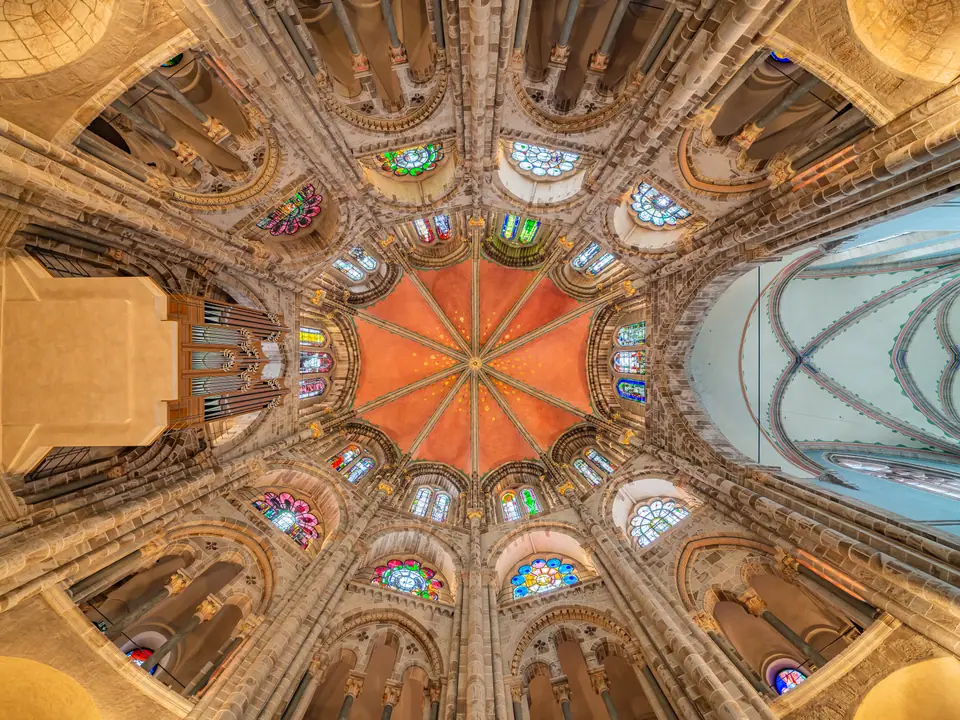
Overshadowed by the Dom's blackened spires, Cologne shelters an unmatched urban constellation of medieval Romanesque masonry. Forming a protective arc inside the old city wall line stand 12 great Romanesque basilicae built or expanded between the 10th and 13th centuries. Many rest atop 4th-to-7th-century late-antique or Merovingian burial sites directly outside Roman walls, reusing cut tuff and tile quarried from temples, bathhouses, and roadside tombs of Colonia Claudia Ara Agrippinensium.
Roman Colonia and Belgisches Haus Interim Galleries
Beneath modern shopping streets, Roman geometry still governs medieval church footprints. Granted full Roman colony status in AD 50, stone ramparts enclosed roughly 1 square kilometre framed by 9 gates and perimeter towers. Visible remnants dot central lanes today, from the riverside Ubiermonument bastion (around AD 4 or 5) to paved Roman Hafenstraße stones beneath Roncalliplatz. Those worn slabs once carried carts hauling amphorae from ancient river quays uphill toward civic forums. Trace northwestern wall mosaics along Burgmauer at the Römerturm. Or pause beside Alter Markt above the Roman governor's Praetorium and medieval Jewish quarter, where MiQua celebrated topping-out in May 2025 toward late-2028 handover and 2029 public opening.
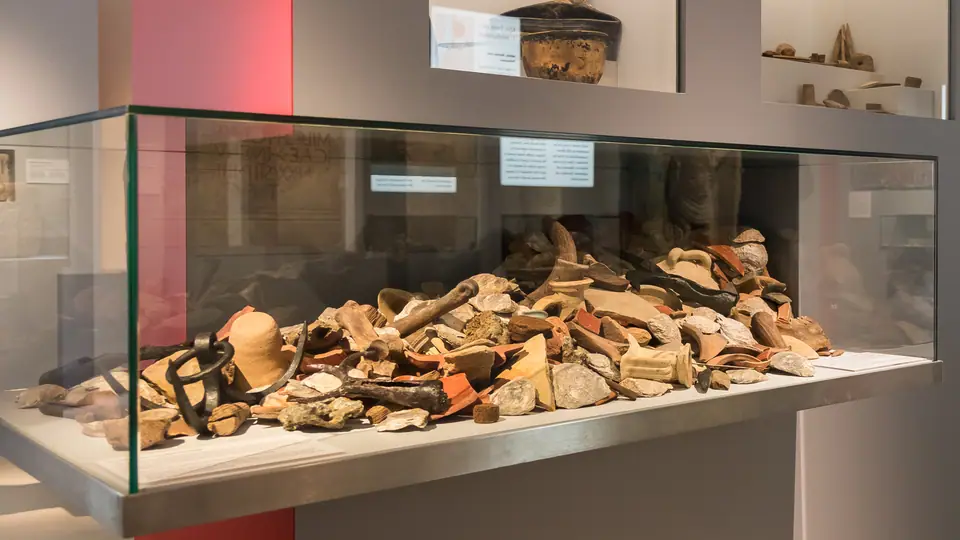
For Roman daily artefacts, walk directly to Belgisches Haus at Cäcilienstraße 46 near Neumarkt. The main 1974 Römisch-Germanisches Museum (RGM) beside the Cathedral closed in 2019 for structural refurbishment running into 2030. Curators exhibit portable highlights inside this clean 1950s pavilion instead. Opened in February 1950 as post-war Germany's first foreign cultural centre, its bright rooms showcase famous Roman glassware including fragile diatreta cage cups, everyday civic bronzes, early Frankish finds, and prehistoric collections. Immovable monuments at Roncalliplatz (the 3rd-century Dionysus Mosaic and 14.7-metre Tomb of Lucius Poblicius, built around AD 40 for a Fifth Legion veteran) stay safely sealed on site during restoration. Always confirm current Belgisches Haus opening dates on official RGM listings beforehand, since municipal museum schedules shift periodically as main-hall refurbishment progresses.
Four Signature Romanesque Basilicae
St Gereon: Decagon Above a Late-Roman Rotunda
St Gereon breaks sharply with standard Latin-cross layouts. Builders added an 11th-century choir and 12th-century twin towers to a 4th-century (350 to 365) oval Roman martyr mausoleum before lifting the central dome. Between 1219 and 1227, masons raised a daring 10-sided vault climbing 34 metres high across four gallery levels. That remarkable stone span bridges Hagia Sophia and Florence Cathedral in structural ambition.
St Maria im Kapitol: Three Apses on the Roman Capitol
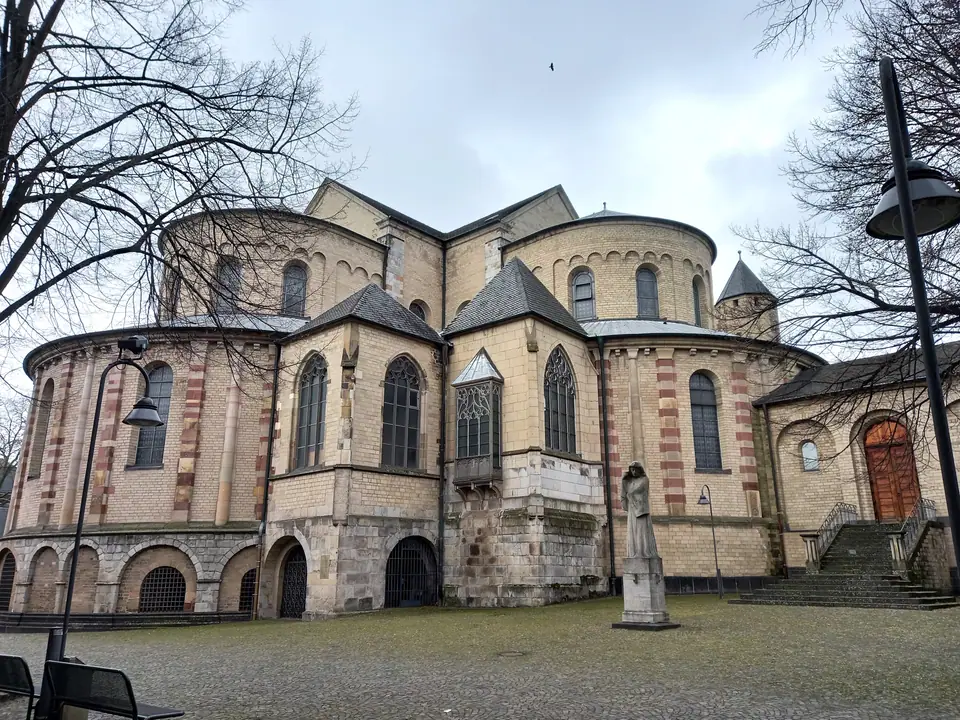
Abbess Ida consecrated this sweeping triconch church in 1065 above Cologne's Roman Capitoline temple podium. Begun around 1040 (with an eastern altar consecrated in 1049 by Pope Leo IX), St Maria im Kapitol stands as the largest of the twelve basilicae. Its bold three-apsed choir echoed Charlemagne's Palatine Chapel in Aachen and keeps intricate carved wooden portal doors from 1065. Standing atop the raised Capitoline terrace kept this riverside monastery above normal seasonal floods along nearby lanes.
Great St Martin and St Kunibert: River Silhouettes
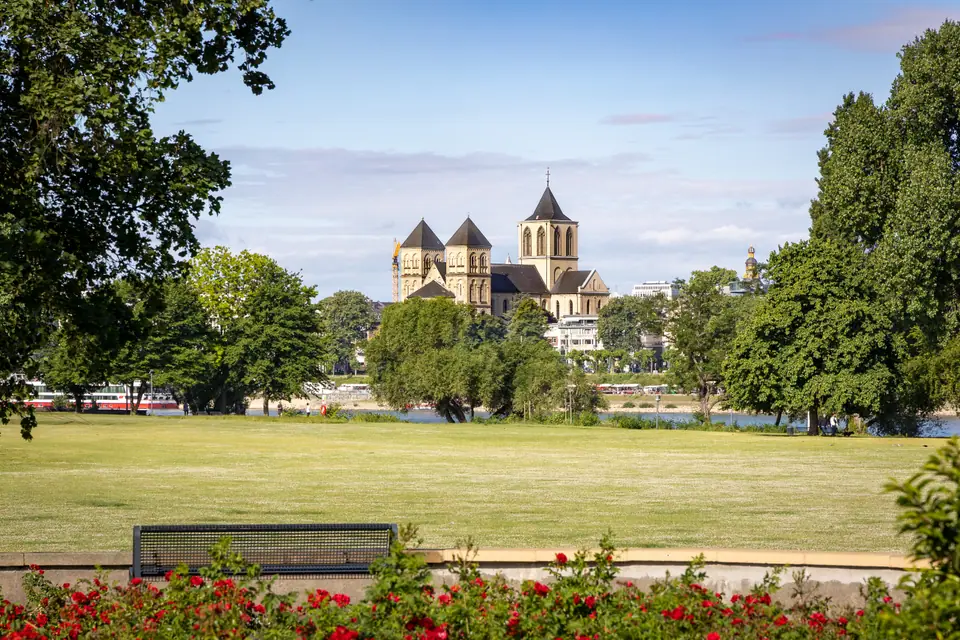
Great St Martin stamps the Altstadt riverbank directly above Fischmarkt. Built between 1150 and 1250 on a former Rhine island (first abbey around 960), its 75-metre crossing tower and four corner turrets sit atop 1st-century Roman warehouse and sports-ground walls. Rebuilt cleanly by 1985 and served since 2009 by the Monastic Fraternities of Jerusalem, it anchors our five-stop river walk. Upstream along green parkland, St Kunibert (site founded around 650 and consecrated in 1247) completes the cycle as youngest of the twelve, retaining rare 13th-century stained glass, medieval frescoes, and 1990s repairs.
St Ursula and the Golden Chamber
North of Hauptbahnhof, St Ursula turns Roman cemetery tradition into dramatic space. Built mostly between 1135 and 1185 over an earlier 866 sanctuary, its calm pillar-basilica nave leads into the 17th-century Goldene Kammer. Thousands of bones dug from an adjacent Roman burial ground line the walls in geometric mosaics surrounding gilded wooden relic busts. Medieval patrons linked the ancient graveyard directly to legends of Ursula and her companions, turning dark stone walls into luminous baroque reliquaries.
Comparing the Key Romanesque Churches on Foot
| Basilica | Quarter & Reach | Signature Architectural Feature | Roman Substratum & Historical Note |
|---|---|---|---|
| Great St Martin | Altstadt above Fischmarkt | Squared crossing tower, four corner turrets, triconch choir | Stands squarely atop Roman Rhine harbour storage structures |
| St Gereon | Gereonsviertel west of Hbf | 13th-century decagonal dome over four gallery tiers | Incorporates mid-4th-century Roman martyrium masonry |
| St Ursula | North of Köln Hauptbahnhof | Romanesque nave linked to ornate bone-lined relic room | Built atop an extramural Roman cemetery beyond old gates |
| St Kunibert | Kunibertsviertel along Rhine | Twin east flank towers and luminous choir windows | Youngest of the twelve basilicae, consecrated in 1247 |
Tracing the remaining 8 basilicae turns an ordinary afternoon walk into an open-air masonry survey. Seek out early Ottonian brickwork across St Pantaleon (begun in 966, consecrated in 980 with Empress Theophanu's tomb inside its westwork) and 4th-century cemetery roots beneath St Severin. Step inside intimate St Maria Lyskirchen (documented 948, built 1210 to 1220), smallest of the twelve, which escaped major wartime collapse and preserves vivid 13th-century vault frescoes. Complete the city-wall arc past St Aposteln at Neumarkt, St Georg, St Andreas, and St Cäcilien, which hosts Museum Schnütgen medieval sacred art today. Those modest sanctuaries highlight clear architectural shifts between sturdy Ottonian or Salian naves and expressive Rhenish trefoil choirs. Walking between quiet parish precincts shows how medieval builders repeatedly layered fresh ashlar above salvaged Roman walls. Eleven of the 12 basilicae endured heavy 1942 to 1945 bomb damage before patient decades of restoration concluded in the 1990s. That quiet persistence pairs cleanly with Cologne's post-war recovery plan and the Gothic Dom.
Where it is
- 1Twelve Romanesque Basilicae Above Colonia Claudia
- Cologne Bonn Airport (CGN) · about 15 km from here in a straight line
- Directions in Google Maps
Stations and taxi ranks: OpenStreetMap. Airports: OurAirports. Distances are in a straight line.
Traveller tips
Real advice from people who have been to Cologne. Every tip is read by our team before it goes live.
No tips yet. Been here? Yours could be the first.
Thank you! Your tip will appear here after a quick review.
More in Cologne
Continue exploring Cologne with related neighbourhood, food, and planning guides