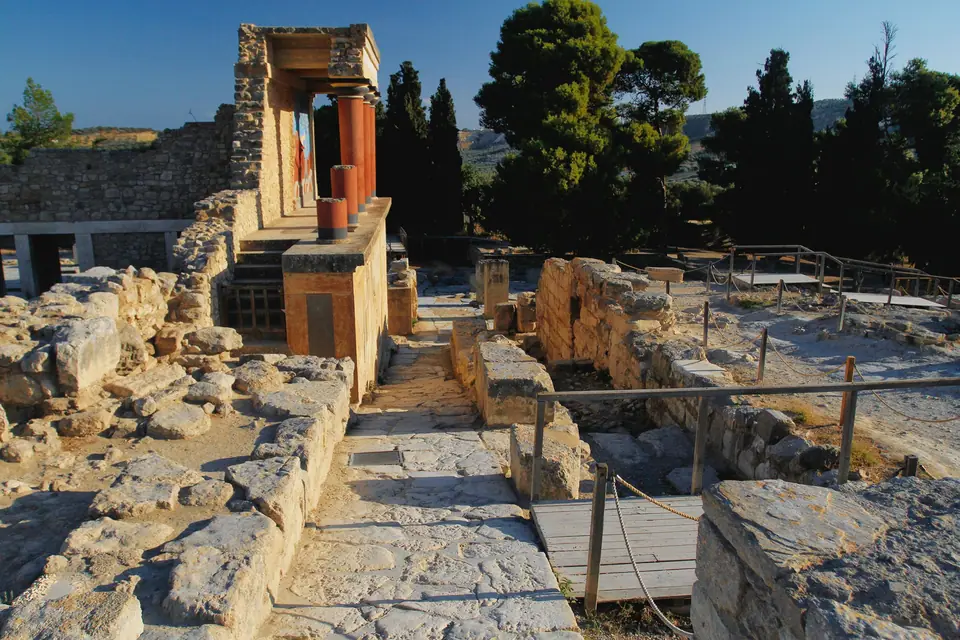
The Minoan Palace of Knossos (1900 BC) and Heraklion Archaeological Museum
Stepping inside Europe's oldest throne room at 1900 BC Knossos and seeing the original frescoes in Heraklion.
Five kilometres south of central Heraklion (20 minutes on Blue City Bus #2 from the harbour / Eleftherias Square) rises the low hill of Kephala, home to the Palace of Knossos, the ceremonial and political capital of the Bronze Age Minoan civilization (c. 2000 BC to 1350 BC), Europe's very first literate urban society. Associated in Greek mythology with King Minos, Queen Pasiphae, the master architect Daedalus, the Minotaur in the Labyrinth, and Ariadne's thread, the sprawling 20,000-square-metre complex had 1,300 interconnected rooms rising up to five storeys high around a central courtyard, and it was that dizzying floorplan (and the sacred Minoan symbol of the double-headed axe, the labrys) that gave the world the word Labyrinth.
1. Walking the Palace of Knossos (Arrive early in the morning)
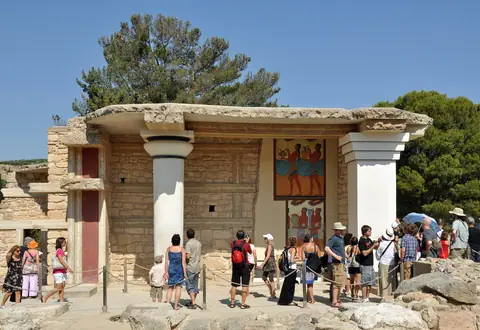
Uncovered in 1878 by Cretan antiquarian Minos Kalokairinos and excavated from 1900 onwards by British archaeologist Sir Arthur Evans (who controversially reconstructed several upper porticoes in painted concrete to show how the timber columns tapered downward and how upper floors were supported), four highlights stand out on the one-way boardwalk:
- The Throne Room of King Minos: look into the antechamber and inner sanctuary where the oldest surviving stone throne in Europe (carved from gleaming white gypsum with a wavy leaf-shaped back) still sits embedded in its original 1450 BC wall flanked by frescoes of wingless griffins.
- The Grand Staircase, Queen's Megaron (Dolphin Fresco) & Horns of Consecration: descend into the royal apartments illuminated by ingenious vertical architectural lightwells, inspect the 4,000-year-old terracotta water pipes and flushable drainage channels, and stand before the giant stone Horns of Consecration and the red-columned North Entrance Bastion (Charging Bull relief).
2. Never Skip the Heraklion Archaeological Museum (In Downtown Heraklion)
Remember that the frescoes you see outdoors at Knossos are replica copies; every single original 3,600-year-old Minoan fresco and treasure is displayed in the air-conditioned galleries of the Heraklion Archaeological Museum on Xanthoudidou Street. Allow two hours to see: the Bull-Leaping Fresco (Taureador), the Prince of the Lilies, La Parisienne, the 1600 BC Faience Snake Goddesses, the carved black steatite Bull's-Head Rhyton with rock-crystal eyes, the Gold Bee Pendant of Malia, and the mysterious spiral-stamped clay Phaistos Disc. Afterwards, walk down pedestrian 25th August Street to Heraklion's 1523 Venetian harbour fortress, Koules (Rocca a Mare).
Traveller tips
Real advice from people who have been to The Minoan Palace of Knossos (1900 BC) and Heraklion Archaeological Museum. Every tip is read by our team before it goes live.
No tips yet. Been here? Yours could be the first.
Thank you! Your tip will appear here after a quick review.
More in Crete
Continue exploring Crete with related neighbourhood, food, and planning guides