


























The Zeugma Mosaic Museum: The Gypsy Girl, Roman Villas and Mars
Inside the world's largest mosaic museum: how Roman villas were rescued from the Euphrates and what to see first.
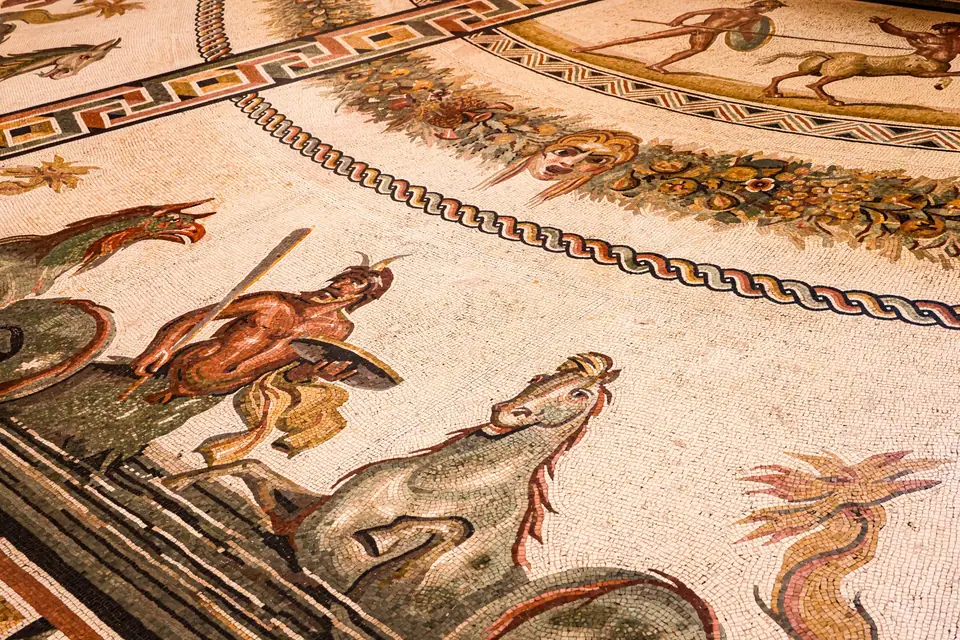
Opened in 2011 inside a 30,000-square-metre complex in Mithatpaşa, the Zeugma Mosaic Museum (Zeugma Mozaik Müzesi) is one of the single greatest archaeological museums in the world. Its treasures come from the ancient Hellenistic and Roman twin city of Zeugma (Seleucia on the Euphrates), founded in 300 BC by Alexander the Great's general Seleucus I Nicator at the strategic pontoon-bridge crossing of the Euphrates River 50 kilometres east of Gaziantep. Stationed here as the headquarters of the Roman Fourth Scythian Legion (Legio IV Scythica), wealthy Roman commanders and Silk Road merchants built tiered riverside villas decorated with dazzling floor mosaics crafted from half a million tiny naturally coloured river-stone cubes (tesserae) per room. When the Birecik Dam was built in the late 1990s and 2000, an urgent international rescue excavation lifted nearly 3,000 square metres of mosaics, wall frescoes and marble fountains before the lower river terraces disappeared beneath the reservoir.
How to Tour the Museum: Four Highlights Not to Miss
Allow at least two full hours and arrive at early in the morning at opening time (Museum Pass Turkey is valid):
- The "Gypsy Girl" (Çingene Kızı, In the Darkened Labyrinth Vault on the 2nd Floor): uncovered in the dining room of the Maenad Villa in autumn 1998, this fragment (actually depicting either the earth goddess Gaia or a follower of Dionysus, nicknamed the "Gypsy Girl" by excavators because of her braided hair, headscarf and hoop earrings) is displayed alone inside a pitch-black, climate-controlled vault. Walk slowly from left to right across the glass barrier: the master Roman mosaicist used the three-quarter gaze technique so her haunting, melancholic eyes follow you across the room from every angle. (In 2018, twelve missing border fragments returned from Bowling Green State University in the US were reunited with her in this hall).
- The Reconstructed Villas of Poseidon and Euphrates (Ground Floor): instead of hanging mosaics flat on concrete walls like paintings, the museum rebuilt the actual architectural columns, peristyle courtyards, rain-collecting pools (impluvium) and painted fresco walls of the riverside villas so you see the mosaics of Oceanus and Tethys, Poseidon on his chariot, Achilles on Skyros, and Perseus rescuing Andromeda in their exact domestic positions.
- The Bronze Statue of Mars (Ares): standing on a raised pedestal overlooking the main hall is a rare, life-size 1.5-metre Roman bronze statue of the god of war Mars with inlaid silver-and-gold eyes, found buried beneath a burned pantry wall during the 253 AD Sassanid sack of Zeugma.
- Wing B (Late Antique & Early Christian Floor Mosaics): cross the skybridge to the second building for lively geometric and animal carpets from 5th-century churches across the Gaziantep plain.
Traveller tips
Real advice from people who have been to The Zeugma Mosaic Museum: The Gypsy Girl, Roman Villas and Mars. Every tip is read by our team before it goes live.
No tips yet. Been here? Yours could be the first.
Thank you! Your tip will appear here after a quick review.
More in Gaziantep
Continue exploring Gaziantep with related neighbourhood, food, and planning guides
Gaziantep's Museums Trail: Kutnu Silk, Mother-of-Pearl, Mevlevihane and Panorama
Gaziantep, Turkey

Getting to Gaziantep: Oğuzeli Airport (GZT) Havaş, Bus B01 and Intercity Coaches
Gaziantep, Turkey
Getting Around Gaziantep: Contactless Cards, Tramway, Gaziray and Walking
Gaziantep, Turkey
Where to Stay in Gaziantep: Stone Mansions in Bey Mahallesi vs Modern Şehitkamil
Gaziantep, Turkey
