


























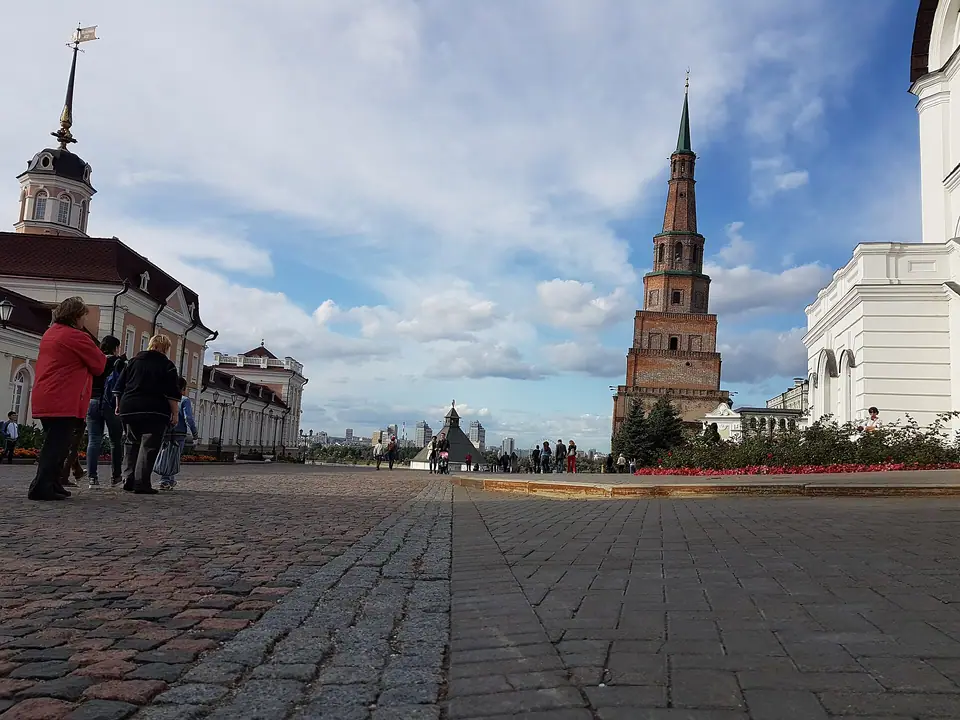
Kazan Kremlin and Söyembikä Tower: History, Architecture and Museums
Explore the UNESCO-listed Kazan Kremlin: the 1562 Annunciation Cathedral, the leaning Söyembikä Tower, the Spasskaya Gate, and the Governor's Palace.
Occupying a limestone promontory above the former mouth of the Kazanka River at latitude 55 degrees 47 minutes north, the Kazan Kremlin is the historic heart of Tatarstan and the oldest settled part of the city. After archaeological digs uncovered a tenth-century Czech coin of Saint Wenceslaus alongside masonry and wooden palisade remains dating urban settlement on the hill to 1004 to 1005 AD, the site served first as a Volga Bulgar border fortress and from 1438 to 1552 as the walled citadel of the khans of Kazan. Following the 1552 Siege of Kazan, Tsar Ivan the Terrible summoned Pskov master builders Postnik Yakovlev and Ivan Shiryai (known as Barma) to reconstruct the fortress in pale local stone and whitewashed brick. Inscribed as a UNESCO World Heritage Site in 2000, the citadel draws millions of visits every year.
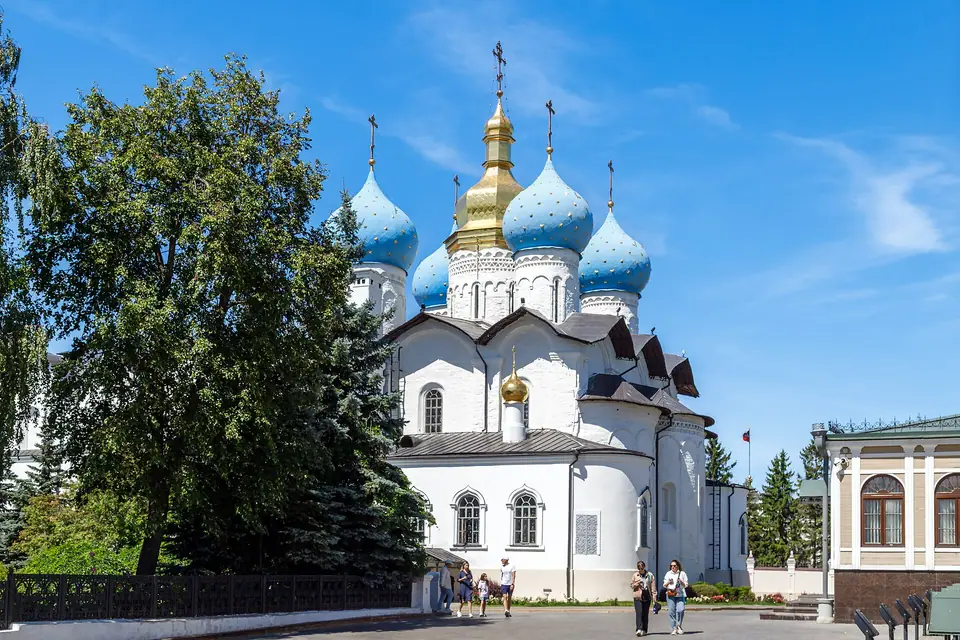
Spasskaya Tower, Taynitskaya Tower and the Fortress Walls
Visitors approach the southern entrance of the citadel from 1 May Square through the whitewashed Spasskaya (Saviour) Tower, erected in the sixteenth century by Postnik Yakovlev and Ivan Shiryai and heightened at the end of the seventeenth century with two octagonal brick tiers and a hipped roof housing an eighteenth-century ringing clock. Named after the adjacent Spassky Monastery (whose 1560s Church of Saint Nicholas and 1590s Transfiguration Cathedral were demolished in the 1930s), the gatehouse opens onto the main cobbled avenue of the Kremlin, Sheinkman Street. Of the original thirteen towers built along the 1.8-kilometre perimeter in the sixteenth and seventeenth centuries, eight survive today, including the classic Pskov-style South-Western and South-Eastern round towers, the Consistory Tower above the medieval Tezitsky merchant moat, and the northern Taynitskaya (Secret) Tower. Built in the 1550s on the site of the Khanate's Nur-Ali gate through which the 22-year-old Ivan the Terrible entered the conquered city in October 1552, Taynitskaya Tower takes its name from a concealed underground passage that supplied drinking water during sieges and features a defensive knee-angled entry corridor that leads down toward the Kazanka River embankment.
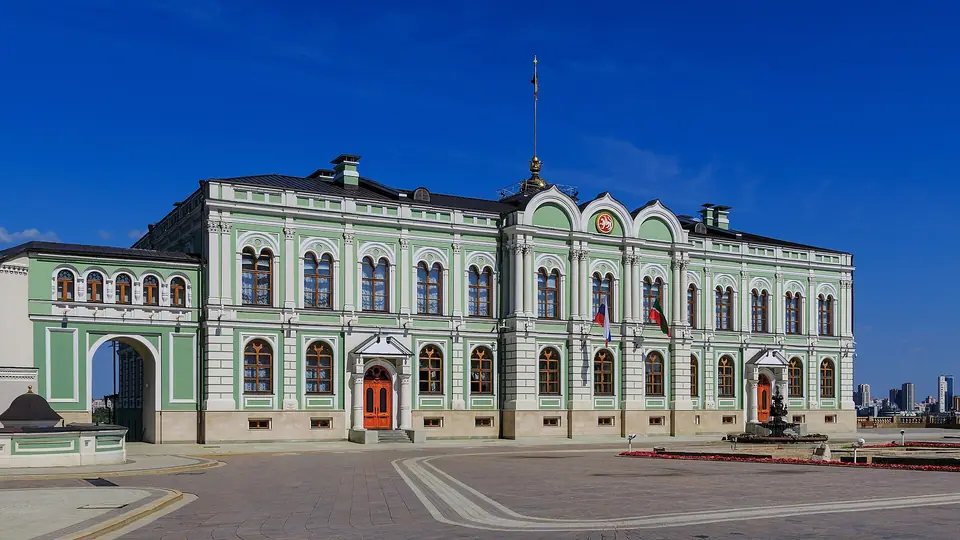
Annunciation Cathedral and the Return of the Kazan Icon
Standing on the eastern ridge of the citadel, the Annunciation Cathedral (Blagoveshchensky Sobor) was completed in 1562 and remains the oldest surviving building in the Kazan Kremlin. Built of pale local stone rather than brick, it has five stepped apses, crowned by five helmet-shaped domes (later remodelled into blue-and-gold onion domes). Its five-tiered detached bell tower, erected at Ivan the Terrible's behest to echo the Ivan the Great Bell Tower in Moscow, was demolished during the Soviet period. Inside, sixteenth- and nineteenth-century frescoes frame the cathedral's revered copy of the icon of Our Lady of Kazan: after the original icon discovered in 1579 by ten-year-old Matrona was stolen in June 1904, a copy of the icon kept in Pope John Paul II's study from 1993 to 2004 was returned to Russia and enshrined in Kazan on 21 July 2005.
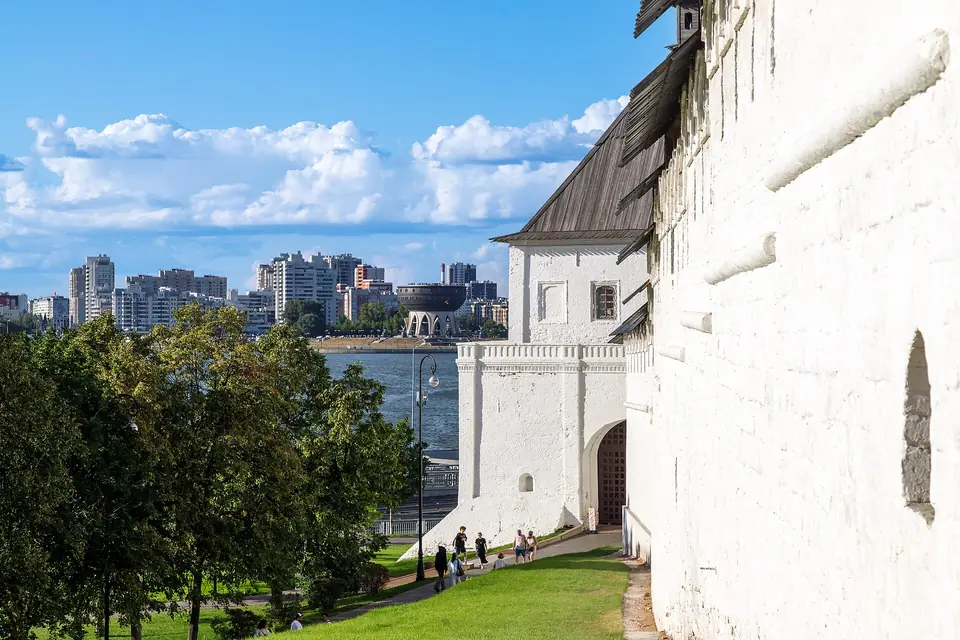
Söyembikä Tower, the Governor's Palace and Citadel Museums
Near the northern tip of the Kremlin rises the 58-metre red-brick Söyembikä Tower, composed of seven diminishing tiers (three square lower levels supporting four octagonal upper tiers) topped by a gilded crescent. Although architectural historians generally date the structure to the turn of the eighteenth century during the reign of Peter the Great, local tradition notes its Central Asian and Bulgar proportions and link it to the last regent-queen of Kazan, Söyembikä (who ruled from 1549 to 1551). According to Tatar legend, when Ivan the Terrible proposed marriage, Söyembikä agreed on the condition that his builders erect a seven-tiered watchtower in seven days; upon climbing the completed seventh tier to gaze across her homeland, she threw herself from the parapet rather than wed the tsar. By the 1990s foundation settling had caused the tower's spire to lean 198 centimetres (78 inches) off vertical, a tilt arrested by steel reinforcement collars during 1990s stabilization works. Beside the tower stands the 1840s Imperial Governor's Palace designed by Konstantin Thon on the site of the former Khan's Palace, alongside the Kul Sharif Mosque, the Hermitage-Kazan Exhibition Center (a regional branch of the State Hermitage Museum housed in the former Junkers' School), the Museum of the History of Statehood of the Tatar People, and the Museum of Natural History of Tatarstan.
Traveller tips
Real advice from people who have been to Kazan Kremlin and Söyembikä Tower: History, Architecture and Museums. Every tip is read by our team before it goes live.
No tips yet. Been here? Yours could be the first.
Thank you! Your tip will appear here after a quick review.
More in Kazan
Continue exploring Kazan with related neighbourhood, food, and planning guides

What to Eat in Kazan: Öçpoçmaq, Qıstıbí, Göbädiä and Chak-Chak
Kazan, Russia
How to Get to Kazan and Get Around: Airport, Trains, Metro and Boats
Kazan, Russia
Where to Stay in Kazan: Best Districts, Historic Streets and River Views
Kazan, Russia
Best Time to Visit Kazan: Weather, Sabantuy Festival and Seasons
Kazan, Russia
