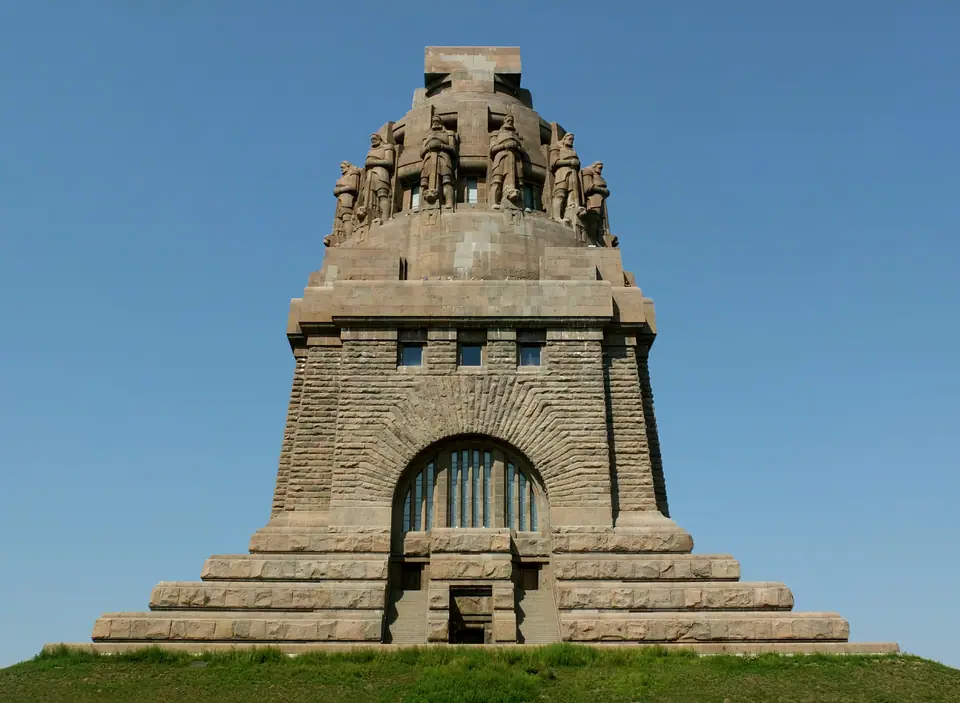
Photo: Palauenc05 · CC BY-SA 4.0
Völkerschlachtdenkmal and the 1813 Battle of Leipzig
Architectural and political-memory guide to the massive 1913 Battle of the Nations monument, its museum pavilion and citywide summit views.
Ride LVB Tram 15 twenty minutes southeast from Augustusplatz along broad residential avenues lined with leafy trees. Quiet suburban chestnut alleys lead steadily out from apartment rows toward wide grassy slopes. Suddenly an immense pyramid of rough porphyry masonry breaks the horizon above manicured lawns. Formally called the Völkerschlachtdenkmal (VÖL-ker-shlakht-denk-mahl), this 91-metre monument looms over a wide reflecting basin. Massive terraced retaining walls weld ancient fortress geometry directly onto early twentieth-century concrete engineering.
Six Hundred Thousand Soldiers on the Southeastern Plain
Between 16 and 19 October 1813, muddy fields and farm parishes across this southeastern plain witnessed the Battle of the Nations. It stands in history as the largest European battle prior to the twentieth century. Napoleon's Grande Armée braced inside a tightening semicircle beyond the old ring road against Sixth Coalition armies from Russia, Prussia, Austria and Sweden. Autumn rain, shifting fog and swollen river crossings turned open farmland chaotic while shattering French control east of the Rhine. Cold downpours soaked woollen army coats as muddy wagon ruts stalled horse artillery along narrow lanes and thick woodsmoke drifted across burning barns and shattered orchards.
Around 600,000 troops from more than 20 countries fought across burning farmsteads and choked stone bridges over four relentless days. Between 90,000 and 110,000 men fell killed or wounded on both sides. Supply carts collapsed completely around crowded Elster crossings when overloaded wooden spans gave way under fire. Long after French columns retreated west across the Elster, surviving churches, schools and fair halls across Leipzig stayed packed with wounded soldiers. Epidemics spread rapidly through damp field wards before local life slowly steadied. Townspeople and civic committees spent decades recovering scattered musket shot and iron fragments across ploughed fields before backing a permanent monument on this gentle southern slope.
Granite Porphyry, Colossal Figures and Shifting Regimes
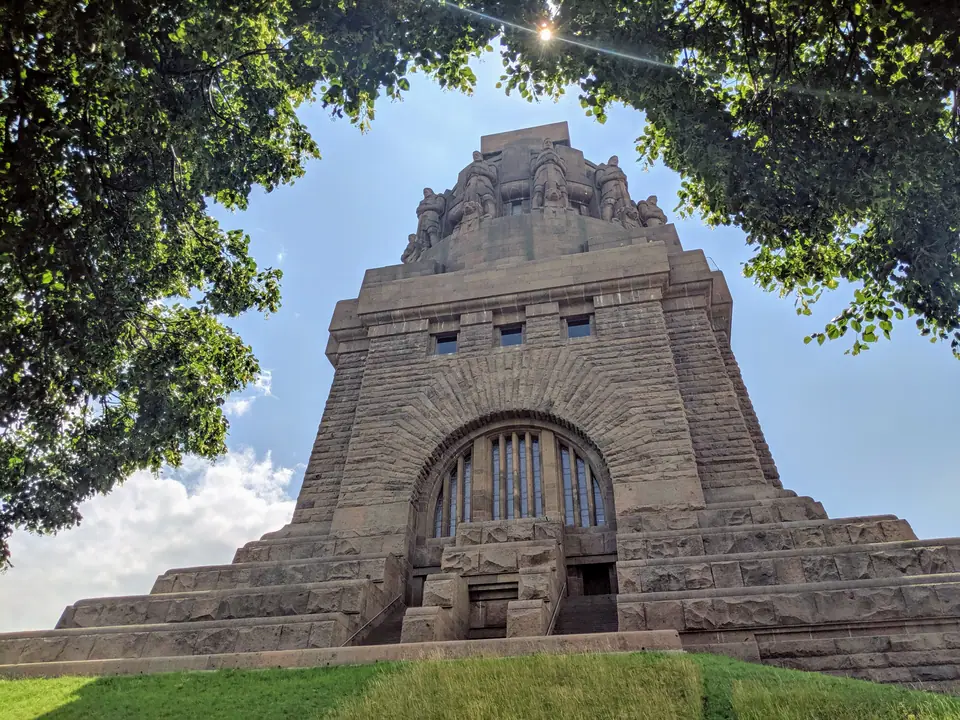
Championed by Leipzig architect Clemens Thieme and designed by monumental specialist Bruno Schmitz after an 1897 competition, excavation opened on 18 October 1898. Main structural masonry rose steadily from September 1900. Paid mainly through public donations and a lottery costing six million gold marks, the 91-metre (299-foot) edifice opened on 18 October 1913 before roughly 100,000 onlookers. Clad in rough red Beucha granite porphyry behind the reflective basin nicknamed the "Lake of Tears" (See der Tränen), it remains Europe's tallest war memorial. Still water across the wide shallow forecourt throws stark geometric stone shadows onto stepped terraces. Broad granite walkways trace the outer terrace edge so visitors sense how massive piers anchor the terraced hillside. A stern stone relief of Archangel Michael keeps watch above the deep front archway.
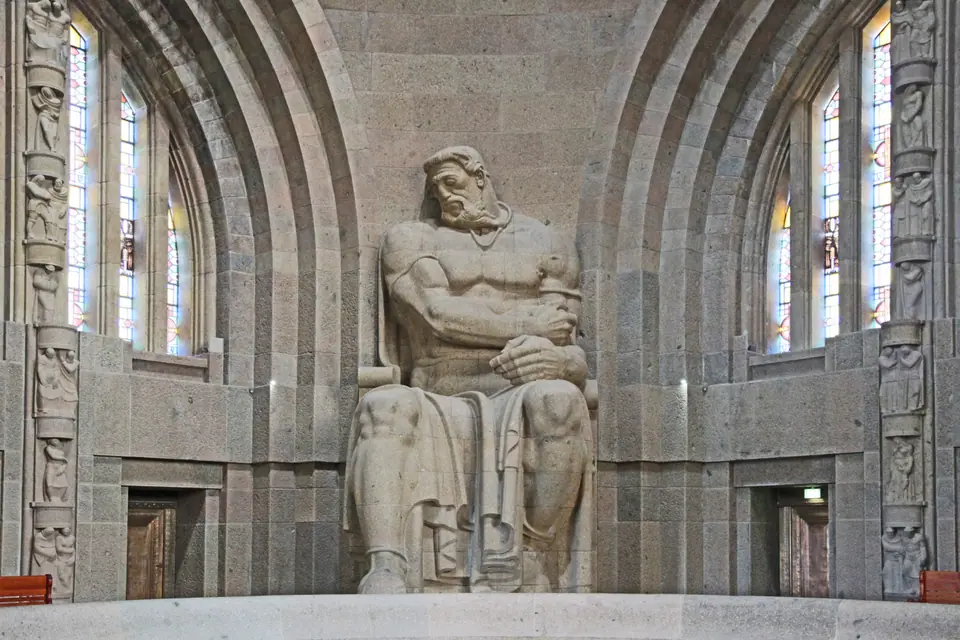
Stepping past heavy oak doors into the dim circular Krypta feels deliberately heavy rather than festive. Cool damp stone air lingers year-round beneath giant masonry vault ribs, quieting casual visitor chatter immediately. Every footstep echoes sharply across dark floors while narrow light shafts slice through thick arched piers. Sculptors Franz Metzner and Christian Behrens ringed the chamber with eight towering stone mourners and standing medieval knights facing shields of fallen fighters. Climb one level higher into the soaring Ruhmeshalle, where solemn stone faces stare inward around quiet circular benches beneath a concrete dome crowded with sculpted horsemen. Four 9.5-metre seated allegories represent Bravery, Faith, Sacrifice and Strength.
Step outside afterward into the crisp glass pavilion of FORUM 1813 beside the forecourt lawn. Run by Stadtgeschichtliches Museum Leipzig, its human-scale displays deliberately puncture imperial stone grandeur. Worn soldier boots, curved bayonets, faded campaign coats, surgical saws and panicked town diaries expose ordinary suffering behind clean tactical maps. Few stone structures in Germany absorbed so many rival political stages within one century. Dedicated under imperial Wilhelmine pomp in 1913, the terraces hosted Weimar gatherings and 1934 Nazi party rallies. In April 1945, German units exchanged artillery fire around its walls before Leipzig's final garrison surrendered to American troops inside its vaults. East German leaders later staged "Brotherhood in Arms" parades in 1963 and 1988, before stone conservation begun in 2003 cleaned darkened porphyry and reframed the complex strictly against war.
500 Steps to the City Horizon
Climbing toward the upper terrace tests calves along progressively tighter stone passages twisting inside hollow concrete piers. Broad outer staircases climb steadily above green lawns before funneling walkers into shadowed interior corridors. Modern passenger lifts spare visitors the steepest lower haul by carrying ticket holders up to an intermediate viewing gallery at 57 metres above the forecourt pool. Smooth stone balconies here frame the dark geometric symmetry of the reflecting basin and chestnut avenues stretching straight toward town.
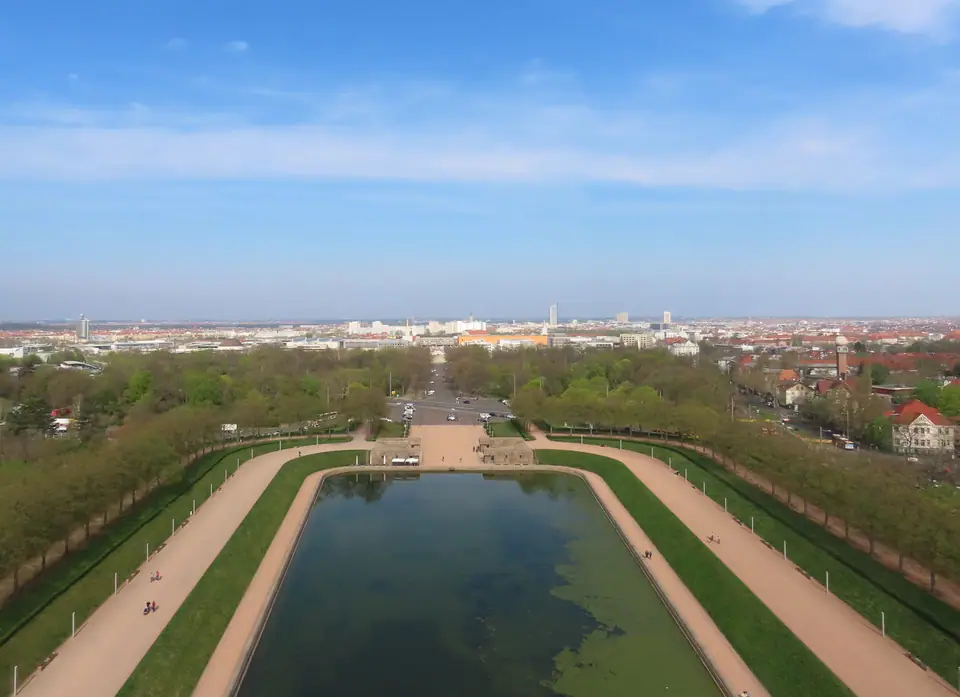
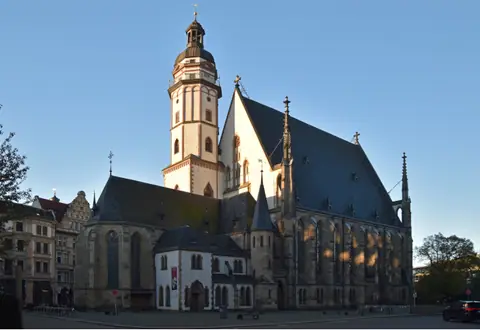
Those completing the full 500-step climb (136 outer steps plus 364 narrow spiral stairs winding past cool masonry walls where wind whistles faintly through arrow slits) pause at occasional narrow landings to let descending walkers squeeze smoothly past before stepping into bright daylight along the summit balustrade. Cool iron handrails guide steady footing upward through dark recesses until open blue Saxon sky breaks cleanly overhead. Unbroken sightlines sweep across flat red roofs, green woodland strips and distant plains across Saxony. You can pick out Augustusplatz tower, Thomaskirche spires and Plagwitz chimneys along the wide horizon. Returning downtown runs smoothly on Tram 15 or S-Bahn lines S1, S2 and S3 from adjacent Leipzig Völkerschlachtdenkmal station directly through the City-Tunnel.
Where it is
- 1Völkerschlachtdenkmal and the 1813 Battle of Leipzig
- Leipzig/Halle Airport (LEJ) · about 17 km from here in a straight line
- Berlin Brandenburg Airport (BER) · about 139 km from here in a straight line
- Directions in Google Maps
Stations and taxi ranks: OpenStreetMap. Airports: OurAirports. Distances are in a straight line.
Traveller tips
Real advice from people who have been to Leipzig. Every tip is read by our team before it goes live.
No tips yet. Been here? Yours could be the first.
Thank you! Your tip will appear here after a quick review.
More in Leipzig
Continue exploring Leipzig with related neighbourhood, food, and planning guides