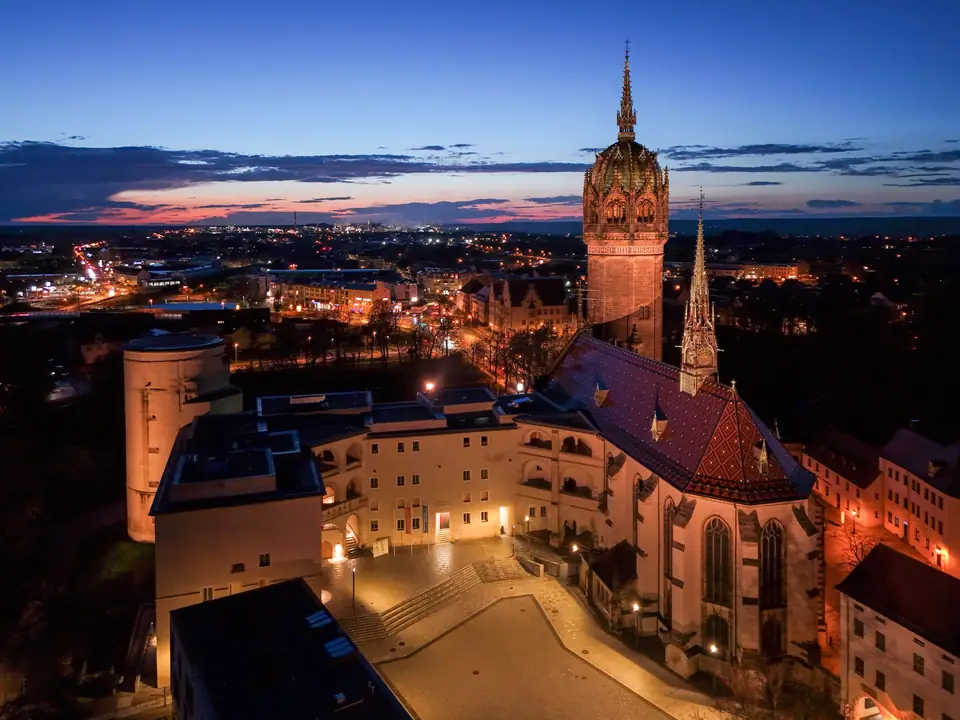
Photo: Toniklemm · CC BY-SA 4.0
Reformation Streets and Doors: Lutherstadt Wittenberg
Practical rail excursion from Leipzig Hbf north to UNESCO Reformation sites in Wittenberg, clarifying train lines and Lutherhaus renovation exhibits.
Just over half an hour north of Leipzig by express train rests a quiet Elbe river town whose cobbled two-street core reshaped European religion, education and printing. Lutherstadt Wittenberg (population roughly 46,000) keeps its 1996 UNESCO World Heritage monuments inside one level walkable corridor. Calm red-tile gables, shaded brick archways and quiet side alleys reward unhurried walking away from busy coach schedules. Flat streets make this a straightforward half-day excursion from Leipzig without packing overnight bags.
Direct Trains North Across the Elbe Plain
Lutherstadt Wittenberg sits 61 to 62 kilometres north of Leipzig Hauptbahnhof across flat sandy plains (roughly 70 kilometres by road). Fast ICE services cover the rail run in 30 to 34 minutes. Frequent regional RE13 trains toward Dessau and Magdeburg run cleanly through the day. S-Bahn line S2 via Bitterfeld similarly reaches Wittenberg in roughly 60 to 66 minutes from underground City-Tunnel stops. Watch departure boards closely before boarding homebound trains in Wittenberg: regional line RE3 heads north toward Berlin rather than south to Leipzig.
Step out of Lutherstadt Wittenberg Hbf past tidy station bakeries, cycle tracks skirting green park strips and clear yellow pedestrian signposts guiding visitors west into town. Walking 1 to 1.5 kilometres (roughly 12 to 20 minutes on foot) along level avenues leads directly onto Collegienstraße as steep red Renaissance gables come into view. Every core Reformation church, scholar residence and Renaissance print courtyard aligns neatly along this single east-west axis leading toward the Elbe castle ramparts.
Schlosskirche and the Bronze Theses Portal
Anchoring the western edge rises the rounded bell tower and tall nave of the Schlosskirche (SHLOSS-kir-kheh, All Saints' Castle Church). Builders raised its stone walls between 1496 and 1506 beside the university founded by Elector Frederick the Wise in 1502. On 31 October 1517, theology professor Martin Luther circulated his Ninety-Five Theses against indulgence sales here, igniting continent-wide printing debate within weeks.
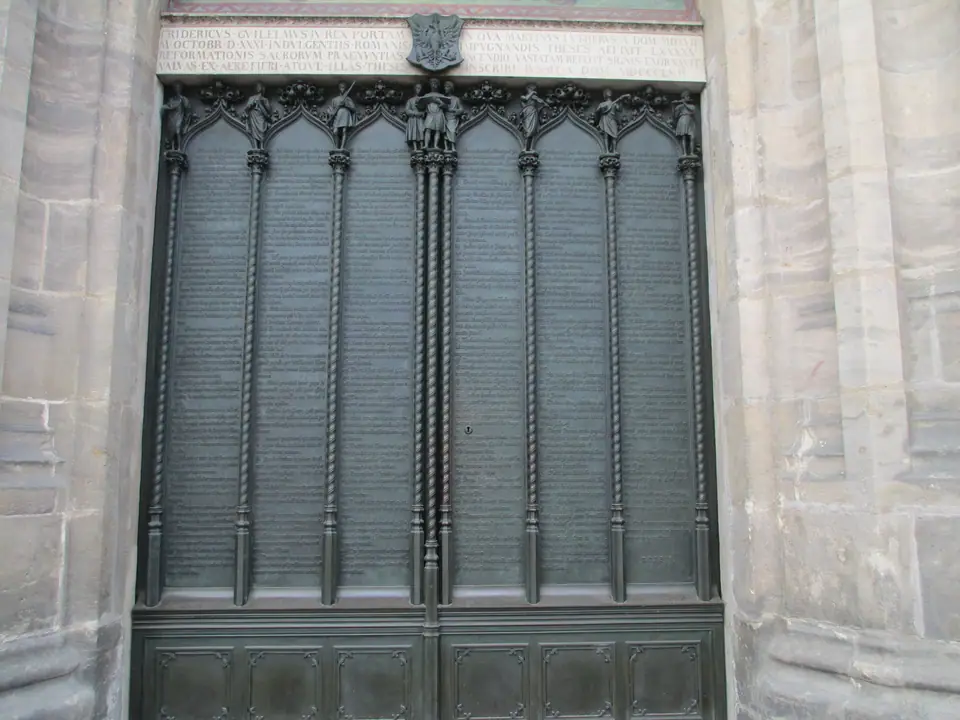
After Seven Years' War bombardment burned away the original wooden doors in 1760, King Frederick William IV commissioned a permanent replacement. Installed inside the northern sandstone arch in 1858, the monumental bronze Thesentür (Theses Door) casts all 95 Latin arguments in heavy dark metal. Weathered raised lettering invites slow reading along the shaded stone wall before visitors push open heavy side oak doorways. Inside the tall stone nave, pale sandstone pillars, delicate wooden choir stalls and tall stained windows soften footsteps. Plain metal floor slabs mark the quiet facing graves of Martin Luther and fellow reformer Philipp Melanchthon opposite the pulpit.
Stadtkirche St. Marien and the Cranach Workshops
Walk east down Schlossstraße into open cobbled Marktplatz, framed by tall stepped gables, the red-brick town hall and the twin octagonal spires of Stadtkirche St. Marien. Whereas Schlosskirche hosted university ceremonies, Stadtkirche St. Marien served as Wittenberg's oldest parish church. Clear window glass floods simple wooden parish pews where Luther preached thousands of weekday sermons and introduced Reformed worship in everyday German.
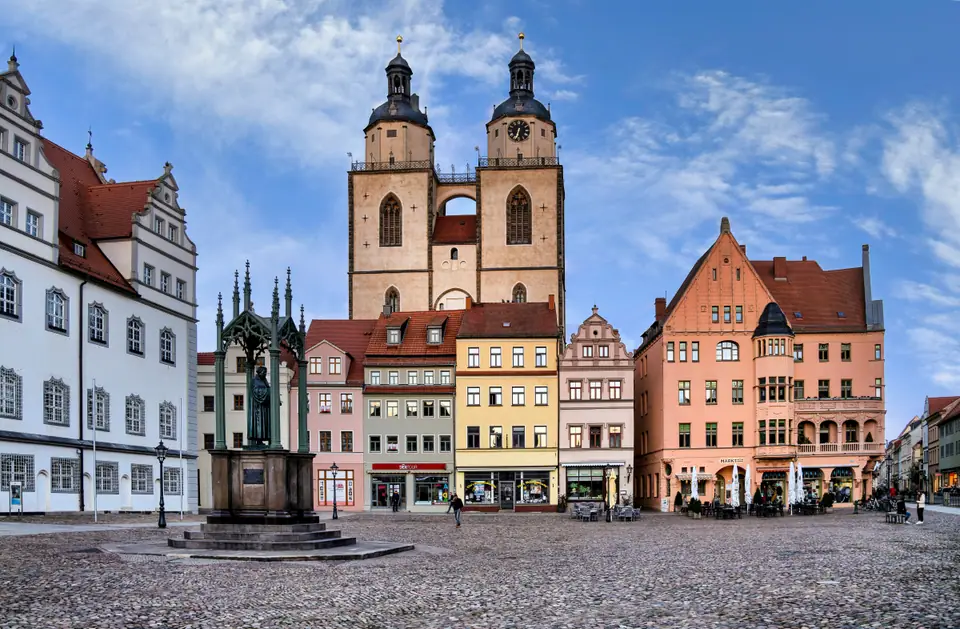
Step behind the high altar to examine the 1547 Reformation Altarpiece painted by Lucas Cranach the Elder and his son Lucas Cranach the Younger. Its crisp wooden panels bring theological reform down to familiar town faces, showing Melanchthon baptising an infant, Johannes Bugenhagen hearing confession and Luther preaching to attentive neighbours. Outside beneath tall Marktplatz eaves, outdoor café tables sit calmly beside stone statues. Nearby around Markt and Schlossstraße 1, restored Cranach-Höfe courtyards preserve quiet Renaissance arches where painters, ink makers and early printers shared cramped backyard workshops.
Melanchthonhaus and the Augusteum Interim Exhibition
Continue east along Collegienstraße past brick gates to reach the white stepped gables of the Melanchthonhaus at number 60. Raised in 1536 in Renaissance style for humanist scholar Philipp Melanchthon, its upstairs timber-beamed study looks cleanly down across a sheltered garden of medicinal herbs. Low garden walls and worn timber staircase treads keep town bustle muted inside the quiet scholar study. A bright modern exhibition wing added in 2013 and quiet courtyard stone benches link historic university halls smoothly along Collegienstraße.
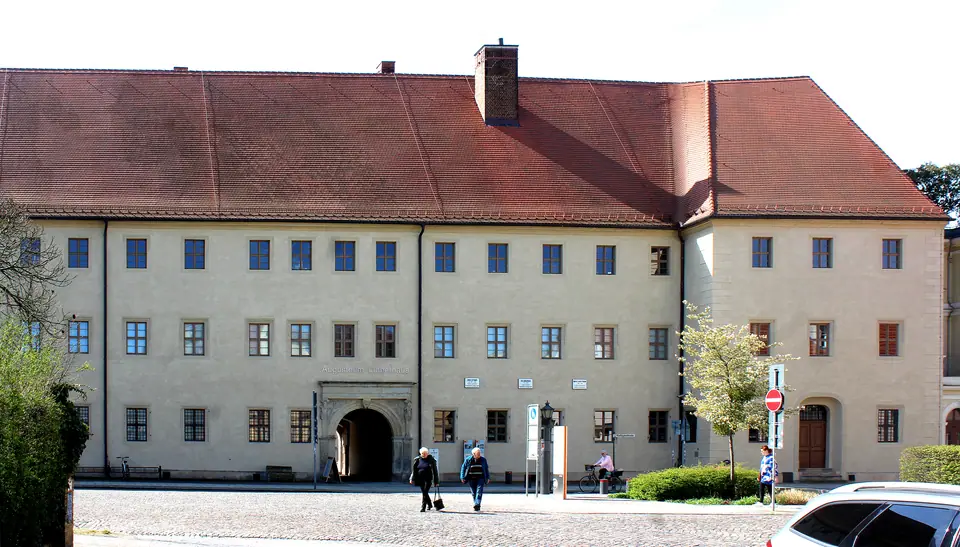
Walk 140 metres further east to enter the courtyard of the Lutherhaus (Collegienstraße 54), former Augustinian monastery and family residence of Martin Luther and Katharina von Bora. Check museum access before stepping into its courtyard. The main historic Lutherhaus building has been closed since 1 November 2023 for comprehensive energy-efficiency, indoor-climate and structural renovation together with a full exhibition redesign. During this ongoing closure, LutherMuseen displays centerpiece original artefacts, personal letters and paintings right next door inside the Augusteum under the exhibition "Literally Luther. Facets of a Reformer", so confirm current hall hours at luthermuseen.de before travelling.
Practical Rhythm for a Half-Day Reformation Walk
Follow the natural east-to-west line from station streets back toward evening trains without backtracking along Collegienstraße.
- Start east at the Augusteum and Melanchthonhaus: Arriving from Wittenberg Hbf brings you onto Collegienstraße at its eastern gate. Explore the interim Luther exhibition while morning halls remain quiet.
- Pause around Marktplatz, Cranach-Höfe and St. Marien: Take unhurried lunch beneath stepped Renaissance gables. Step inside Stadtkirche St. Marien afterward to inspect Cranach's 1547 Reformation Altarpiece in afternoon clerestory light.
- Finish west at Schlosskirche for trains home: Examine the bronze Theses Door and castle ramparts, then walk south along shaded park lanes. Board ICE, RE13 or S2 trains cleanly back to Leipzig.
Where it is
- 1Reformation Streets and Doors
- Berlin Brandenburg Airport (BER) · about 81 km from here in a straight line
- Directions in Google Maps
Stations and taxi ranks: OpenStreetMap. Airports: OurAirports. Distances are in a straight line.
Traveller tips
Real advice from people who have been to Leipzig. Every tip is read by our team before it goes live.
No tips yet. Been here? Yours could be the first.
Thank you! Your tip will appear here after a quick review.
More in Leipzig
Continue exploring Leipzig with related neighbourhood, food, and planning guides