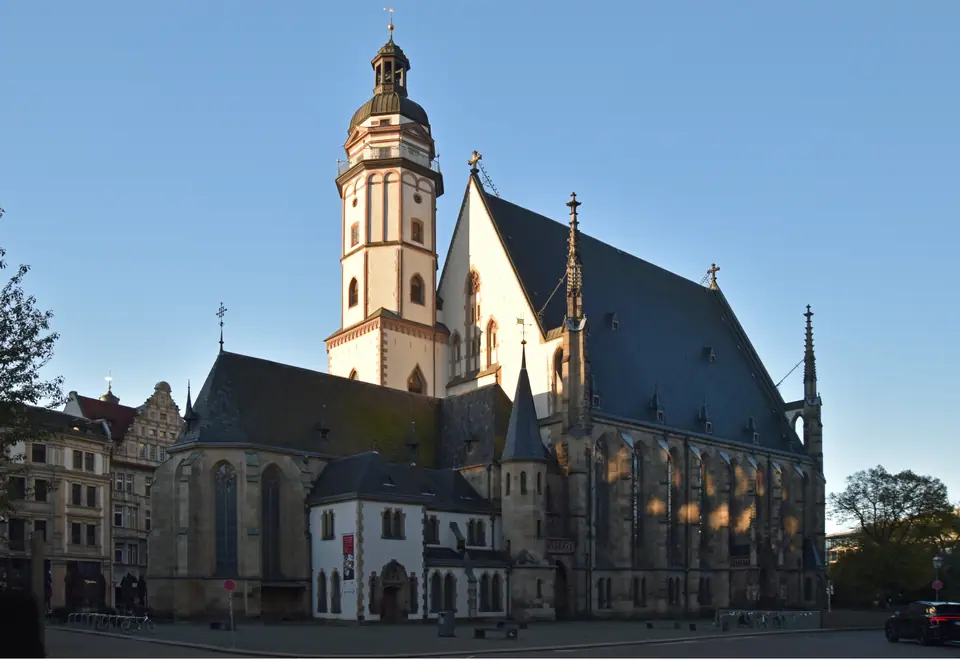
Photo: Tdn70 · CC BY 4.0
Thomaskirche, Thomanerchor and Bach's Final Choir
Musical history essay tracing Johann Sebastian Bach's 27-year tenure at Thomaskirche, the 1212 boys' choir, opposing organs and the Bach-Museum.
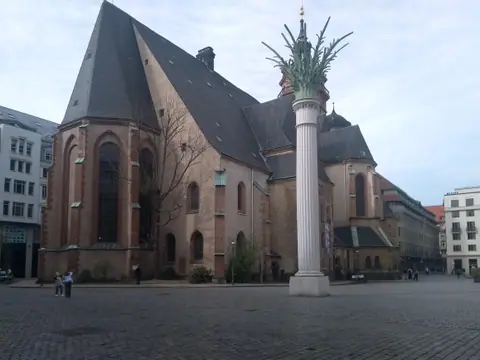
Few churches in Europe carry living musical discipline as naturally as Thomaskirche (TO-mas-kir-kheh) on the western rim of the inner ring at Thomaskirchhof 18. Rather than sitting as a silent stone monument, its choir stalls answer daily rehearsals and rushing pipe bellows. Tall leaded windows soften pale sandstone piers inside while bicycle commuters roll quietly across cobbles outside. Municipal musical routine still beats on time three centuries after Bach walked these aisles.
Twenty-Seven Years as Civic Cantor
Romanesque crossing stones buried under the nave recall an early twelfth-century parish. Augustinian canons later rebuilt the site as a monastery between 1212 and 1222. Craftsmen completed the Gothic choir in 1355 before Leipzig citizens consecrated the steep-roofed hall church on 10 April 1496. Rising 68 metres along the north flank, its bell tower holds eight bells weighing 10.8 tonnes. They pair the 1477 Gloriosa with four modern bells installed in 2020 and 2021. Martin Luther preached from this pulpit at Pentecost 1539 when the Reformation reached town. An 1884 to 1889 Neo-Gothic restoration later replaced most older Baroque woodwork.
Johann Sebastian Bach took office here in 1723 to serve 27 demanding years as civic Thomaskantor and Director of Music until his death on 28 July 1750. Civic duty filled every calendar week rather than offering quiet studio calm. Bach often copied fresh choir parts late into winter evenings by candlelight inside adjoining school quarters. He taught boarding scholars Latin and vocal counterpoint while negotiating budgets with stern town councillors. He coordinated singers across four main town churches and directed works including the St Matthew Passion, St John Passion and Christmas Oratorio beneath these high arches.
Polyphony of the Thomanerchor and Weekly Motette
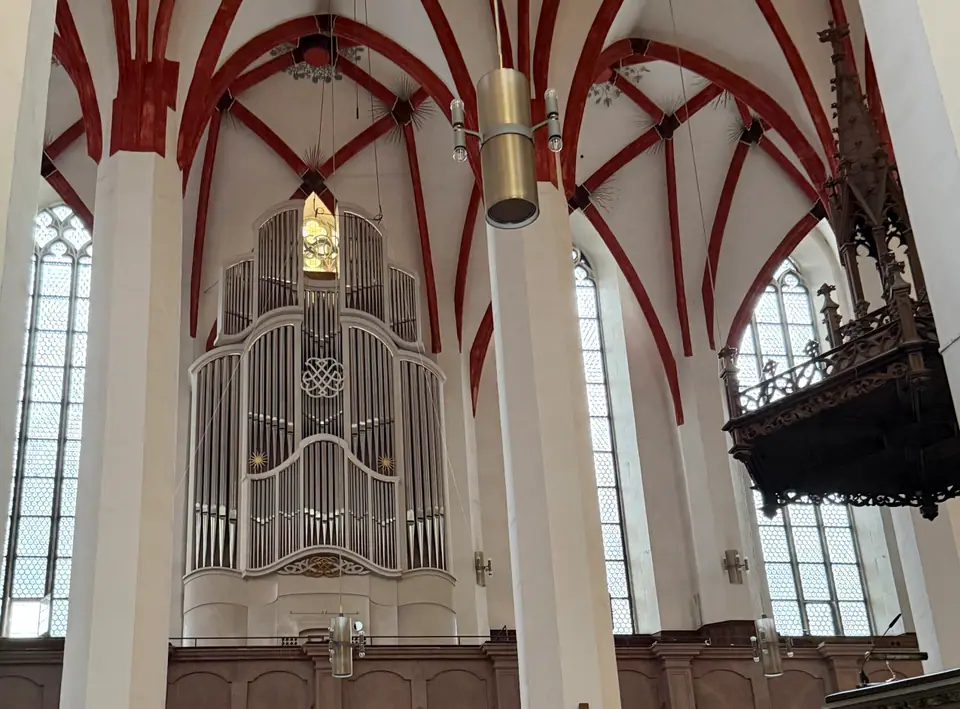
Founded with the monastery school back in 1212, the Thomanerchor boys' choir preserves over eight centuries of sacred polyphony in one parish. Clear treble and bass voices rebound off crisp white rib vaulting. Warm acoustic clarity grounds Bach's achievement far better than silent wall plaques ever manage. Dark carved pew ends catch soft afternoon window light whenever choirboys file neatly into front stalls. Schoolboys still cross Thomaskirchhof from boarding houses daily, weaving schoolwork and rehearsal directly into town life.
Friday Vespers and Saturday Cantatas
Outside school holidays and concert tours when guest choirs fill the loft, the boys sing liturgical Motette services every Friday evening and Saturday afternoon. Friday focuses on short vesper polyphony, whereas Saturday afternoon normally centres on a full Bach cantata. Listeners fill long wooden pews as soft dusk hush settles across the nave. Visitors do not need online tickets months ahead. Arrive calmly before opening organ chords outside the west portal. Picking up a printed programme booklet at the door lets listeners follow every sung German verse in real time.
Listening Between Two Opposing Organs
Stand in the central aisle and glance up toward both gallery lofts. Towering on the western gallery sits the Romantic Wilhelm Sauer organ. Built from 1884 to 1889 with 63 stops, builders enlarged it to 88 stops in 1908 for lush nineteenth-century repertoire. Facing it from the north wall hangs the crisp Gerald Woehl "Bach organ". Craftsmen dedicated that Saxon Baroque instrument in 2000 after an earlier 1966 Schuke organ came down in 1999. Hearing performers alternate between deep Romantic warmth and bright Baroque articulation shows two musical aesthetics conversing smoothly across stone.
From Johanniskirche to the Bronze Chancel Slab
When Bach died on 28 July 1750, officials lowered his plain oak coffin outside the southern wall of suburban Johanniskirche without a durable stone marker. Nearly a century and a half passed before churchyard building forced workmen to excavate beside that outer wall in 1894. Anatomist Wilhelm His matched skeletal measurements and age traits against Bach portraits. City officials placed his remains inside a stone sarcophagus at Johanniskirche in 1900.
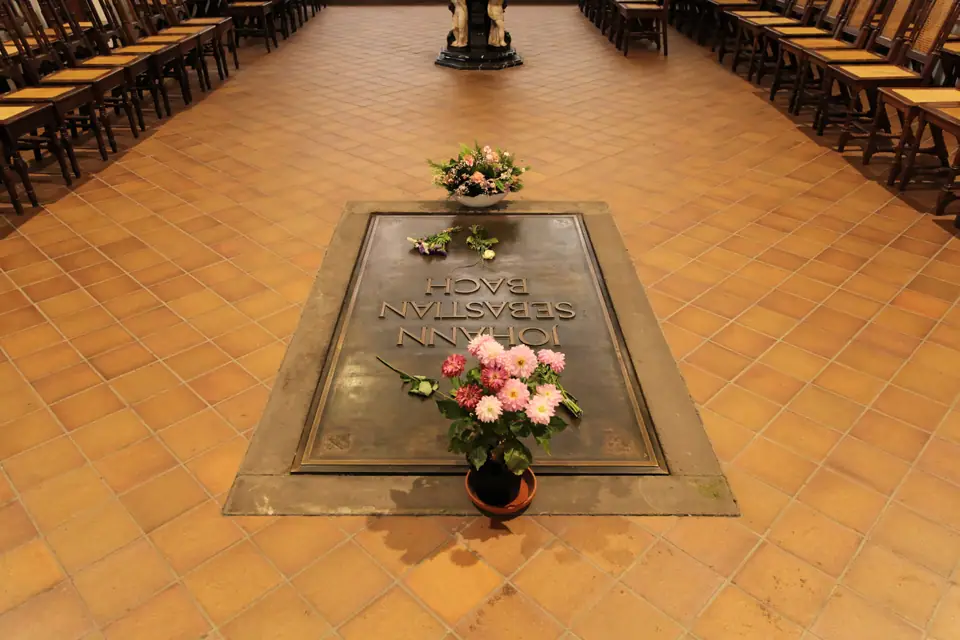
Wartime air raids ruined Johanniskirche in December 1943, prompting clergy to move the intact sarcophagus inside Thomaskirche's chancel. On 28 July 1950, two hundred years to the day after his death, craftsmen laid a flat bronze ledger flush into the choir floor. Carved simply with Johann Sebastian Bach, it skips heavy marble ornament in favour of quiet proximity to music stands. Visitors often pause quietly along wooden choir benches while organists practise scales overhead. Fresh white bouquets still border the warm bronze rectangle almost every morning.
Manuscripts and Listening Rooms Inside the Bosehaus
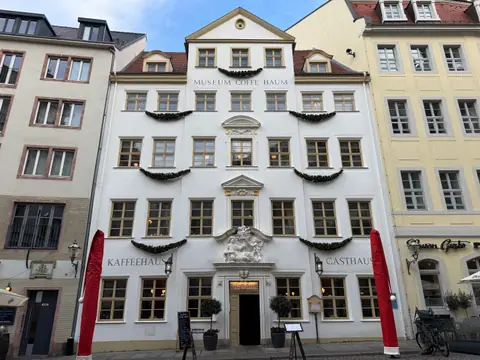
Exit through the south porch onto Thomaskirchhof past the 1908 bronze Bach statue toward the warm yellow facade of the Bosehaus at number 16. Once owned by Bach's wealthy merchant friends the Bose family, the sixteenth-century residence houses the June Bachfest offices, the Bach-Archiv library and the expanded Bach-Museum Leipzig.
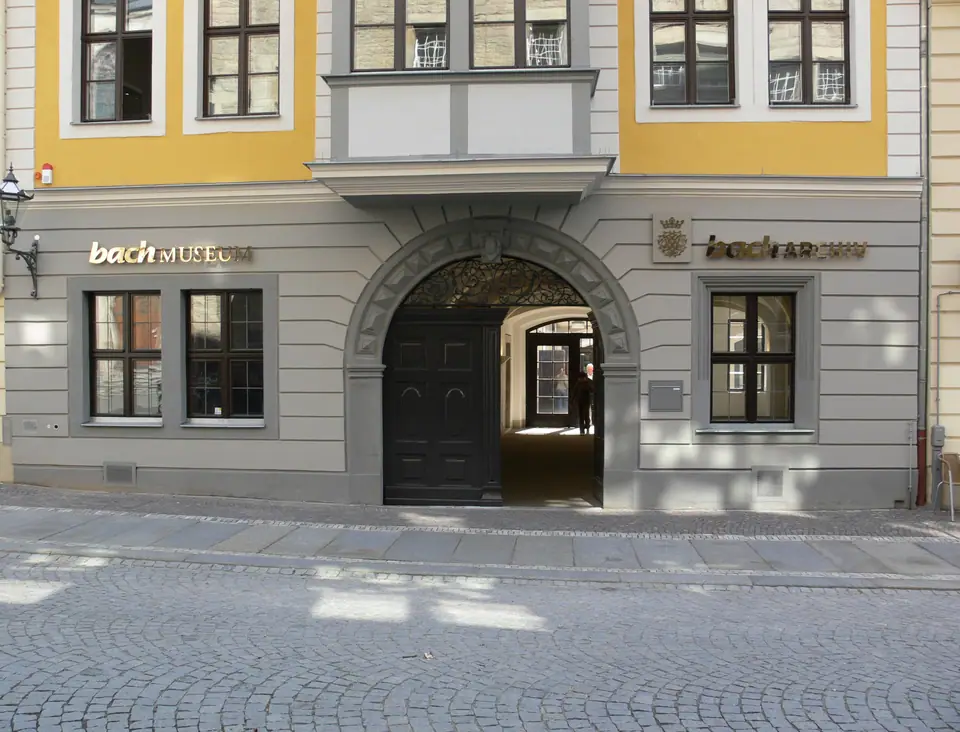
Opened on 21 March 1985 for Bach's 300th birthday, the museum expanded cleanly after conservation work on 20 March 2010. Its quiet treasure vault uses low museum lighting to protect fragile inked cantata sheets bearing quill corrections from fading. Climate-controlled glass cases guard original letters, household scores and fine chamber parts neatly out of direct daylight. Visitors inspect worn household balance ledgers, period keyboards and the salvaged organ console Bach tested at St John's church before wartime raids. Worn oak floors open smoothly onto calm inner courtyard shade. Sunlit interactive listening tables let visitors isolate single vocal lines inside dense fugues before heading east across Markt toward the Nikolaikirche.
Where it is
- 1Thomaskirche, Thomanerchor and Bach's Final Choir
- Leipzig/Halle Airport (LEJ) · about 13 km from here in a straight line
- Berlin Brandenburg Airport (BER) · about 138 km from here in a straight line
- Directions in Google Maps
Stations and taxi ranks: OpenStreetMap. Airports: OurAirports. Distances are in a straight line.
Traveller tips
Real advice from people who have been to Leipzig. Every tip is read by our team before it goes live.
No tips yet. Been here? Yours could be the first.
Thank you! Your tip will appear here after a quick review.
More in Leipzig
Continue exploring Leipzig with related neighbourhood, food, and planning guides