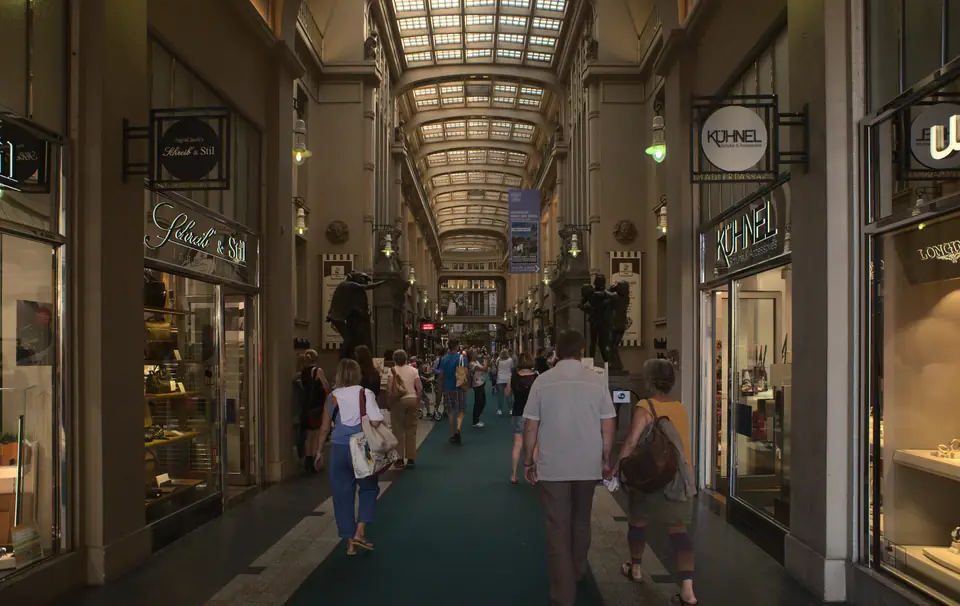
Photo: Flocci Nivis · CC BY 4.0
Mädlerpassage to Plagwitz Canals: Leipzig on Foot
Thematic walking route across Leipzig linking glass trade-fair passages, GDR contemporary history museums, Plagwitz studios and the Panometer gasometer.
Leipzig rewards walkers better than hurried bus tours. Its landmarks grew directly out of working trade yards, brick factories and neighbourhood activism. Over two unhurried days we can step through covered Renaissance courtyards and examine East German surveillance archives. The same city then opens out into converted cotton mills and a cylindrical panoramic painting. Every district links smoothly via footpaths and LVB tram routes without hiring a car. Pacing mornings inside quiet downtown arcades and afternoons beside western water matches local light and opening rhythms.
Historic Passagen Across the Old Fair Spine
Long before exhibition halls relocated outside the inner ring, cloth, book and porcelain merchants traded samples inside downtown courtyard blocks. Covered arcades stitched those dense medieval plots together behind stone street facades. Walking through these ground-floor passages keeps Saxon rain off your shoulders while showcasing brass shopfronts and hidden staircases. Public access rights run late into the evening, so warm light and café clatter linger long after upstairs offices lock.
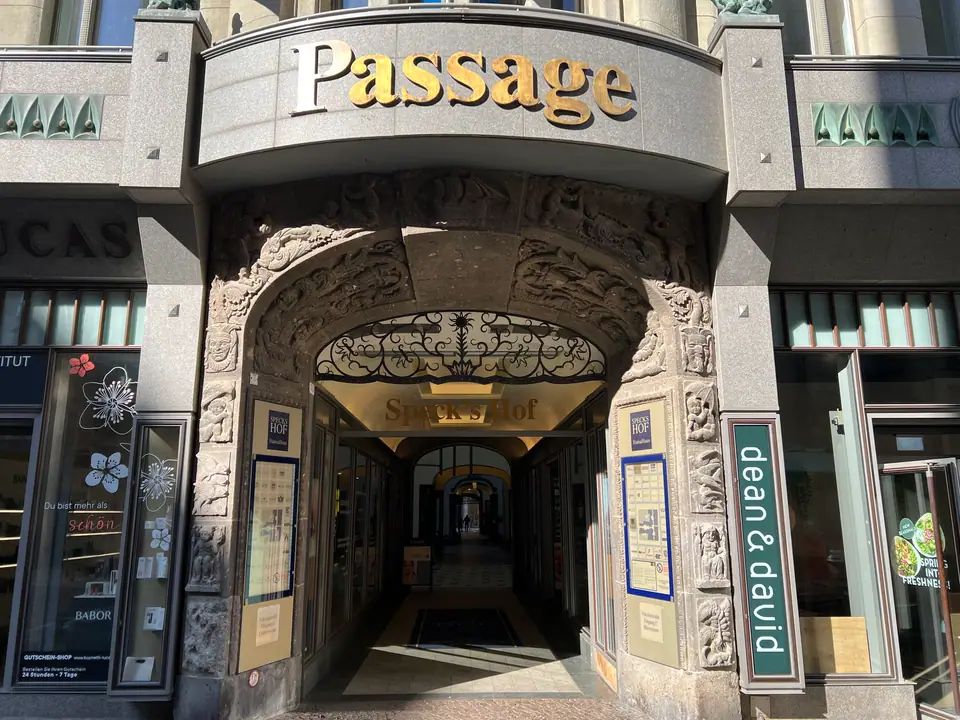
Mädlerpassage and Specks Hof
Between 1912 and 1914, luggage maker Anton Mädler rebuilt older Auerbachs Hof off Grimmaische Straße 2 to 4 into sweeping Mädlerpassage. High glass barrel vaults funnel clear daylight down pale limestone piers to the basement staircase of Auerbachs Keller (dating from 1525). Framing the cellar entrance stand Mathieu Molitor's 1913 bronze statues of Goethe's Faust, Mephistopheles and bewildered students. Local custom rubs Faust's bright bronze boot tip for good luck.
Walk east between Reichsstraße and Nikolaistraße to enter Specks Hof directly from the street. Architect Emil Franz Hänsel designed this block from 1908 to 1909 around three tiled lightwells that preserve Leipzig's oldest surviving trade-fair arcade. Glazed ceramic friezes and quiet iron balconies look down over small galleries and bakeries below.
Barthels Hof and Zeitgeschichtliches Forum
Step north across Markt toward Hainstraße to inspect Barthels Hof, an eighteenth-century through-courtyard (Durchhaus). The stone passageway preserves its Baroque carriageway and projecting timber hoist beam (Aufzugsbalken) intact above café seating. Back along Grimmaische Straße 6, the Zeitgeschichtliches Forum Leipzig shifts sharply from merchant elegance to lived twentieth-century struggle.
Opened on 9 October 1999 by Stiftung Haus der Geschichte, its free permanent exhibition traces East German life from division to reunification. Original schoolbooks, censored rock posters, quiet listening booths and placards from the 1989 marches line clear chronological galleries. Note that the museum closes on Mondays. Pair a weekday visit with our Nikolaikirche chronology two blocks east.
Cotton Mills Turned Studios in Plagwitz
Ride LVB tram 14 or catch S-Bahn lines S1 and S10 west to Leipzig-Plagwitz. Here downtown limestone polish gives way abruptly to dark industrial brickwork at Spinnereistraße 7. Founded in 1884, the Leipziger Baumwollspinnerei formed a self-contained brick company town complete with worker housing, nursery spaces and freight sidings. It stood for decades as continental Europe's largest cotton mill.
Cotton spinning halted permanently in 1993, opening 10 hectares of tall north-lit lofts to painters of the New Leipzig School and international galleries. Weathered steel loading bays and old rail tracks still slice across cobbled courtyards between giant brick chimneys. Time your tram ride carefully around gallery operating days. Spinnerei exhibition spaces open Tuesday through Friday and on Saturdays while closing completely on Sundays and Mondays.
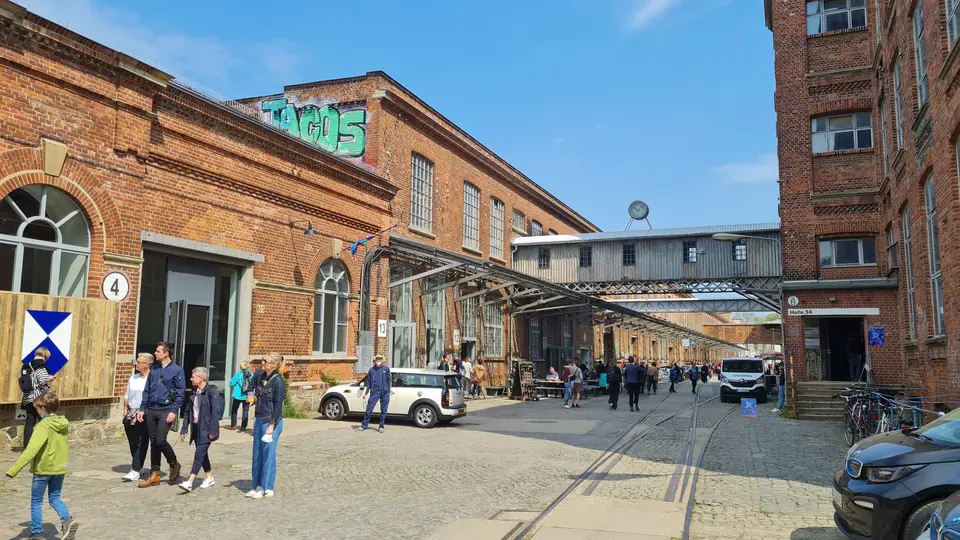
Stroll freely along open mill lanes, step inside the Halle 14 cultural centre, and browse Eigen+Art, ASPN or Galerie b2. Active lithography presses, bronze foundries and print workshops operate quietly behind open steel stairwells. Rotating exhibition calendars ensure every trip reveals fresh canvas work and sculpture, while casual yard espresso counters welcome visitors between warehouse doors.
Towpaths Along the Karl-Heine-Kanal
Ten minutes northeast of the spinning mill, industrial brick lanes open gently onto calm water and overhanging willows along the Karl-Heine-Kanal. Nineteenth-century developer Carl Heine cut this channel across boggy meadows to link the White Elster directly with Lindenau harbour. Today the 3.3-kilometre artificial canal passes under 15 bridges across Plagwitz and leafy Schleußig. Former iron foundries and grain warehouses now house airy loft flats, architecture studios and water-level cafés.
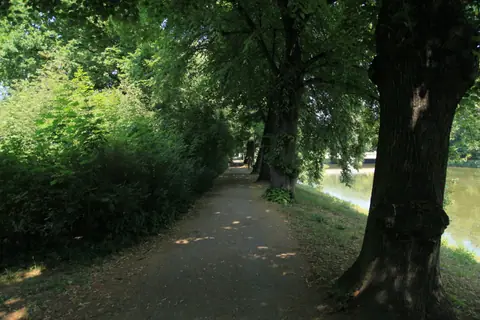
Watch for the cantilevered brick Stelzenhaus ("stilt house"), projecting dramatically on slender concrete piers straight over the canal edge. Iron bridge railings give walkers clean views down the straight basin toward historic smokestacks. Continuous gravel towpaths carry pedestrians and cyclists smoothly into shaded floodplain meadows and Clara-Zetkin-Park. On warm afternoons, paddlers launch canoes and quiet electric boats from timber jetties without waking bankside benches.
Thirty-Two Metres of Painted Canvas at the Panometer
Head south beyond Südvorstadt down Richard-Lehmann-Straße 114 to visit a cylindrical brick gasometer built in 1910. Converted in 2003 by artist Yadegar Asisi, this former municipal tank now operates as the Panometer Leipzig. Inside, a multi-tiered steel viewing tower rises into a hushed 32-metre-high rotunda.
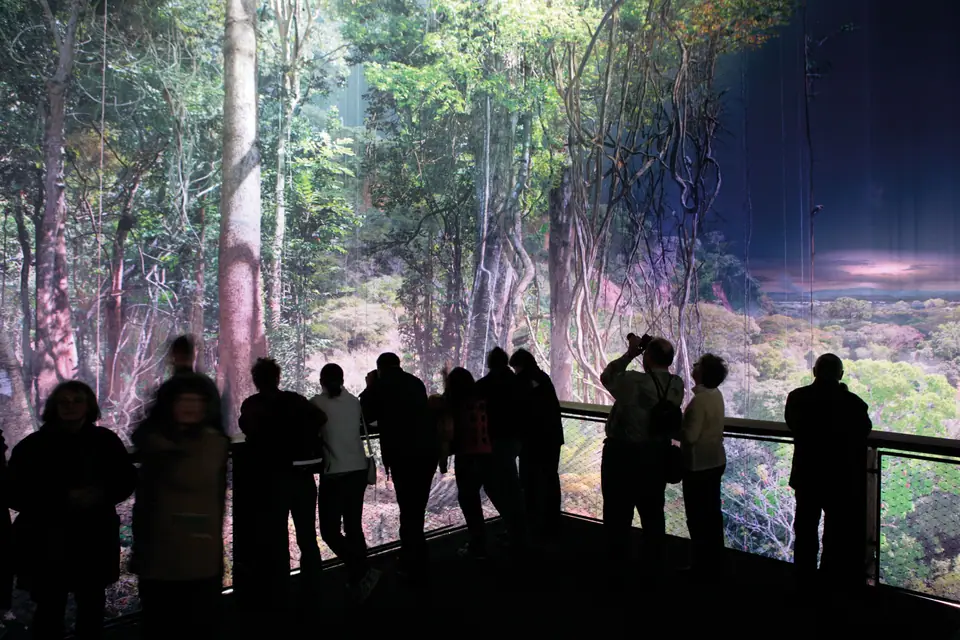
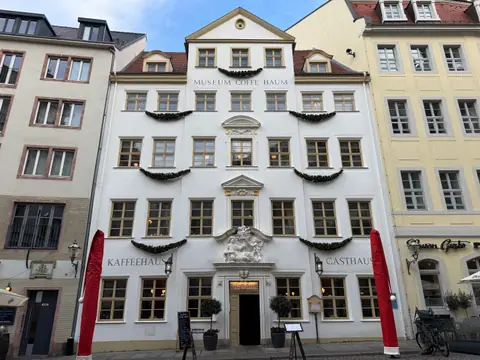
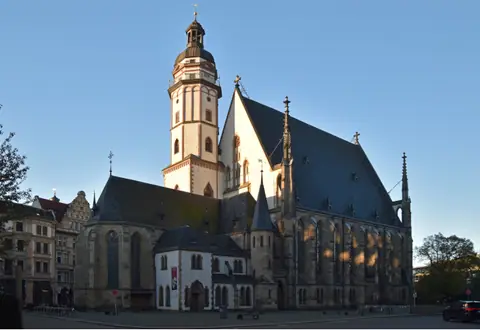
Stepping out of narrow entry corridors into sudden circular scale catches visitors off guard. Giant 360-degree painted canvas walls surround the tower completely. Lighting cycles gradually through artificial dawn glow, crisp midday haze and dusk soundscapes as you climb higher observation decks. Rotating exhibitions pair documentary rooms along the base wall with distant landscapes or vanished city skylines. Reach the complex cleanly via S-Bahn station Leipzig MDR or trams 9 and 16. From here you can continue south toward the Völkerschlachtdenkmal, or loop back downtown for Thomaskirche recitals and coffee-house cakes.
Where it is
- 1Leipzig
- Leipzig/Halle Airport (LEJ) · about 13 km from Leipzig in a straight line
- Berlin Brandenburg Airport (BER) · about 138 km from Leipzig in a straight line
- Directions in Google Maps
Stations and taxi ranks: OpenStreetMap. Airports: OurAirports. Distances are in a straight line.
Traveller tips
Real advice from people who have been to Leipzig. Every tip is read by our team before it goes live.
No tips yet. Been here? Yours could be the first.
Thank you! Your tip will appear here after a quick review.
More in Leipzig
Continue exploring Leipzig with related neighbourhood, food, and planning guides