Photo: Frank Vincentz · CC BY-SA 3.0
Leipzig: Trade Arcades, Polyphony and Post-Industrial Lofts
Orientation to Leipzig covering the historic Passagen core, western Plagwitz canal studios, southern Gründerzeit streets and essential local quirks.
Leipzig (LYP-tsig) splits cleanly between two contrasting urban faces separated by parks and flat river meadows. Inside the medieval oval, merchant wealth built glass-covered shopping courts so visiting buyers could inspect goods out of Saxon rain. Two kilometres west across the White Elster floodplain, nineteenth-century engineers cut shipping canals and raised brick cotton mills. Today painters, printers and independent workshops fill those weathered industrial lofts.
Granted city and market privileges in 1165, this Saxon lowland hub grew to roughly 612,000 inhabitants across 297.8 square kilometres. Unlike royal capitals such as Berlin or Munich, Leipzig never depended on a princely court for stature. Publishers, merchants, cantors and ordinary residents shaped a walkable city best explored on foot over three full days. Germany uses the euro (EUR) everywhere, though carrying coins still helps at outdoor bakery windows and market stalls.
Inside the Promenadenring and Its Passagen
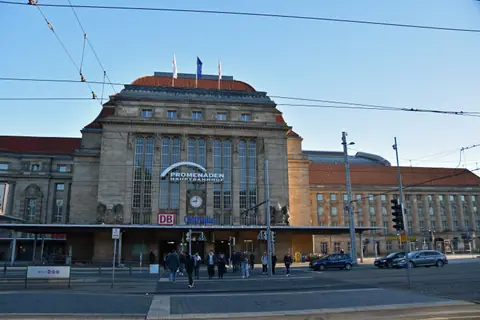
Germany's oldest municipal landscape park wraps the historic inner city (Zentrum, postcode 04109) along a 3.6-kilometre green belt tracing demolished town walls. Almost every early landmark stands within a ten-minute stroll of Marktplatz. After the 1190 fair charter anchored commercial life, modern sample trade fairs (Mustermesse) replaced heavy wagon caravans with compact downtown showrooms. Ground-floor stone alleys still carry foot traffic smoothly out of sudden wind and rain.
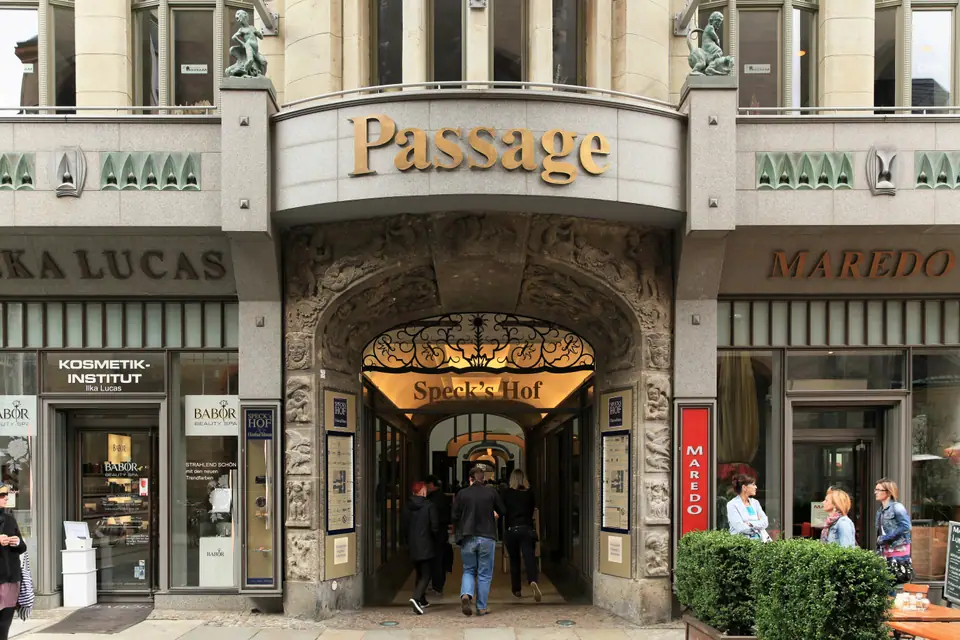
That commercial evolution gave central Leipzig its signature indoor street grid of covered Passagen and linked interior yards called Messehöfe. Running between Nikolaistraße and Reichsstraße, Specks Hof (designed by Emil Franz Hänsel from 1908 to 1909) preserves Leipzig's oldest surviving trade arcade around glowing tiled lightwells. One block south off Grimmaische Straße, Anton Mädler raised glass-vaulted Mädlerpassage between 1912 and 1914 straight above the historic cellar of Auerbachs Keller.
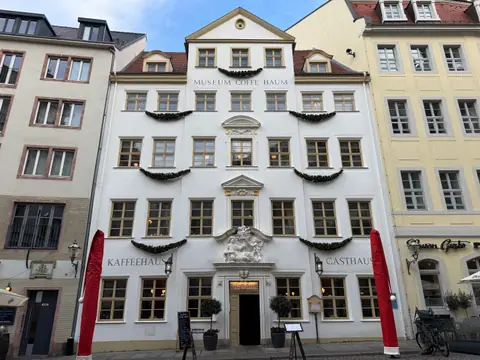
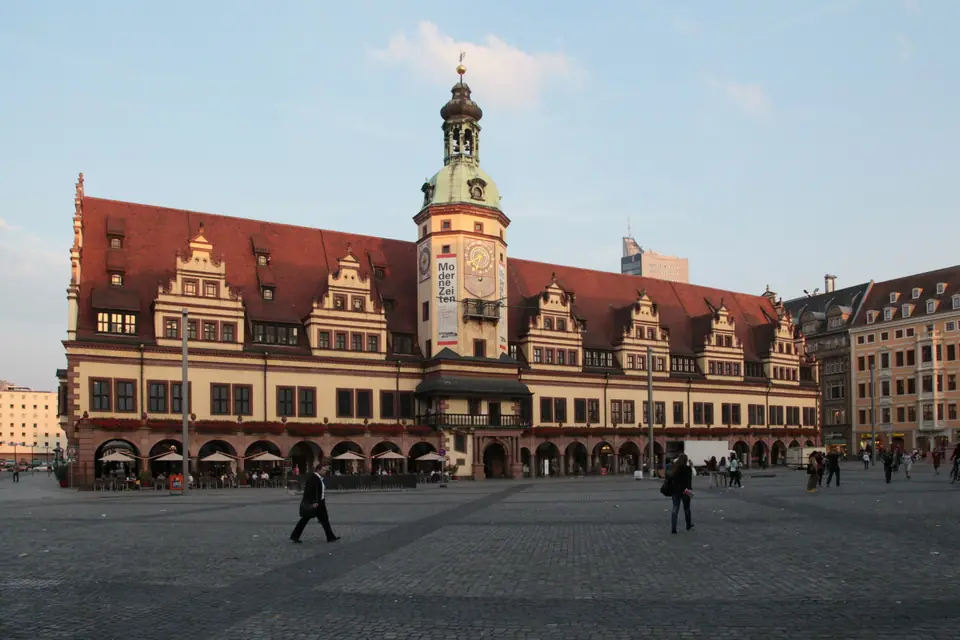
Walking north from Markt past Petersstraße and Grimmaische Straße leads into Barthels Hof, another surviving trade courtyard close to the city's classic coffee houses. Stepping past heavy courtyard gates lowers downtown street noise within paces. Standing beneath the sandstone gable of the Altes Rathaus places you midway between two Protestant churches that shaped European culture. Bach's Thomaskirche rises two streets west, housing the Thomanerchor founded in 1212. The Nikolaikirche anchors the quiet eastern square where weekly Monday prayers sparked the marches of October 1989.
Augustusplatz and the Southern KarLi Spine
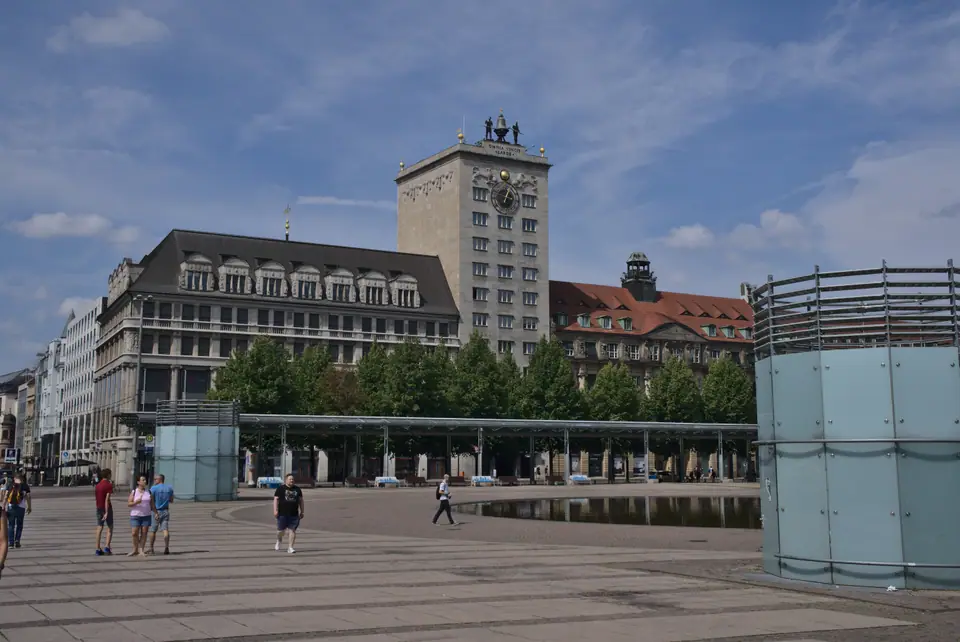
Step out across the eastern rim of the inner ring onto Augustusplatz to see clashing German centuries face each other across tram tracks. The vast plaza balances the clean lines of the postwar Opera house, the modern Gewandhaus concert hall and the steep gable of Leipzig University's Paulinum. Behind Mende fountain rises the tall City-Hochhaus office spire. Wide pedestrian crossings guide concertgoers and university crowds smoothly back into old-town shopping lanes, while dozens of tram routes fan out across the square.
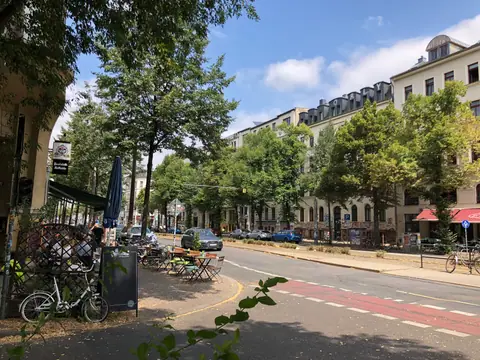
Heading south past Wilhelm-Leuschner-Platz shifts the streetscape from limestone business palaces into dense nineteenth-century residential architecture. Through Südvorstadt (postcode 04275), daily street energy collects along Karl-Liebknecht-Straße, known universally as KarLi. Independent bookshops, late-opening kitchens, small cinemas and summer café tables line both pavements continuously toward Connewitz. Behind ornate stone doorways, quiet inner courtyards hide bicycle racks and shaded chestnut trees. Side-street calm contrasts sharply with nightlife frontage, mapped block by block in our district stay comparison.
Canals and Converted Spinning Mills in Plagwitz
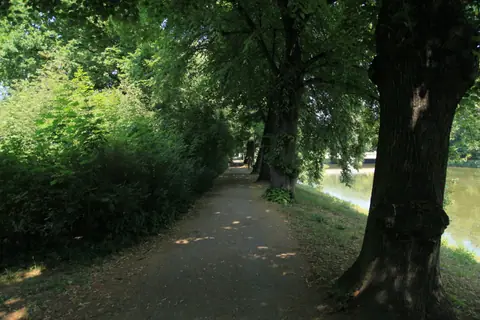
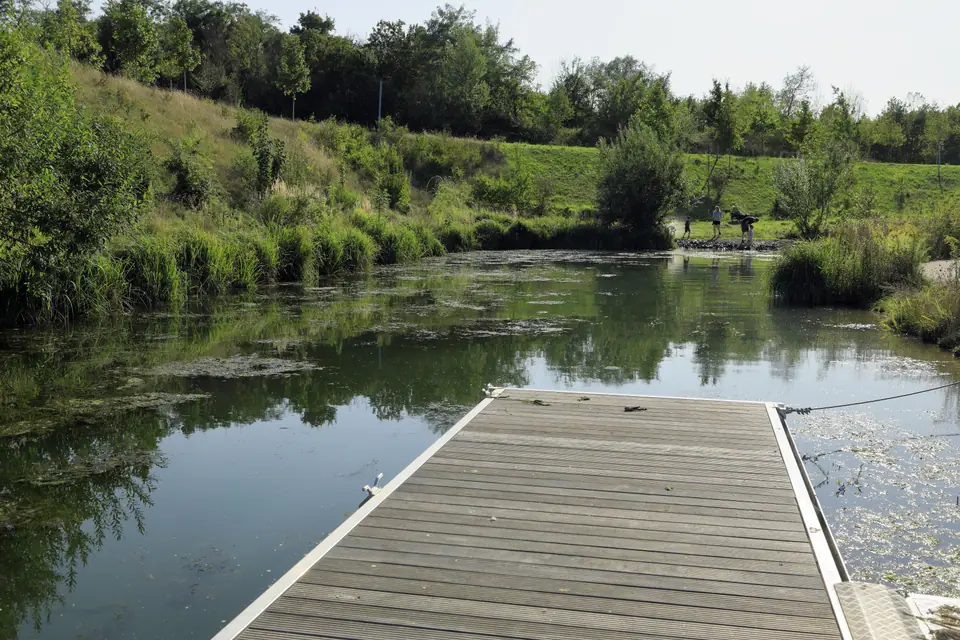
Cross west past the shaded tree canopy of the Auenwald floodplain forest and grand stone squares give way abruptly. Timber yards, red brick warehouses and quiet green water define the western bank. Developer Carl Heine drained western marshland during the second half of the nineteenth century by digging the 3.3-kilometre Karl-Heine-Kanal. Fifteen bridges carry trams and pedestrian foot traffic over the canal while linking former warehouse sidings toward Lindenau harbour. Cyclists share wide gravel towpaths with slow evening strollers along shaded embankments.
At the western edge stands the 1884 Leipziger Baumwollspinnerei, once continental Europe's largest cotton spinning complex before factory looms stopped in 1993. Rather than clearing the 10-hectare brick village, contemporary painters, sculptors and print workshops filled its tall north-facing workrooms. Former turbine sheds now host indie bookbinders, ceramic kilns and calm espresso counters beneath iron roof trusses. Today Plagwitz (04229) and neighbouring Lindenau (04177) form Leipzig's relaxed counterpoint to central arcade walks, trading souvenir crowds for quiet brick alleys and working artist courtyards.
Three Local Realities Before You Step Out
Everyday municipal rules and transit layouts across Leipzig's 10 boroughs and 63 districts surprise newcomers moving quickly between quarters. Subterranean City-Tunnel trains join Leipzig/Halle Airport to downtown squares smoothly, yet surface crossings and opening schedules reward a little forethought.
- The Promenadenring pairs quiet park paths with heavy traffic: Shaded benches hug the multi-lane Innere Ringstraße beside fast tram corridors. LVB operates 13 daytime tram routes across 143.5 kilometres of urban track, plus 46 to 61 bus lines and night tram 10. Use signalled crosswalks or dip through City-Tunnel stairs instead of dashing across rails.
- Gallery campuses and Sunday retail observe strict calm: Exhibition spaces across the Plagwitz Spinnerei operate Tuesday through Saturday and lock their gates on Sundays and Mondays. Most small downtown shops similarly close completely on Sundays under Saxony trading rules.
- Postcodes pinpoint lookalike nineteenth-century blocks reliably: Checking postal digits before booking prevents winding up across town from your dinner plans. Postcode 04109 denotes central Zentrum, 04107 marks leafy Musikviertel and Zentrum-Süd, 04275 signals Südvorstadt around KarLi, and 04229 covers Plagwitz canals.
Where it is
- 1Leipzig
- Leipzig/Halle Airport (LEJ) · about 13 km from Leipzig in a straight line
- Berlin Brandenburg Airport (BER) · about 138 km from Leipzig in a straight line
- Directions in Google Maps
Stations and taxi ranks: OpenStreetMap. Airports: OurAirports. Distances are in a straight line.
Traveller tips
Real advice from people who have been to Leipzig. Every tip is read by our team before it goes live.
No tips yet. Been here? Yours could be the first.
Thank you! Your tip will appear here after a quick review.
More in Leipzig
Continue exploring Leipzig with related neighbourhood, food, and planning guides