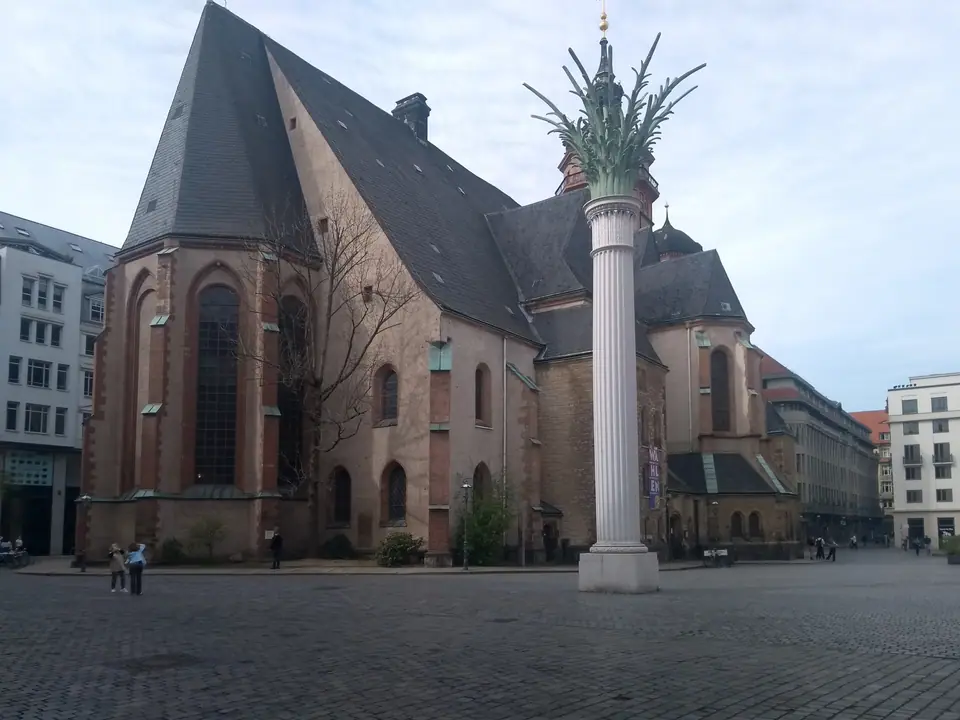
Photo: Onkel Tomm · CC BY-SA 4.0
Monday Prayers at the Nikolaikirche: Autumn 1989
Chronological four-step account of how weekly prayers inside a neoclassical Leipzig parish sparked the peaceful mass marches of October 1989.
Walk ten minutes east of Thomaskirche past narrow bookseller lanes and Nikolaikirchhof opens beneath the quiet stone walls of the Nikolaikirche (NI-ko-lye-kir-kheh). Few European churchyards bind architectural surprise and recent civic courage so closely together. Heavy wooden doors shut out passing tram bells completely within paces. Inside these modest wooden pews, restrained weekly prayers grew across the 1980s until unarmed citizens faced down armed troops on the ring road without shedding blood.
Classicist Palm Columns Behind a Medieval Shell
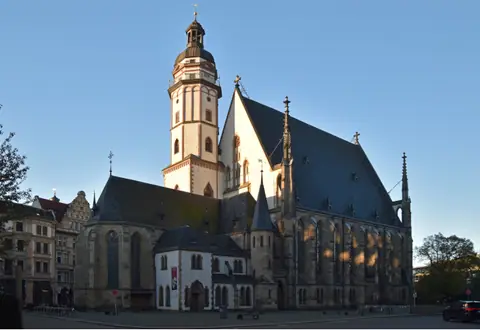
Started around 1165 as a Romanesque merchant basilica, the parish expanded into a Gothic hall church in the early sixteenth century. Builders later added a Baroque tower crown in 1730 and carved stone portal in 1759. Yet nothing along outer alleys hints at the sunlit hall waiting behind heavy doors. Between 1784 and 1797, city architect Johann Carl Friedrich Dauthe cleared out dark Baroque timber galleries. He shaped one of Germany's standout neoclassical interiors, seating over 1,400 worshipers in bright calm.
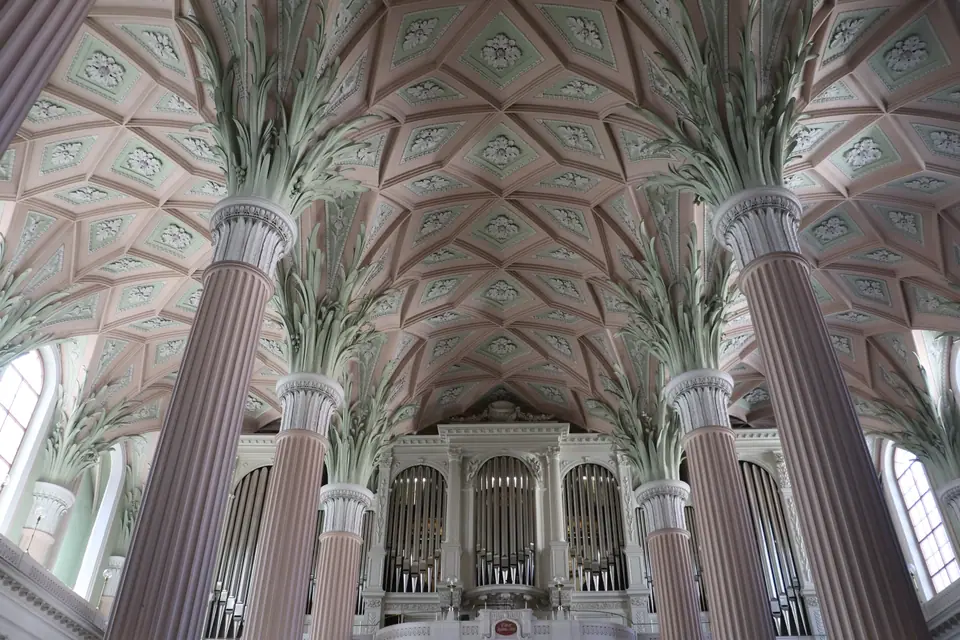
Tall fluted cream pillars rise cleanly into pastel green and blush-pink capitals sculpted like date-palm fronds. Gilded garlands soften painted ceiling coffers, while brass chandeliers hang evenly between calm bays above neatly sloped wooden balcony pews angled for clear pulpit sightlines. Soft daylight gives the hall an airy garden quality far removed from stern northern vaults. Above the western loft rises the monumental 106-stop organ, Saxony's largest organ. Built originally by Friedrich Ladegast in 1862 with 84 stops, reworked by Wilhelm Sauer in 1902 and 1903, and restored by Eule Orgelbau in 2004, it anchors a nave where Bach earlier directed works including the St John Passion.
Monday Peace Prayers Gather Quiet Momentum
On 20 September 1982, youth pastor Günter Johannsen launched quiet Monday Peace Prayers (Friedensgebete) inside the sanctuary to question Cold War missile deployments and military schooling. Sustained from 1986 onward by minister Christoph Wonneberger and parish pastor Christian Führer (who served from 1980 to 2008), the weekly hour welcomed atheists, ecologists and East German families seeking exit visas equally.
For seven patient years, the congregation defended one clear rule posted inside: "open to everyone". Quiet word-of-mouth kept wooden pews packed every Monday evening long before foreign television crews appeared in town. Parish stewards straightened hymnals and stacked folded candle sheets before late arrivals pressed gently onto crowded bench ends. Neighbours passed crumpled typed flyers silently from bench to bench while plainclothes state agents stood near back stone pillars. Security officers photographed arrivals across Nikolaikirchhof and filed informant notes on every speaker. Even under watch, citizens debated rigged local votes, censorship and travel bans while pledging strict non-violence as public tension mounted.
The Ninth of October on the Ring Road
Restrained parish meetings stepped onto open pavement on 4 September 1989. Activists led by Katrin Hattenhauer and Gesine Oltmanns unfurled simple banners outside calling for travel freedom and open assembly. Harsh state crackdowns followed around the regime's fortieth anniversary on 7 October with roughly 500 arrests. Bleak rumours warned residents that live hospital beds and armed units awaited Monday's crowd.
On Monday 9 October 1989, East German forces sealed the inner ring with roughly 8,000 armed police, factory militia and army troops. Over 40,000 citizens packed Nikolaikirche and adjoining alleys as autumn dusk cooled the cobbles. Nervous parish stewards swung heavy oak doors outward onto shadowed alleys as overflowing listeners spilled steadily toward Augustusplatz. Cupped hands shielded flickering wax candles against evening gusts while clergy and civic figures broadcast calm appeals against bloodshed through loudspeakers. When roughly 70,000 unarmed demonstrators stepped out around the Promenadenring chanting "We are the people", commanders held fire. Columns walked peacefully past darkened train yards and shopfronts in complete discipline without smashing glass.
Momentum turned irreversible over the following Mondays. Crowds doubled to 120,000 on 16 October and surged to 320,000 on 23 October 1989. Within weeks on 9 November 1989, the Berlin Wall opened in Berlin, while Leipzig's Monday marches continued until March 1990 and April 1991. Every autumn on 9 October, candlelit vigils at Lichtfest Leipzig honour this peaceful turning point across downtown squares.
Traces Across Nikolaikirchhof and the Runde Ecke
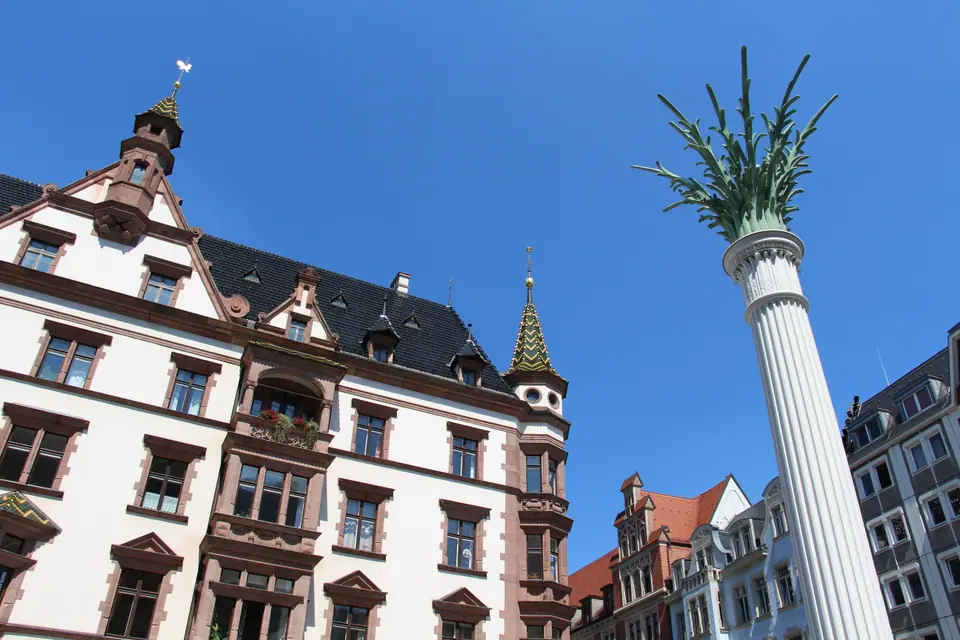
Walking out the north portal onto Nikolaikirchhof brings visitors straight beneath the 16.5-metre stone Nikolaisäule. Sculpted by Markus Gläser after Andreas Stötzner's design and unveiled on 9 October 1999 for the tenth anniversary, the column lifts the church's palm capitals onto open cobbles. Follow the march route northwest round the ring road to Dittrichring 24. Here stands the curved stone building known as the Runde Ecke ("Round Corner"), former district headquarters of the Ministry for State Security (Stasi).
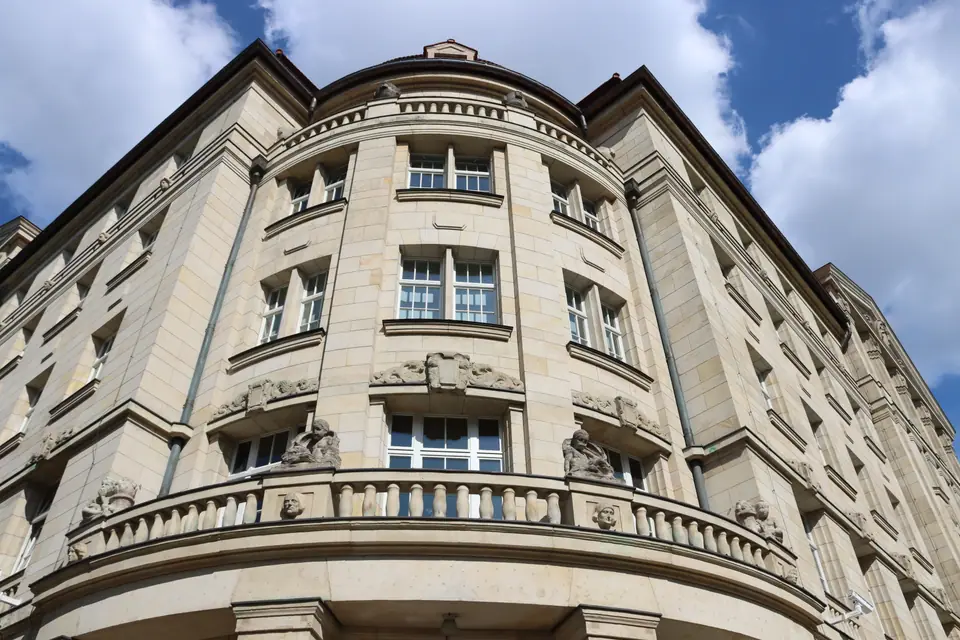
Entered peacefully by citizens in December 1989 to save shredding files, it opened permanently as a museum in August 1990 under the Bürgerkomitee Leipzig. Creaking wooden corridors, cramped darkroom desks and drab metal filing cabinets keep bureaucratic reality intact. Rows of battered typewriters and locked mail trolleys preserve how methodically state clerks tracked ordinary correspondence. Exhibits display hidden wall cameras, mail-steaming benches, taped envelopes, disguise wigs and sealed scent jars used to monitor citizens across the district. Stepping back onto sunny Dittrichring cafés after quiet surveillance rooms lets the scale of autumn change register sharply. Walking southeast back toward Grimmaische Straße connects these rooms cleanly with the Zeitgeschichtliches Forum.
Where it is
- 1Monday Prayers at the Nikolaikirche
- Leipzig/Halle Airport (LEJ) · about 14 km from here in a straight line
- Berlin Brandenburg Airport (BER) · about 137 km from here in a straight line
- Directions in Google Maps
Stations and taxi ranks: OpenStreetMap. Airports: OurAirports. Distances are in a straight line.
Traveller tips
Real advice from people who have been to Leipzig. Every tip is read by our team before it goes live.
No tips yet. Been here? Yours could be the first.
Thank you! Your tip will appear here after a quick review.
More in Leipzig
Continue exploring Leipzig with related neighbourhood, food, and planning guides