Photo: Dan Lundberg · CC BY-SA 2.0
Old Town Plovdiv: Three Hills Mansions, Gates & Routes
Architectural loop across Plovdiv Old Town linking reopened Nebet Tepe walls, Hisar Kapia, painted National Revival mansions, and Monday pass planning.
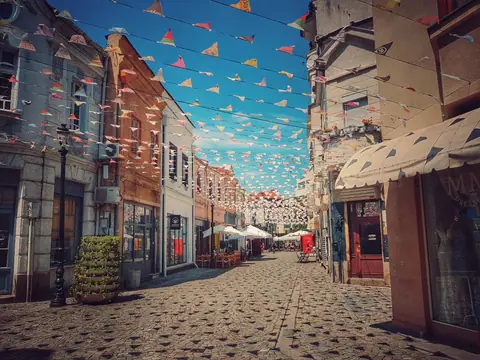
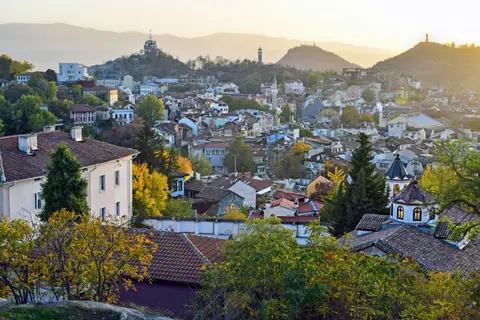
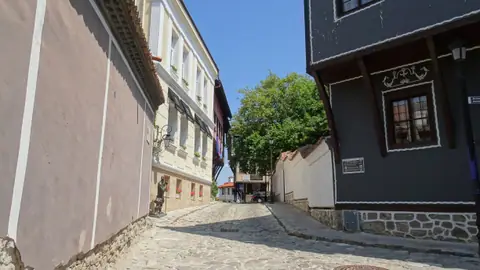
Spread across thirty-five rocky hectares atop Dzhambaz Tepe, Nebet Tepe, and Taksim Tepe, Architectural and Historical Reserve Ancient Plovdiv forms an open architectural stage. Placed on UNESCO's World Heritage Tentative List in 2004, these hilly cobbled lanes reject flat street grids at every curve. Instead, overhanging timber merchant bays tilt out over grey stone paving anchored straight onto Roman and Thracian stone ridges.
Nineteenth-century master builders stacked asymmetrical wooden upper rooms cleverly above irregular rock ledges once Ottoman civic restrictions eased. Lace up stiff walking shoes and cross-check Monday closure schedules in our Plovdiv sights guide before ascending from Dzhumaya Square.
Three Hills Reserve and March 2025 Fortress Reopenings
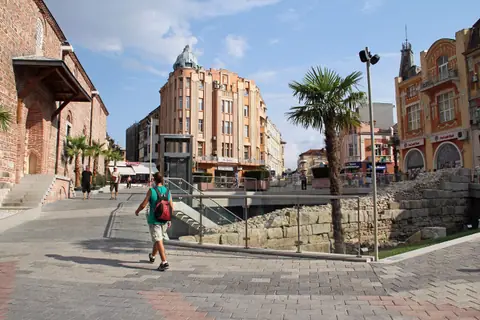
Begin uphill toward Nebet Tepe's 207-metre northern rock platform, perched beside 212-metre Dzhambaz Tepe and 195-metre Taksim Tepe. Reopened cleanly to visitors in March 2025, European-backed conservation titled Along the Fortress Walls of Philippopolis transformed ancient earthworks safely. Fresh pathways, low protective rails, and warm architectural floodlights frame cyclopean dry-stone ashlar walls, square Justinianic towers, a dark postern stair, and a carved underground water reservoir.
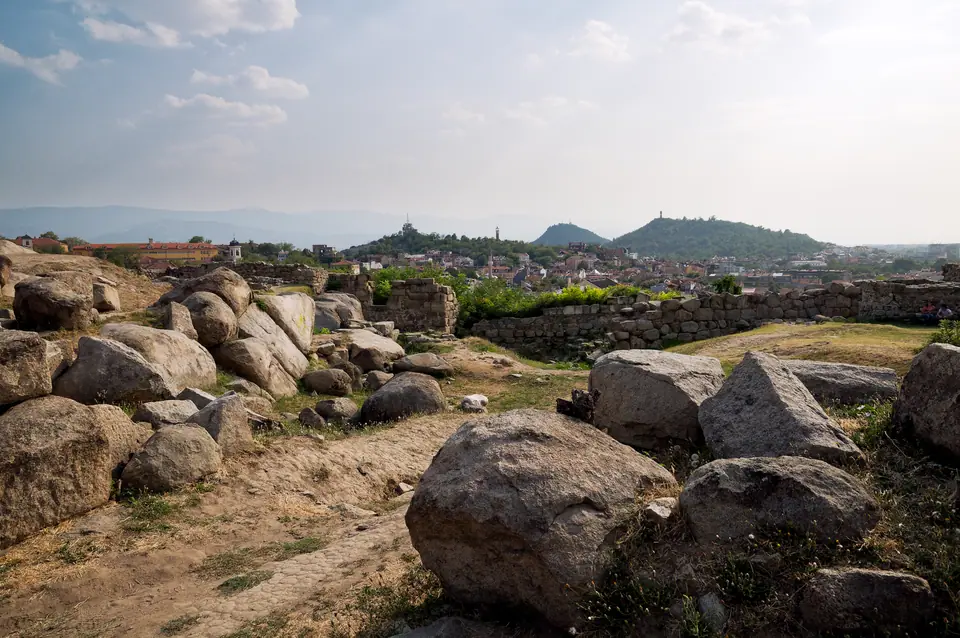
Archaeological trenches here reach back roughly to 4000 BC and twelfth-century BC Thracian Eumolpias. Best of all, Nebet Tepe welcomes hikers freely twenty-four hours daily without turnstiles or entrance gates. Descending eastern steps drops cleanly onto the newly reopened Roman Eastern Gate built near the imperial triumphal highway leading toward the Hellespont and Constantinople. Broad Hadrianic and Aurelian stone flagstones and upright marble columns frame bright morning views away from central traffic.
Hisar Kapia Masonry and St. Constantine and Helena Icons
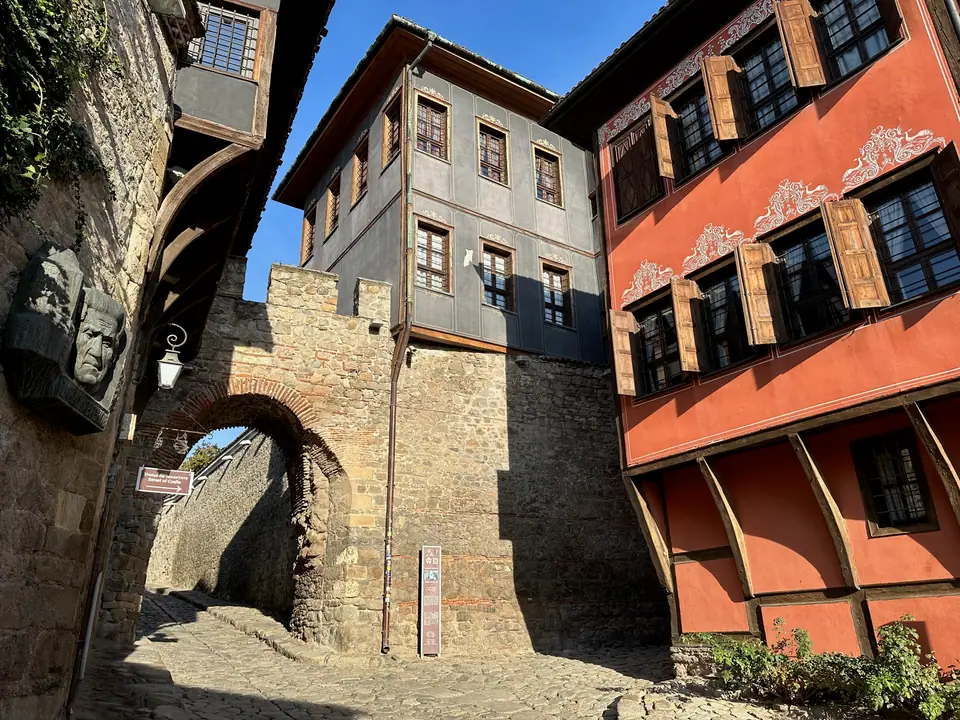
Walking south from Nebet Tepe funnelling past small garden walls leads straight through Hisar Kapia, Plovdiv's defining eleventh-century medieval gateway. Raised directly above second-century Roman stone footings, its tight arch braces overhanging Revival house bays soaring sharply overhead. Carts and walkers still squeeze single file beneath ancient mortar joints where fortress watchmen once barred eastern approaches.
Just steps west behind thick stone precinct walls rises St. Constantine and Helena Church, completed in 1832 atop far older early Christian shrine sites. Inside its cool timber nave gleam rich carved gilded iconostases and bright panel icons painted by master Zahari Zograf. Quiet cypress trees and weathered stone inscriptions lend the shaded churchyard serene stillness between bus groups.
Merchant Overhangs at Lamartine and Hindliyan Houses
Follow steep Knyaz Tseretelev Street south past Hisar Kapia to see stepped timber brackets supporting tall upper rooms over crooked corners. Built between 1829 and 1830 for merchant Georgi Mavridi, the dark-and-white Lamartine House lodged French poet Alphonse de Lamartine for three days in 1833. Every stepped erker overhang gains generous upper light while shrinking expensive street-level stone footprints.
Walk downhill along Artin Gidikov Street into the glowing terracotta courtyard of Hindliyan House, built in 1835 for wealthy Armenian trader Stepan Hindliyan. Masters Moko and Mavrudi from Chirpan spent six months painting vivid coastal murals of Venice, Alexandria, and Constantinople across sunlit reception walls. Guests also inspect an indoor marble water fountain beside a preserved vaulted private steam bath.
Kuyumdzhioglu's 130 Windows and Balabanov's Salon
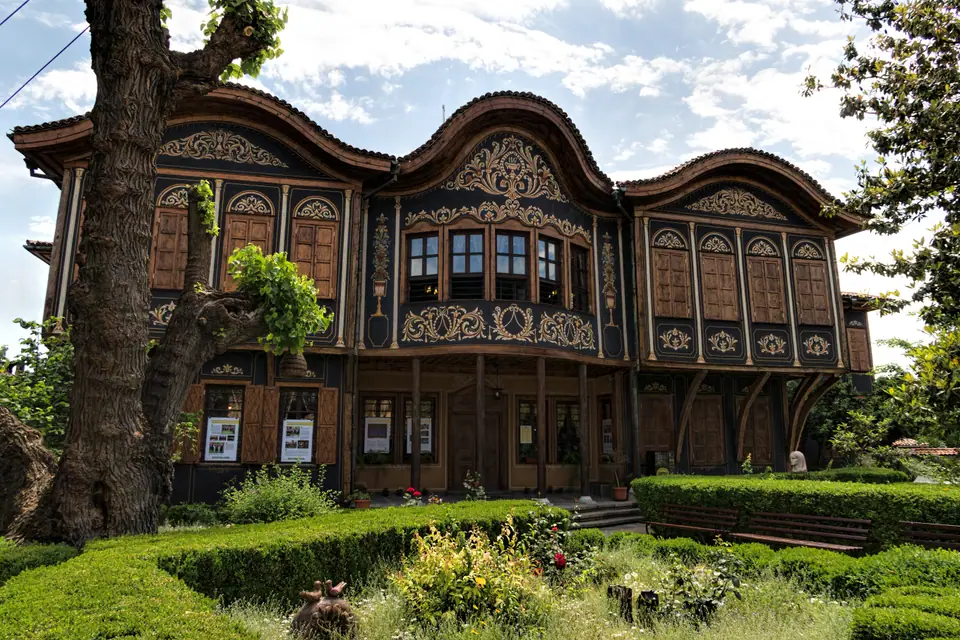
Dominating the cobbles beside Hisar Kapia rises the sweeping cobalt-blue 1847 Kuyumdzhioglu House, constructed by skilled master builder Hadzhi Georgi. Spanning 570 square metres across twelve rooms lit by 130 windows beneath a wavy Baroque gable, the mansion hosts the Regional Ethnographic Museum since 1938. Inside, displays exhibit heavy woollen shepherd cloaks, copper baking trays, silver belt buckles, and rosewater distilling stills.
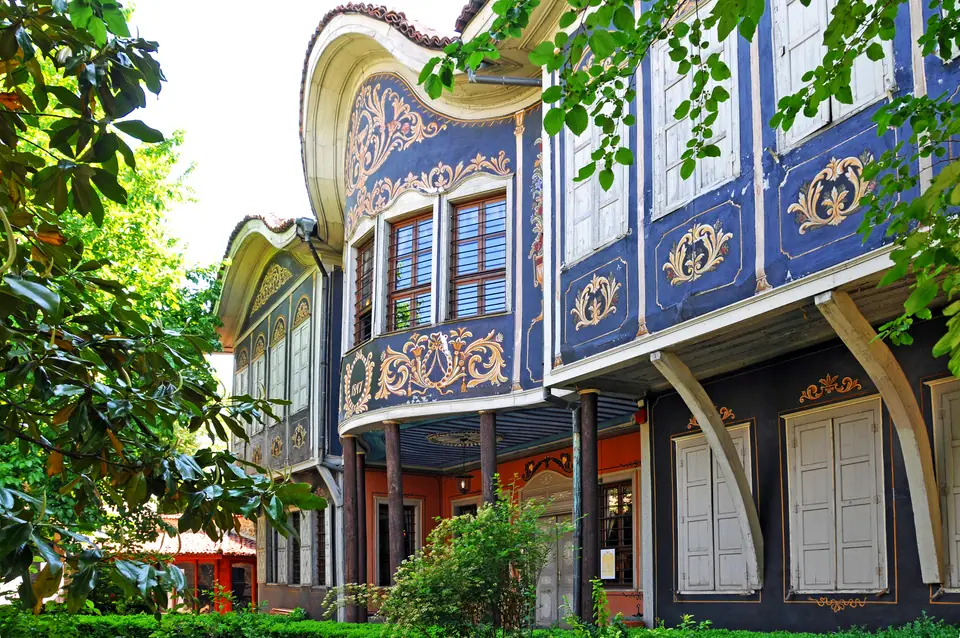
Two blocks south along Konstantin Stoilov Street sits brick-red Balabanov House, reconstructed in the late 1970s after wood merchant Luka Balabanov's earlier timber palace fell. Climb inside to admire its broad central upper reception hall, carved cedar-tone ceilings, traditional wall sofas, and rotating classical recitals.
Nedkovich's Classical Portico and Municipal Ticketing
Farther along quiet Tsanko Lavrenov Street shines yellow Nedkovich House, erected in 1863 for wealthy textile trader Nikola Nedkovich. Its stately four-column entrance portico and intact nineteenth-century Vienna furnishings showcase calmer domestic elegance away from tour queues. Keep pass boundaries clear before buying entries because Municipal Institute Ancient Plovdiv separates ticket pools neatly.
Ancient Plovdiv's five-site combined ticket includes Balabanov, Hindliyan, Nedkovich, Pharmacy Hippocrates, Zlatyu Boyadzhiev gallery, and the Ancient Roman Theatre. It explicitly excludes the Small Basilica, Bishop's Basilica, and the independent Regional Ethnographic Museum inside Kuyumdzhioglu House.
Walking the Three Hills Around Monday Closures
Because Balabanov, Hindliyan, Pharmacy Hippocrates, Zlatyu Boyadzhiev, and the Regional Ethnographic Museum all lock doors on Mondays, save indoor rooms for Tuesday through Sunday. Walk this downward six-stop loop so gravity eases strain descending toward mehana lunches. Sturdy walking trainers handle both steep rounded syenite stones and uneven timber stairs safely without slipping after afternoon summer rain.
- Nebet Tepe Summit: Begin high on reopened Bronze Age, Thracian, and medieval walls overlooking the entire Maritsa valley.
- Hisar Kapia and Kuyumdzhioglu House: Walk south beneath the medieval fortress arch to tour Baroque gables and Ethnographic galleries.
- St. Constantine and Helena Church: Turn west behind stone precinct walls to study gilded woodcarvings and Zahari Zograf icons.
- Balabanov and Hindliyan Houses: Explore expansive carved timber salons, rosewater fountains, and historic courtyard steam baths.
- Lamartine House and Theatre Rim: Step south past cantilevered erkers straight down to the Ancient Roman Theatre rim.
- Saborna Street Descent: Follow rounded grey stones cleanly downhill back onto flat pavements beside Dzhumaya Mosque.
Where it is
- 1Old Town Plovdiv
- Sofia Airport (SOF) · about 125 km from here in a straight line
- Directions in Google Maps
Stations and taxi ranks: OpenStreetMap. Airports: OurAirports. Distances are in a straight line.
Traveller tips
Real advice from people who have been to Plovdiv. Every tip is read by our team before it goes live.
No tips yet. Been here? Yours could be the first.
Thank you! Your tip will appear here after a quick review.
More in Plovdiv
Continue exploring Plovdiv with related neighbourhood, food, and planning guides