Photo: BrankaVV · CC BY-SA 4.0
Plovdiv Roman Stadium & Dzhumaya Mosque: Complete Guide
Side-by-side guide to Hadrian buried Roman Stadium sphendone, 14th-century Dzhumaya Mosque brick architecture, and active mosque visiting etiquette.
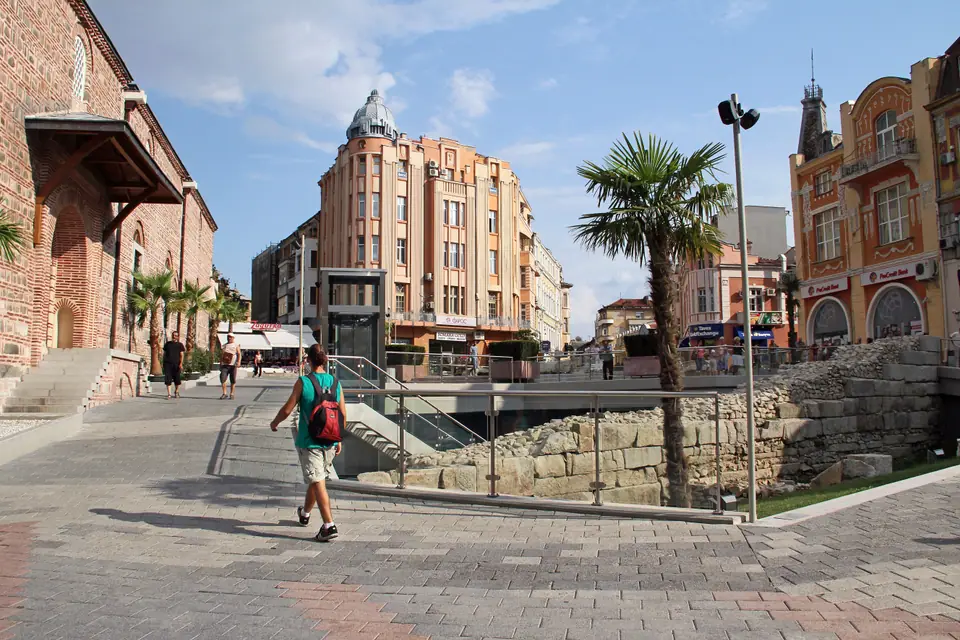
Nowhere else in central Plovdiv do classical and Ottoman worlds collide more visibly within one frame than across Dzhumaya Square in postcode 4000. Visitors peer straight down past wrought-iron rails into Hadrian's marble racing curve before turning slightly east toward patterned brick walls and lead domes. Setting monuments roughly 1,300 years apart side by side anchors the whole northern tip of the 1.75-kilometre pedestrian promenade between Taksim Tepe and Sahat Tepe.
Unlike steep hilltop climbs inside Trimontium, Dzhumaya Square sits completely flat one step south of Kapana cafes. Visit this sunken junction early before climbing east into the Old Town or continuing south toward the Ancient Theatre.
Hadrian's Buried Stadium Beneath Knyaz Alexander I Street
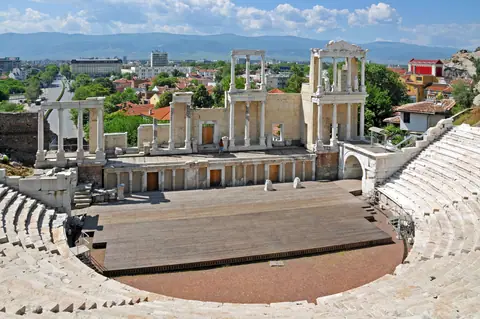
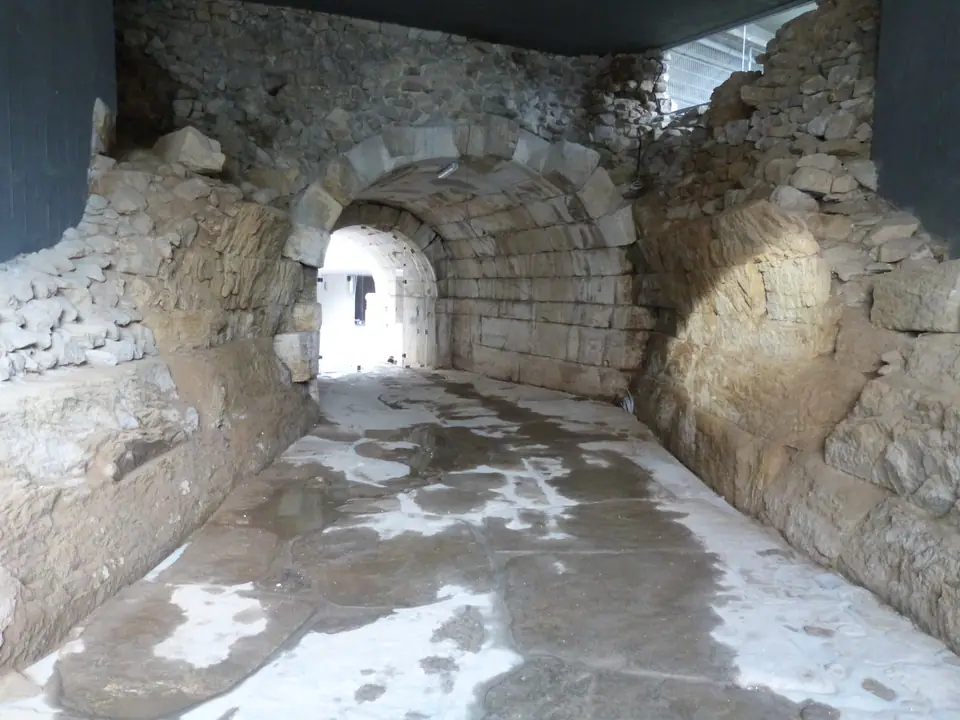
Early in the second century AD under Emperor Hadrian, military masons cut a monumental stadium neatly into the natural valley gap between Sahat Tepe and Taksim Tepe. Modelled unusually inside the walled city after Greece's Delphi arena, the oblong arena measured roughly 240 metres long by fifty metres wide. Inside stretched a one-stadion running track measuring around 180 metres, equal to 625 Roman feet, framed by fourteen marble seat rows for up to 30,000 spectators.
Civic athletes competed here in Pythian games as well as Alexandrian contests marking Caracalla's AD 214 arrival and Kendrisian festivals under Elagabalus in AD 218. Archaeologists initially documented marble tiers in 1923 before major excavations ran between 1973 and 1977 and again from 2004 to 2010. Protected as a national monument since 1995 and freshly landscaped through 2013, thirteen exposed marble seating rows and the vaulted northern sphendone arch now sit open daily free of charge.
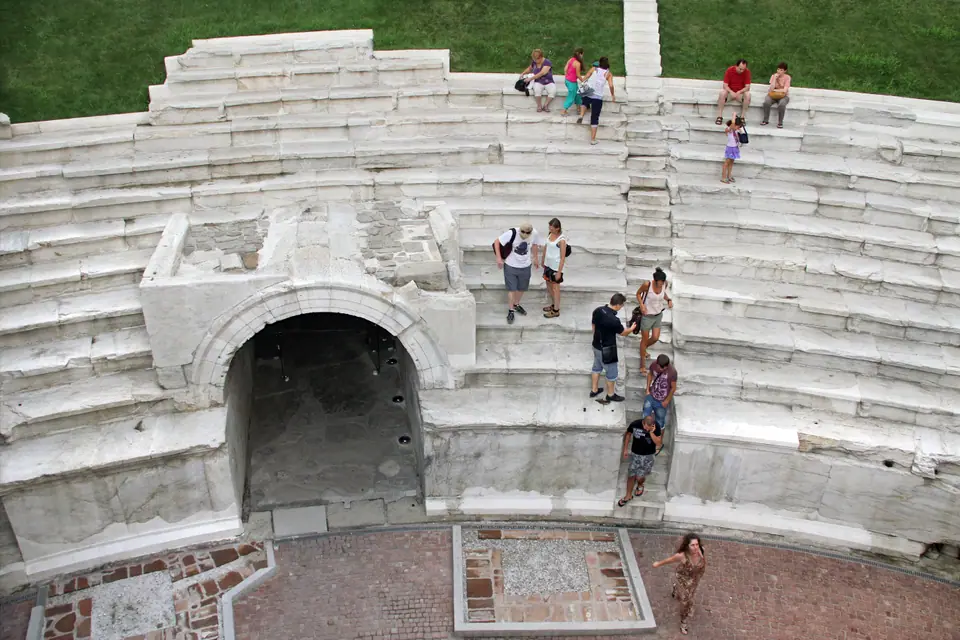
Beneath busy Knyaz Alexander I Street storefronts, intact marble wall courses and running track edges stretch south below modern ground floors, visible cleanly through glazed retail basement displays. Stand inside modern clothing halls and look down past glass balustrades at real Hadrianic starting blocks preserved beneath retail tiles. Walk straight down the stone ramp into the open northern terrace to inspect carved Greek inscriptions and donor wreaths along weathered benches.
Adjacent beside the square terrace, a tourist screening room presents short 3D stadium films reconstructing chariot races and cheering crowds right beneath current pedestrian flagstones. Notice above the sunken pit how early twentieth-century neoclassical shops bend gently around buried oval retaining walls.
Dzhumaya Mosque Under Murad II and Nine Lead Domes
Crowding the northeastern terrace immediately above Hadrian's sunken stone tiers rises Dzhumaya Mosque, known historically as Hudavendigar Camii. Erected atop the former Sveta Petka Tarnovska church following fourteenth-century Ottoman conquest, early local tradition recalls a 1360s prayer hall before Sultan Murad II built the surviving stone landmark between 1421 and 1451. Its thirty-three by twenty-seven metre interior spans 891 square metres, forming an imposing early Ottoman Friday mosque in Bulgaria.
Inspect the distinctive cloisonne masonry alternating pale dressed limestone blocks cleanly with twin horizontal courses of bright red fired brick around pointed arches. Overhead, nine lead-clad domes arranged in three symmetrical rows cap four heavy square internal stone piers. Late-eighteenth to early-nineteenth-century painted floral medallions and delicate geometric scrolls glow softly across plastered vaults inside the hall. Broad wooden entrance galleries filter bright noon glare before worshippers step onto woven prayer rows.
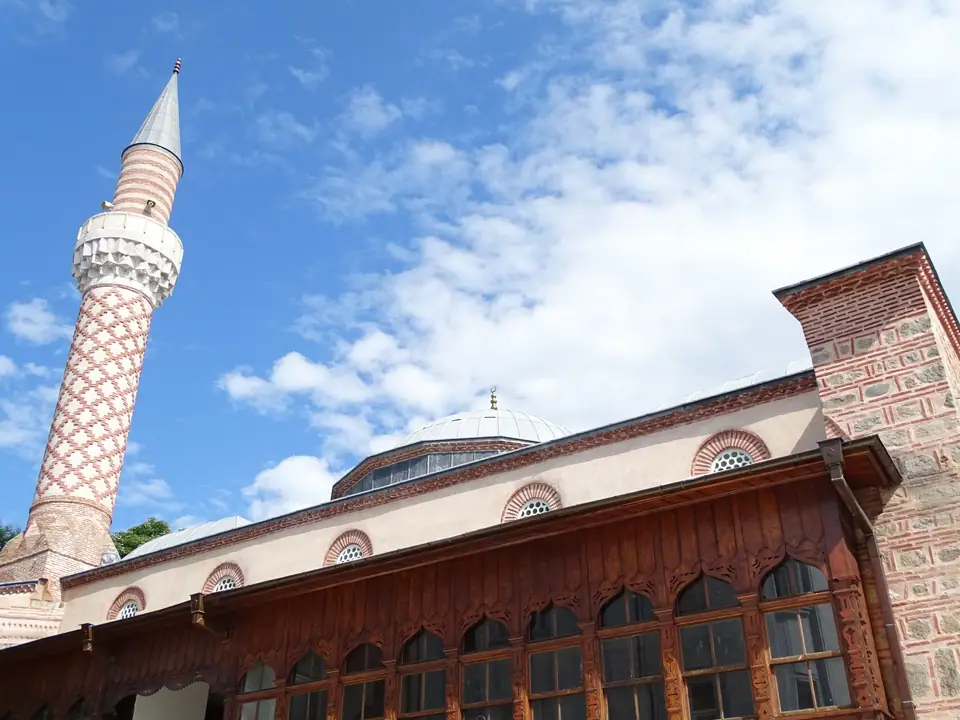
A tall cylindrical minaret rises beside the northern wall wrapped in terracotta brick diamond latticework catching crisp sunlight over square flags. Step past its southern masonry wall to spot an inlaid stone sundial mounted cleanly beside wooden balconies. Against the lower retaining buttress, an independent tea house serves slow Turkish coffee and flaky baklava beside ancient syenite blocks.
Reading Stadium Dimensions and Mosque Etiquette Together
Looking cleanly from sunken Roman vaults up toward Sultan Murad II brickwork turns Dzhumaya Square into an instant engineering comparison. Keep these dimensions and mosque courtesies in mind before stepping onto the prayer carpet.
| Feature | Ancient Roman Stadium | Dzhumaya Mosque (Hudavendigar Camii) |
|---|---|---|
| Primary Era | Early 2nd century AD (Emperor Hadrian) | Rebuilt 1421 to 1451 (Sultan Murad II) |
| Scale & Capacity | 240 metres long; up to 30,000 seats | 33 by 27 metre hall under nine domes |
| Construction Material | Marble seating, syenite vaults, brick arches | Cloisonne cut limestone, twin brick courses, lead domes |
| Visible Preservation | Open northern sphendone curve; rest buried under shops | Intact active Friday mosque and decorated minaret |
| Access & Dress | Free daily open-air terrace; ticketed 3D hall | Free exterior; modest dress and no shoes inside |
Dzhumaya Mosque remains an active parish house serving Plovdiv's Turkish and Muslim residents, demanding quiet respect inside vestibule doors. Time non-Muslim visits carefully outside congregational prayer windows, especially avoiding midday Friday gatherings when carpets fill quickly. Slip shoes neatly onto wooden racks outside, silence camera shutters, and cover bare knees or shoulders using clean wraps provided inside.
Outside worship hours, peaceful visitors regularly pause inside the entrance edge to absorb daylight streaming past upper arched tracery. Beneath cool domes, quiet visitors study painted Ottoman calligraphy framing high plastered arches in calm silence away from downtown traffic. Look upward at the wooden corner balconies and rhythmic masonry symmetry that give Sultan Murad II's hall remarkable serene poise.
Step back onto granite square flagstones afterwards to inspect glass shop basement displays stretching southward down Knyaz Alexander I Street. From there, continue straight across Central Square toward the Roman Forum, Odeon, and Bishop's Basilica mosaics or connect architectural heritage overland toward Istanbul.
Where it is
- 1Plovdiv Roman Stadium & Dzhumaya Mosque
- Sofia Airport (SOF) · about 125 km from here in a straight line
- Directions in Google Maps
Stations and taxi ranks: OpenStreetMap. Airports: OurAirports. Distances are in a straight line.
Traveller tips
Real advice from people who have been to Plovdiv. Every tip is read by our team before it goes live.
No tips yet. Been here? Yours could be the first.
Thank you! Your tip will appear here after a quick review.
More in Plovdiv
Continue exploring Plovdiv with related neighbourhood, food, and planning guides