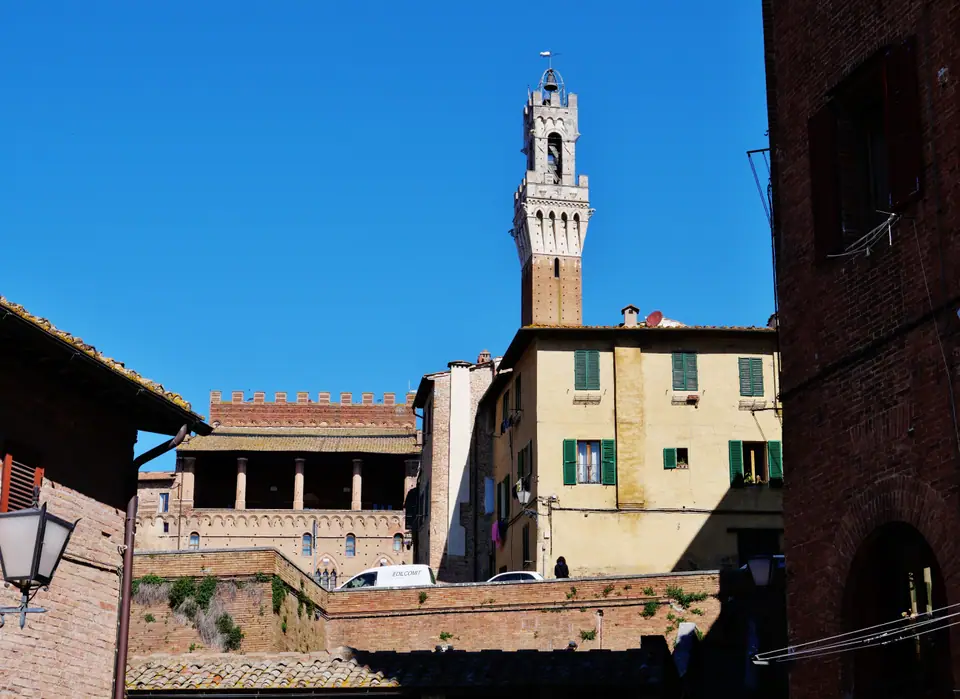
Photo: Zairon · CC BY 4.0
Palazzo Pubblico and Torre del Mangia: Civic Art and the Tower Climb
Inside Siena medieval government seat: Museo Civico masterpieces by Lorenzetti and Simone Martini, Lippo Memmi 102 m stone-crowned tower and climb prep.
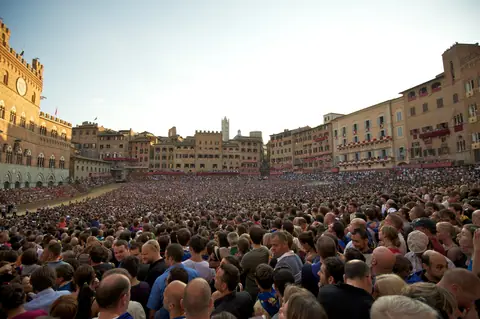
Closing the flat southern base of Piazza del Campo, Palazzo Pubblico bends subtly inward to trace curved bricks outside. That fortress-like brick block balances secular republican rule opposite hilltop Siena Cathedral. Begun in 1297 for Siena's ruling Nine (Noveschi), its facade pairs sturdy grey travertine ground arcades beneath three brick upper storeys, crenellated rooflines and the 102-metre Torre del Mangia.
Passers-by step freely inside shaded ground courtyards without admission tickets. Notice heraldic stone shields carved along brick courtyard walls displaying medieval civic coats of arms across centuries. Upstairs rooms inside Museo Civico guard celebrated medieval secular frescoes beside one tall brick tower climb overlooking Tuscany. Align museum timing cleanly with Siena sightseeing routes and warm-day strategies on best time to visit Siena.
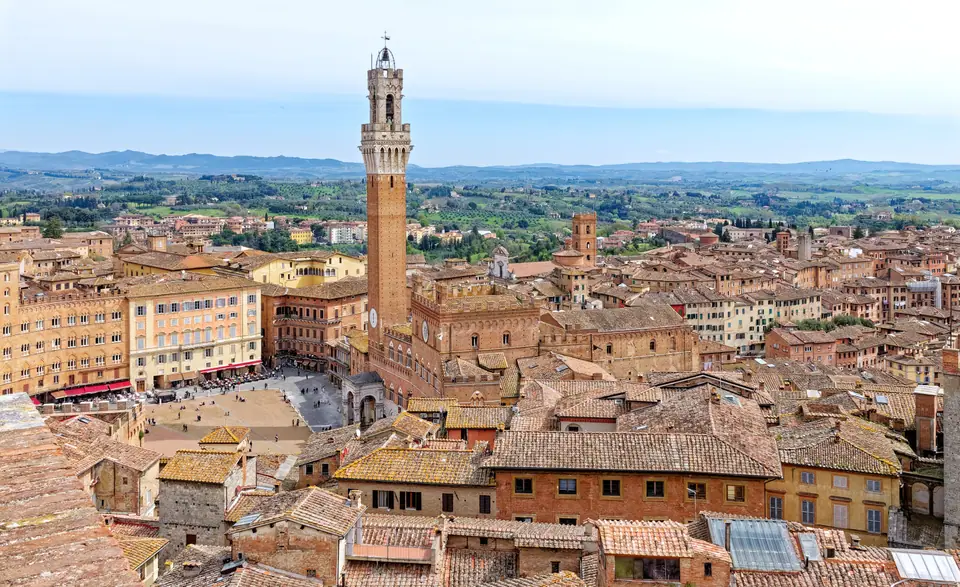
Sala dei Nove: Lorenzetti's Good and Bad Government
Broad travertine stairs rising off Cortile del Podestà deliver ticket holders directly into former government council rooms inside Museo Civico. Centre stage awaits inside the Sala dei Nove (Sala della Pace). Painter Ambrogio Lorenzetti covered three lime plaster walls between 1338 and 1339 with his master cycle: The Allegory and Effects of Good and Bad Government in City and Country.
Setting church miracles aside, Lorenzetti captured 14th-century Tuscan street craft in vivid everyday truth. Twenty-four Sienese citizens clasp hands holding the woven cord of civic concord. Across town lanes, brick masons lay mortar atop wooden scaffolds, cobblers fit shoes, bridal dancers glide past market stalls and farmers harvest olive slopes outside city walls.
Facing directly across the hall stretches Tyranny's shattered cityscape, flaked gently across dry plaster yet staying strikingly readable beside calm restoration plaques. Spend quiet minutes along the eastern landscape wall counting walled villages, pack mules and busy bridges threading neatly across terracotta hills. Few surviving medieval cycles document ordinary Tuscan tailors, stone builders and countryside trade in such grounded humanist clarity.
Adjacent Sala del Concistoro shows bright ceiling frescoes painted two centuries later in Renaissance Siena, framing carved walnut benches and stone portals smoothly across adjoining civic chambers.
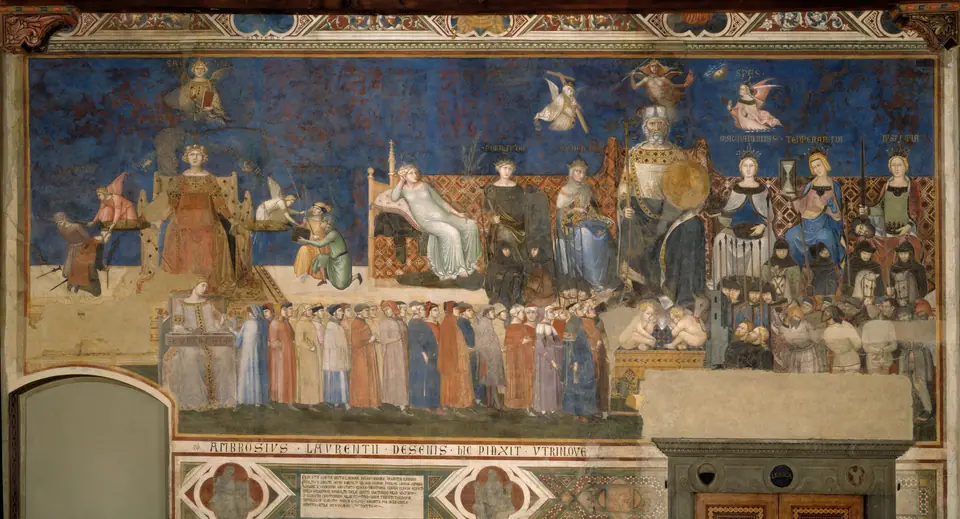
Sala del Mappamondo and Equestrian Debates
Carved wooden arches open immediately into the vast Sala del Mappamondo (Council Hall). Simone Martini painted his glowing Maestà here, finishing on 15 June 1315 before returning in 1321 to restore key heads and hands. Enthroned beneath red silk canopies beside kneeling city saints, stern gilded Latin inscriptions instruct magistrates to judge without malice.
Opposite rides military commander Guidoriccio da Fogliano trotting calmly over fortified hillside towns and wooden siege palisades. Modern restoration probes uncovered older painted walls hidden cleanly underneath Guidoriccio's plaster bed. Those discoveries sustain active scholarly debates questioning Martini's long-standing traditional attribution. Look toward faded circular wall grooves below where Lorenzetti's rotating parchment map once turned.
Torre del Mangia Architecture and Height Claims
Rising cleanly off the left flank of Palazzo Pubblico, the brick tower topped by pale travertine corbels climbs 102 metres high atop three-metre-thick base walls. Lippo Memmi supplied the design executed beside sculptor Agostino di Giovanni. Popular civic legend ties its playful name to spendthrift first bell-ringer Giovanni di Balduccio (also recorded as Giovanni di Duccio), nicknamed Mangiaguadagni ("eater of profits").
- Italian Civic Tower Comparison: Standing 102 metres high puts Torre del Mangia 10 metres under Cremona's 112-metre Torrazzo. Meanwhile Siena's tower clears Bologna's 97-metre Asinelli Tower by 5 metres.
- Optical Cathedral Symmetry: Designers matched the tower elevation to level visually with the 77-metre Duomo roofline up the higher western hill. That alignment gives Church and State balanced prominence across skyline views despite a 25-metre base offset.
- Fourteenth-Century Construction: Built in terracotta brick across the second quarter of the 14th century (1325 to 1348), the slender shaft supports a travertine bell belfry and loggia anchor at its base.
- Clock Shaft and Sunto Bell: Lower shaft stonework carries Siena's mechanical clock from 1360. Above hang three bells crowned by heavy Sunto, ringing solemnly during summer Palio parades.
Confirm active timed entry windows, small-bag storage locker requirements and queue limits directly on comune.siena.it before waiting inside the brick loggia.
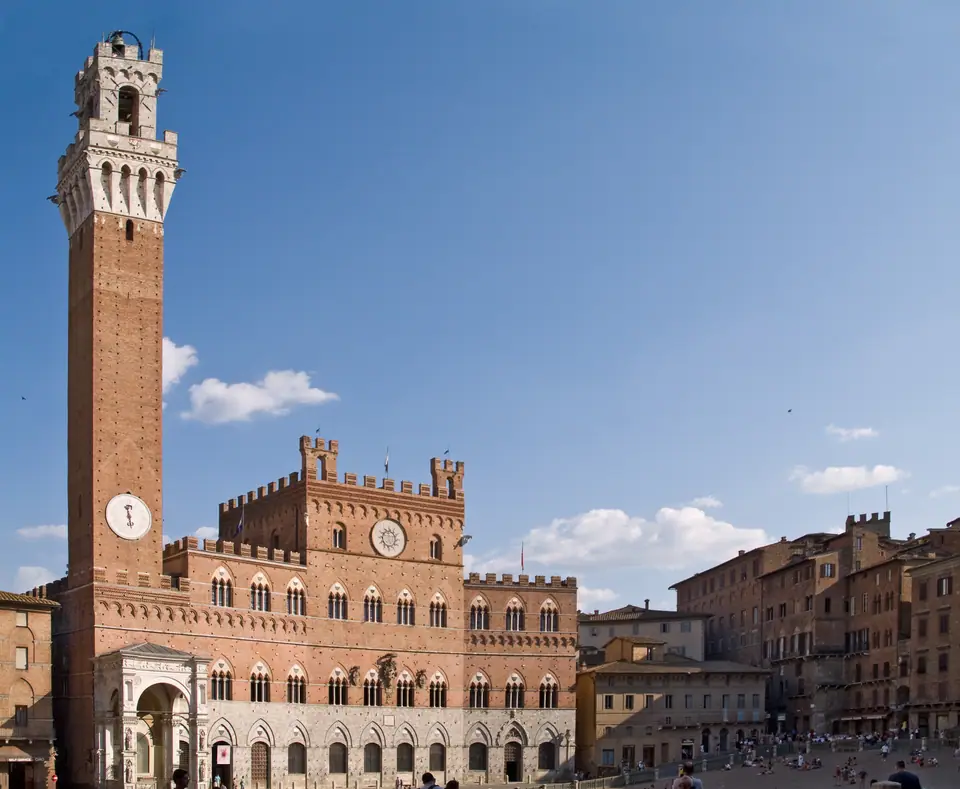
Cappella di Piazza and Climb Prep
Hugging the tower's lower square edge rests the cool white marble portico of Cappella di Piazza, founded in 1352 as Siena's thank-offering following the 1348 plague. Gothic corner pilasters rose in 1378 beside carved gable figures finished by 1382. Architect Antonio Federighi added a crisp Renaissance marble barrel vault from 1461 to 1468. Restorers moved Sodoma's faded 1537 to 1539 chapel frescoes indoors inside Museo Civico.
Before joining afternoon stair queues, walk back across Cortile del Podestà to read carved stone coats of arms lining quiet brick arches. Each shield records historical magistrates who governed Siena during medieval communes across centuries of civic debate. Downstairs municipal exhibitions occasionally open temporary historic galleries around lower palace chambers beside bookshops. Quiet benches underneath shady cloister vaults also let tired hikers rest calmly between museum rooms and tower ascents.
Climbing roughly four hundred worn internal stone steps up Torre del Mangia rewards early starts before summer noon sun warms cramped stairways. Stepped flights grow tight near top stone arches without lifts or hand-rails on every turn. Visitors pause briefly along narrow arched landings midway up to let descending climbers squeeze comfortably past. At the upper travertine parapet, gentle Tuscan wind cools faces after the steep masonry climb while church bells hang close overhead. Pack supportive rubber walking soles for slick stone landings, lock backpacks downstairs as directed, and step back onto Siena Cathedral's Facciatone balcony, check central sleeping alleys or trace our three-terzi walking map afterwards to match every valley landmark from two angles.
Where it is
- 1Palazzo Pubblico and Torre del Mangia
- Florence Airport, Peretola (FLR) · about 56 km from here in a straight line
- Directions in Google Maps
Stations and taxi ranks: OpenStreetMap. Airports: OurAirports. Distances are in a straight line.
Traveller tips
Real advice from people who have been to Siena. Every tip is read by our team before it goes live.
No tips yet. Been here? Yours could be the first.
Thank you! Your tip will appear here after a quick review.
More in Siena
Continue exploring Siena with related neighbourhood, food, and planning guides