


























Photo: Holger Uwe Schmitt · CC BY-SA 4.0
Piazza del Campo: Nine Brick Wedges, Fonte Gaia and Civic Palaces
How Piazza del Campo works as open-air civic engineering: the 4.6 m brick gradient, Government of the Nine paving symbolism, Fonte Gaia and palace rim.
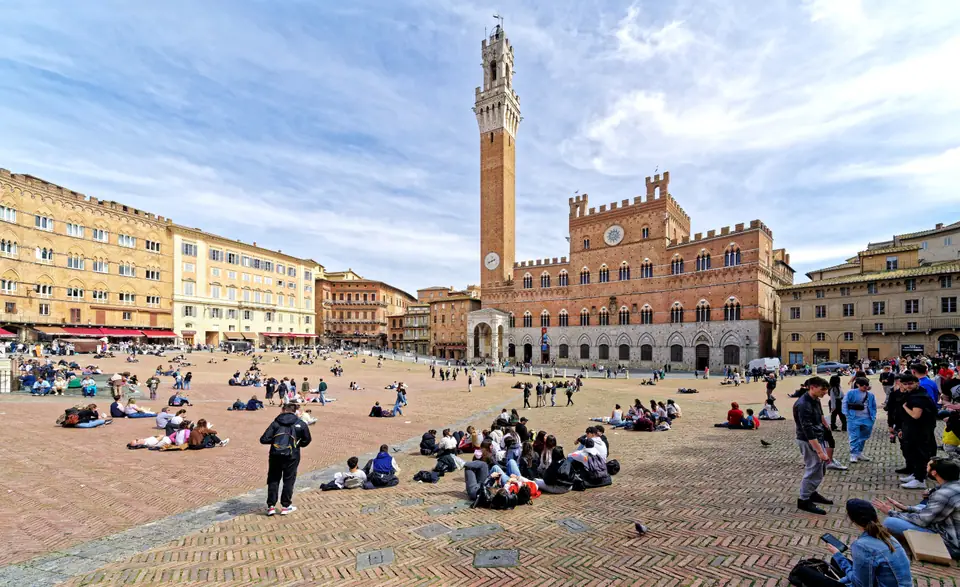
Piazza del Campo rejects flat Renaissance symmetry entirely, which makes stepping out from narrow Sienese lanes so startling. Medieval builders carved an open scallop-shell hollow roughly 425 by 650 feet (130 by 198 metres) across neutral hillside. Three early hillside settlements met here outside older walls: Castellare, San Martino and Camollia. Civic layout started in 1169 before masons angled warm brick smoothly downward 4.6 metres toward Palazzo Pubblico.
Early dawn brings empty bricks before waiters open umbrellas across northern arcades. Walk gently down the brick slope before climbing Torre del Mangia or exploring race-week access on our Palio guide.
Nine Red-Brick Wedges and the Gavinone Drain
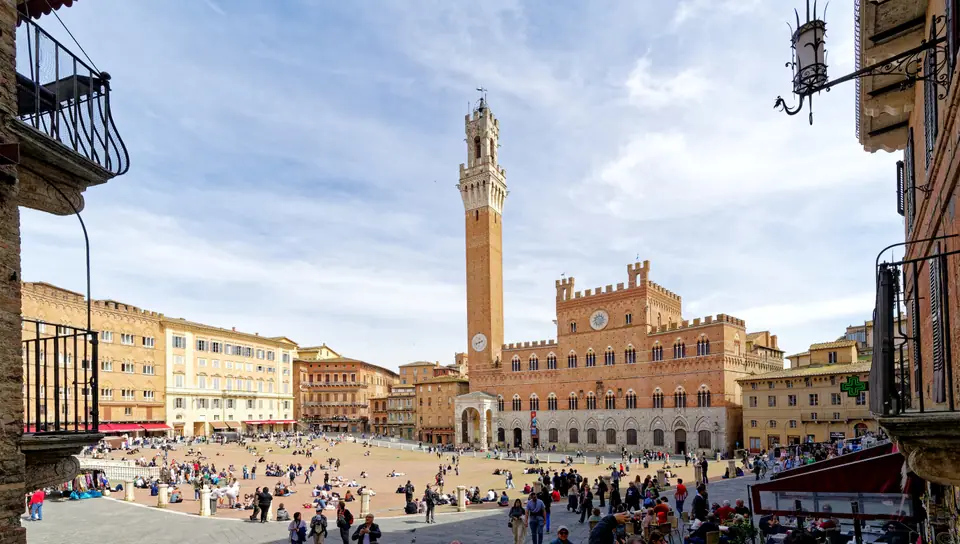
Eight pale travertine lines slice warm herringbone brickwork into nine clean triangular wedges. Rainwater runs smoothly straight down all nine slopes into one stone drain called the Gavinone beside Palazzo Pubblico. Finished in 1349, one year after plague halved Siena's population, those nine brick fans honour the Noveschi (Council of the Nine). That nine-man council guided Siena's richest civic building decades from 1292 until 1355.
- Eleven Hidden Gateways: Eleven stepped stairways including Costarella dei Barbieri and shadowed medieval chiassi pierce outer facades discreetly. No wide avenue breaks the continuous architectural ring around the bowl.
- Harmonised Palace Silhouettes: Medieval statutes forced proud aristocratic families like Sansedoni, Piccolomini and Saracini to lower tall battle towers into level Gothic window heights.
- 1966 Pedestrian Landmark: Siena banned private cars from Piazza del Campo in 1966, making it Europe's earliest pedestrian central civic square.
- Twelfth-Century Roots to 1349 Paving: Carved out across 12th-century common meeting ground formalised in 1169, the curved basin gained its red-brick herringbone surface in 1349.
Strolling from northern café tables down to the town-hall courtyard spans roughly 200 metres. Walking that brick bowl end to end takes barely three calm minutes on foot. Turning back at the bottom lets curved Gothic facades frame open sky like a hillside stone amphitheatre. Notice how the curved outer rim also traces subtle hill elevations around Croce del Travaglio and Banchi di Sotto without sharp right angles anywhere.
Spot compact stone boundary posts framing the outer cobblestone ring along the bricks. During July and August Palio weeks, municipal teams slot tall wooden fencing cleanly into those stone sockets. Outside festival weeks, students and residents perch peacefully along dry brickwork soaking up warm Tuscan afternoon light.
Watch your step near lower gutters beside Palazzo Pubblico whenever sudden autumn showers clear terracotta eaves. Rainwater speeds down angled travertine ribs toward the Gavinone grate, turning damp edge stones slick beneath smooth shoe leather. Dry benches wait quietly inside nearby stone loggias whenever brief clouds roll past.
Fonte Gaia Marble Panels and Bottini Aqueducts
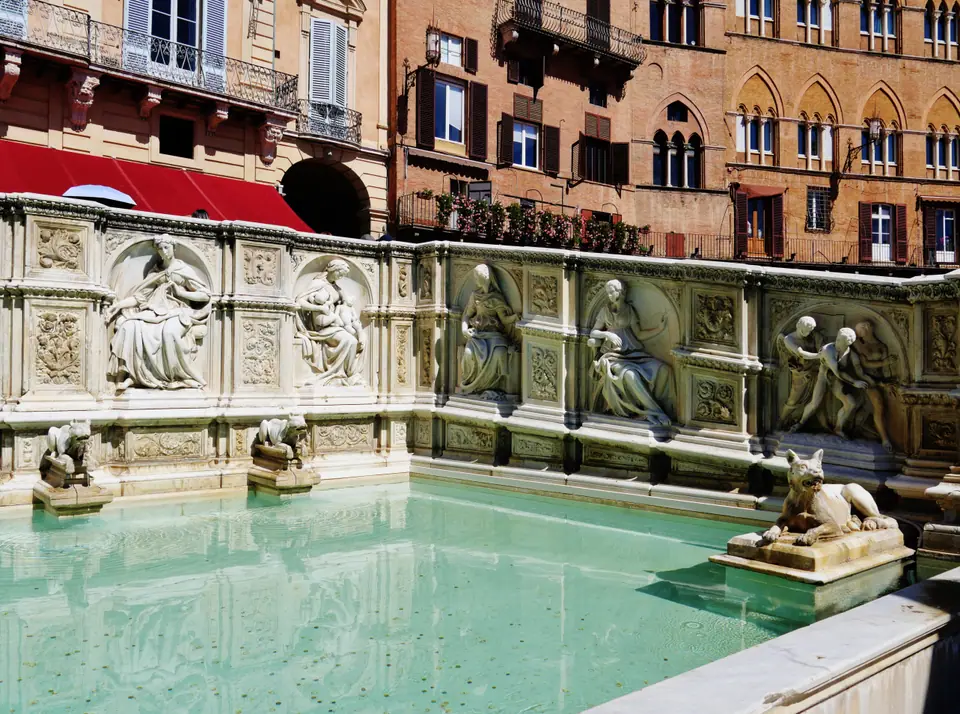
Centred squarely beneath the northern brick curve glows the carved white marble rectangle of Fonte Gaia ("Fountain of Joy"). Municipal elders opened this basin in 1419 to mark fresh water arriving through Siena's underground clay conduits called bottini. Skilled tunnel workers excavated miles of sandstone channels beyond city walls, replacing an unadorned 1342 precursor.
Master sculptor Jacopo della Quercia framed three white marble sides with carved narrative reliefs depicting Christian virtues, Genesis scenes and Siena's twin wolf legend. Four centuries of sun, hail and frost gradually pitted soft limestone figures outdoors. In 1866 municipal leaders engaged Tito Sarrocchi to carve durable marble replacements running today, omitting two nude statues of Rhea Silvia and Acca Larentia.
Restorers carried Quercia's weathered 1419 originals safely inside Santa Maria della Scala opposite Siena Cathedral. Walking uphill from Fonte Gaia past noble palaces along Via di Città toward the Duomo takes roughly five brisk minutes. Public water jets along modern fountain corners still offer chilled sips during crisp walks between square arches.
Trace architectural rhythm across noble house walls climbing gently along the western and northern edges. Prominent merchant residence Palazzo Sansedoni turns its terracotta brick facade steadily round the northwestern curve with crisp white limestone window mullions. Just steps below sits Palazzo Piccolomini near Via Banchi di Sotto, uniting Siena's secular marketplace directly with aristocratic stone avenues. Late afternoon sunlight warms Sansedoni's upper storeys golden brown right across the basin.
Everyday Square Etiquette and Sunlight Timing
No park trees interrupt Piazza del Campo's wide red saucer, letting midday Tuscan sunlight warm exposed brick uniformly across every season. University students, picnicking families and cycling crowds watching early-March Strade Bianche gravel racers gather directly along lower brickwork near Cappella di Piazza. Check sheltered afternoon rooms during intense July heat peaks on our Siena weather page.
Compare café menu signs closely before selecting seated patio chairs ringing the upper northern arc. Seated table service adds substantial service charges compared with espresso bars tucked one block north along Via Banchi di Sopra. Standing quietly beside polished marble espresso counters for morning macchiato and crisp pastries remains normal Sienese rhythm before shops open full awnings. Mid-morning hours also keep outdoor café seats comfortably cool beneath broad palace cornices before afternoon sunlight hits straight down onto bricks.
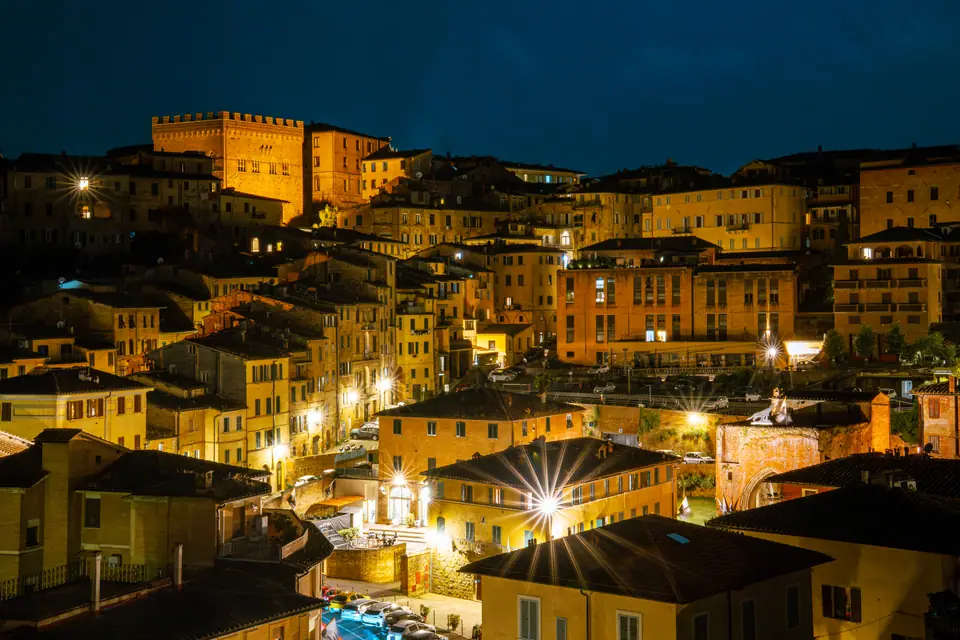
Explore family trattorie off the square via our Siena food guide and choose quieter sleeping alleys using Siena accommodation quarters. Step into Costarella dei Barbieri or Vicolo del Contino after dark to watch lantern glow stretch quietly back down the bricks. Look north toward Palazzo Piccolomini arches and south toward Cappella di Piazza to appreciate how cleanly stone lanterns frame medieval brickwork once day coaches depart. Photographers arriving around dawn catch pink morning light touching Torre del Mangia long before cleaning vans pull away. Even though the square lies inside Siena's 24-hour car-free core, electric sweepers and dawn delivery vans cross quietly before morning cafés open.
Where it is
- 1Piazza del Campo
- Florence Airport, Peretola (FLR) · about 55 km from here in a straight line
- Directions in Google Maps
Stations and taxi ranks: OpenStreetMap. Airports: OurAirports. Distances are in a straight line.
Traveller tips
Real advice from people who have been to Siena. Every tip is read by our team before it goes live.
No tips yet. Been here? Yours could be the first.
Thank you! Your tip will appear here after a quick review.
More in Siena
Continue exploring Siena with related neighbourhood, food, and planning guides
Best Time to Visit Siena: Monthly Weather, Cathedral Floor and Crowds
Siena, Italy
What to Eat in Siena: Pici Pasta, Panforte IGP, Cinta Senese and Chianti
Siena, Italy
Siena Cathedral Complex: Opa Si Pass, Marble Floor and Facciatone
Siena, Italy
The Palio di Siena: 17 Contrade, Trial Days and Square Logistics
Siena, Italy
