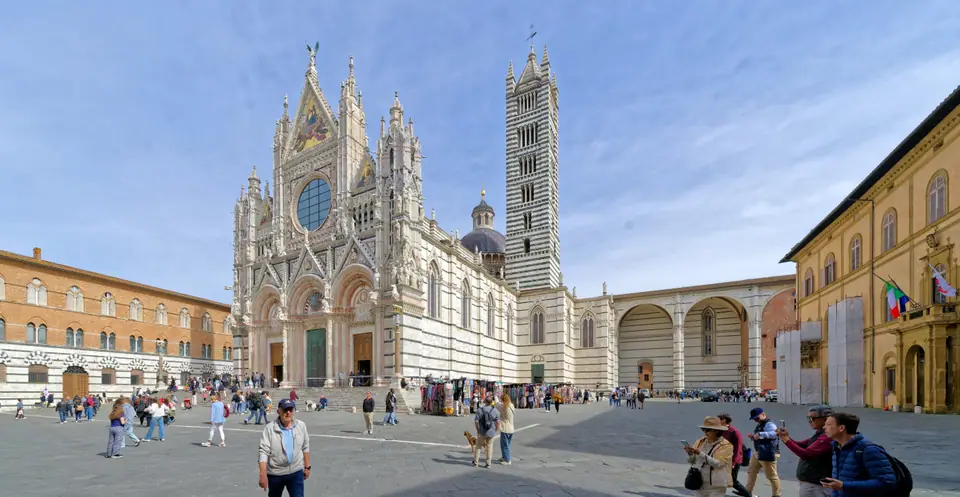
Photo: Holger Uwe Schmitt · CC BY-SA 4.0
Siena Cathedral Complex: Opa Si Pass, Marble Floor and Facciatone
Master the Siena Cathedral complex: how the Opa Si Pass connects six monuments, when the 56-panel marble floor opens, Porta del Cielo and dress rules.
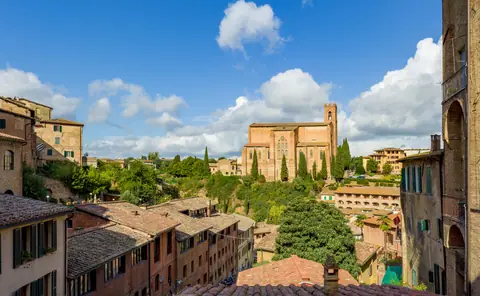
Horizontal bands of Carrara white and Prato green marble crown the Cathedral of Santa Maria Assunta (Duomo di Siena) visibly above western rooftops. Measuring 89.4 metres long inside and soaring 77 metres high on a Latin-cross plan, the church anchors six monuments overseen by Opera della Metropolitana (OPA). Groundbreaking ran back to 1196, daily masses operated by 1215 (refuting older 1179 myths), and the crossing dome finished in 1264.
Choosing the right bundled pass before lining up beside west doors keeps morning plans effortless. Link cathedral art naturally with Santa Maria della Scala opposite the steps, or compare heights against Torre del Mangia below.
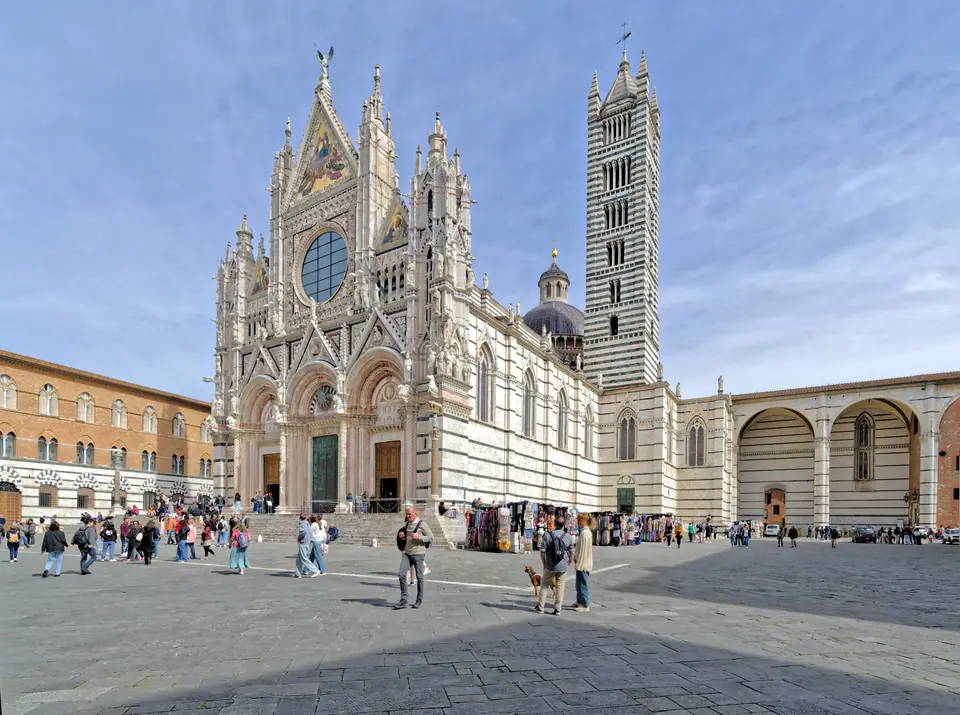
Unfinished Duomo Nuovo and the Facciatone Wall
In 1339 republican leaders launched an extraordinary expansion meant to turn the existing church into simply the side transept of Italy's largest basilica. Master masons pushed tall white marble arcades outward largely under Giovanni di Agostino until two shocks halted building forever. The 1348 plague halved Siena's workforce, and surveyors noted unstable ground beneath eastern piers, driving formal abandonment in 1355.
Stepping out right past the facade reveals tall unfinished skeletal arches standing bold against blue sky over Piazza Jacopo della Quercia. Tight spiral steps inside Museo dell'Opera del Duomo climb straight atop that curtain wall, the soaring Facciatone (fah-chah-TOH-neh). Walkways at the top deliver sweeping framed panoramas across Piazza del Campo and Tuscan valleys. Reserve museum entry times carefully on operaduomo.siena.it before travelling, since narrow landings hold strict visitor batches. Evening climbs catch warm stone light hitting the striped nave cupola just below your railing.
When the 56 Inlaid Marble Floor Panels Open
Art historian Giorgio Vasari praised the Duomo pavement as the finest stone floor ever crafted. Fifty-six polychrome commesso marmoreo panels span side aisles and transepts, made between the 14th and 16th centuries by roughly forty mostly Sienese masters. Look closely for Domenico di Niccolò dei Cori's 1413 to 1423 David panels, Pietro di Tommaso del Minella's 1447 scenes, Francesco di Giorgio Martini's 1473 designs and ten Sibyl figures.
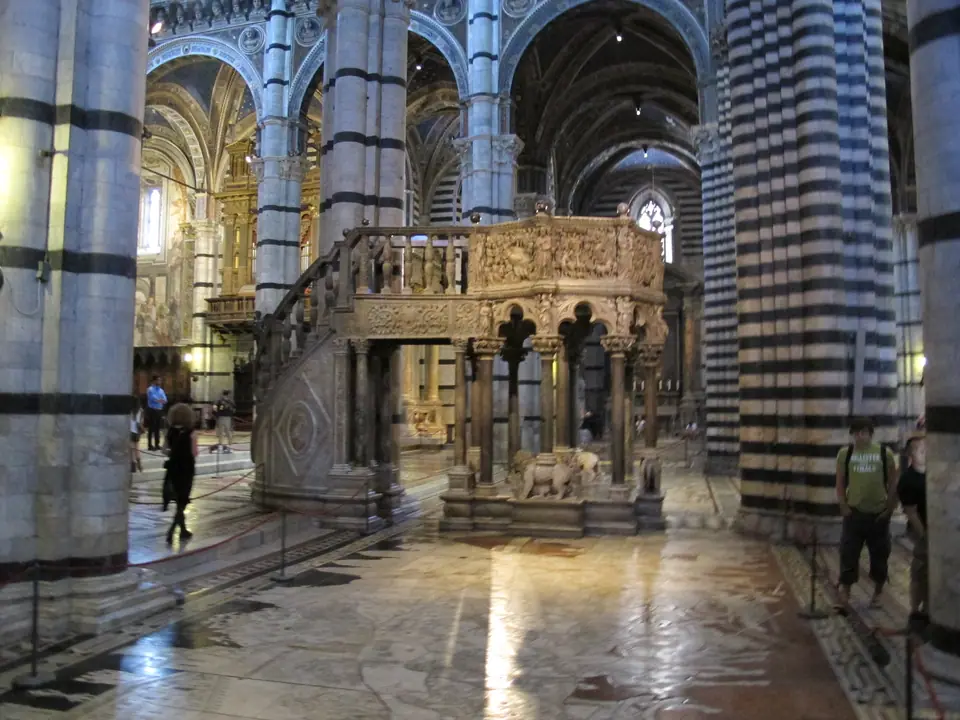
To prevent walking boots grinding fragile tinted limestone inlays flat, conservation staff seal most panels under sturdy protective board covers through winter and spring. Full floor uncovering spans only six to ten weeks annually, regularly encompassing September plus late August or early October edges. Verify exact yearly opening announcements directly on operaduomo.siena.it before picking flight weeks. Outside autumn months, several outer side-aisle scenes stay uncovered for daily viewing.
Nicola Pisano Pulpit and Pinturicchio Library
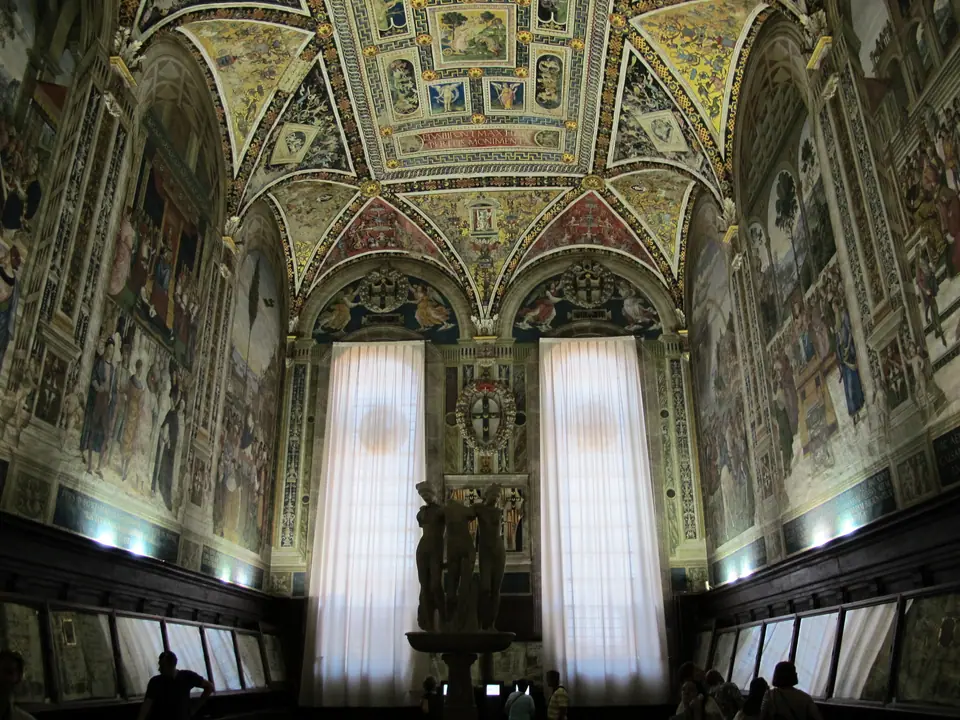
Beneath the hexagonal crossing cupola rises Nicola Pisano's octagonal marble pulpit carved between 1265 and 1268 for Bishop Federico Visconti. Young workshop sculptors Arnolfo di Cambio and Giovanni Pisano assisted on the crisp Gospel reliefs, while Bartolomeo Neroni added bronze steps in 1543. Steps off the north nave enter Cardinal Francesco Todeschini Piccolomini's bright 1492 to 1507 library. Pinturicchio painted ceiling vaults and ten crisp arches celebrating Pope Pius II around an antique Roman marble copy of the Three Graces.
- Bernini and Michelangelo Works: Inspect Bernini's dramatic Mary Magdalene and Saint Jerome inside the 1659 Chigi Chapel. Look closer nearby to see four crisp early Michelangelo statues carved between 1501 and 1504 for Andrea Bregno's Piccolomini Altarpiece.
- Facade Evolution and Campanile: Upper western marble gables rose between 1360 and 1380, crowned later by 1878 Venetian mosaics and Vico Consorti's 1946 bronze central doors, while the six-bell campanile preserves its oldest bell cast in 1149.
Vaulted rooms inside Museo dell'Opera del Duomo next door shelter Giovanni Pisano's original facade statues inside the peaceful Crypt of the Statues. Walking past weathered 13th-century figures indoors shows why crisp exterior sculptures outside are protective stone copies. Upstairs galleries also safeguard Duccio's two-sided Maestà altarpiece (1308 to 1311), the original stained-glass rose window and glowing gold liturgical chalices away from midday crowd crush.
Opa Si Pass vs Porta del Cielo Roof Access
Choose neatly between two official OPA admission options sold across Piazza del Duomo:
- Opa Si Pass (Three-Day Bundle): Combines Cathedral nave entry, Piccolomini Library, Baptistery of San Giovanni, 1999 Crypt chambers and Museo dell'Opera del Duomo displaying Duccio's golden 1308 to 1311 Maestà altarpiece.
- Porta del Cielo Reservation: Separate guided upper route traversing dusty attic beams and exterior marble gallery ledges high beneath nave clerestories. Book weeks early before peak spring weekends.
Leaving generous breaks between nave viewing and museum floors helps absorb gold-leaf panel paintings calmly. Morning daylight brightens central rose glass cleanly before late afternoon crowds fill eastern chapels.
Baptistery Stairs, Crypt and Santa Maria della Scala
Exit through northern side doors past Palazzo Reale to step down steep external marble stairs onto quiet Piazza San Giovanni. Tucked beneath the cathedral apse stand both the Gothic Baptistery (housing Donatello, Ghiberti and Quercia's bronze-and-marble font) and the adjacent 1999 Crypt. Excavators cleared rubble filling those crypt vaults since the 15th century, uncapping 45 vivid late 13th-century Passion frescoes.
Check liturgical parish mass schedules on cathedral noticeboards before entering during Sundays and Catholic feast mornings. Active worship pauses casual aisle roaming inside central piers cleanly for brief periods. Tour guides and individual ticket holders both wait discreetly outside carved side chapels until parish prayers finish.
Cathedral Dress Rules and Photography Restraints
Siena Cathedral remains an active Roman Catholic parish church, so door stewards inspect dress modesty strictly every season. Bare shoulders, low straps and hems rising above knees prevent entry even during warm July afternoons. Pack a lightweight wrap inside daybags to throw comfortably over shoulders before stepping inside.
Keep voices low near devotional side altars, disable camera flash inside Libreria Piccolomini vaults and follow directional floor arrows during September marble-viewing season. Morning entry passes let quiet contemplation settle calmly beside green-and-white columns before guided bus groups reach central pews. Check calm queuing months on our Siena seasons page, walk steep surrounding spurs using three-terzi orientation, or plan neighbourhood food stops on what to eat in Siena.
Where it is
- 1Siena Cathedral Complex
- Florence Airport, Peretola (FLR) · about 56 km from here in a straight line
- Directions in Google Maps
Stations and taxi ranks: OpenStreetMap. Airports: OurAirports. Distances are in a straight line.
Traveller tips
Real advice from people who have been to Siena. Every tip is read by our team before it goes live.
No tips yet. Been here? Yours could be the first.
Thank you! Your tip will appear here after a quick review.
More in Siena
Continue exploring Siena with related neighbourhood, food, and planning guides