





















St John's Co-Cathedral Guide: Caravaggio's Beheading, 405 Marble Tombs & Tips
Inside Valletta's greatest monument: how to visit St John's Co-Cathedral, understand Caravaggio's signed masterpiece in the Oratory, read the 8 Chapels of the Langues, and avoid queues.
The church was commissioned in 1572 by Grand Master Jean de la Cassière for the Order of the Knights of St John and designed by Maltese military architect Girolamo Cassar. Today, St John's Co-Cathedral (Kon-Katidral ta' San Ġwann) is the artistic and spiritual crown jewel of Malta. Its austere Mannerist facade on St John's Square was built to withstand cannon fire after the Great Siege of 1565. Inside, the church was transformed in the 1660s by Calabrian artist and Knight Mattia Preti into a magnificent theatre of carved gilded limestone, crowned by Caravaggio's greatest painting. Pair this monument guide with our Valletta dress and shoe rules and our Grand Master's Palace guide.
| Visitor Information | 2026 Details (as of November 2026) | Important Visitor Rule / Tip |
|---|---|---|
| 1. Ticket Prices & Audio Guide. | €15.00 adult / €12.00 senior & student / Free under 12. | Includes handheld audio guide in 8 languages (not covered by Heritage Malta Pass). |
| 2. Opening Hours (Sightseeing). | Mon to Sat 09:00 to 16:45 (last admission at 16:15). | Closed Sundays and public feast days for tourist visits (open for Mass only). |
| 3. Visitor Entrance vs Exit. | Enter on Republic Street side; exit onto St John's Square. | Book online at stjohnscocathedral.com to use the faster pre-paid queue. |
| 4. Footwear & Dress Enforcement. | Zero stiletto / narrow heels; shoulders and knees covered. | Bring your own scarf/shawl; disposable wraps are no longer handed out at the door. |
A Floor of 405 Marble Tombs and Mattia Preti's Carved Stone Vault
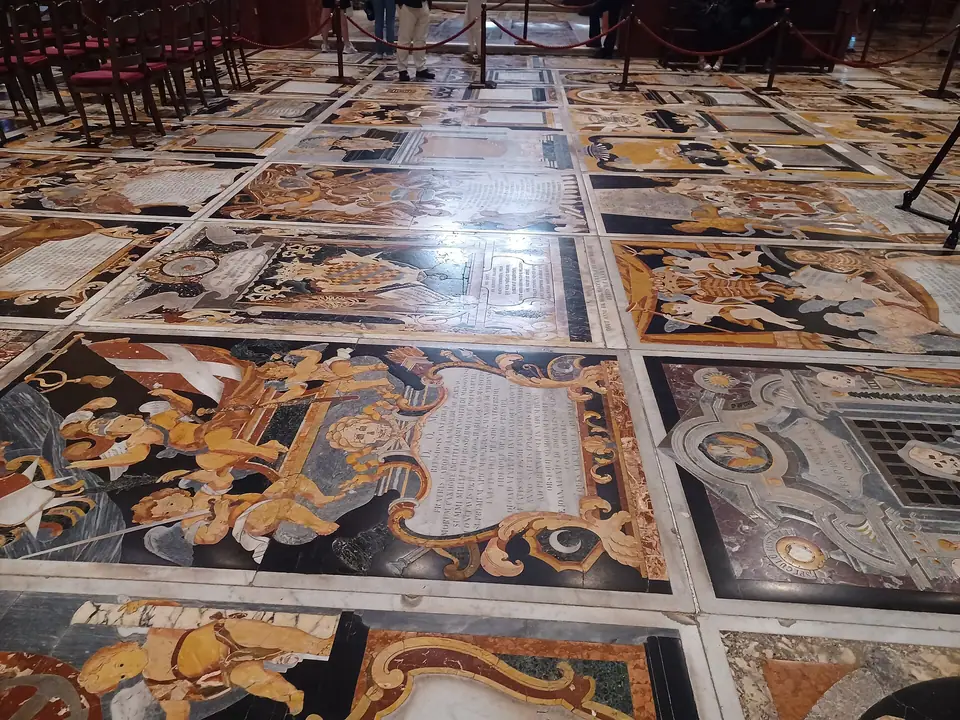
The moment you step into the 53-metre-long nave, look down beneath your feet. The entire floor of the Co-Cathedral is a continuous carpet of 405 polychrome inlaid marble tombstones (pietra dura) . These slabs mark the burial vaults of the noble sons of Europe's greatest aristocratic families who served as Knights of Malta between 1600 and 1798. Every slab is a Latin visual poem of Baroque memento mori symbolism: winged skeletons wielding scythes, hourglasses, and extinguished torches. Battle cannons, eight-pointed Maltese crosses, and family heraldry inlaid in red Sicilian jasper, green serpentine, lapis lazuli, and white Carrara marble.
Now look up at the barrel vault. Unlike Italian churches painted in wet plaster fresco, Mattia Preti (1613 to 1699) primed the porous Maltese globigerina limestone with linseed oil. He then painted eighteen episodes from the life of St John the Baptist in oil directly onto the stone vault. Every pillar, arch, and wall spandrel around the paintings was carved in situ straight into the soft yellow wall stone and covered in 24-carat gold leaf.
Inside the Oratory: Caravaggio's The Beheading of Saint John the Baptist (1608)
Follow your audio guide into the Oratory (built in 1602 for the training of young novices), where two original paintings by Michelangelo Merisi da Caravaggio (1571 to 1610) hang in striking low lighting. Caravaggio had fled Rome in May 1606 with a papal death sentence on his head after killing Ranuccio Tomassoni in a brawl. He arrived in Valletta in July 1607 hoping that Grand Master Alof de Wignacourt would induct him as a Knight of Obedience and secure a papal pardon.
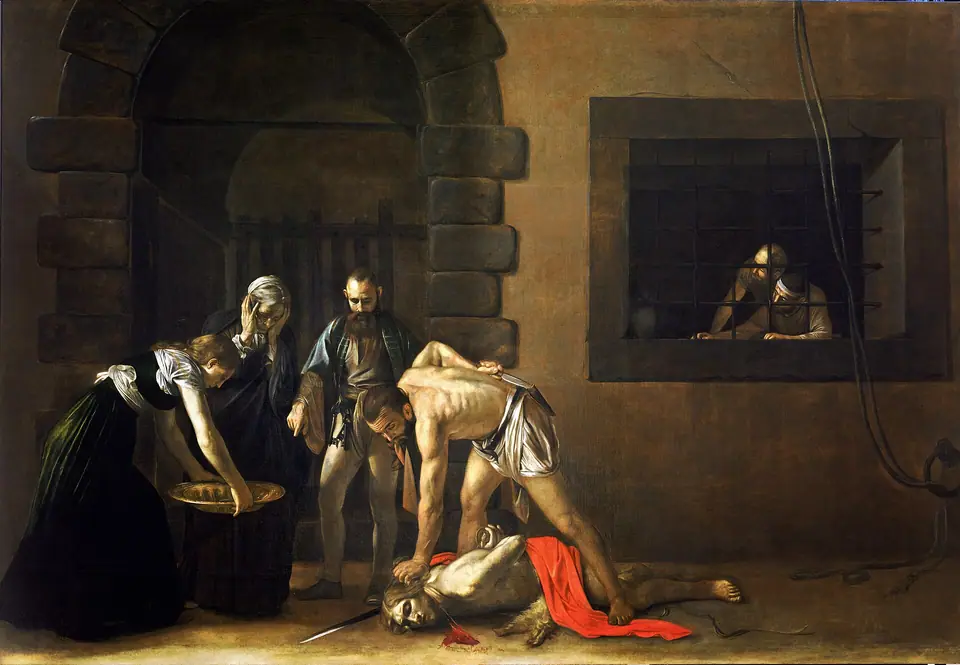
As his reception piece for the Order, Caravaggio painted The Beheading of Saint John the Baptist (1608), filling the entire altar wall of the Oratory (361 cm × 520 cm). Stripped of heavenly angels or triumphant Baroque clouds, the scene takes place in the stark, shadowy courtyard of a Maltese prison. The executioner reaches for his short misericordia dagger to finish the cut while an elderly prison woman covers her ears in horror. Look closely at the dark red blood pooling from the saint's throat: in the blood itself, Caravaggio painted his only signature in his entire career, "f. Michelang.o" (Fra Michelangelo, Brother Michelangelo), shortly before he was imprisoned in Fort St Angelo following another violent brawl and escaped by boat to Sicily. Opposite hangs Caravaggio's second Malta masterpiece, the intensely lifelike 1607 Saint Jerome Writing.
The Eight Chapels of the Langues and why it is called a "Co-Cathedral"
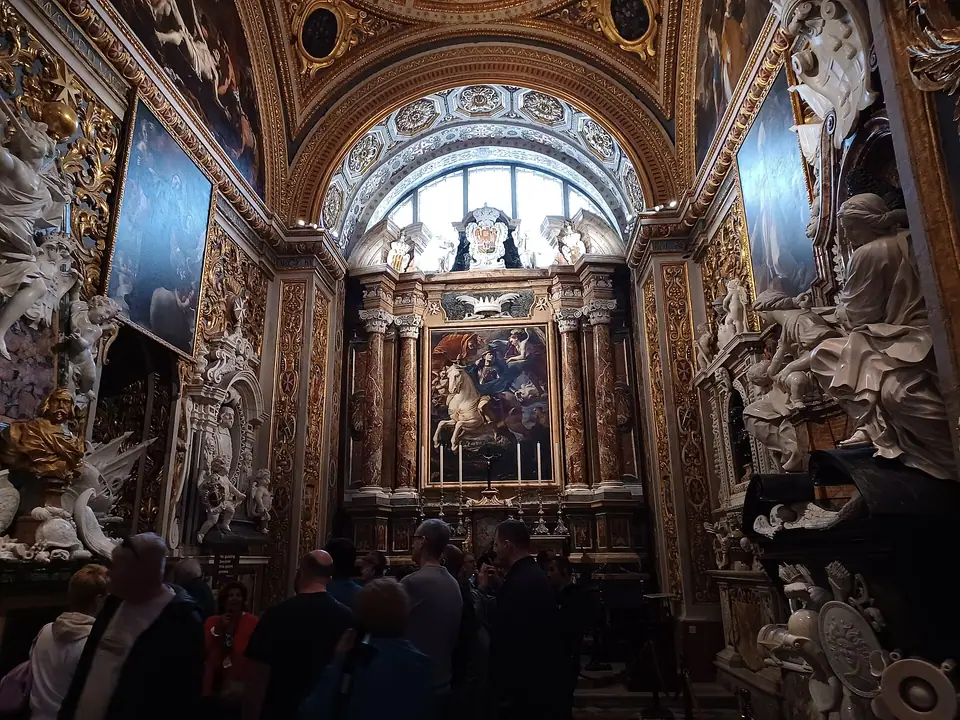
Flanking the central nave are eight richly decorated side chapels, each assigned to one of the eight Langues (ethno-linguistic divisions) of the Order of St John, arranged in order of seniority:
- North Aisle (Left). The Chapel of Anglo-Bavaria (preserving relics and wooden statues), the Chapel of Provence, the Chapel of France (remodelled in the 19th century). Next to it sits the Chapel of Italy (containing Mattia Preti's painting of St Catherine of Alexandria and the tomb of Preti himself at the entrance).
- South Aisle (Right). The Chapel of Auvergne, the Chapel of Aragon, Catalonia, and Navarre (housing Mattia Preti's dynamic painting of St George on horseback and the flamboyant Baroque marble mausoleum of Grand Master Nicolas Cotoner supported by chained bronze figures). Beyond it lie the Chapel of Castile, León, and Portugal, and the Chapel of Germany.
Finally, why is the church called a "Co-Cathedral"? For centuries, the seat (cathedra) of the Bishop of Malta stood solely inside St Paul's Cathedral in the ancient inland capital of Mdina, while St John's in Valletta belonged exclusively to the Knights Hospitaller. In 1816, Pope Pius VII issued a papal bull elevating St John's to share equal episcopal status together with Mdina, giving the Archbishop of Malta two thrones ("co-cathedrals") in Mdina and Valletta. Before exiting, climb the stairs to the newly opened Caravaggio Wing and Viewing Balcony, which lets you look down across the entire nave from the upper organ gallery.
Where it is
- 1St John's Co-Cathedral
- Malta International Airport (MLA) · about 6 km from here in a straight line
- Directions in Google Maps
Traveller tips
Real advice from people who have been to Valletta. Every tip is read by our team before it goes live.
No tips yet. Been here? Yours could be the first.
Thank you! Your tip will appear here after a quick review.
More in Valletta
Continue exploring Valletta with related neighbourhood, food, and planning guides
Where to Stay in Valletta: Flat Ridge Palazzos vs Stepped Harbour Streets
Valletta, Malta
Valletta 3-Day Itinerary: Knights' Palaces, the Three Cities, Hypogeum & Mdina
Valletta, Malta
Upper & Lower Barrakka Gardens, Saluting Battery Noon Gun & Lift Guide
Valletta, Malta
Grand Master's Palace, Armoury, Casa Rocca Piccola & Knights' Auberges Guide
Valletta, Malta
