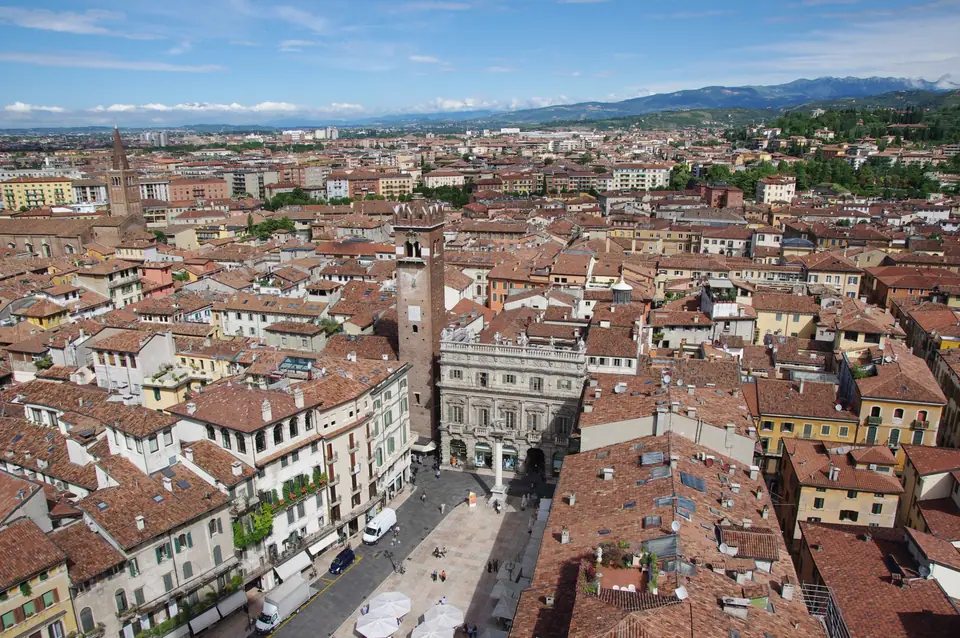
Photo: Jakub Hałun · CC BY-SA 4.0
The Arena and the Old Centre
Piazza Bra, the Arena, Piazza delle Erbe, the Lamberti Tower and Juliet's House on one walk.
The old centre of Verona is a walk of a few hundred metres that crosses two thousand years. It runs from the Roman Arena on Piazza Bra north to Piazza delle Erbe, the old forum, then past the Lamberti Tower to the courtyard of Juliet's House. This guide gives the dates and dimensions that explain each stop, with walking times. The wider context is in the Verona travel guide.
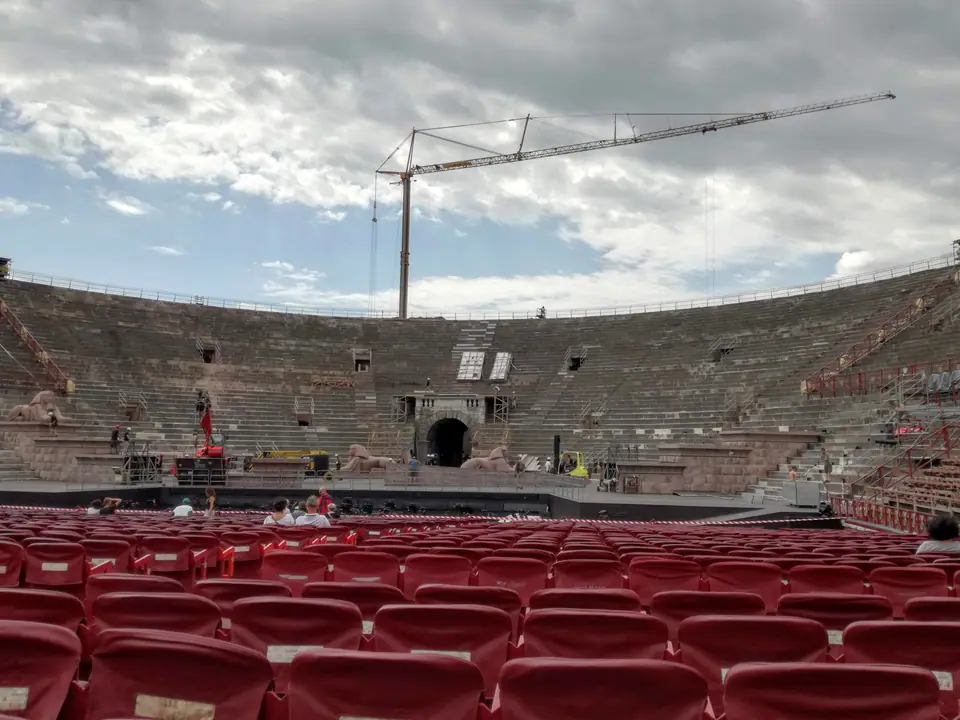
Roman engineering inside the Verona Arena
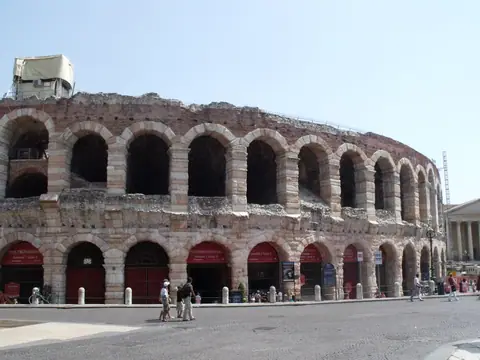
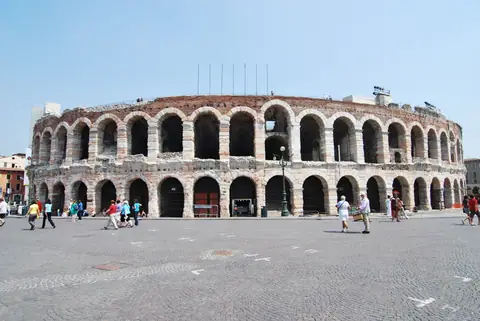
The Arena was completed around AD 30, although scholars have proposed dates between the 1st and 3rd centuries, and it is the third-largest Roman amphitheatre in Italy. It is 152.43 metres long and 123.23 metres wide at its maximum, and its performance space measures 75.68 by 44.43 metres, or 250 by 150 Roman feet. It has 72 arches and entrances, numbered counterclockwise from I at the western entrance, and 64 staircases, or vomitoria, serve the seating.
Only a four-arch fragment of the outer ring, called the ala, survives. Its three tiers of arches, built of red ammonitic limestone, curve prominently over Piazza Bra. An earthquake on 3 January 1117 destroyed most of the outer ring. The Arena holds about 22,000 spectators in summer, with the stage occupying about a third of the seats, against an estimated 30,000 in Roman times.
Summer opera staging and Olympic ceremonies
The Arena di Verona Festival began in 1913 with Aida. The Arena hosted the closing ceremony of the 2026 Winter Olympics and the opening ceremony of the 2026 Winter Paralympics. Season dates are in the best time to visit guide.
| Feature | Figure |
|---|---|
| Completed | Around AD 30 |
| Maximum length and width | 152.43 by 123.23 metres |
| Arches and entrances | 72 |
| Capacity in summer | About 22,000 |
| First opera festival | 1913 |
Walking north from Piazza Bra along Via Mazzini
Piazza Bra is the large square in front of the Arena, and the tourist office stands in Palazzo Barbieri on it, at Via Leoncino 61. From here, walking north along Via Mazzini, Verona's marble-paved pedestrian shopping street, brings you to Piazza delle Erbe in around 10 minutes.
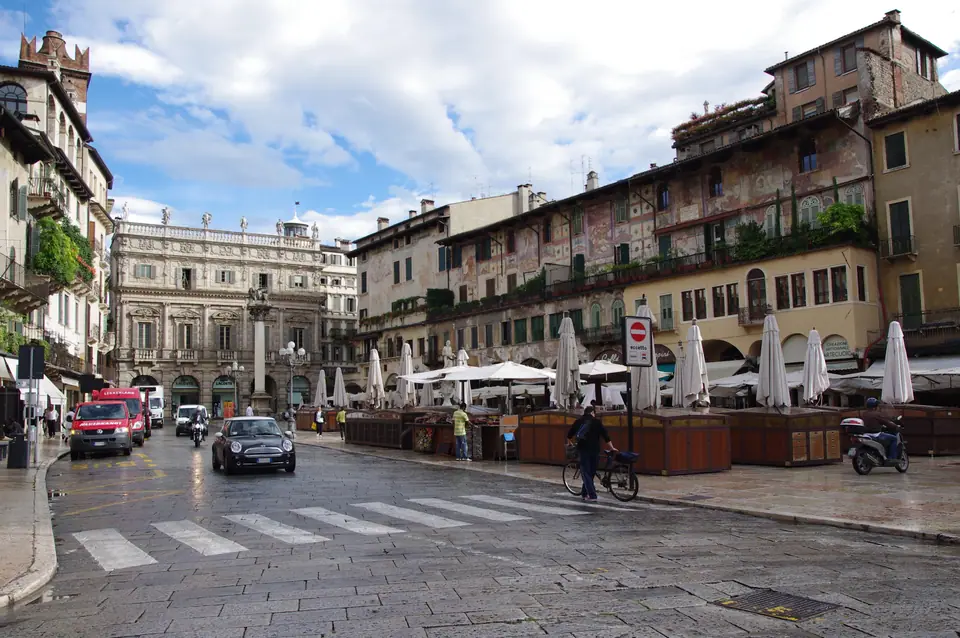
Frescoed palaces and market umbrellas on Piazza delle Erbe
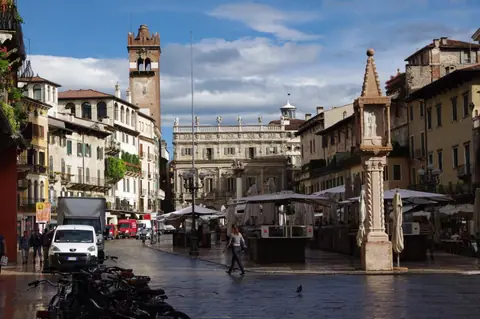
The square was the town's forum in Roman times, and its north-western side occupies the site of the ancient Capitol hill. The fountain was built in 1368 by Cansignorio della Scala, and its statue, the Madonna Verona, is a Roman sculpture dating to AD 380, the oldest monument on the square. A white marble column on the western side, facing the Baroque Palazzo Maffei, carries the Lion of St Mark, the symbol of the Republic of Venice. On the south side stands the crenellated Domus Mercatorum, also called the Casa dei Mercanti, and the frescoed Mazzanti houses stand on the north side.
Dante's monument and Scaliger palaces on Piazza dei Signori
Beside Piazza delle Erbe, the Palazzo della Ragione was built at the end of the 12th century and once had four towers, of which the Lamberti Tower is the most important. Its marble staircase, the Scala della Ragione, is notable. The Loggia del Consiglio was postponed until 1476, and in 1404 the Venetians opened a new portal on the Palazzo del Podestà. A Carrara marble statue of Dante by Ugo Zannoni, three metres tall, was inaugurated on 14 May 1865 to mark the sixth centenary of the poet's birth.
Climbing the 84-metre Torre dei Lamberti
The Torre dei Lamberti is 84 metres high, and its construction traces back to 1172. A lightning strike in May 1403 collapsed its top, and restoration began only in 1448 and was completed in 1463 and 1464, when the octagonal bell chamber was built. A clock was added between 1779 and 1798. The tower opened to the public in 1972.
| Bell | Cast | Weight | Role |
|---|---|---|---|
| Rengo | 1557, by the Bonaventurini | 4,215 kg | Summoned the council and called people to arms; announced the armistice on 4 November 1918 |
| Marangona | Recast in 1833 by Giovanni Cavadini | 1,300 kg | Signalled fires and the start and end of the working day |
White limestone arches at Roman Porta Borsari
Corso Porta Borsari follows the original Roman Via Sacra to the twin-arched Porta Borsari gate. Measuring about 13 metres high and wide in white Valpantena limestone, it rises through two upper arcaded levels of six windows each. In antiquity it was called Porta Iovia, after the nearby Temple of Jupiter Lustralis, and its medieval name comes from the bursarii, the officials who collected duties on goods entering and leaving the city. Scholars debate the surviving façade's date between the first half of the 1st century AD and a later 3rd-century phase around 245 AD.
Via Cappello's 14th-century tower house and balcony
Juliet's House stands in Via Cappello, about 250 metres from the corner of Piazza delle Erbe. It is a medieval tower house, first attested in documents from 1351, formed from two buildings merged probably in the 14th century. The city bought it in 1905. In 1930, part of the property was allocated for the Teatro Nuovo. Museum director Antonio Avena completed the romanticised house-museum layout in 1939, adding two red marble corbels beneath the balcony. The balcony slab itself is a 14th-century stone from a Della Scala palace, from Avesa. A bronze Juliet by Nereo Costantini was placed in the courtyard on 1 June 1973, a gift of the Lions Club of Verona.
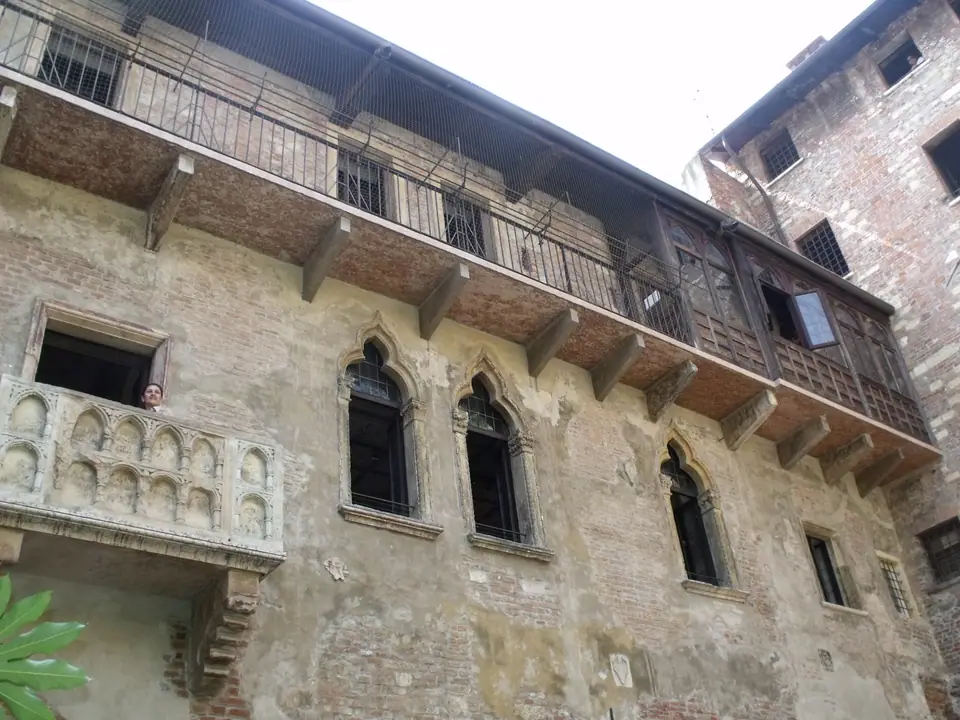
Online Teatro Nuovo entry rules for Juliet's House
Since 1 April 2026, visitors enter both courtyard and museum strictly through the Teatro Nuovo in Piazzetta Navona. Timed tickets are sold online through Coopculture with no on-site box office. Online booking is required for everyone, including VeronaCard holders and people entitled to free admission. Free admission applies to children under 5, to people with a Disability Card and their companion, to tour guides with a group and to VeronaCard holders. On days with performances at the Teatro Nuovo, access to the route may be limited in some time slots, so check the slots on the museums' official site before you plan.
Italian novellas behind Shakespeare's Verona
The tale of the two lovers is older than Shakespeare. Luigi da Porto wrote Giulietta e Romeo in 1524, and it was published in 1531, set in Verona under Bartolomeo della Scala. He introduced the lovers' names, the Montecchi and Capuleti families and Friar Laurence. Matteo Bandello's version appeared in 1554, Arthur Brooke's poem in 1562, and Shakespeare wrote his play between 1591 and 1595, with the first quarto published in 1597. The balcony fittings therefore date from 1939, while the building itself is attested from 1351.
A morning loop from Piazza Bra to Via Cappello
- Start: The Arena on Piazza Bra, then Via Mazzini northward.
- Middle: Piazza delle Erbe, about 10 minutes later, and the Lamberti Tower.
- Finish: Juliet's House in Via Cappello, about 250 metres from the Erbe corner.
- Next: Continue to Castelvecchio, or return to Piazza Bra for lunch.
Where it is
- 1The Arena and the Old Centre
- Verona Villafranca Valerio Catullo Airport (VRN) · about 10 km from here in a straight line
- Directions in Google Maps
Stations and taxi ranks: OpenStreetMap. Airports: OurAirports. Distances are in a straight line.
Traveller tips
Real advice from people who have been to Verona. Every tip is read by our team before it goes live.
No tips yet. Been here? Yours could be the first.
Thank you! Your tip will appear here after a quick review.
More in Verona
Continue exploring Verona with related neighbourhood, food, and planning guides