Photo: Dguendel · CC BY 3.0
Ponte Pietra, the Cathedral and the Hills
The Roman bridge, Roman Theatre, Duomo, Sant'Anastasia and the Giusti Garden on the east bank.
The east bank of the Adige carries some of Verona's oldest layers. A Roman bridge leads to a Roman theatre on the hillside, and below it stand the cathedral, the Dominican church of Sant'Anastasia and a Renaissance garden. This guide follows that bank in the order a visitor would walk, with dates for each building. Start from the Castelvecchio walk if you are coming from the west.
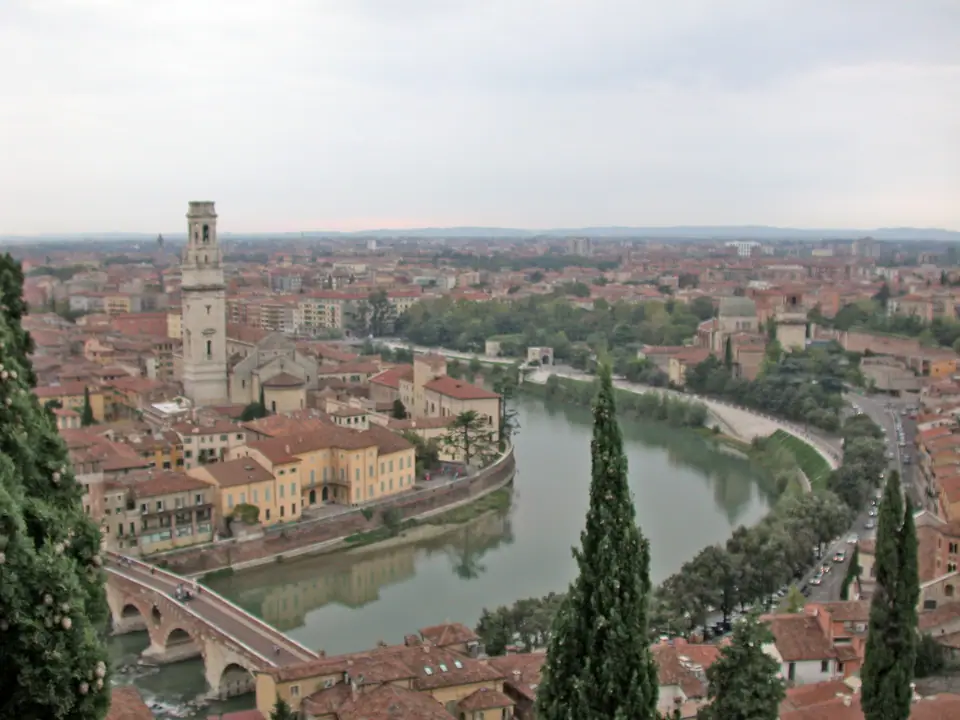
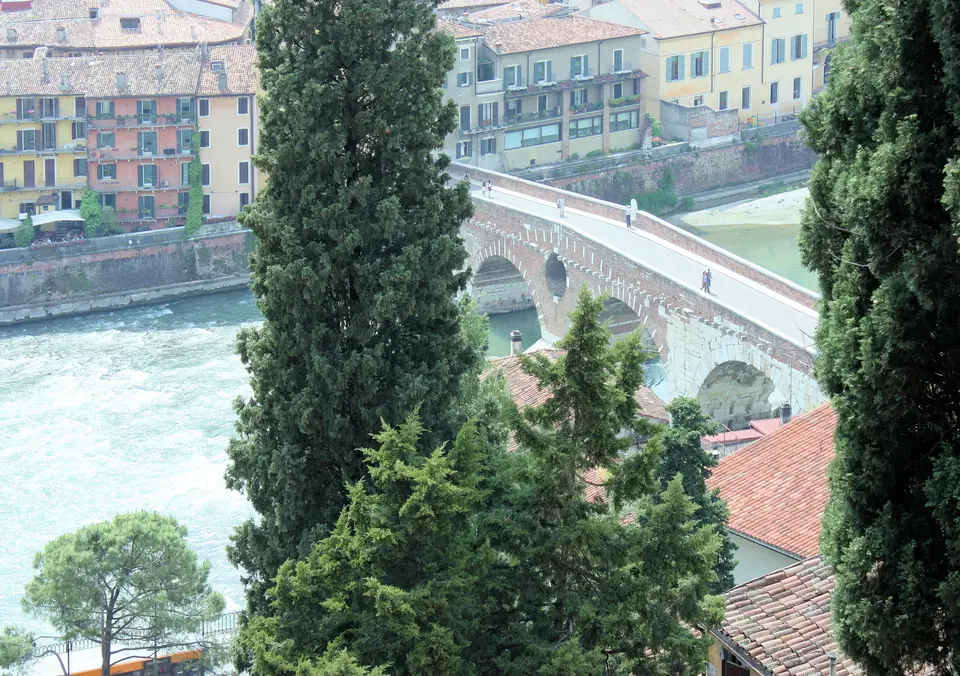
Roman limestone arches at Ponte Pietra
The bridge was completed in 100 BC, and the Via Postumia from Genoa to Aquileia passed over it. Together with the Pons Postumius it gave access from the right bank to the Roman theatre on the east side. The arch nearest the right bank was rebuilt in 1298 by Alberto I della Scala. Retreating German troops blew up four arches in 1945, and the bridge was rebuilt in 1957 using original materials, with the far-left arch the only one that escaped destruction.
Slope seating and summer stage at the Roman Theatre
The theatre was built in the last years of the 1st century BC, and construction continued for several decades. Its cavea is 105 metres wide, its upper terraces 123 metres wide and its stage building was 71 metres long. The merchant Andrea Monga bought the site and directed excavations from 1834 to 1844, demolishing about thirty houses built over the ruins. The Estate Teatrale Veronese, a summer theatre season, has been held at the site every year since 1948, and the Museo Archeologico al Teatro Romano is part of the visit route. The city's hostel stands near it, which makes this a district to consider for a budget stay, as the where to stay guide explains.
Funicular climb to Castel San Pietro terrace
The castle stands on Colle San Pietro above the theatre, and visitors can reach its forecourt by funicular. The Romans built a fortified sacred site there in the early 1st century BC to guard the Adige crossing of the Via Postumia, and Berengar's works fortified the hill in 890. Gian Galeazzo Visconti commissioned a larger castle in 1393, and Napoleonic soldiers mined and destroyed much of it in 1801. The Austrians built the barracks that still stands there between 1852 and 1858 for Field Marshal Josef Radetzky. The military ceded it to the city in 1934, and it housed an orphanage until 1978.
| Sight | Key date |
|---|---|
| Ponte Pietra | Completed in 100 BC, rebuilt in 1957 |
| Verona Cathedral | Consecrated on 13 September 1187 |
| Sant'Anastasia | Begun in 1290, consecrated on 22 October 1471 |
| Giusti Garden | Land bought in 1406, labyrinth redesigned in 1786 |
Titian's Assumption inside Verona Cathedral
Two early Palaeo-Christian churches occupied the site in the 4th and 5th centuries before the earthquake of 1117 destroyed them. Romanesque rebuilding started around 1120, and Pope Urban III consecrated the new cathedral on 13 September 1187. The double porch over the main portal is by the sculptor Niccolò, dated about 1139, with twisted columns resting on two griffins, and the upper façade was completed in 1587 under Bishop Agostino Valier.
Inside, Titian's Assumption hangs in the Cartolari-Nichesola chapel, on an altar remodelled about 1532 by Jacopo Sansovino. The French took it in 1797, and it later returned to Italy. Michele Sanmicheli designed the choir screen, completed in 1550, and the original bell-tower project. The tower is 75 metres tall and holds ten bells, and its octagonal bell chamber was completed in 1925. The adjoining church of Sant'Elena rose over older foundations for Archdeacon Pacifico and was consecrated between 842 and 847 by Patriarch Andrea of Aquileia. Following the 1117 earthquake, builders reconstructed it in the 1120s ahead of a 1140 rededication. The cloister of the canons is first cited in documents from 1123, and the Chapter Library has a conventional founding date of 517 based on a scribe's signature.
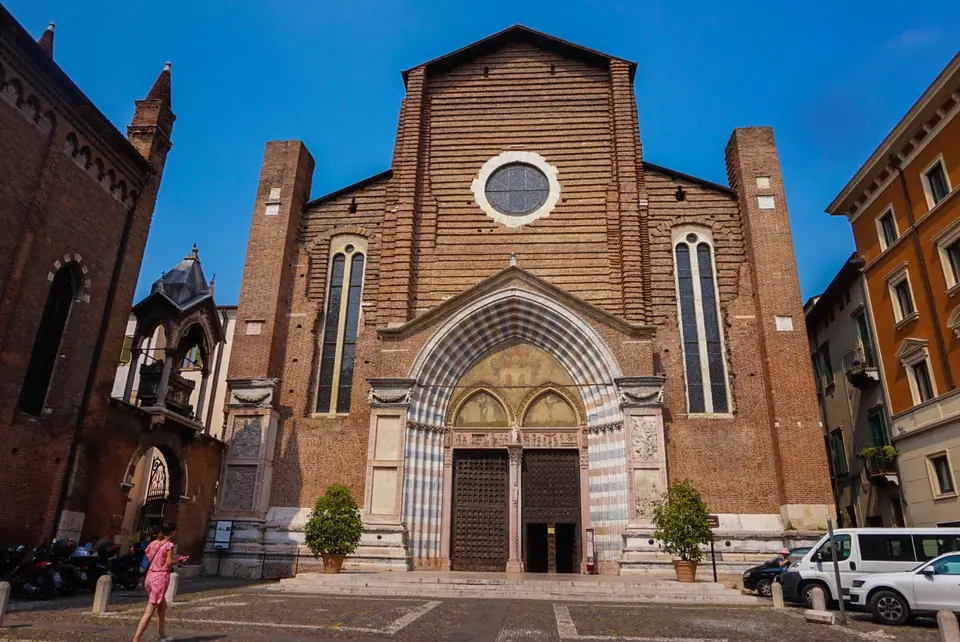
Gothic terracotta columns and frescoes at Sant'Anastasia
In 1260 Bishop Manfredo Roberti granted the Dominicans land for a new church and convent, and construction of the current basilica began in 1290. By the death of Guglielmo da Castelbarco in 1320 the apses, high altar, transept and lower façade were complete, and the building was largely finished in the 1440s. Cardinal Giovanni Michiel consecrated it on 22 October 1471. The Dominican order was suppressed under Napoleon in 1807, and major restorations followed in 1878 to 1881 and in 2010.
The church is Veronese Gothic with Renaissance elements, with a Latin cross plan, five apses and brick walls. Two sets of six cylindrical columns of white and red Verona marble divide the three naves. The façade is unfinished, and a decision of 1428 to complete it in stone was never carried out for lack of funds.
| Feature | Detail |
|---|---|
| Pisanello fresco | St George and the Princess, painted between 1433 and 1438 above the arch of the Pellegrini Chapel |
| Pellegrini Chapel | 24 terracotta reliefs by Michele da Firenze, dated 1435 |
| Holy water stoups | Supported by hunchbacks, one placed in 1491 and the other, called Pasquino, in 1591 |
| Organ | Built in 1625, with 30 stops |
| Stained glass | Installed in 1498 in the rose window and façade windows |
The marble floor was laid from 1462, and the Fregoso Altar dates from 1565.
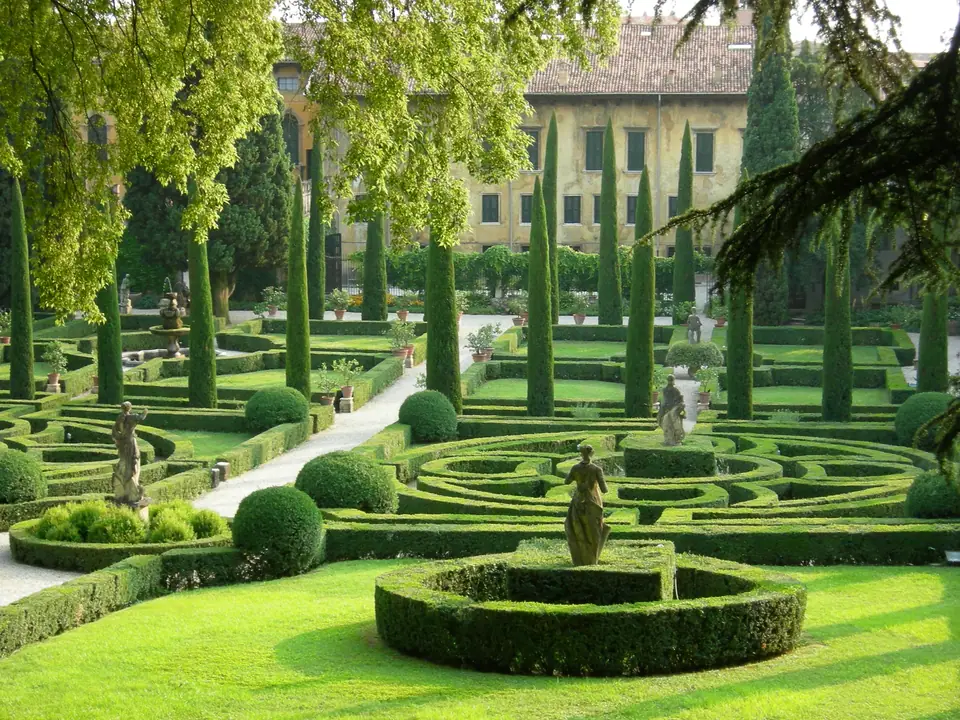
Cypress avenues and boxwood labyrinth at Giusti Garden
Provolo Giusti bought the land in 1406, and Agostino Giusti commissioned the 16th-century palazzo and formal garden. The boxwood labyrinth is not the original design: the architect Luigi Trezza redesigned it in 1786 and simplified its path. A gigantic stone mask, attributed to Bartolomeo Ridolfi, sits above the grotto of the genius loci, with a belvedere over it. The second terrace has four artificial grottoes, and the courtyard portico has six arches.
Climbing to Santa Maria di Lourdes for hillside rooftops
Bus 41 climbs to the Santa Maria di Lourdes sanctuary on the city's highest hilltop ridge. Its terrace gives a quieter panoramic view over the roofs than the Lamberti Tower.
East-bank walk across Ponte Pietra and the hills
- Start: Ponte Pietra, then the Roman theatre on the hillside.
- Middle: The cathedral and its library.
- Finish: Sant'Anastasia, then the Giusti Garden.
- Extra: Bus 41 to the sanctuary hill for a view of the roofs.
Where it is
- 1Ponte Pietra, the Cathedral and the Hills
- Verona Villafranca Valerio Catullo Airport (VRN) · about 11 km from here in a straight line
- Directions in Google Maps
Stations and taxi ranks: OpenStreetMap. Airports: OurAirports. Distances are in a straight line.
Traveller tips
Real advice from people who have been to Verona. Every tip is read by our team before it goes live.
No tips yet. Been here? Yours could be the first.
Thank you! Your tip will appear here after a quick review.
More in Verona
Continue exploring Verona with related neighbourhood, food, and planning guides