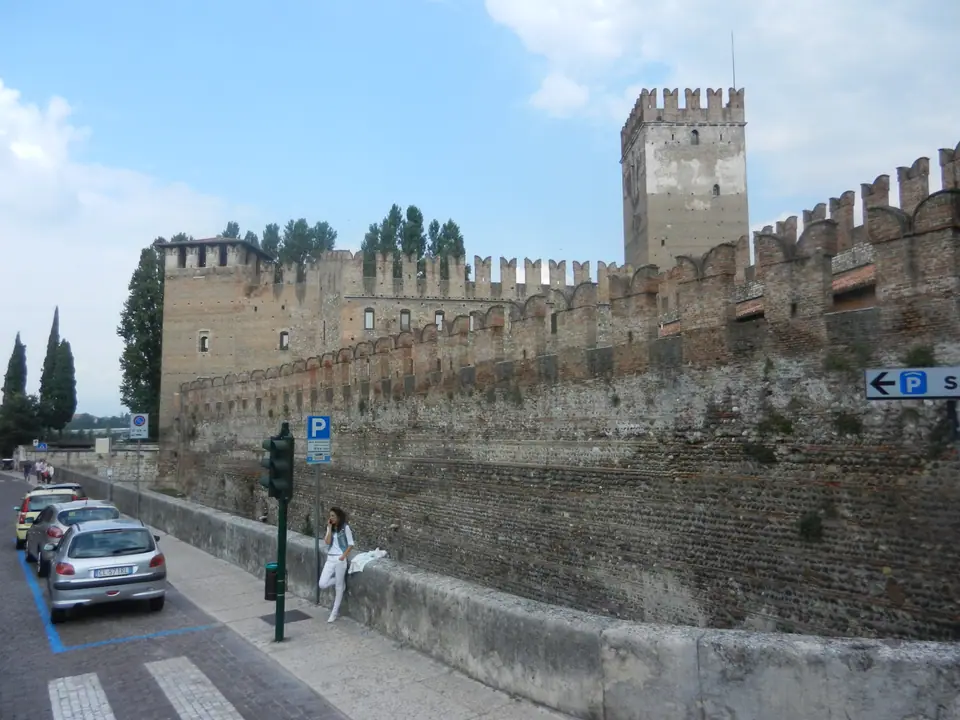
Photo: Ljuba brank at Slovenian Wikipedia · CC BY-SA 3.0
Castelvecchio, San Zeno and the Adige
The Scaliger castle, its bridge, the Carlo Scarpa museum, the Scaliger Tombs and the Basilica of San Zeno.
West of the old centre, Verona changes from Roman and market squares to the fortresses and churches of the Scaliger period. This walk links three monuments: the castle of Castelvecchio with its fortified bridge, the Gothic Scaliger Tombs beside Santa Maria Antica, and the Romanesque Basilica of San Zeno. Castelvecchio and San Zeno are about 10 minutes apart on foot, so the whole route fits half a day. The wider order is in the things to do guide.
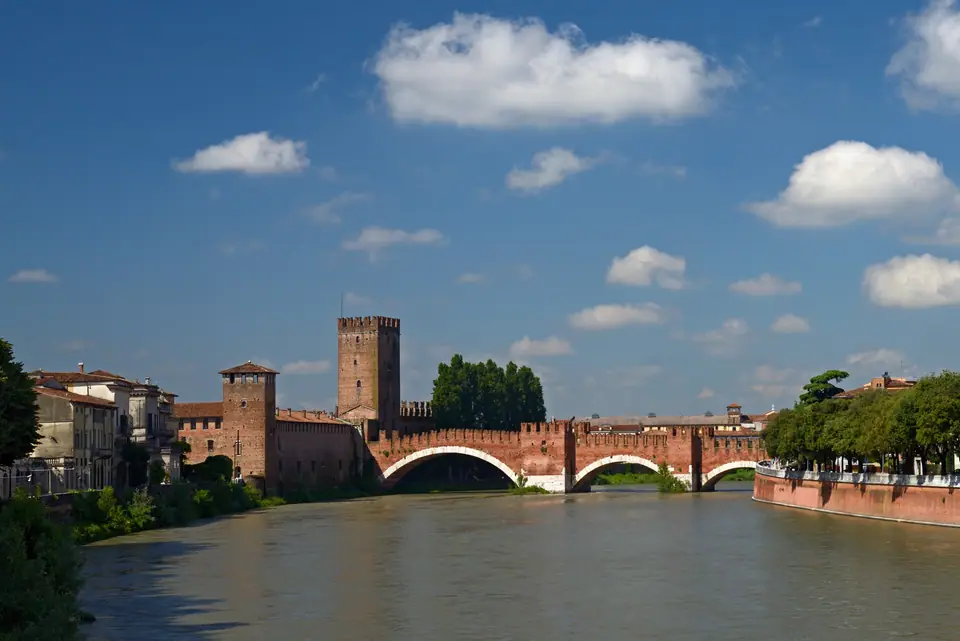
Cangrande II's brick fortress along the Adige
Cangrande II della Scala had the castle built between 1354 and 1376, together with its bridge over the Adige. It was meant as a deterrent to powerful neighbours such as Venice, the Gonzaga and the Sforza, and its bridge was designed to let the ruler escape north towards the Tyrol if a rebellion or coup broke out. The castle has seven towers and a raised keep with four main buildings inside. Napoleonic damage came during the French campaigns of 1796 and 1797, and the Venetians fortified the bridge with cannon.
| Date | Event |
|---|---|
| 1354 to 1376 | Built for Cangrande II della Scala |
| 1796 to 1797 | Damage in the French campaigns |
| 1924 | Antonio Avena and Ferdinando Forlati restore it in a medieval style as a home for the civic art collections |
| 1945 | Retreating German forces destroy the bridge |
| 1949 | The bridge is rebuilt |
| 1958 to 1974 | Carlo Scarpa's remodelling and display of the museum |
Carlo Scarpa's museum rooms and Cangrande's sword
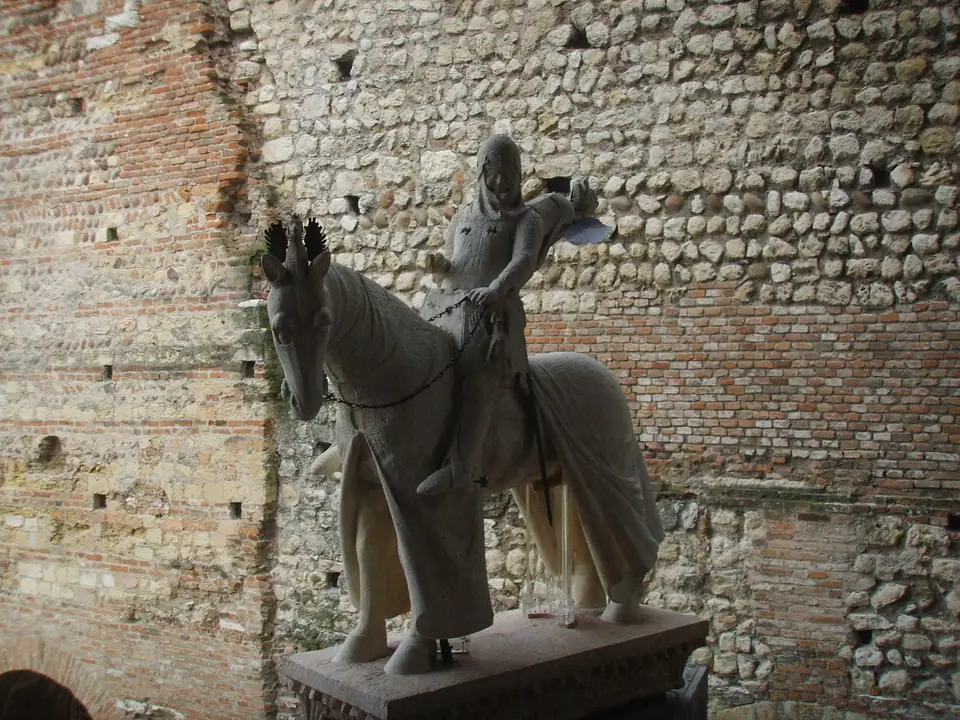
Antonio Avena directed the civic museums when the castle first took on this role. The museum has about thirty rooms of sculpture, painting, antique weapons, ceramics, goldwork, miniatures and the city's historic bells. Its holdings start with Romanesque sculpture and run through Veronese and Venetian painting from the Gothic period to the 18th century, including a work by Tiepolo, and an armour collection that includes Cangrande's sword. Scarpa's main works date from 1958 to 1964, with the library added in 1968 and 1969 and the Sala Avena in 1973 to 1975. The equestrian statue of Cangrande I, moved here from the tombs, stands on a concrete base at a key point on the route, and you can view it from the museum path or the garden.
The crenellated Scaliger Bridge across the river
The Scaliger bridge has a main span of 48.70 metres and was completed in 1356. It is one of the places where you see how the castle controlled the river, and it forms one end of the limited traffic zone described in the getting there guide.
The Roman Arco dei Gavi rebuilt beside the castle
Near Castelvecchio stands the Arco dei Gavi, built in the first half of the 1st century AD, probably towards the end of the reign of Augustus or in the early years of Tiberius. It straddled the main Roman road into the city. The architect, Lucius Vitruvius Cerdo, a freed Greek slave, signed it twice on the inner faces of its piers. French military engineers dismantled it in 1805, and after works authorised in 1931 it was reassembled near Castelvecchio and inaugurated on 28 October 1932.
Gothic stone canopies of the Scaliger Tombs
Five Gothic funerary monuments stand in a small court outside the church of Santa Maria Antica, separated from the street by a wall with iron grilles whose pattern refers to the family name through a stair motif. Each tomb is an open, tabernacle-like structure with a sarcophagus under a baldachin, topped by an armoured rider.
| Tomb | Date and detail |
|---|---|
| Cangrande I | The first built, in the 14th century, according to his will; built out from the church wall over a doorway and supported by richly harnessed dogs; the statue on top is a copy |
| Mastino II | Begun in 1345; four statues of the Virtues at the corners of its railing |
| Giovanni | Finished in 1359 by Andriolo de' Santi; built into the church wall |
| Cansignorio | Dated 1375 and designed by Bonino da Campione; the most richly decorated |
The tomb of Cansignorio inspired the Brunswick Monument in Geneva, completed in 1879.
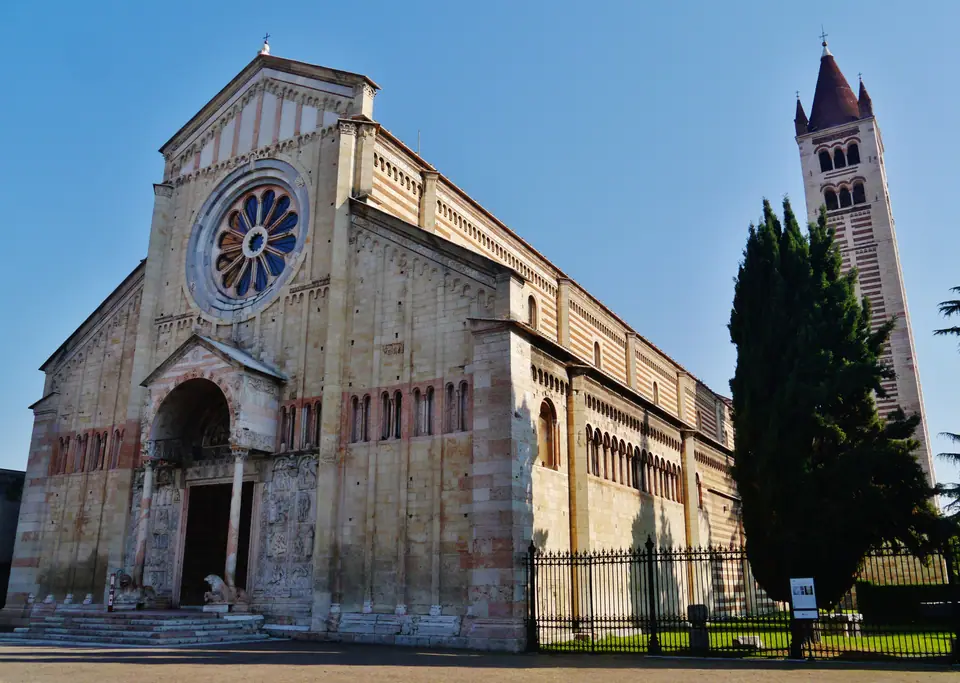
Bronze doors and Wheel of Fortune at Basilica of San Zeno
The Carolingian church on the site was consecrated on 8 December 806, and the body of Saint Zeno was moved into its crypt on 21 May 807. King Pepin of Italy and Bishop Ratold ordered the Carolingian rebuilding. After Magyar raids between 899 and 933, Bishop Ratherius began reconstruction in 967. The earthquake of 1117 interrupted work, and most of the present church was complete by about 1138. The relics were rediscovered on 22 March 1838, and the church became a minor basilica in 1973.
The bronze doors of the portal carry 73 panels made by various founders across different periods, mounted across tall wooden leaves. Above the porch, the Wheel of Fortune rose window is credited in an inscription dated 14 April 1189 to Brioloto de Balneo, carved with twelve sectors and six statues representing the phases of Fortune. Underneath the raised choir, the crypt dates back to the 10th century, while the neighbouring campanile was begun in 1045 and reached roughly half its present height by 1067.
Art and literature at San Zeno
The basilica holds a San Zeno altarpiece by Andrea Mantegna, painted shortly after the middle of the 15th century for the high altar. The poet Dante is said to have mentioned Abbot Gerardo of San Zeno in Canto XVIII of the Purgatorio, although the identification is a belief and not a certainty.
Half-day loop through western Verona
- Start: Castelvecchio and its bridge, then the museum.
- Middle: The Scaliger Tombs beside Santa Maria Antica, close to Piazza dei Signori.
- Finish: San Zeno, about 10 minutes on foot from Castelvecchio.
- Next: Cross to the east bank for Ponte Pietra.
Where it is
- 1Castelvecchio, San Zeno and the Adige
- Verona Villafranca Valerio Catullo Airport (VRN) · about 9 km from here in a straight line
- Directions in Google Maps
Stations and taxi ranks: OpenStreetMap. Airports: OurAirports. Distances are in a straight line.
Traveller tips
Real advice from people who have been to Verona. Every tip is read by our team before it goes live.
No tips yet. Been here? Yours could be the first.
Thank you! Your tip will appear here after a quick review.
More in Verona
Continue exploring Verona with related neighbourhood, food, and planning guides