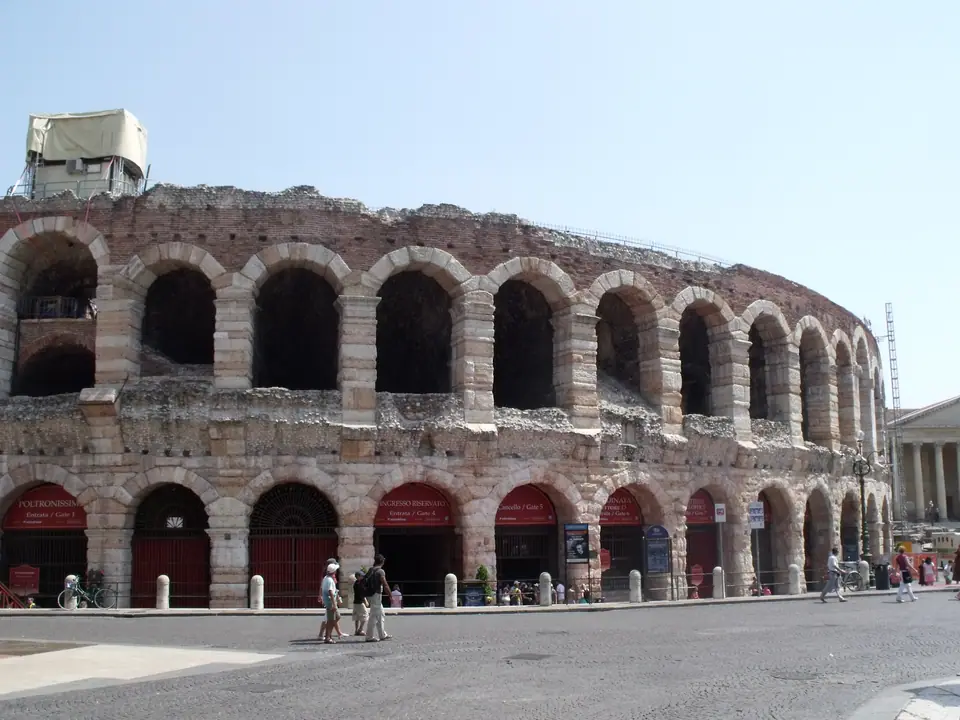
Photo: Elliott Brown from Birmingham, United Kingdom · CC BY 2.0
Things to Do in Verona
The Arena, Piazza delle Erbe, Castelvecchio, San Zeno, Ponte Pietra and the hills in a three-day order with walking times.
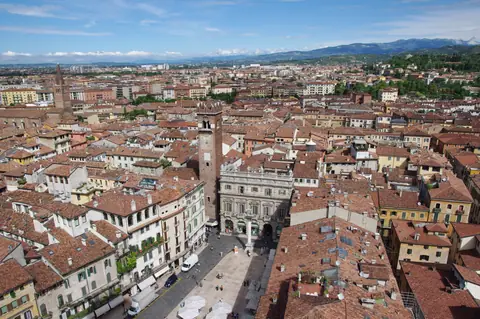
Verona's main sights sit close together inside the river bend, so a rewarding itinerary depends less on local transport than on pacing your days. This guide lays out three practical days with landmark-to-landmark walking times and indoor wet-weather swaps. Dedicated chapters deepen each area: the Arena and the old centre, Castelvecchio and San Zeno and Ponte Pietra and the east bank.
The municipal tourist desk, IAT Verona, operates in Palazzo Barbieri at Via Leoncino 61 on Piazza Bra; check Visit Verona's official page for seasonal hours. The 24-hour or 48-hour Verona Card works as a digital pass for civic museums, key churches and urban ATV buses (starting validation at central monuments or Piazza Bra), though it excludes the airport Aerobus.
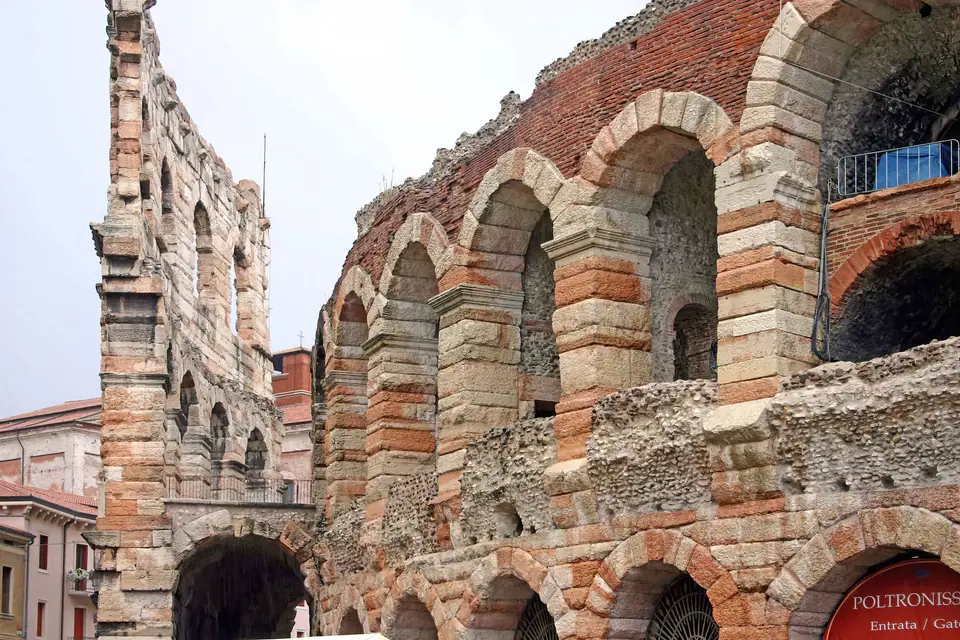
Day one: Piazza Bra, Piazza delle Erbe and Juliet's courtyard
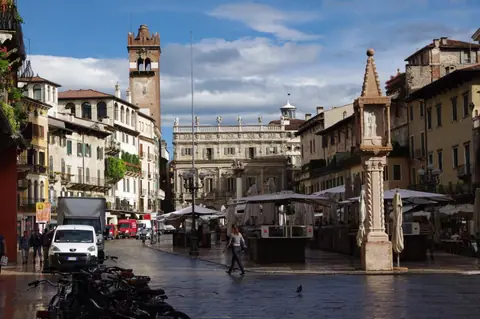
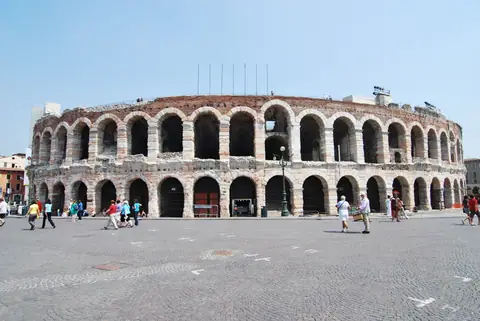
Begin on Piazza Bra at the Arena, completed around AD 30 and still hosting live performances every summer. Walk north along Via Mazzini into Piazza delle Erbe, once the Roman forum and anchored by its 1368 Madonna Verona fountain, then step down Via Cappello towards Juliet's House. Remember that since April 2026 entry requires timed online tickets via Piazzetta Navona. Continue up the 84-metre Lamberti Tower, open to visitors since 1972, before crossing into quiet Piazza dei Signori.
| Stop | Walk from the previous stop | Suggested time |
|---|---|---|
| Arena, Piazza Bra | Start | 1 to 2 hours |
| Piazza delle Erbe | About 10 minutes | 30 minutes |
| Juliet's House | About 250 metres | 30 minutes |
| Lamberti Tower | A few minutes | 45 minutes |
Day two: Castelvecchio bridge and San Zeno
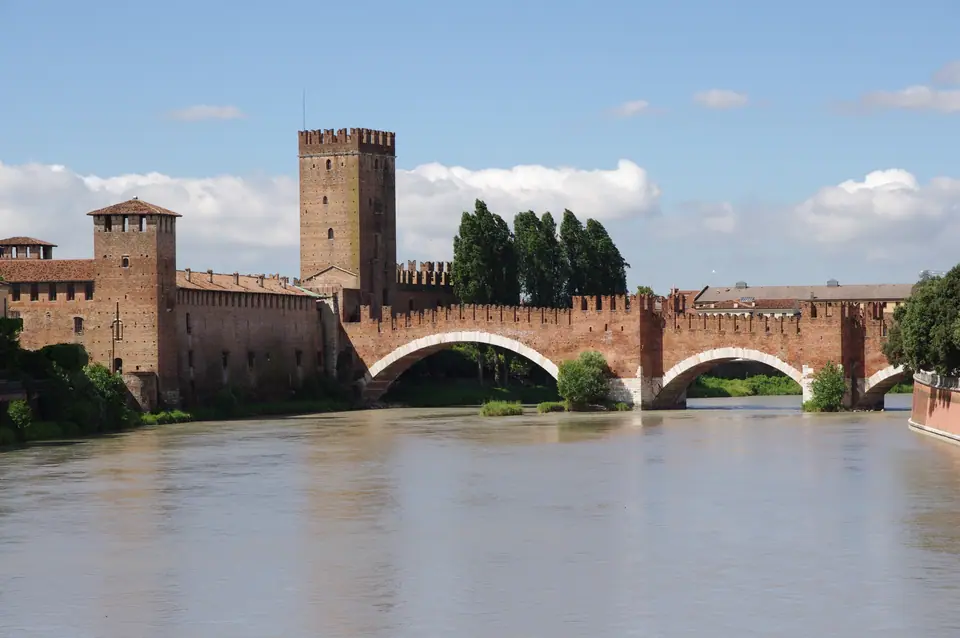
Start the second morning at Castelvecchio, built between 1354 and 1376 for Cangrande II della Scala. Inside, Carlo Scarpa's luminous 1958 to 1964 museum layout fills a morning across courtyard galleries and river views. Double back briefly towards the Gothic Scaliger Tombs beside Santa Maria Antica. Or continue walking ten minutes west along the Adige to the Basilica of San Zeno before strolling back along the embankment.
Day three: Ponte Pietra and the Veronetta hills
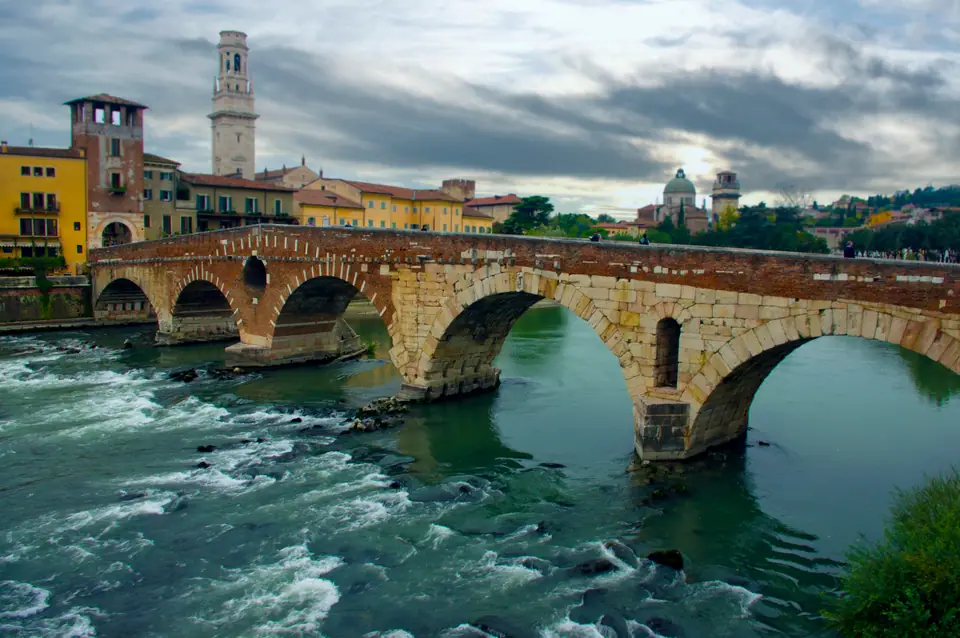
Cross the stone arches of Ponte Pietra, completed in 100 BC and reconstructed in 1957 from recovered masonry, then climb or ride the funicular up to the Roman theatre and Colle San Pietro. Loop back along the east bank past the Duomo, consecrated on 13 September 1187, and the Gothic brick church of Sant'Anastasia, begun in 1290. Leave late afternoon for the cypress terraces of Giusti Garden, laid out on family land bought in 1406. Full monument details live in the Ponte Pietra guide.
Metric walking times across the centre
| Route | Distance or time |
|---|---|
| Porta Nuova station to Piazza Bra | About 1.5 km, about 20 minutes |
| Corso Porta Nuova midpoint to the Arena | About 700 metres, under 10 minutes |
| Corso Porta Nuova midpoint to Juliet's House | About 1.3 km |
| Piazza Bra to Piazza delle Erbe via Via Mazzini | About 10 minutes |
| Piazza delle Erbe to Juliet's balcony | About 250 metres |
| Castelvecchio to Basilica of San Zeno | About 10 minutes |
| Castel San Pietro hillside to the centre | About 15 minutes |
Walking times lengthen noticeably during weekend afternoon crowds along Via Mazzini or before summer opera curtains on Piazza Bra, so add a short cushion if you hold timed museum slots.
Local ATV buses for hills and Lake Garda
Inside the bend you rarely need wheels. When your feet tire between Porta Nuova and Piazza Bra, weekday buses 11, 12 and 13 cover the avenue quickly. Up on the ridge, bus 41 climbs to the Santa Maria di Lourdes sanctuary on Verona's highest hilltop vantage point. Towards Lake Garda, ATV routes 162 to 165 connect central Verona with Lazise, Bardolino and Garda; complete seasonal lake lines appear in the excursions guide, and airport buses in the getting there guide.
Opera summer nights in the Arena
Between mid-June and early September, the Roman amphitheatre turns into an open-air opera stage. Its 2027 billing runs into the second week of September with classic productions of Aida, La Traviata, Carmen and Nabucco, plus ballet and gala concerts. Read seating and weather guidance in the best time to visit guide before choosing unnumbered stone steps versus cushioned seats.
Museums and covered churches for wet weather
Rain transforms Verona's sights cleanly. Castelvecchio's museum spans roughly thirty rooms of sculpture, Renaissance canvases, historic bells and armour, offering the richest indoor refuge in the centre. Both the Basilica of San Zeno and Sant'Anastasia repay an unhurried dry hour inside, leaving the open-air Lamberti Tower climb for brighter skies.
A condensed route for a single day
- Morning: Enter the Arena right at opening, cross Piazza delle Erbe and reach Juliet's courtyard early.
- Midday: Pause near Piazza dei Signori for lunch, then climb the Lamberti Tower if visibility is crisp.
- Afternoon: Cross Castelvecchio and its fortified bridge before walking the Adige embankment to Ponte Pietra.
- Evening: Finish with Valpolicella by the glass near Piazza delle Erbe, guided by the food guide.
Quiet churches for a slower afternoon
When you want calmer artistry away from the main squares, visit San Fermo Maggiore near the river. Two stacked churches share one roof at San Fermo Maggiore. A vaulted Romanesque lower church, rebuilt from 1065 to 1143, supports an airy Franciscan hall taken over in 1261. Overhead, its timber ceiling curves like an inverted ship's hull with 416 painted 14th-century panels above Pisanello's 1426 Brenzoni mausoleum frescoes.
On the east bank, Santa Maria in Organo was tended by Olivetan Benedictines from 1444 until 1806. It retains Michele Sanmicheli's 16th-century incomplete marble lower façade beneath a bell tower built from 1495 to 1533. Step into the choir and sacristy to see Fra Giovanni da Verona's inlaid walnut panels.
Making Mantua a fourth-day rail outing
Mantua lies just 46 to 54 minutes south by regional train from Porta Nuova, making an effortless fourth-day palace excursion without touching a hire car.
Wine hills, lakes and palaces beyond the bend
Extra mornings open up Lake Garda, Valpolicella's terraced vineyards, walled Soave and the Palladian Veneto. Side-by-side rail and driving routes live in the excursions guide, and our where to stay guide matches your base to car or train logistics.
Where it is
- 1Verona
- Verona Villafranca Valerio Catullo Airport (VRN) · about 9 km from Verona in a straight line
- Directions in Google Maps
Stations and taxi ranks: OpenStreetMap. Airports: OurAirports. Distances are in a straight line.
Traveller tips
Real advice from people who have been to Verona. Every tip is read by our team before it goes live.
No tips yet. Been here? Yours could be the first.
Thank you! Your tip will appear here after a quick review.
More in Verona
Continue exploring Verona with related neighbourhood, food, and planning guides