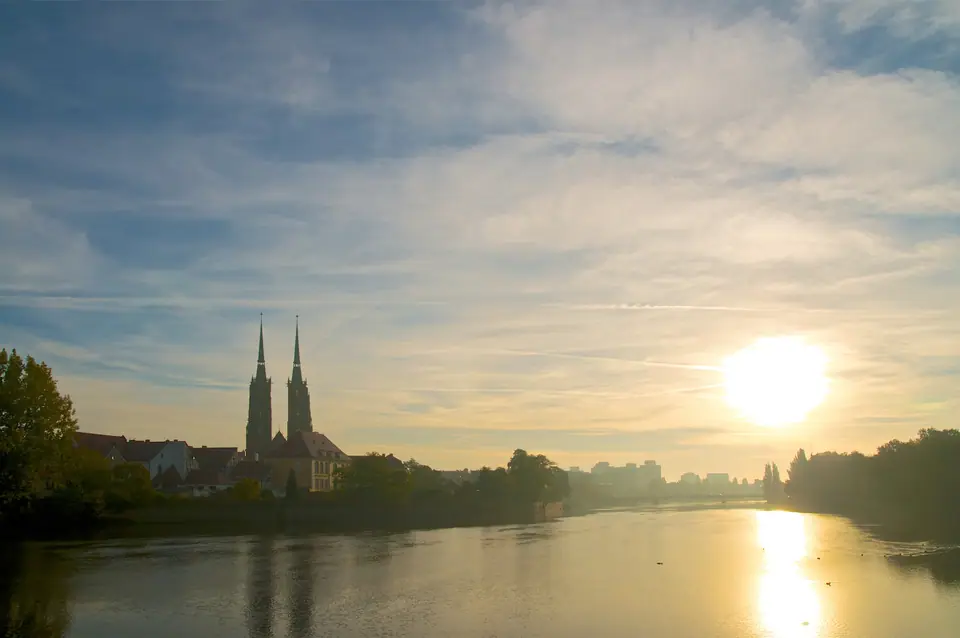
Photo: Paweł Liwosz · CC BY-SA 3.0
Cathedral Island at Dusk: Gas Lamps and Brick Spires
Atmospheric evening walk across Ostrów Tumski: Cathedral north-tower lift, two-tier Holy Cross church, Most Tumski and hand-lit gas lamps.
Cross north over steel river spans onto Ostrów Tumski, Cathedral Island, and commercial clatter falls behind thick seminary garden walls. Mature sycamore avenues replace shop windows immediately across cobbled lanes rising lightly above calm Odra water. Long before merchant squares gridded streets south of the river, Piast dukes fortified this quiet island elevation. Arrive shortly before sunset so warm gas flames catch deep blue twilight across towering Gothic brickwork. Few central European walks shift mood as sharply within a short river crossing.
From Piast Timber Fort to AD 1000 Bishopric
Tenth-century Piast rulers raised timber palisades on Ostrów Tumski to guard shallow crossings between braided river streams. In AD 1000, the Congress of Gniezno founded the Bishopric of Wrocław directly inside those earthworks. Centuries of autonomous church rule grew cleanly behind brick boundaries separate from town bailiffs south across the channel. Though filled side streams welded the island physically to the northern mainland long ago, monastic hush endures behind ancient stone arches. Seminarians and quiet walkers cross cobblestone intersections unhurriedly without tram rails or shop neon. Brass wall plaques and cloister gates guard calm courtyards beneath steep tiled roofs.
Crossing Cast-Iron Most Tumski Without Padlocks
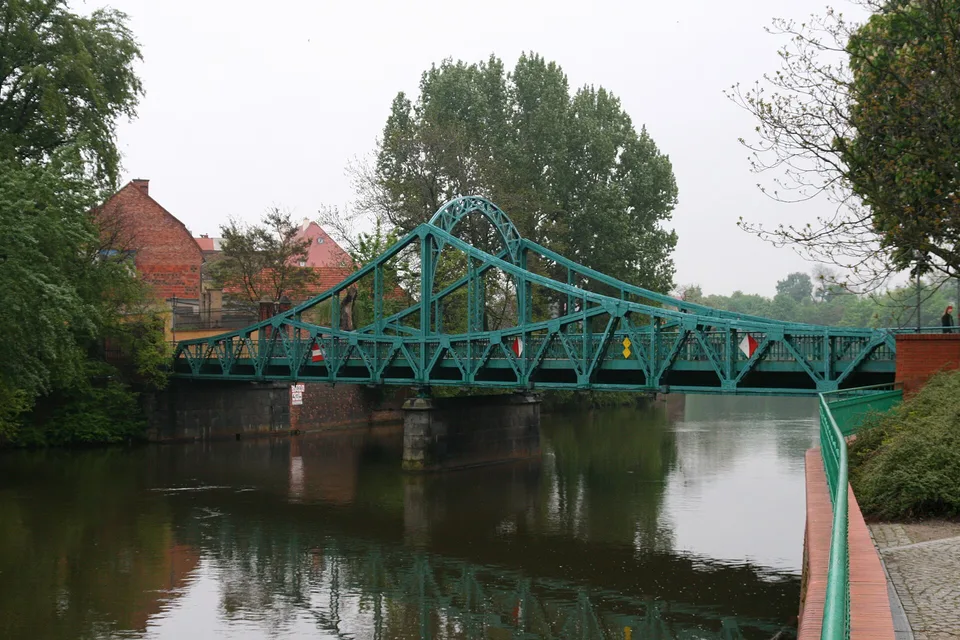
Walkers enter smoothly from Sand Island across riveted green steel trusses of Most Tumski, built in 1889 in two arches replacing older timber spans. For years couples clipped brass padlocks densely along its iron latticework until severe weight and rust threatened structural safety. Restoration teams working between 2019 and 2020 removed roughly 17 tonnes of metal padlocks cleanly off the railings. That conservation step returned crisp open river sightlines framing weathered stone saint figures guarding either bridgehead.
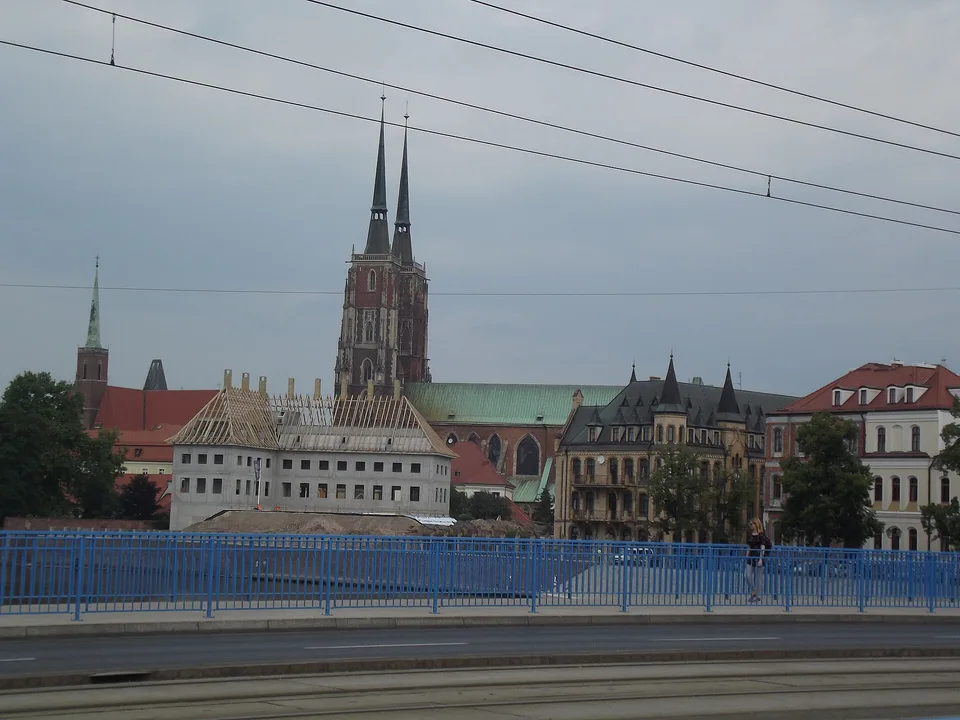
Pausing mid-bridge lets you watch slow tourist boats glide west beneath university halls while cathedral spires loom steadily ahead. Late afternoon light flashes across green water eddies and sandstone saints guarding the island approach. Wind rustles riverside willow branches below old stone flood embankments beside Sand Island mills. Photographers gather quietly near either stone abutment as evening glow warms brick facades straight ahead.
Two Stacked Sanctuaries at Holy Cross Church
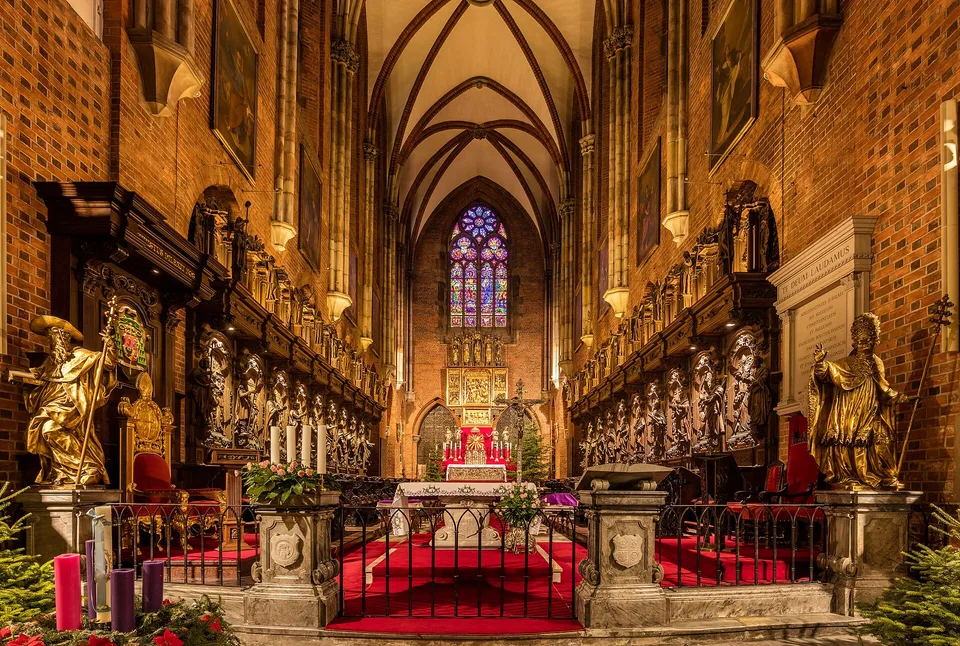
Up the gentle cobbled incline rises the massive Gothic brickwork of the Collegiate Church of the Holy Cross and St Bartholomew, founded in 1288 and completed across the fourteenth century. Architectural form sets this monumental church apart across Silesia. Medieval builders stacked two complete sanctuary halls vertically inside one towering pitched brick shell. Below rests the intimate lower Church of St Bartholomew, while wide stone stairs climb straight to the tall vaulted upper Church of the Holy Cross.
Out on the open cobbled square in front stands an ornate Baroque sandstone monument to St John of Nepomuk. Sculpted stone cherubs hold crisp evening silhouettes against tall stepped buttresses and dark timber doors. Stepping round the flank exposes how monumental red brick anchors the entire central ridge of the island. Warm late rays accentuate tall lancet windows cutting deep shadows along the eastern choir bay.
Brick Twins and North-Tower Lift at the Archcathedral
Walk straight down brick-walled Katedralna Lane toward the twin 97-metre western towers of the Archcathedral of St John the Baptist. Wartime shelling during 1945 tore through vaults and roofs across the ancient sanctuary. Patient craftsmen later restored lofty Gothic nave bays and rescued Baroque funerary chapels glowing quietly behind side screens. High brick buttresses rise smoothly above stone courtyard tombs along the quiet outer wall.
Beside the northern entrance porch waits one of Wrocław's cleanest elevated panoramas without gruelling staircase climbs. An internal passenger lift climbs effortlessly inside the north tower straight onto an open viewing platform above copper roofs. Sweeping horizons open immediately across winding Oder river bends, university towers and red Old Town spires stretching south. Down below on clear evenings, river barges trace silver streaks right under Sand Bridge.
The Cape-and-Hat Gas Lamplighter at Dusk
While bright electric LEDs illuminate tram shelters south across the river, Ostrów Tumski protects an intimate evening ceremony every dusk. Between 102 and 103 traditional cast-iron gas street lamps still light cobblestone lanes curling past Katedralny Square, Kanonia and Kapitulna entirely by real gas flame. Cast brackets hold glass chimneys steadily against winter winds across seminary corners and red-brick garden walls.
Each twilight and dawn, a uniformed lamplighter known locally as the latarnik walks purposefully past dark walls wearing a flowing black cape and tall top hat. Lifting a long brass-tipped pole neatly into each glass lantern housing, he turns brass valves until amber mantles hiss warmly awake against brick facades. Stand politely back along narrow pavements so the latarnik finishes his route smoothly before you stroll south toward central cafes or Nadodrze avenues. Amber halos scatter soft reflections across damp autumn cobbles long after dinner crowds gather south across river channels.
Quiet Island Pathways Beyond the Main Nave
Spare unhurried minutes circling behind the cathedral apse before crossing bridges back toward dinner tables:
- Bishop's Garden riverside path: Follow quiet brick walls behind the choir overlooking calm Oder eddies below overhanging riverside willows. Calm stone benches face west toward shimmering Sand Island church reflections.
- Kanonia and Seminary lanes: Trace wrought-iron gas lamp brackets mounted cleanly onto Seminary facades and brick canons' houses off ul. Kanonia. Tall arched doorways hide shaded monastic lawns behind sturdy oak gates.
- Time sunset carefully: Reach Most Tumski shortly before twilight fades blue so warm amber gas lamps greet you down Katedralna Lane before dusk turns dark. Brass lantern glow frames brick spires neatly without camera flash.
Where it is
- 1Cathedral Island at Dusk
- Copernicus Wrocław Airport (WRO) · about 12 km from here in a straight line
- Directions in Google Maps
Stations and taxi ranks: OpenStreetMap. Airports: OurAirports. Distances are in a straight line.
Traveller tips
Real advice from people who have been to Wrocław. Every tip is read by our team before it goes live.
No tips yet. Been here? Yours could be the first.
Thank you! Your tip will appear here after a quick review.
More in Wrocław
Continue exploring Wrocław with related neighbourhood, food, and planning guides