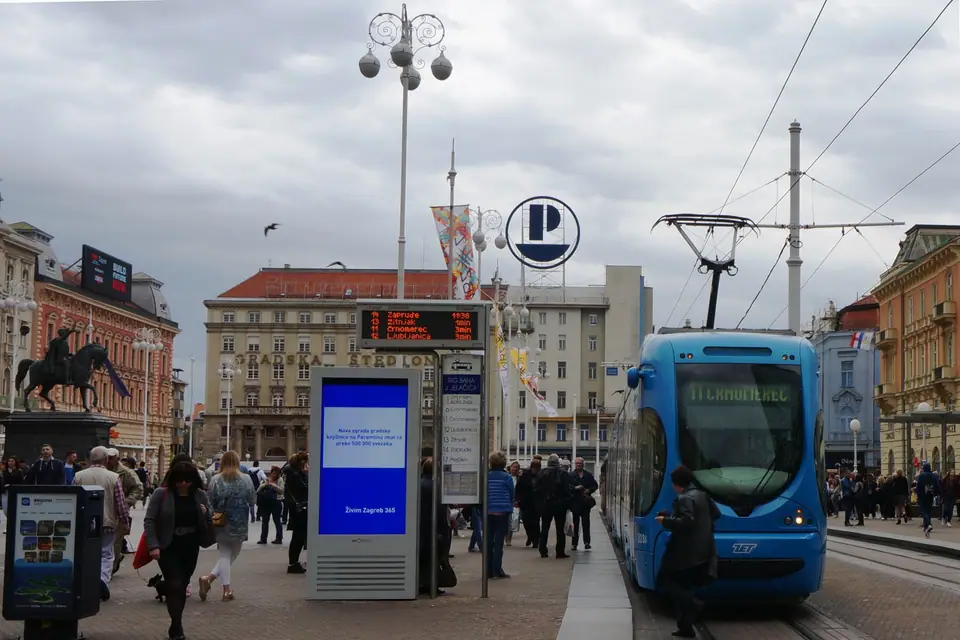
Photo: Naturpuur · CC BY-SA 4.0
Ban Jelačić Square, Dolac Market & the Lower Town
From central Ban Jelačić Square and Dolac red parasols through Tkalčićeva cafés and Lenuci Green Horseshoe parks.
Step down from Gradec or stroll north out of Zrinjevac Park and central Zagreb converges onto one broad open plaza: Ban Josip Jelačić Square. Serving smoothly as tram interchange, civic promenade, and outdoor meeting ground, it bridges Zagreb's twin medieval hills with the flat avenues of Donji grad (Lower Town).
Walking south from here traces Zagreb's steady shift from open seventeenth-century cattle fairs to symmetrical nineteenth-century Austro-Hungarian parks.
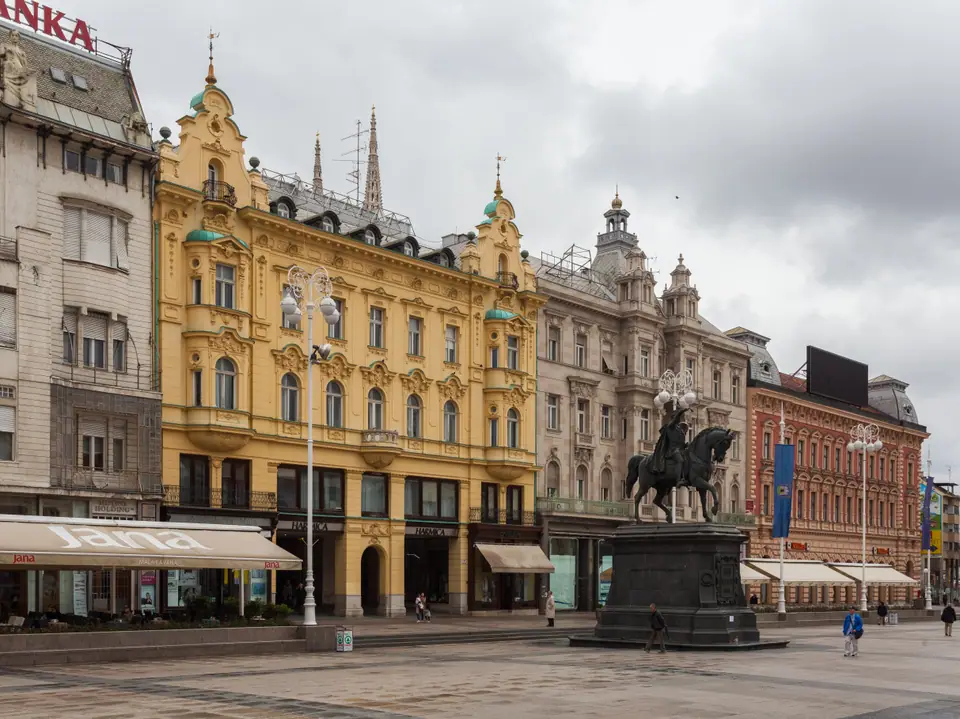
Ban Jelačić Square and its turning equestrian statue
Records from 1641 place Zagreb's fairground here beside the Manduševac spring below Gradec walls. Livestock shifted to Zrinjevac in 1826, while vegetable stalls stayed until Dolac opened in 1930. Renamed in 1848 after Ban Josip Jelačić, the plaza wore the name Republic Square from 1946 until multiparty independence restored its historic title in 1990.
Anton Dominik Fernkorn cast the bronze equestrian statue erected in autumn 1866 facing north toward Gradec rather than Hungary. Yugoslav authorities removed the monument in 1947 and stored it inside the Gliptoteka basement until returning it in 1990 facing south. Electric trams crossed starting in 1910, motor traffic ended in 1975, stone cobbles arrived in 1987, and huge crowds welcomed Croatia's World Cup football finalists on 16 July 2018.
Manduševac fountain and local square lore
Watch near the eastern tram shelter for a modest round stone basin bubbling quietly flush with square cobbles. Crews covered the Manduševac spring in 1898 and uncovered it cleanly during 1986 excavations. Local legend credits a thirsty knight calling a maiden named Manda to scoop water (zagrabi), giving Zagreb its name.
Walkers toss spare coins into the spring before cutting up Splavnica toward market stairs. Across the tracks rises the slender blue municipal clock, Zagreb's classic meetup pillar for guests staying along central Lower Town tram corridors.
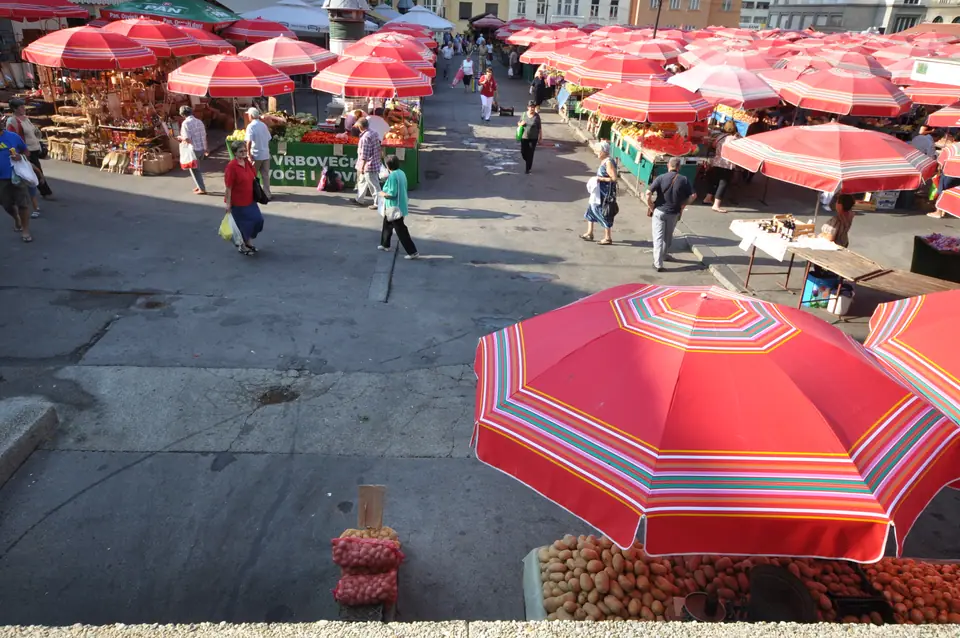
Red parasols and multi-year upgrades at Dolac Market
Stone steps climb past flower vendors onto architect Vjekoslav Bastl's open terrace at Dolac Market, inaugurated on 1 September 1930. Nicknamed "Zagreb's belly", this airy deck fills beneath traditional red Sixtine umbrellas with seasonal cherries, green beans, walnuts, figs, and hand-carved spoons.
Look atop the stairs for Stjepan Gračan's 2006 bronze statue of Kumica Barica, honouring rural women who carried produce crates down from Medvednica before dawn. After an October 2025 ceiling plaster collapse inside the indoor hall, open-air stalls periodically shift onto nearby European Square ahead of Dolac's 2030 centenary, so check active layouts on site.
Covered dairy, butcher, and fish counters below Dolac
Descend concrete staircases beneath the upper terrace to reach Dolac's sheltered indoor hall, reopened in December 2025 after structural checks. Cooled glass cases show farm women ladling tangy cottage cheese and thick cream for breakfast sir i vrhnje beside round cornmeal loaves.
Adjoining butcher bays hang smoky Slavonian kulen salami and dry-cured hams. Dedicated fish stalls north off Splavnica arrange Adriatic squid, sea bream, and sardines hauled overnight from coastal ports. Morning freshness peaks before noon when gathering ingredients from our Zagreb regional food overview.
Walking Tkalčićeva over the vaulted Medveščak stream
Stepping west off Dolac terrace drops straight onto pedestrian Tkalčićeva Street, tracing the winding channel of the buried Medveščak stream. Engineers enclosed the creek inside brick sewers between the 1890s and 1920s, swapping timber watermills for pastel workshops and sunny café tables.
Narrow Skalinska alley climbs cleanly westward toward Stone Gate up to Gradec. Early daylight gives calm views of pastel gables before restaurant parasols expand across the cobbles.
Zrinjevac Park and the eastern Green Horseshoe
Crossing south off Ban Jelačić Square down Praška Street enters Nikola Šubić Zrinski Park, called Zrinjevac and opened in 1873 as the anchor of Milan Lenuci's 1882 park ring. Mature plane trees shade gravel paths, Adolf Holzer's ornate 1884 weather pillar, and the cast-iron 1891 Music Pavilion hosting weekend concerts.
Just south on Strossmayer Square, the Croatian Academy of Sciences and Arts protects the medieval Baška Tablet. Carved around 1100, this major Glagolitic stone inscription has resided here since 1934. Across Zrinjevac stands the Archaeological Museum, opening onto a shady courtyard of Roman Pannonia carvings.
King Tomislav Square and the yellow Art Pavilion
Continuing straight south crosses into King Tomislav Square, laid out before 1892 Glavni kolodvor so rail arrivals faced fountain jets beneath Medvednica slopes. Facing north across flowerbeds glows the yellow Art Pavilion. Its iron frame served Zagreb at the 1896 Budapest Millennium Exhibition before engineers shipped and rebuilt it permanently here in 1898.
Major post-earthquake structural works across the pavilion's iron roof and facade target late 2026 completion along the green spine. Verify active gallery exhibition dates on the museum portal before planning interior stops.
Botanical Garden glasshouses beside the railway curve
Turning west along Antuna Mihanovića Street traces the southern curve past Hotel Esplanade directly into the University Botanical Garden, planted in 1889 by Professor Antun Heinz. Calm shaded gravel paths weave past lotus ponds, tall ginkgo and oak trees, Croatian alpine rockeries, and classic cast-iron Victorian greenhouses.
Woodland birdsong mixes gently with distant rail bells drifting over the southern garden fence. Check seasonal gate hours at the eastern entrance along Mihanovića Street before settling onto shady park benches.
Croatian National Theatre, Mimara, and Ilica return
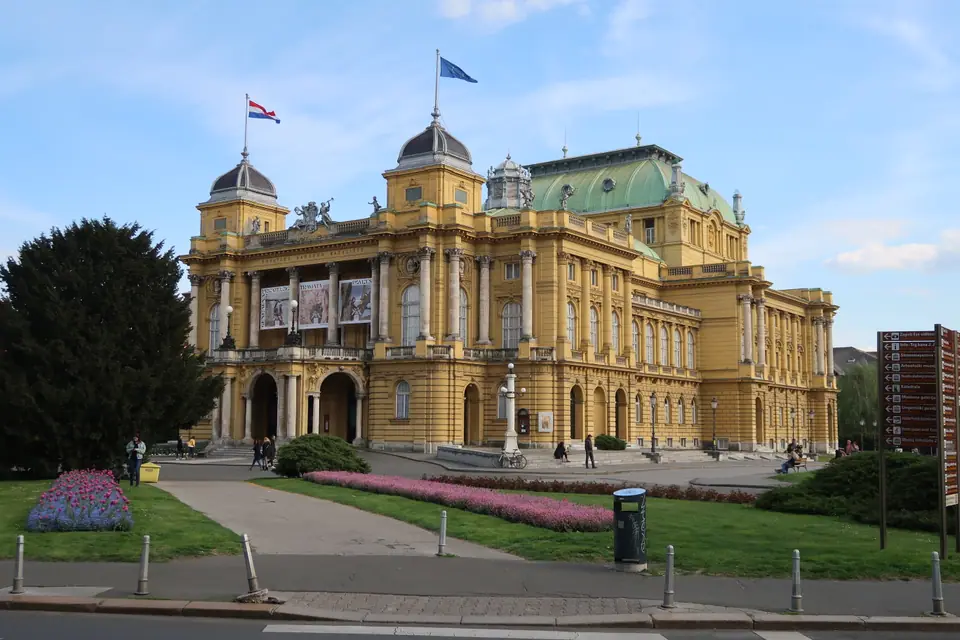
Walking north up Marko Marulić Square reaches Zagreb's yellow neo-baroque Croatian National Theatre, built in 1895 by Viennese partnership Fellner and Helmer. Ivan Meštrović's bronze Well of Life fountain anchors the landscaped lawn facing historic University Rectorate facades.
Two blocks west on Roosevelt Square stands the grand neo-Renaissance Mimara Museum, reopened on 7 November 2026 following structural earthquake refurbishment. While the main Museum of Arts and Crafts palace completes renovation through 2027, browse its temporary gallery on Ilica 163 before riding trams east back into Ban Jelačić Square.
Where it is
- 1Ban Jelačić Square, Dolac Market & the Lower Town
- Zagreb Franjo Tuđman International Airport (ZAG) · about 11 km from here in a straight line
- Directions in Google Maps
Stations and taxi ranks: OpenStreetMap. Airports: OurAirports. Distances are in a straight line.
Traveller tips
Real advice from people who have been to Zagreb. Every tip is read by our team before it goes live.
No tips yet. Been here? Yours could be the first.
Thank you! Your tip will appear here after a quick review.
More in Zagreb
Continue exploring Zagreb with related neighbourhood, food, and planning guides