Photo: Gveret Tered · CC BY-SA 4.0
Zagreb Cathedral, Mirogoj Cemetery & the Two Earthquakes
How seismic fractures in 1880 and 2020 reshaped Kaptol, Hermann Bollé's neo-Gothic spires, and Mirogoj's grand arcades.
Few European capitals carry seismic history as visibly across stone skylines as Zagreb. Both Zagreb Cathedral on Kaptol hill and monumental Mirogoj Cemetery two kilometres north owe their existing appearance largely to the Great Earthquake of 1880. Both landmarks also remain under careful restoration after March 2020 tremors damaged spires and brick vaults.
Exploring them together clarifies why scaffolding surrounds Zagreb's most prominent church belfries and why Hermann Bollé defined modern Zagreb architecture.
Kaptol fortress walls and medieval cathedral beginnings
Cathedral foundations mark the historic centre of Kaptol, established when King Ladislaus created Zagreb's bishopric in 1094. An earlier Romanesque sanctuary consecrated under King Andrew II in 1217 suffered heavy destruction during the 1242 Tatar invasion. Succeeding bishops erected a soaring Gothic hall church between the late thirteenth century and 1510. Carved stone capitals inside recall that long medieval building phase.
When Ottoman troops advanced across Slavonia in the early sixteenth century, cathedral canons wrapped Kaptol inside Renaissance defensive walls and round corner watchtowers built between 1512 and 1521. Heavy masonry bastions still encircle the Archbishop's Palace behind the gilded bronze Assumption column on Kaptol square. Quiet baroque canons' residences (kurije) also line Kaptol Street leading north toward Ribnjak Park. Walk slowly along the pavement edge to spot surviving Renaissance stone window frames.
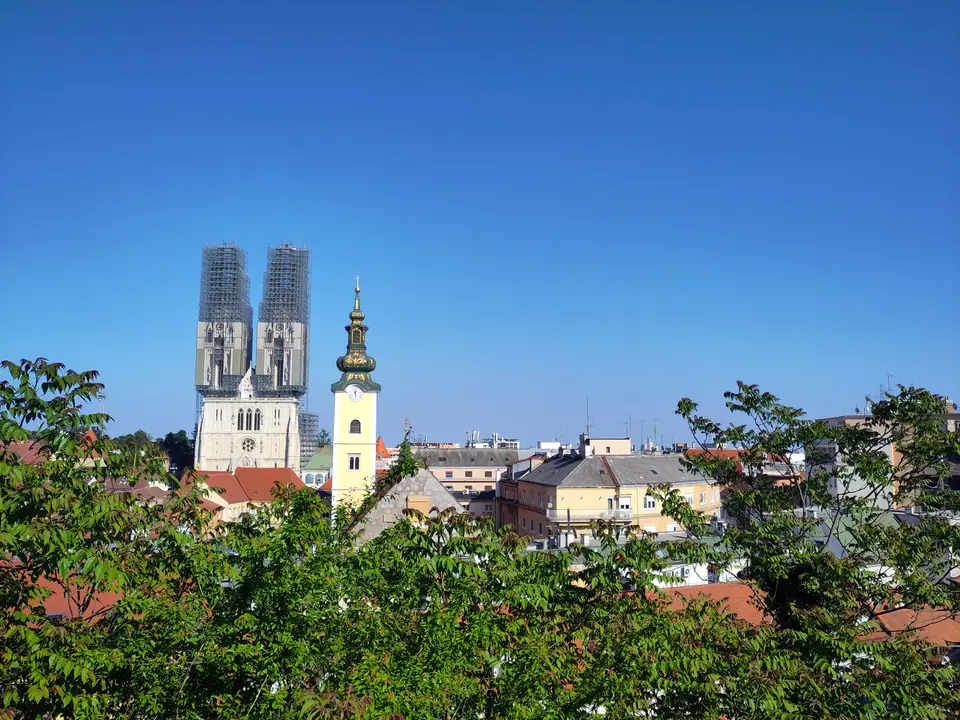
The 1880 earthquake and Hermann Bollé's neo-Gothic spires
On the morning of 9 November 1880, a magnitude 6.3 earthquake shattered stone rib vaults, split walls, and collapsed altars inside the cathedral while wrecking rooftops across town. Viennese restoration architect Friedrich von Schmidt drew neo-Gothic reconstruction plans. Supervision fell locally between 1880 and 1906 to Cologne-trained builder Hermann Bollé. Bollé spent the rest of his life reshaping churches, palaces, and civic landmarks across central Zagreb.
Bollé demolished the western fortress gateway and extended the nave footprint to 77.55 metres long by 46.20 metres wide for 5,000 worshippers. His twin bell towers pierced 108.4 metres high, securing the sanctuary's rank as Croatia's tallest sacral monument. Soft porous Bizek limestone weathered quickly over industrial decades, locking stone conservation rigs onto one spire or another long before 2020.
March 2020 damage and late-2026 restoration progress
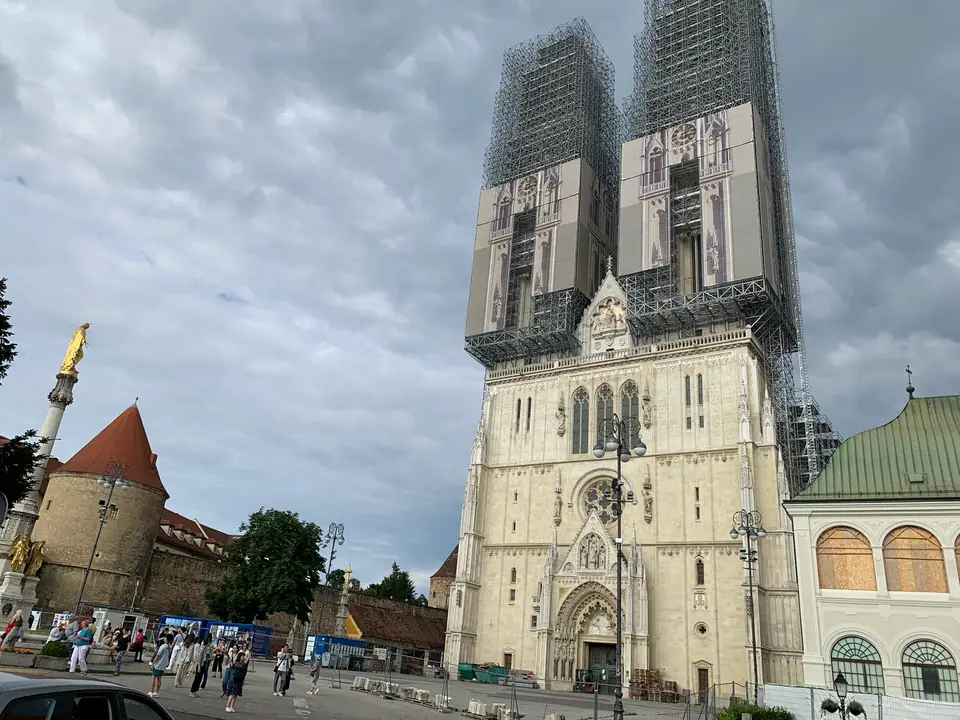
Early on Sunday 22 March 2020, a shallow magnitude 5.3 to 5.5 earthquake centred near Markuševec snapped the stone pinnacle and gilded cross off the south spire at 95 metres. Inspection showed the weakened twin north spire risked toppling onto residential rooftops below. Engineers lowered its upper tip carefully using controlled explosives on 17 April 2020.
By May 2024 crews had dismantled roughly 30 metres off each stone spire to ease seismic strain, before inserting steel bracing into interior nave piers. Following over five years of closure, Zagreb Cathedral reopened its interior nave to worshippers and quiet visitors in December 2025. Heavy steel scaffolding still encases exterior towers as delicate stone masonry rebuilds gradually into the next decade. Look up from Kaptol square to trace temporary structural trusses steadying both belfries.
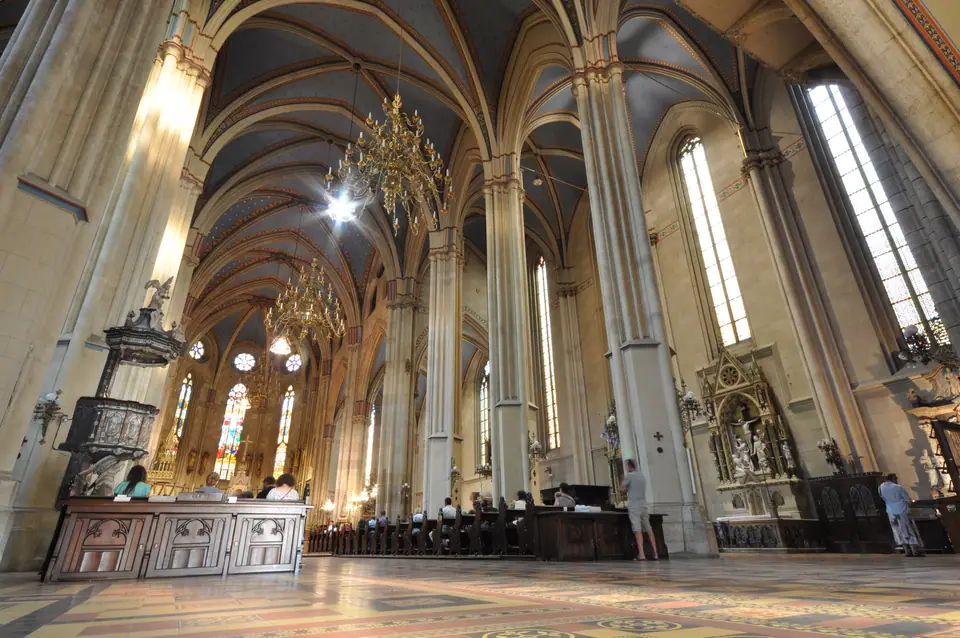
Inside the reopened nave and Archbishop's gardens
Stepping back inside the cathedral hall reveals slender clustered columns, deep blue starry ribbing overhead, and stained glass repaired after 2020 shockwaves shattered panes. Behind the high altar rests the silver-and-crystal sarcophagus holding Blessed Cardinal Alojzije Stepinac, bordered by bronze reliefs carved by sculptor Hrvoje Ljubić. Tall brass chandeliers illuminate gilded stone pulpit carvings on overcast winter afternoons.
Look closely along the north aisle for surviving medieval fragments, including a Glagolitic stone inscription and baroque marble altars spared during Bollé's Gothic refit. Sunlight through clerestory windows picks out intricate stonework high above the oak pews. Respect active safety barriers, keep voices hushed inside worship spaces, and fit Kaptol seamlessly into our broader central heritage loop.
Hermann Bollé's arcades and cupolas at Mirogoj Cemetery
North up wooded slopes, Hermann Bollé shaped Zagreb's quietest architectural park atop former vineyards owned by language reformer Ljudevit Gaj. Municipal authorities purchased Gaj's hilltop estate in 1872. They opened Mirogoj on 6 November 1876 as an interfaith civic cemetery welcoming Catholic, Orthodox, Protestant, Jewish, and Muslim burials together.
Between 1879 and 1929 Bollé framed the western boundary with sweeping Neo-Renaissance red-brick arcades anchored by the central green copper cupolas of the Church of Christ the King. Those grounds preserve roughly 60,000 graves and over 322,000 burials. Notable monuments honour writer Miroslav Krleža, novelist Ivana Brlić-Mažuranić, basketball icon Dražen Petrović, chemist Vladimir Prelog, leader Stjepan Radić, and president Franjo Tuđman. Deep cracking in 2020 placed Mirogoj onto Europe's endangered heritage list. Fenced northern wings remain under repair while shady central walkways stay open throughout daylight hours.
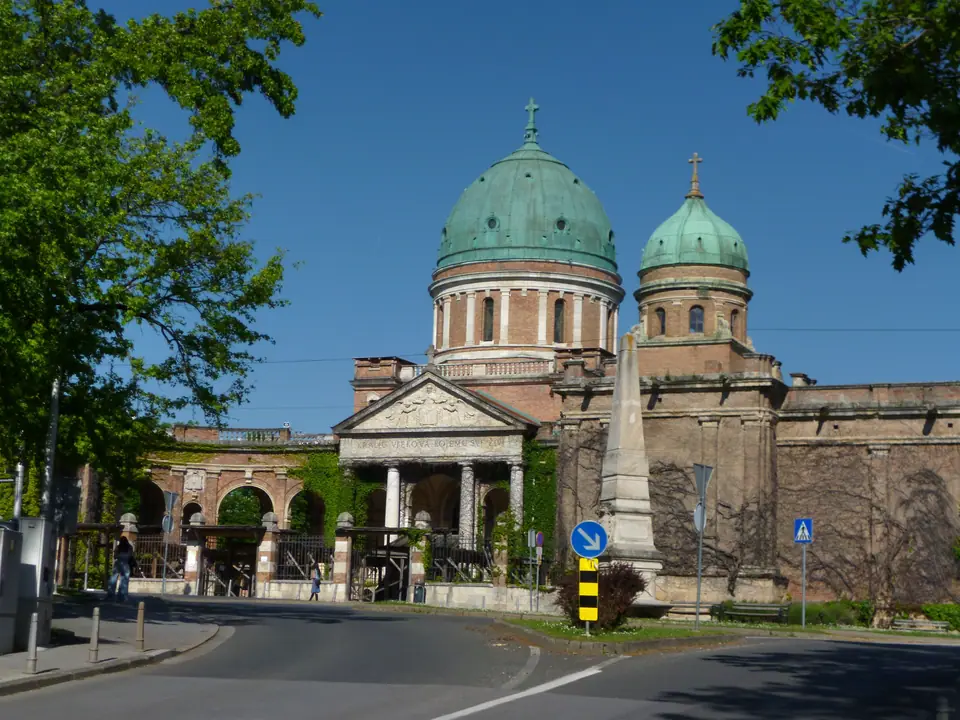
Reaching Kaptol and riding ZET Bus 106 to Mirogoj
Zagreb Cathedral rises immediately uphill east from Ban Jelačić Square via Bakačeva Street. It pairs easily with any walk through both historic hill quarters. Continuing north past stone bastion walls places travellers outside Ribnjak Park and Kaptol's northern bus terminal. Respect closed safety gates around scaffolded belfry bases throughout Kaptol Square.
ZET Bus 106 climbs steadily along curving Mirogojska cesta and stops right opposite Mirogoj's twin-domed portal in under a quarter-hour without uphill hiking. Fresh flower kiosks crowd the entrance archway throughout mild autumn weeks. Winding gravel paths lead visitors beneath golden maples toward quiet stone family vaults. Validate a standard Zone 1 ticket inside onboard yellow boxes or the MojZET app using our ZET transit guide. Visit thoughtfully outside crowded All Saints' Day chrysanthemum processions in early November.
Where it is
- 1Zagreb Cathedral, Mirogoj Cemetery & the Two Earthquakes
- Zagreb Franjo Tuđman International Airport (ZAG) · about 11 km from here in a straight line
- Directions in Google Maps
Stations and taxi ranks: OpenStreetMap. Airports: OurAirports. Distances are in a straight line.
Traveller tips
Real advice from people who have been to Zagreb. Every tip is read by our team before it goes live.
No tips yet. Been here? Yours could be the first.
Thank you! Your tip will appear here after a quick review.
More in Zagreb
Continue exploring Zagreb with related neighbourhood, food, and planning guides