


























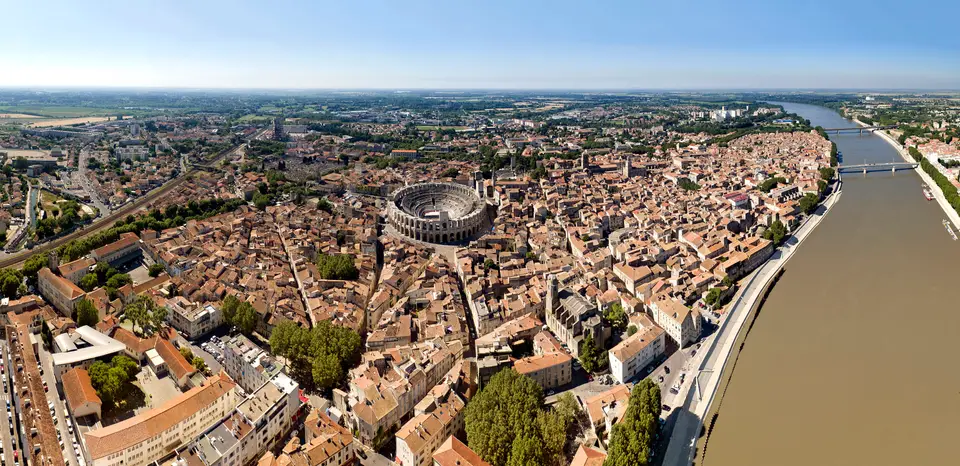
Quick Field Data
- UNESCO Inscription: 1981 · Cultural Criteria (ii), (iv).
- Scale & Footprint: 65 hectares (160 acres) of protected historic urban centre encompassing eight Roman and Provençal Romanesque monument complexes.
- Access & Ticketing: Located in the walkable city centre of Arles; municipal monument passes grant entry to the Amphitheatre, Roman Theatre, Cryptoporticus, Thermes of Constantine, Alyscamps, and Cloister of Saint-Trophime.
- Arrival Logistics: Positioned beside the Rhône within southern France's Provence-Alpes-Côte d'Azur region, linked by regional rail and highway routes to Mediterranean hubs including Nice.
From Roman Colony on the River Rhône to Medieval Capital of Provence
Set along the banks of the River Rhône inside southern France's Provence-Alpes-Côte d'Azur region, the 65-hectare (160-acre) historic core of Arles, listed on the UNESCO World Heritage Atlas in 1981 under the title Arles, Roman and Romanesque Monuments (known in French as Arles, monuments romains et romans), demonstrates how an ancient Classical city adapted its street grid, public spaces, and monumental architecture to medieval European civilisation. Rather than building on a separate site outside the ancient walls, medieval Arles developed in direct continuity with the urban structures inherited from Antiquity, turning Roman arenas, baths, and cemeteries into the civic and spiritual core of a thriving Mediterranean city.
Three major historical eras shaped the eight monument complexes protected within the 65-hectare perimeter. The earliest monumental buildings, the Arles Amphitheatre (arena), the Gallo-Roman theatre, and the subterranean galleries of the Cryptoporticus beneath the Roman forum, were erected during the 1st century BC alongside the 1st century AD, when the Romans introduced the full suite of imperial urban facilities into Gaul atop a site that already held earlier Greek foundations. Across Late Antiquity from the 4th to the 6th centuries, the city ascended to become a premier political and religious capital and experienced a second golden age, attested by the riverside public baths known as the Thermes of Constantine (Baths of Constantine) and the marble sarcophagi lining the necropolis of the Alyscamps.
After the defensive adaptations of the early Middle Ages, when the Roman amphitheatre was transformed into a walled fortress while the riverside Thermes of Constantine were adapted to serve as a count's palace, Arles enjoyed a third urban flowering during the 11th and 12th centuries among the foremost cities of the Mediterranean world. Inside the medieval ramparts and along the avenue of the Alyscamps, master masons and sculptors drew directly on the surrounding Roman ruins to create major works of Provençal Romanesque art, culminating in the 12th-century Church of Saint-Honorat and the Church of Saint-Trophime with its sculpted portal and canonical cloister.
The First-Century BC and First-Century AD Roman Monuments
Anchor of the northern and central old town is the Arles Amphitheatre (arena), which forms an exceptional ensemble alongside the nearby Roman Theatre and the Cryptoporticus. Erected across the 1st century BC and the opening decades of the 1st century AD as a monumental oval arena for public spectacles, the amphitheatre dominates the urban skyline with its superimposed stone arcades and internal vaulted corridors. During the turbulent centuries following the end of the Roman Empire, the local population sealed the outer arches and turned the amphitheatre into a fortified citadel within the city, demonstrating the practical reuse of ancient engineering that characterises Arles. Throughout the early medieval period, houses, lanes, and defensive towers were built directly inside the oval seating bowl and stone galleries of the 1st-century arena, turning a monument of Classical spectacle into a self-contained walled neighbourhood that sheltered townspeople for centuries before modern conservation cleared the interior arcades.
Immediately south-west of the arena stands the Gallo-Roman theatre (Roman theatre), dating back to the 1st century BC. Although much of its stone seating and stage wall was quarried during the Middle Ages, the surviving semicircular cavea tiers and standing marble pillar ruins illustrate the civic grandeur introduced into Gaul by the Romans. Flanking the historical core are surviving sections of the Ramparts of the Roman castrum, which protected the ancient river port along the Rhône.
West of the theatre, directly beneath the present City Hall and the adjoining Chapel of the Jesuit College in the heart of the old town, lies the Cryptoporticus and Roman forum. Likely built by the Greeks or early Roman builders in the 1st century BCE, these cool subterranean stone galleries supported the level terrace of the Forum of Arles above ground and may also have been used as slave barracks or vaulted storage spaces. Just beside the forum precinct, preserved inside the courtyard of the Museon Arlaten, stands the curving stone colonnade of the Roman exedra, completing the 1st-century civic core. Taken together, the subterranean vaulted galleries of the Cryptoporticus, the open terrace of the Forum of Arles, the curving colonnade of the Roman exedra in the Museon Arlaten courtyard, the Gallo-Roman theatre, the Amphitheatre, and the defensive Ramparts of the Roman castrum illustrate how Roman planners engineered level public plazas and monumental entertainment venues across the sloping terrain beside the River Rhône.
4th-century Splendour: The Baths of Constantine and the Alyscamps
During the 4th century CE, as Arles entered its second golden age as an imperial capital of Late Antiquity, builders erected the Thermes of Constantine (French: Thermes de Constantin) directly overlooking the banks of the River Rhône. Constructed of alternating courses of brick and limestone masonry, this monumental public bath complex preserves its lofty vaulted hot rooms and semi-circular apse, which were later incorporated into a medieval count's palace before being uncovered and conserved as a historic monument.
To the south-east of the historic city walls stretches the Alyscamps, the celebrated necropolis of ancient and medieval Arles. Lined with stone sarcophagi dating back to the Roman era and Late Antiquity (4th to 6th centuries), the funerary avenue remained a prestigious Christian burial ground throughout the Middle Ages. Across France, toward the end of the sarcophagus-lined walk rises the Church of Saint-Honorat, built in the 12th century in the Provençal Romanesque style over the ancient cemetery.
Provençal Romanesque Revival: Saint-Trophime and the 1178 Coronation
Within the city walls beside the City Hall and the subterranean Cryptoporticus stands the Church of Saint-Trophime (Church of St. Trophime) and its adjoining cloister, one of the foremost Romanesque monuments in Provence. Built in the 11th and 12th centuries, the church exemplifies the enduring influence of Classical Antiquity on the architecture and sculpture of medieval Provence. Its richly carved western portal was inaugurated for the ceremonial coronation of the German emperor Frederick Barbarossa, who was crowned King of Arles inside the church in 1178. Next to the church nave, the Cloister of Saint-Trophime frames a quiet stone courtyard with carved piers and capitals that bridge Roman decorative motifs and medieval Christian narrative.
Walking the 65-Hectare Monument Circuit in Arles
Today, the eight component locations of the UNESCO World Heritage site lie within easy walking distance of one another across the 65-hectare historic centre. Sunlight warms the limestone arches. Because the Roman street grid and public squares still organise daily life in Arles, visitors can trace two thousand years of Mediterranean urban history in a single continuous walk. Whether examining the Classical Corinthian capitals and narrative reliefs on the 12th-century portal of the Church of Saint-Trophime, where Emperor Frederick Barbarossa received the crown of the Kingdom of Arles in 1178, or walking past the Roman and 4th-century stone sarcophagi of the Alyscamps toward the Romanesque Church of Saint-Honorat, travellers encounter a city where Antiquity and the Middle Ages form a single architectural fabric.
- Entry and Route Across the Historic Centre: Start at the central square beside the City Hall to admire the 1178 coronation portal and sculpted cloister of the Church of Saint-Trophime, then descend beneath the City Hall and the adjoining Jesuit College chapel into the subterranean galleries of the 1st-century BC Cryptoporticus and inspect the nearby Roman exedra in the courtyard of the Museon Arlaten.
- Tickets and Viewpoints: Continue east to walk through the pillar ruins of the Gallo-Roman theatre and climb the upper tiers of the Arles Amphitheatre for views across the tiled roofs to the River Rhône, then visit the 4th-century Thermes of Constantine by the riverfront, trace the Ramparts of the Roman castrum, and walk the sarcophagus-lined avenue of the Alyscamps to the 12th-century Church of Saint-Honorat; check the official site for combined monument ticket passes.
- Timing and Onward Connections: Visit the open-air ruins of the Roman theatre, amphitheatre, and Alyscamps in the morning or late afternoon light, reserving the shaded galleries of the Cryptoporticus and the Cloister of Saint-Trophime for midday. Connect your visit to Arles with our coastal guide to Nice and our UNESCO World Heritage Atlas.
