Photo: JourneyCities
Palau de la Música Catalana: Tours, Concerts and Booking
Domènech i Montaner's concert hall, and whether to see it on a tour or at a concert.
Lluís Domènech i Montaner built the Palau de la Música Catalana between 1905 and 1908 for the Orfeó Català, a choral society that still owns it. It's a working concert hall and a UNESCO World Heritage Site, shared on the list with his Hospital de Sant Pau, and it is the most richly decorated interior in Barcelona. Gaudí gets the crowds. This is where Modernisme goes furthest indoors.
It's also awkward to see from outside. The Palau is wedged into the lanes of Sant Pere, just north of El Born, and there's no square in front of it. We photographed the façade from Carrer de Sant Pere Més Alt in June 2026, and the street is narrow enough that you stand close and look up: mosaic-covered columns, busts of composers along the top, and a sculpture group on the corner representing Catalan folk song.
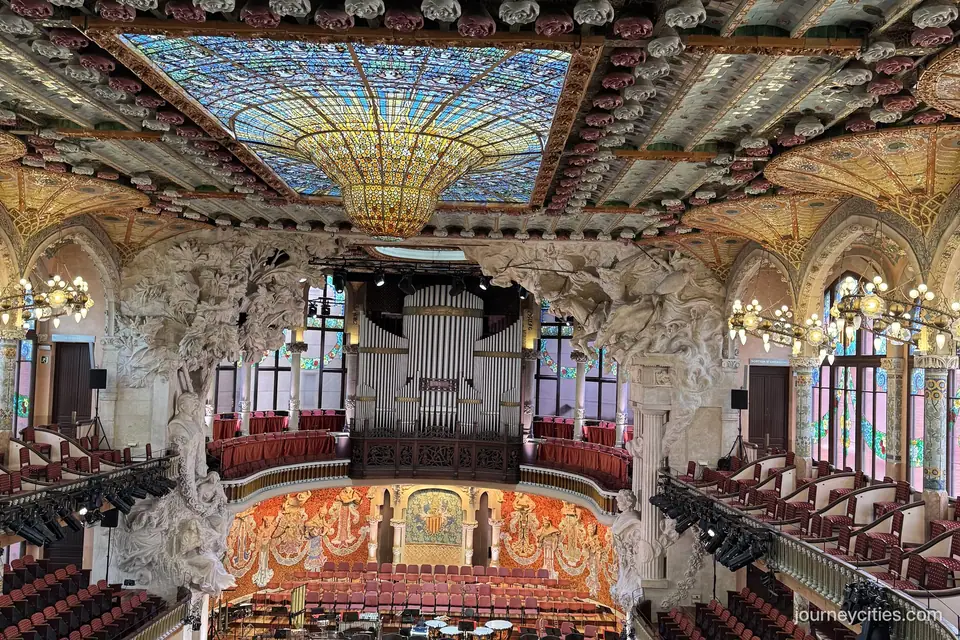
Inside, the main hall is a glass box. The side walls are mostly windows, and in the middle of the ceiling hangs a skylight of stained glass by Antoni Rigalt, gold at the centre, blue around the edge. Around the stage, the arch is crowded with sculpture: on one side a bust of Anselm Clavé, founder of the Catalan choral movement, and on the other Beethoven beneath Wagner's Valkyries riding out of the wall. Along the back of the stage, the muses emerge half in mosaic and half in relief.
We went inside the hall in the daytime, late in the morning on 9 June 2026, with the skylight lit from above and people in the seats and up on the stage.
Guided visit or concert?
Our things to do list says a concert beats the tour, and for the sound and the sense of occasion it does. For the building, the daytime visit shows you more. Daylight is what makes the glass work, and a visit also takes you through the foyer and the Lluís Millet Hall, whose balcony looks straight at the mosaic columns of the façade. At a concert you stay in your seat, the hall is lit artificially, and photos during the performance aren't allowed.
So: if you only have one slot and you came for architecture, take a daytime visit. If you love music, book a concert. With time for both, see the hall by day and come back at night.
Booking and getting there
Everything is sold on the official site, palaumusica.cat. The main ways to visit by day are a guided tour in several languages, an audio guide on your phone, or a cheaper self-guided visit with a printed brochure. The guided tour is the one we'd pick, because the symbolism in the decoration is dense and easy to miss. Slots sell out in spring and summer, so book about a week ahead. The official site also sells combined tickets with other Modernista buildings.
The concert programme runs from the Orfeó Català choir and visiting orchestras to shorter guitar and flamenco evenings aimed at visitors. The cheapest seats are high up, which isn't a hardship here, since the upper levels are closest to the skylight.
The nearest metro is Urquinaona on L1 and L4, a few minutes' walk away. The Gothic Quarter and the cathedral are a short walk south, so a morning visit leads naturally into the old town.
Traveller tips
Real advice from people who have been to Palau de la Música Catalana: Tours, Concerts and Booking. Every tip is read by our team before it goes live.
No tips yet. Been here? Yours could be the first.
Thank you! Your tip will appear here after a quick review.
More in Barcelona
Continue exploring Barcelona with related neighbourhood, food, and planning guides