Photo: JourneyCities
Casa Batlló and Casa Milà: Which Gaudí House to Visit
Two Gaudí apartment houses on one avenue, and how to choose between them.
Gaudí did two pieces of private housing on Passeig de Gràcia, a few blocks apart. Casa Batlló, at number 43, was a remodel of an existing building for the textile magnate Josep Batlló, finished in 1906. Casa Milà, at number 92, was built from scratch for Pere Milà and Roser Segimon between 1906 and 1912, and the city laughed at it: La Pedrera, "the stone quarry", started as an insult. Both are now UNESCO-listed and both are timed-ticket visits.
The short answer
One is enough for most people. Choose Casa Batlló if you want to walk through Gaudí's imagination room by room. Choose La Pedrera if you want the rooftop and a clearer sense of how he built. If you only have time to look from the street, Casa Batlló's façade is the more striking of the two.
Casa Batlló: for the inside
The façade is the famous one: balconies like carnival masks, columns like bones, and a roof ridge of glazed tiles shaped like a dragon's back. Inside, there's hardly a straight line. The main floor rooms ripple, and the light well is lined with tiles that run from deep blue at the top to pale at the bottom, so the light looks even from every floor. The visit, with a smartguide, takes a little over an hour, and recent seasons have added immersive digital rooms. Those are fun, but they're not Gaudí. The house stays open into the evening.
La Pedrera: for the roof
The visit climbs to the rooftop first: a landscape of stairwell exits and chimneys like helmeted warriors. Below it, the attic holds the Espai Gaudí exhibition under rows of brick arches, the clearest explanation anywhere of how he worked out his curves. Then comes an apartment furnished as it was around 1911, and the two courtyards. Allow about an hour and a half. The rooftop closes in rain, so keep a dry day for it.
Visiting at night
Both houses sell evening visits. La Pedrera's Night Experience is a guided tour that ends with a projection show on the rooftop and a glass of cava, and there's also an early-morning Sunrise visit. Casa Batlló runs seasonal night visits. Book any of these on the official websites, which list the current formats.
The avenue itself
Passeig de Gràcia is the spine of the Eixample, and the street furniture is part of the show. Look down at the hexagonal grey paving tiles, a Gaudí design with sea creatures that he made for Casa Batlló, and at Pere Falqués' wrought-iron lampposts with mosaic benches at their base. Next to Casa Batlló stand Casa Amatller and Casa Lleó Morera, the clashing neighbours our three-day itinerary walks you past. The metro is Passeig de Gràcia (L2, L3, L4) at the lower end and Diagonal (L3, L5) by La Pedrera.
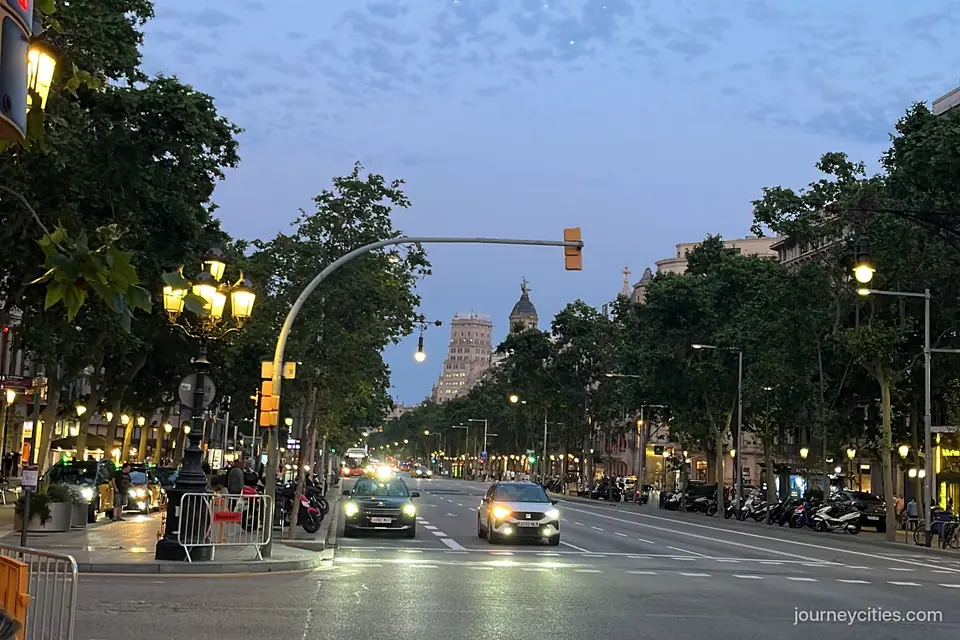
The avenue is at its most handsome late in the day. We were there at dusk on 9 June 2026: a wide avenue still busy with traffic, the street lamps lit. Our first night's dinner, on 8 June, was in a large dining hall just off Passeig de Gràcia, with a high arched roof, hanging lamps and plants. The streets either side of the avenue are full of places to eat, and the Eixample is where we'd base a first stay, as our where to stay guide explains.
Traveller tips
Real advice from people who have been to Casa Batlló and Casa Milà: Which Gaudí House to Visit. Every tip is read by our team before it goes live.
No tips yet. Been here? Yours could be the first.
Thank you! Your tip will appear here after a quick review.
More in Barcelona
Continue exploring Barcelona with related neighbourhood, food, and planning guides