


























Quick Field Data
- UNESCO Inscription: 1979 (Cultural heritage serial property in the Dordogne department, Nouvelle-Aquitaine region, southwestern France)
- Scale & Footprint: 15 inscribed prehistoric sites, decorated caves and rock shelters, within a 30-by-40-kilometre stretch of the Vézère Valley containing 147 to more than 150 Palaeolithic deposits and 25 to 30 decorated caves
- Access & Ticketing: Administered by the Centre des monuments nationaux and departmental heritage authorities; check the official site for strict daily visitor caps (under 100 per day at Font-de-Gaume and Les Combarelles) and Lascaux IV reservations
- Arrival Logistics: Centred on Les Eyzies-de-Tayac-Sireuil, the "Capital of Prehistory", and upstream Montignac, Rouffignac, Marquay, Peyzac-le-Moustier, and Tursac in the Dordogne
Four Hundred Millennia of Human Occupation and the Birth of Prehistoric Archaeology
Winding through steep Cretaceous limestone cliffs and wooded hills in the Dordogne department of Nouvelle-Aquitaine across a compact territory of roughly 30 by 40 kilometres, the decorated caves and prehistoric rock shelters of the Vézère Valley preserve the richest concentration of Palaeolithic habitats and parietal art in Europe. Since 1979, the UNESCO World Heritage Atlas in 1979, the reserve specifically protects 15 flagship caves and rock shelters, known in French as abris, clustered around the riverside village of Les Eyzies-de-Tayac-Sireuil and neighbouring communes such as Montignac, Rouffignac, Marquay, Peyzac-le-Moustier, and Tursac, inside a wider valley landscape holding 147 to over 150 documented Palaeolithic sites and 25 to 30 decorated caves spanning a chronological arc from 400,000 (or 450,000) to 10,000 (and 8,000) years ago.
Because successive ice-age hunter-gatherer groups returned generation after generation to the sheltered, south-facing limestone overhangs above the game-rich Vézère River and its side valleys, their hearths, flint workshops, bone tools, and burials accumulated in deep, superimposed stratigraphic layers that became the global reference framework for European prehistory. After early digs in the Dordogne began in 1810, systematic scientific archaeology was launched here over five months in 1863 by the French palaeontologist Edouard Lartet and his English partner Henry Christy, who excavated Grotte Richard, the Gorge d'Enfer shelters, Laugerie-Basse, Laugerie-Haute, Le Moustier, and La Madeleine, finding in 1864 at La Madeleine an ivory plate engraved with a woolly mammoth that proved unequivocally that early humans had coexisted with extinct Pleistocene megafauna.
In 1872 archaeologist Gabriel de Mortillet named the primary cultural epochs of the Palaeolithic directly after the Vézère type-sites: the Micoquien (after La Micoque, inhabited from roughly 450,000 to 100,000 years ago across 10 metres of strata where the Tayacian industry was also identified), the Mousterian associated with Neanderthals from 160,000 to 40,000 years ago (after Le Moustier, where a 45,000-year-old Neanderthal skull was unearthed in 1908 alongside regional Neanderthal burials at La Ferrassie, Le Regourdou, and Roc de Marsal), and the Magdalenian of 17,000 to 12,000 years ago (after the Abri de la Madeleine in Tursac). Equally foundational was the 1868 discovery at the Abri de Cro-Magnon in Les Eyzies of five Aurignacian human skeletons, four adults and an infant dated to around 28,000 years ago, which gave the name "Cro-Magnon" to early modern humans in Europe.
Settling the Cave Art Debate: From La Mouthe and Font-de-Gaume to Lascaux
Just as the Vézère rock shelters established the timeline of Stone Age technology, its subterranean limestone galleries settled one of the fiercest scientific controversies of the 19th century: whether Palaeolithic humans possessed the artistic capacity to paint and engrave deep underground. Although decorated caves had been found at Chabot in 1879, Altamira in 1880 alongside Pair-non-Pair in 1881, leading sceptics dismissed the paintings as recent forgeries until archaeologist Émile Rivière investigated the cave of La Mouthe in Les Eyzies in 1895 (discovered in 1894), uncovering animal engravings 90 metres inside the entrance sealed beneath ancient stalagmite layers alongside a carved stone fat-burning lamp depicting an ibex. Six years later, in September 1901, the local schoolteacher and archaeologist Denis Peyrony, working with Henri Breuil and Louis Capitan, discovered more than 600 Magdalenian engravings along the 300-metre-long, 1-metre-wide corridor of Les Combarelles (inhabited 13,000 to 11,000 years ago) and, just eight days later, more than 200 polychrome bison, horses, mammoths, and reindeer dated to 17,000 years ago inside nearby Font-de-Gaume, prompting chief critic Émile Cartailhac to publish his famous 1902 confession in L'Anthropologie, "Mea culpa d'un sceptique".
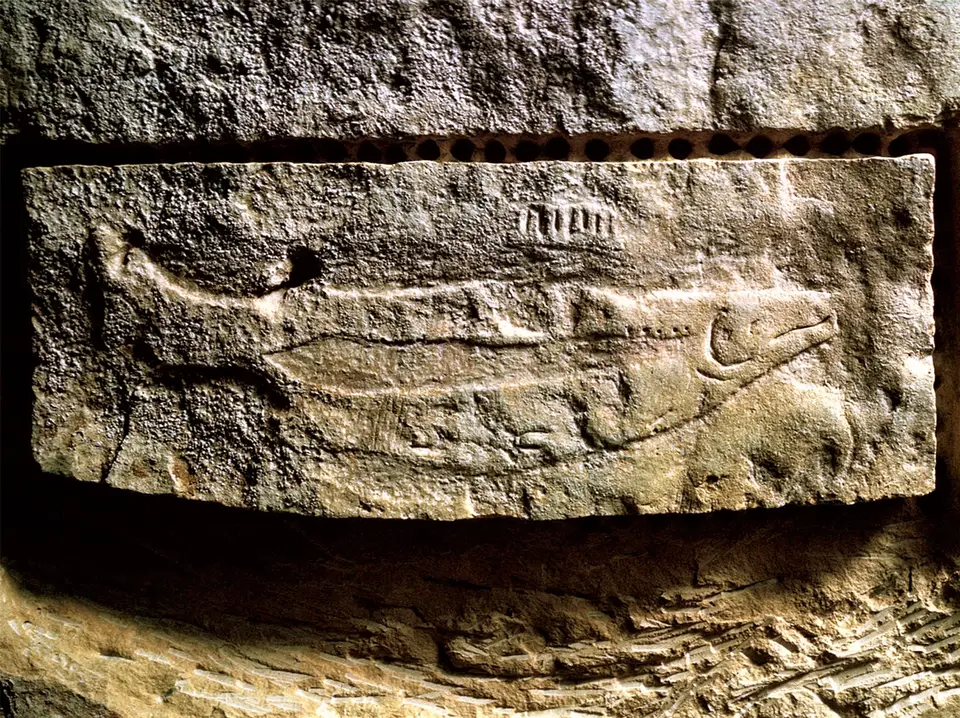
Crowning the valley's artistic heritage was the discovery of Lascaux Cave near Montignac in September 1940, whose bright red, yellow, and black mineral pigments preserve around 600 polychrome paintings and hundreds of engravings, including 100 major animal figures of aurochs, horses, stags, and bison dated to approximately 17,000 years ago, celebrated for their anatomical vitality and perspective. Alongside these painted caverns, the 15 listed sites encompass extraordinary sculptural reliefs and portable art: at the Abri du Poisson in the Gorge d'Enfer (discovered in 1892, fish carving identified in 1912), a 1-metre-long bas-relief of a salmon dated to the Middle Gravettian around 25,000 years ago forms one of the oldest representations of a fish in the world; at the 15-metre-long Cap Blanc shelter in Marquay (discovered in 1908, skeleton of the Magdalenian Girl found in 1911), a 13-metre-long, 2-metre-high deep limestone frieze sculptures 10 life-size horses and bison; at Laugerie-Basse (inhabited 14,000 years ago, adjacent to the 200-metre-long Laugerie-Haute shelter occupied from 24,000 to 15,000 years ago), Paul Hurault, 8th Marquis de Vibraye, unearthed the ivory "Vénus impudique" in 1864; at La Madeleine, Denis Peyrony's 1921 to 1922 excavations revealed the 10,000-year-old burial of the Enfant de la Madeleine wearing over 1,000 shell beads and the carved reindeer-antler spear-thrower "Bison Licking Insect Bite"; at Roc de Saint-Cirq (Grotte du Sorcier, discovered in 1952), bas-reliefs include the human "sorcerer"; and at the vast Rouffignac Cave (Cro de Granville, mentioned as early as 1575 and scientifically authenticated in 1956), over 200 mammoth drawings and finger flutings lie 2 kilometres underground.
Visiting Lascaux IV, Font-de-Gaume, and the Les Eyzies Rock Shelters
Because human breath, body heat, and lighting rapidly destabilise subterranean microclimates, forcing French authorities to close the original Lascaux Cave to the public in 1963 after post-1948 visitor crowds triggered green algae and fungal growth, while keeping La Mouthe and La Madeleine closed to general tourists, visiting the Vézère Valley combines leading facsimile centres with strictly quota-limited original caves and open-air cliff shelters. Limestone cliffs overhang the river.
- Lascaux IV in Montignac and the Rouffignac mammoth train: Begin at the northern end of the valley in Montignac at the International Centre for Cave Art, Lascaux IV (opened in 2016 as the comprehensive successor to the 1983 Lascaux II replica), where sub-millimetre 3D laser scans and mineral pigments recreate the entire subterranean cave layout alongside interactive galleries. Pair Lascaux IV with a drive west to Rouffignac Cave, where a small electric train carries visitors 2 kilometres into the dark karst labyrinth to view original 13,000-year-old Magdalenian mammoth engravings and paintings.
- Font-de-Gaume, Les Combarelles, and the Cap Blanc sculpted frieze: Base yourself in Les Eyzies-de-Tayac-Sireuil to book one of the strictly capped daily tickets (fewer than 100 visitors per day) into Font-de-Gaume, the only cave in the valley containing original polychrome prehistoric wall paintings that remains open to visitors, and nearby Les Combarelles. From Les Eyzies, drive up the hill toward Marquay to view the deeply carved Magdalenian horse frieze inside the original Cap Blanc rock shelter, stopping along the road near the Abri de Laussel and Bernifal.
- National Museum of Prehistory, Abri Pataud, and the Gorge d'Enfer shelters: In the centre of Les Eyzies, climb to the cliffside Château de Tayac to explore the National Museum of Prehistory, founded by Denis Peyrony in 1913, and the nearby International Pole of Prehistory, before walking to the stratified cliff excavations of Abri Pataud and the Abri de Cro-Magnon. Continue a short distance upstream along the Vézère to visit the 1924 stalactite cavern of Le Grand Roc, the overhanging shelters of Laugerie-Basse and Laugerie-Haute, the salmon relief at Abri du Poisson in the Gorge d'Enfer, and the monumental cliff ledges of Roque Saint-Christophe and Castel Merle near Peyzac-le-Moustier and Sergeac. Across the surrounding valleys of the Dordogne, additional excavated caves and shelters, including the engraved cavern of Bara-Bahau at Le Bugue (discovered in 1951), the Muzardie cave and Roc de Marsal Neanderthal child burial at Campagne, the subterranean horse carvings discovered in 1915 beneath the medieval ruins of Château de Commarque, the Venus relief shelter of Abri de Laussel at Marquay, the painted cave of Bernifal at Meyrals, and the Neanderthal burial sites of La Ferrassie at Savignac-de-Miremont and Le Regourdou near Montignac, demonstrate why the Vézère basin remains an inexhaustible archaeological reserve for studying Quaternary human evolution.
