


























Quick Field Data
- UNESCO Inscription: 1983 (Criterion vi; 10th-century Eastern Orthodox monastic spiritual centre and masterpiece of 18th- and 19th-century Bulgarian National Revival architecture and fresco art).
- Scale & Footprint: Encompasses an 8,800-square-metre main quadrangle (including a 3,200-square-metre inner courtyard) within an 8.7-hectare core zone at 1,147 metres elevation in the southwestern Rila Mountains.
- Access & Ticketing: The central courtyard and the main church remain accessible to visitors, while separate tickets apply for the Tower of Hrelja alongside the monastic museum and historic collections; check the official site before visiting.
- Arrival Logistics: Situated 117 kilometres (73 miles) south of Sofia along the Rilska River valley inside Rila Monastery Nature Park; reachable by road along the mountain gorge from the region of Dupnica.
Ascetic Origins, Medieval Royal Patronage, and the Bulgarian National Revival
Set at an elevation of 1,147 metres (3,763 feet) above sea level along the Rilska River valley among the forested peaks of the southwestern Rila Mountains, the Monastery of Saint John of Rila (known in Bulgarian as Sveti Ivan Rilski) emerged in the 10th century from the ascetic retreat of Bulgaria's patron hermit. Born as Saint Ivan of Rila (876 to 946 AD) and active during the rule of Tsar Peter (reigned 927 to 968), the hermit lived in a nearby mountain cave without material possessions while his students travelled into the mountains to receive their education and constructed the earliest monastic buildings around 927. Over the following centuries, the sanctuary grew into a revered pilgrimage destination for Orthodox Christians across Southern Europe and the hub of spiritual and artistic life throughout medieval Bulgaria.
Nearly all medieval rulers of the Second Bulgarian Empire granted generous donations and charters to the mountain sanctuary, elevating it into a focal point of Bulgarian cultural identity that reached its medieval peak between the 12th and 14th centuries. Early in the 14th century, a regional feudal lord named Hrelja relocated and rebuilt the monastery on its present riverside terrace, erecting the fortified stone Tower of Hrelja between 1334 and 1335 alongside an adjacent church in 1343, a carved wooden bishop's throne, and richly engraved monastery gates. When Ottoman armies conquered the Balkan peninsula at the close of the 14th century, the monastic complex endured repeated raids and mid-15th-century devastation before three brothers from the Dupnica region reconstructed the sanctuary late in the 15th century with financial support provided by Sultana Mara Branković alongside the Russian Orthodox Church and the Rossikon community on Mount Athos. Through Sultana Mara Branković's diplomatic intervention, the revered relics of Saint Ivan of Rila were translated from Tarnovo into the newly restored complex in 1469.
Throughout four centuries of Ottoman rule between 1400 and 1878, the mountain abbey acted as an essential depository of Bulgarian language alongside Slavic literacy and Christian artistic traditions across the Balkans, hosting a monastery school established by the educator Neofit Rilski and providing a secure mountain refuge for Bulgarian revolutionary leaders including Vassil Levski alongside Gotse Delchev and the poet Peyo Yavorov. After a destructive fire swept through the complex in 1833, wealthy Bulgarian benefactors from across the country pooled funds for a monumental reconstruction between 1834 and 1862 directed by architect Alexi Rilets, transforming the medieval stronghold into the crowning achievement of the Bulgarian National Revival and a symbol of Slavic cultural awareness following centuries of foreign occupation.
Fortress Ramparts, Striped Mamluk Porticoes, and the Five-Domed Main Church
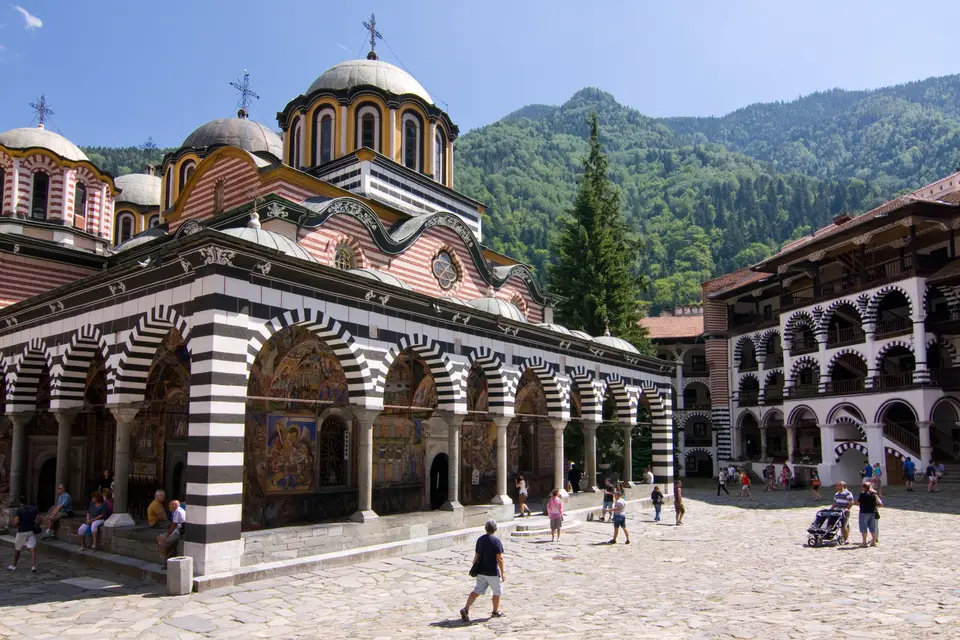
From the outside, the rectangular 8,800-square-metre complex presents the austere profile of a stone mountain fortress, with high masonry walls and narrow upper windows designed to withstand bandits and raids. Once visitors step through the entrance gates into the 3,200-square-metre cobbled inner yard, the military exterior gives way to a four-storey residential quadrangle (excluding the basement) whose construction began in 1816 under Alexi Rilets. Deep open porticoes and arcaded verandas wrap around the courtyard in tiers of striped masonry arches and small domes that reflect Mamluk architectural influences popularised across Ottoman lands following the conquest of Egypt.
Behind these painted verandas lie 300 monastic chambers alongside four chapels, an abbot's room, a monumental kitchen famous for its uncommonly large cooking vessels, a donor's reception room, and a historic library preserving 250 medieval manuscripts together with 9,000 old printed books. The courtyard is anchored by two freestanding monuments from different epochs: the 14th-century stone Tower of Hrelja (1334 to 1335), to which a belfry was added in 1844, and the mid-19th-century main church erected between 1834 and 1837 by architect Pavel Ioanov. The stone tower dominates the yard.
Pavel Ioanov crowned the main church with five domes above three altars and two side chapels, creating a rhythmic silhouette against the surrounding Rila Monastery Forest Nature Reserve. Completed in 1846, the interior and exterior frescoes were painted by master artists from the regional schools of Bansko alongside Samokov and Razlog, led by the celebrated brothers Zahari Zograf and Dimitar Zograf, who covered the open narthex galleries and interior vaults with biblical murals alongside treasured icons spanning the 14th to the 19th centuries. Inside the central nave, four master woodcarvers (Atanas Teladur alongside Petar Dashini, Georgi Dashini, and Dimitar Stanishev, with debated participation by Petre Filipovich) worked for five years to fashion the monumental gold-plated iconostasis, whose openwork floral reliefs frame the sanctuary doors near the burials of Saint Ivan of Rila alongside Hreljo, Tsar Boris III of Bulgaria, Neofit Rilski, and British correspondent James David Bourchier.
Field Navigation across the Courtyard, Museum, and Mountain Reserve
Visiting Rila Monastery involves balancing the architectural detail of the main quadrangle with its museum treasures and the surrounding nature park across the mountain valley, where the forested peaks and the Rilska River frame the monastic ramparts.
- Approaching via the Rilska River Valley: Travelling 117 kilometres (73 miles) south from Sofia, follow the highway past Dupnica and ascend the deep valley road alongside the Rilska River to the monastery gates at 1,147 metres elevation. Stepping into the 3,200-square-metre inner courtyard reveals the contrast between the sheer exterior stone fortress walls and the four storeys of striped National Revival residential galleries built from 1816 under Alexi Rilets.
- Inspecting the Main Church and Tower of Hrelja: Begin at the central church built by Pavel Ioanov between 1834 and 1837 to study the 1846 exterior gallery frescoes painted by Zahari Zograf and Dimitar Zograf, then step inside to view the gold-plated wooden iconostasis carved over five years by Atanas Teladur's workshop alongside the tomb of Tsar Boris III. Directly beside the church, examine the 1334 Tower of Hrelja with its 1844 belfry and 1343 church foundations, the oldest surviving medieval structures in the complex.
- Exploring the Monastic Museum and Ascetic Cave: Visit the monastery museum in the residential wing to see the 14th-century engraved gates, the medieval bishop's throne, and Rafail's Cross: a single piece of wood measuring 81 by 43 centimetres whittled over 12 years until 1802 by a monk named Rafail, who used fine burins and magnifying lenses to carve 104 religious scenes and 650 miniature figures before losing his sight. Afterwards, walk through the surrounding Rila Monastery Nature Park and Rila Monastery Forest Nature Reserve to the nearby cave where Saint Ivan of Rila lived as a 10th-century hermit during the reign of Tsar Peter.
Alpine Preservation and Institutional Continuity
Declared a national historical monument in 1976, inscribed on the UNESCO World Heritage List in 1983, and featured on the reverse side of the 1-lev Bulgarian banknote issued in 1999, Rila Monastery returned in 1991 to the full ecclesiastical authority of the Bulgarian Orthodox Church and its Holy Synod, housing approximately 60 resident monks today across its historic residential wings and chapels. Welcoming some 900,000 visitors in 2008 alone (and earlier receiving Pope John Paul II during his pilgrimage on 25 May 2002, when Bishop Ioan, the monastic igumen and a former Second Vatican Council observer, welcomed the pontiff inside the courtyard), the brotherhood maintains daily liturgical services while planned conservation works protect the medieval wood-carvings alongside the historic library manuscripts and 1846 mural paintings against natural force effects across the Rila Mountains. You can explore this mountain sanctuary alongside other Balkan religious landmarks in our UNESCO World Heritage Atlas.
