Quick Field Data
- UNESCO Inscription: Cultural World Heritage Site (Ref. 1426), inscribed on 22 June 2014 under Criteria (i) and (iii).
- Scale & Footprint: 9 hectares protecting subterranean chambers of roughly 8,500 square metres and the limestone plateau above the Ardèche River near Vallon-Pont-d'Arc.
- Access & Ticketing: The authentic cave stays permanently closed to public visitors to preserve its stable microclimate. Travellers visit the full-scale Caverne du Pont d'Arc facsimile (Chauvet Cave 2), booking timed admission on the official website.
- Arrival Logistics: Marseille Provence Airport (MRS) sits 123 km south as the primary international gateway. Avignon Caumont Airport (AVN) lies 66 km away with limited flights, and Marseille lies 143 km south.
Karst Plateau Above Pont d'Arc and Discovery
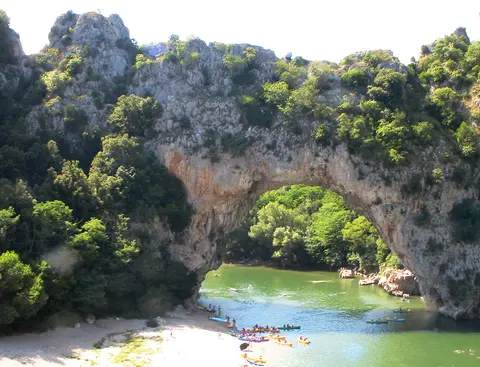
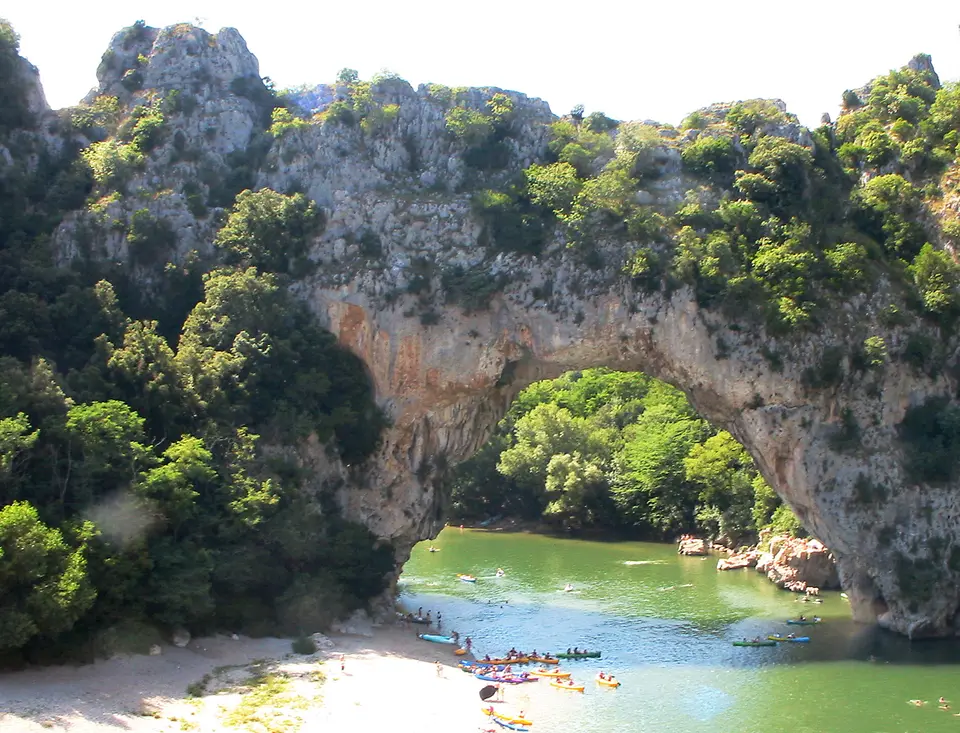
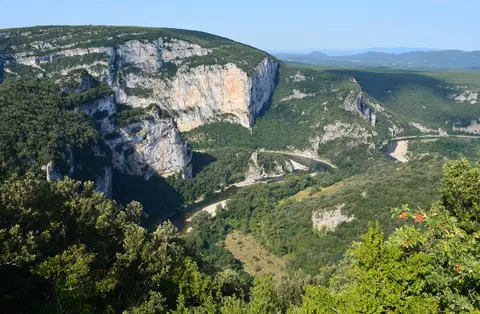
Chauvet Cave sits near Vallon-Pont-d'Arc in the Ardèche department of southern France. The underground chambers sit inside a limestone plateau overlooking a dry former meander of the Ardèche River called the Combe d'Arc. Water cut straight through the rock barrier roughly 124,000 years ago to carve the natural Pont d'Arc arch and divert the river southward.
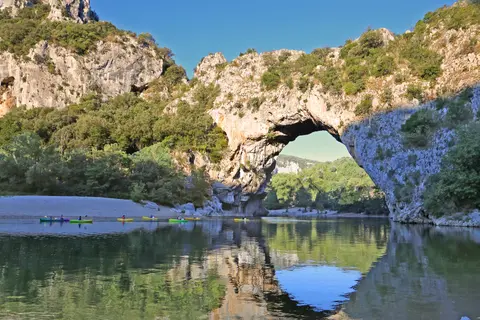
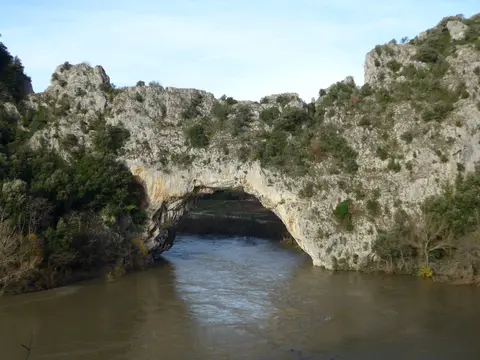
Standing 59 metres wide and 34 metres high, the Pont d'Arc limestone span sits 5 km from Vallon-Pont-d'Arc as the gateway to the Gorges de l'Ardèche. Protected as a natural site since 24 January 1931, it remains the sole natural stone arch in the area spanning an active river. Karst erosion continues shaping limestone gorge bends over geological timescales, meaning natural arches like the 59-metre Pont d'Arc eventually wear down while river meanders cut new spans.
On 18 December 1994, speleologists Eliette Brunel-Deschamps, Christian Hillaire, and Jean-Marie Chauvet lowered themselves into an aperture above the abandoned river bend. Six months earlier, Michel Rosa, nicknamed Baba, had detected cool air rising from a narrow gap dubbed Le Trou de Baba. Following further exploration by Michel Chabaud and two colleagues, the team entered immense chambers culminating in the Gallery of the Lions and the End Chamber, completely untouched since the Ice Age.
Geomorphological sampling and 36Cl dating on fallen cliff blocks by researchers from the University of Savoy, Aix-Marseille University, and France's prehistory centre confirmed why the interior remained intact. Cosmogenic dating shows cliff collapses began blocking the prehistoric entrance around 29,400 years ago, with a mid-stage slip roughly 23,500 years ago and a final rockfall around 21,500 years ago sealing the cave completely until 1994. Within the 9-hectare protected boundary and surrounding 2013 buffer zone, national monument laws prohibit surface construction above the 8,500-square-metre cavern so humidity stays unchanged.
Aurignacian Cave Paintings, Cave Bear Dens, and Dating
Specialists have catalogued more than 1,000 wall images inside Chauvet Cave, depicting at least 13 distinct animal species together with geometric signs and rare human fragments. Unlike many later Palaeolithic caves dominated by prey herbivores such as horses, bison, mammoths, and aurochs, Chauvet Cave paintings devote exceptional wall space to dangerous Ice Age carnivores. Cave lions, leopards, cave hyenas, woolly rhinoceroses, and the famous Chauvet cave bear move across charcoal-blackened and red-ochre limestone panels.
Field studies led by French prehistorian Jean Clottes reveal sophisticated preparation and drawing methods across the main chambers. Before applying pine charcoal or red ochre, Aurignacian artists systematically scraped dark clay and mineral concretions off rock panels to expose bright limestone underneath. Painters then combined blended charcoal shading with incised stone lines cut around animal outlines, producing three-dimensional volume and dynamic action such as two woolly rhinoceroses clashing horns.
Full human figures do not appear, matching wider Upper Palaeolithic conventions, though two partial female depictions occupy deep galleries. One lower-body motif sits inside a vestibule niche of the End Chamber, while another hangs from a conical rock pendant touching a bison head, forming a hybrid image often compared to a minotaur. Elsewhere, artists blew red pigment over pressed hands to leave hand stencils, arranged rows of red dots, drew two bird-like or butterfly shapes, and sketched a plume recalling active regional volcanoes later overdrawn with a deer.
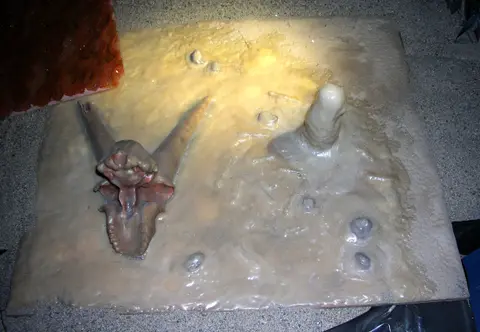
Beneath the decorated walls, soft clay floors retain 4,000 inventoried prehistoric faunal bones, including horned ibex skulls and abundant skulls of extinct cave bears. Bears hibernating inside the deep rooms left deep claw marks along walls, paw prints, and round sleeping hollows stamped into the mud. Centuries after the painters departed, Gravettian visitors walked through the cave between 27,000 and 25,000 years ago, leaving torch soot stains and charred hearths. That later visit also left a child's footprints that may represent Europe's oldest accurately dated human tracks, close to paw prints dated 26,000 years before present linked to a wolf or early dog.
Early dating results sparked fierce debate among European rock-art scholars. When 31 radiocarbon samples reported by 1999 included sample Gifa 99776 from zone 10 at roughly 32,900 years before present, stylistic critics including Christian Züchner, Paul Pettitt, and Paul Bahn questioned whether shaded animal perspective could be older than Gravettian or Magdalenian art. By 2011, more than 80 radiocarbon dates placed creation firmly in the Aurignacian era, while Gravettian engravings incised over older charcoal proved the black drawings came first.
A landmark 2016 study examining 259 radiocarbon dates from charcoal pigment, floor soot, and bone resolved the timeline into two clear phases. The first human group visited between 37,000 and 33,500 years ago, producing most of the monumental black mammal drawings before a rockfall temporarily closed the entrance. A second cultural group arrived between 31,000 and 28,000 years ago before final cliff collapses sealed the cavern, and 2020 IntCal20 radiocarbon calibration places the oldest Chauvet Cave drawings around 36,500 years ago.
Since 2008, researchers under Julien Monney's Datation Grottes Ornées project have expanded chronological studies to neighbouring Ardèche gorge sanctuaries, including Points Cave in Aiguèze and Deux-Ouvertures Cave. Comparing pigment chemistry, engraving sequences, and stylistic motifs across multiple sites places Chauvet Cave art within a connected regional Aurignacian landscape rather than treating it as an isolated anomaly. Ongoing laboratory work continues refining how early hunter-gatherer bands moved across southern French limestone valleys.
In addition to dating studies, the French Ministry of Culture enforces a dual protective framework across both the underground galleries and the plateau above. The decorated cave itself holds top national historic monument status, while the surrounding buffer zone gained matching national protection in early 2013 to prohibit future construction or quarrying above the karst cap. Management plans launched for 2012 to 2016 and subsequent revision cycles coordinate non-intervention monitoring, institutional responsibilities, and strict limits on research visits so relative humidity and air composition never shift.
Visiting the Caverne du Pont d'Arc Replica Complex
Public visitors cannot enter the authentic cavern, which French heritage authorities have kept sealed since December 1994. Experience at Lascaux and Altamira proved earlier in the twentieth century that tourist crowds alter cave temperature, humidity, and carbon dioxide levels, triggering destructive mould growth across ancient pigments.
Strict preventive conservation governs every detail inside the real chambers today. Archaeologist Dominique Baffier directed preservation from 2000 until 2014, when Marie Bardisa assumed oversight under continuous atmospheric monitoring and a strict non-intervention rule forbidding any retouching of the walls. Even specialists enter sparingly along suspended, reversible stainless-steel walkways built solely to protect clay footprints and bear nests below. In 2010, filmmaker Werner Herzog received restricted interior permission to record Cave of Forgotten Dreams, bringing rare views of the real chambers to cinema audiences.
To share the discovery safely, regional authorities launched the Grand Projet Espace de Restitution de la Grotte Chauvet and opened Caverne du Pont d'Arc on 25 April 2015. Commonly called Chauvet Cave 2, this full-scale facsimile near Vallon-Pont-d'Arc recreates roughly 3,000 square metres of decorated cave floor inside a single climate-controlled complex (dramatically larger than Lascaux II's partial 1983 two-chamber replica, alongside the later 2016 Lascaux IV centre in Montignac). Painters, karst geologists, and digital modellers replicated key panels, floor hollows, and limestone reliefs at full scale inside a condensed climate-controlled building.
Inside Caverne du Pont d'Arc, timed tours guide guests past illuminated reproductions of the lion frieze, horse panels, and cave bear bones before opening onto the Aurignacian discovery gallery. Interactive displays explain how Upper Palaeolithic artists burned pine for drawing charcoal, ground iron-rich ochre, and survived the cold steppe environment of southern France. Visitors should check official ticketing calendars well ahead of summer and holiday weekends, as timed slots often fill weeks in advance.
Access Zones Across the Ardèche Gorge and Replica Site
Separating the sealed hillside cavern from the Caverne du Pont d'Arc complex and nearby gorge landmarks makes day planning straightforward.
| Complex Zone | Key Highlights | Access & Ticket Rule |
|---|---|---|
| Original Chauvet-Pont-d'Arc Cave | Authentic Aurignacian lion panels, woolly rhinos, cave bear dens, and clay footprints. | Permanently closed to general visitors since 1994, with rare scientific entry on steel walkways. |
| Caverne du Pont d'Arc Complex | Full-scale facsimile galleries, bear nest replicas, and the Aurignacian interpretation gallery. | Public access by timed admission ticket booked through the official site. |
| Pont d'Arc Natural Arch | 59-metre limestone arch spanning the Ardèche River above beaches and Combe d'Arc. | Open public access along gorge roads and reserve trails 5 km from Vallon-Pont-d'Arc. |
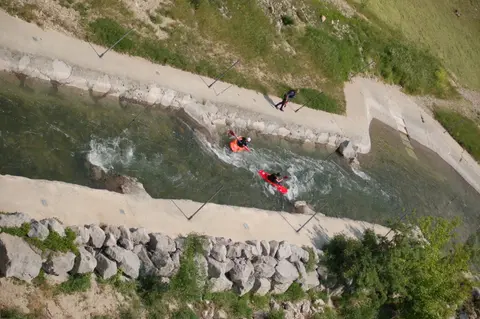
| Vallon-Pont-d'Arc Gorge Reserve | Riverbank viewpoints, whitewater canoeing stretches, and neighbouring karst cliff paths. | Open access along public lanes and marked reserve tracks under seasonal parking controls. |
Calcite Varnish, Scraped Walls, and Dual-Phase Dates
Walking slowly through the replicated chambers at Caverne du Pont d'Arc highlights three prehistoric wall techniques rare in European cave art.
- Scraped pale backgrounds behind charcoal art: Look closely around the horse heads and hunting lions to notice bright pale limestone zones where artists scraped off dark surface clay before sketching, sharpening visual contrast under torchlight.
- Translucent calcite varnish preserving pigment: Using ultraviolet beam analysis in 2026, scientists from Sorbonne Université and France's national research centre identified a fine natural calcite layer acting like transparent varnish across painted lines.
- Incised contours and superimposed Gravettian scratches: Around charcoal limbs and rhino horns, stone-engraved grooves create shadow relief, while later Gravettian marks cut across older lines confirm millennia between human visits.
Getting to Chauvet Cave, Seasonal Timing, and Marseille Pairings
Reaching Vallon-Pont-d'Arc requires rural road connections across southern Ardèche, as no mainline rail line enters the gorge. Marseille Provence Airport (MRS) sits 123 km south as the primary year-round international airport, while Avignon Caumont Airport (AVN) lies 66 km away with limited seasonal flights. From either Rhône corridor arrival point, motorway exits lead west toward Vallon-Pont-d'Arc, located 5 km from the Pont d'Arc natural bridge, where regional buses supplement private drivers during warmer months.
Spring and autumn bring pleasant southern French sunshine and quieter viewpoints along the Combe d'Arc escarpment, avoiding peak summer canoeing crowds paddling beneath Pont d'Arc. Because interior air inside the facsimile remains brisk and cool to mimic genuine karst temperatures, bringing a light jacket proves practical even on warm summer afternoons. Pairing the Ardèche prehistoric sanctuary with Mediterranean heritage in Marseille, 143 km south, builds a rewarding southern France itinerary, while broader European monuments appear across the UNESCO World Heritage Atlas.