Quick Field Data
- UNESCO Inscription: Reference 228, inscribed in 1995 as a Cultural World Heritage Site under criteria (i), (ii), and (iv).
- Scale & Footprint: Covers 8.2 hectares along the Rhône at the Rocher des Doms, anchored by the 15,000-square-metre Palais des Papes on an 11,000-square-metre ground footprint (118,403 square feet).
- Access & Ticketing: Exterior squares, the Rocher des Doms gardens, and river views of the bridge are open public ground; entering the Palais des Papes, the Petit Palais museum, and the surviving span of Pont Saint-Bénézet requires admission tickets. Check official Avignon heritage sites for current entry rules.
- Arrival Logistics: The primary major gateway is Marseille Provence Airport (MRS, 66 km), paired with our Marseille destination guide (86 km). Avignon Caumont Airport (AVN, 9 km) is closer but handles limited passenger routes.
Palais Vieux and Palais Neuf: Two Papal Building Campaigns
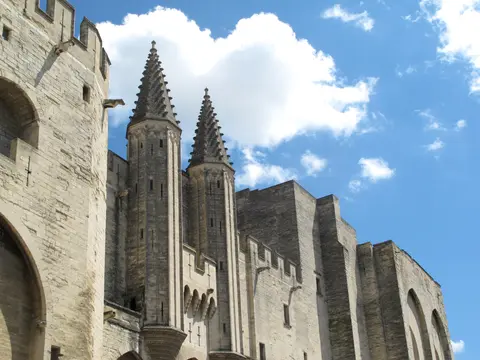
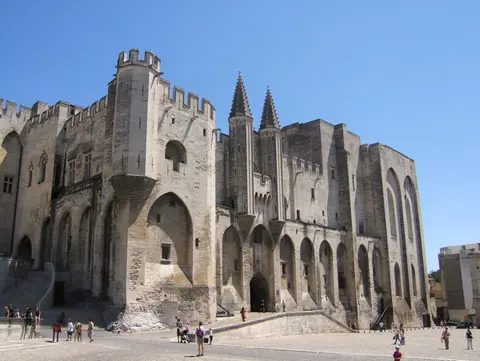
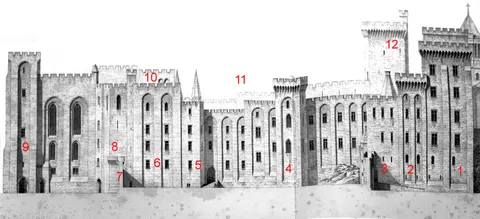
Elected in 1305 after Philip IV of France's conflict with Pope Boniface VIII and Benedict XI's eight-month pontificate, Pope Clement V, the Gascon Bertrand de Goth, avoided violent factional strife in Rome. He transferred the Papal Curia to Avignon in 1309, living initially as a guest in the city's Dominican monastery. Under his successor Pope John XXII, the papal household expanded quickly, yet monumental construction began in earnest only under Pope Benedict XII (1334 to 1342). He built atop the Rocher des Doms, a natural limestone outcrop rising at the northern edge of Avignon above the River Rhône. Groundbreaking on the earlier episcopal site had begun back in 1252, before Benedict XII ordered Mirepoix architect Pierre Peysson (also spelled Pierre Poisson) to demolish that older bishops' palace. In its place, Peysson raised the Palais Vieux: an austere, cloister-centred stronghold enclosed by four fortified wings flanked by high towers.
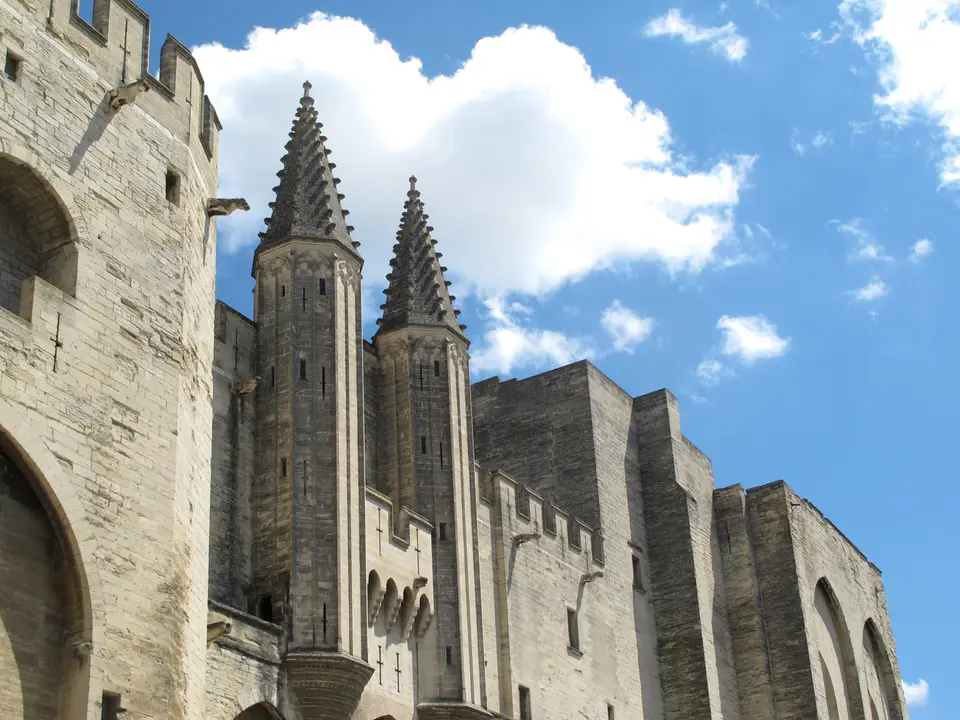
His successor Clement VI (elected in 1342), the most extravagant of Avignon's pontiffs, engaged Paris-trained master architect Jean de Louvres to raise a grand southern wing known as the Palais Neuf. This second building campaign added a new tower and ceremonial halls anchored by a 52-metre-long (171-foot) Grand Chapel built for papal liturgy. Subsequent popes extended and closed the ensemble: Innocent VI (elected 1352) added two towers and a bridge, while Urban V (elected 1362) completed the main enclosure known today as the Court of Honour. By completion in 1364, the joined Palais Vieux and Palais Neuf covered an area of 11,000 square metres and offered 15,000 square metres (160,000 square feet) of floor space. Forming Europe's largest Gothic palace, the complex consumed most contemporary papal revenue and earned chronicler Froissart's description as the most fortified house in the world.
Six papal conclaves met inside these walls, electing Benedict XII (1334), Clement VI (1342), Innocent VI (1352), Urban V (1362), Gregory XI (1370), and antipope Benedict XIII (1394). Convinced that the papal chair belonged beside Saint Peter's tomb in Rome, Urban V was also encouraged by progress toward Latin-Orthodox dialogue and Italian stability. He departed against French court and cardinal opposition on 30 April 1362, and Gregory XI completed a permanent return on 13 September 1370 and in 1377. That departure triggered the Papal Schism, during which antipopes Clement VII and Benedict XIII held Avignon until 1403. Benedict XIII spent five years imprisoned inside after Geoffrey Boucicaut's army occupied Avignon and besieged the fortress in 1398. Antipapal forces held out through a further siege from 1410 to 1411 until papal legates re-established authority in 1433, governing the city and Comtat Venaissin for over 350 years.
Fourteenth-Century Sienese Frescoes and the Curia Administration
Behind crenellated walls and 52-metre towers such as the Tour de Trouillas, one of the tallest medieval towers in France, the Palais des Papes reshaped how the Catholic Church administered Christendom. Immense architectural scale enabled centralised chancery, judicial, and financial offices, expanding the Curia from 200 officials in the late thirteenth century to over 300 early in the fourteenth century and 500 administrators by 1316, joined by over 1,000 lay officials working inside the palace. In the Palais Vieux, the vast Consistory Hall led into the Chapel of St John beneath the Great Tinel feast hall, while the western Wing of the Great Dignitaries housed the Grande Audience (Hall of Justice), big enough to hold up to 700 guests today.
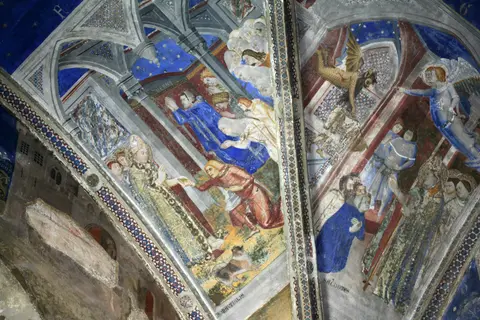
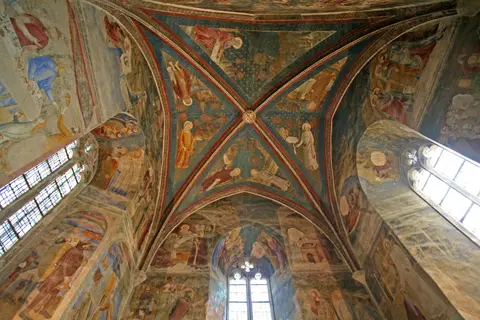
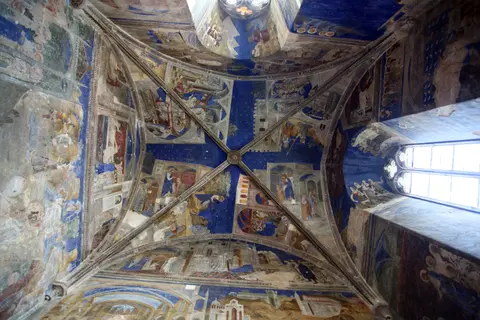
Court patronage drew scholars, composers, and painters from across Europe. The papal library grew above 2,000 volumes, becoming the largest book collection in Europe and attracting early humanist writer Petrarch. In the Grand Chapel, Clement VI used Guillaume de Machaut's Mass of Notre-Dame, Philippe de Vitry presented his Ars Nova music treatise at papal invitation, and Johannes Ciconia came to study. Visual decoration fell largely to leading pupils of the Sienese school, Simone Martini and Matteo Giovanetti (Giovannetti). Between 1344 and 1345 Giovanetti decorated the Saint-Martial Chapel on the second level of the Saint-Jean tower, structuring narrative scenes of Saint Martial's life to read from top to bottom. From 1347 to 1348 he painted the Saint-Jean Chapel beneath it, a compact room ten metres high. Its ceiling depicts both John the Baptist and John the Evangelist with their biblical families, while its north, east, south, and west walls employ complex illusionistic architecture praised by art historian Dieter Blume.
In Clement VI's private study, known as the Chambre du Cerf (Room of the Stag), court painters executed rare secular hunting, hawking, and woodland frescoes in a style influenced by Sienese masters. Elsewhere, destruction ran deep: a fourteenth-century fire swept the Great Tinel, where starry blue tapestries perished and cardinals later walled the hall up behind brick during conclaves leaving only a small food hatch. A 1516 restoration stalled decline only briefly before the 1789 French Revolution brought sacking and a June 1790 massacre of counter-revolutionaries. Seized by Napoleonic authorities and used by the Third Republic as military barracks and stables until 1906, the palace had its woodwork cleared and frescoes covered over. That alteration ensured the limestone shell survived as described starkly by Charles Dickens in Pictures from Italy before modern museum restoration began.
Ramparts, Rocher des Doms, and the Four Surviving Bridge Arches
UNESCO protection reaches beyond the papal fortress across the 8.2-hectare historic core uniting the Episcopal Ensemble, town defences, and river crossing. Immediately north of the Palais des Papes rises the Romanesque Cathedral of Notre-Dame-des-Doms, dating from 1150. Gothic side chapels were added between the fourteenth and seventeenth centuries, and in 1671 builders demolished the medieval cloister to erect an enlarged Baroque apse, yet the cathedral preserved its Romanesque fabric and active religious role.
Opposite the palace on the square's western edge stands the Petit Palais, initiated in 1317 as a bishop's residence. Expanded through the fourteenth and fifteenth centuries, it later underwent restoration to house medieval and Renaissance collections. Below the north flank of the Rocher des Doms garden, listed as a protected site since 1933, surviving city ramparts connect the Châtelet gatehouse and the Tour des Chiens (Dog Tower) above the Rhône. Ownership today reflects shared French stewardship: Place du Palais, the Petit Palais, the bridge, the gardens, and most of the Palais des Papes belong to the City of Avignon. The Chapel of Benedict XII and Tour de Trouillas belong to the Department of Vaucluse, which co-hosts archives and a papal research centre with the École française de Rome and IRHT. Finally, the Cathedral belongs to the French State, protected under historic monument listings dating back to 1840 and a safeguarding plan approved in 2007.
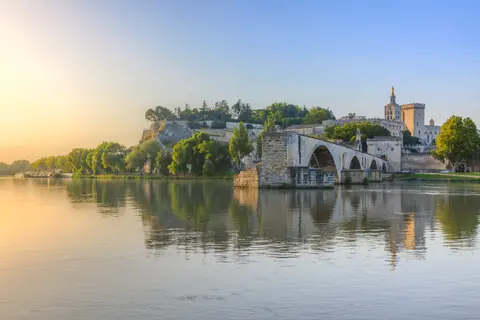
At the foot of the rock, the twelfth-century Saint Bénézet Bridge originally crossed the Rhône on twenty-two stone arches. Centuries of river floods swept away eighteen spans, leaving the fortified city gatehouse and four surviving masonry arches carrying the part-Romanesque, part-fifteenth-century Chapel of St Nicolas atop the second pier.
Monument Sectors Across Avignon's Papal Core
All monuments in the inscribed core sit within compact walking distance around Place du Palais and the Rocher des Doms cliff, coordinated jointly by municipal, departmental, and national heritage teams.
| Complex Zone | Key Highlights | Access & Ticket Rule |
|---|---|---|
| Palais des Papes (Palais Vieux & Palais Neuf) | Consistory Hall, Great Tinel, Grande Audience, Chambre du Cerf, and Giovanetti's frescoed chapels | Ticketed museum route operated year-round; check the official site for timed slots and July Festival d'Avignon courtyard closures. |
| Pont Saint-Bénézet (Avignon Bridge) | Gatehouse entrance, four surviving medieval arches, and the two-tier Chapel of St Nicolas | Accessible via paid walkway ticket from the river gatehouse; paired tickets are often available with the Palais des Papes. |
| Cathedral of Notre-Dame-des-Doms & Rocher des Doms | 1150 Romanesque cathedral nave, 1671 Baroque apse, and 1933-listed clifftop gardens above the Rhône | Cathedral interior and Rocher des Doms park offer open public entry; respect liturgical services inside the church. |
| Petit Palais Museum | 1317 cardinal and episcopal palace housing medieval and Renaissance paintings on Place du Palais | Exterior courtyard and façade remain open to view; check official museum hours and ticketing before entering galleries. |
| Northern Ramparts, Tour des Chiens & Châtelet | Medieval defensive walls, gatehouse towers, and riverfront fortifications at the base of the cliff | Public lanes and exterior defensive walls are freely walkable; verify seasonal access to upper wall walks locally. |
Architectural Marks to Spot Inside the Papal Complex
Before walking out toward the river ramparts, pause at three structural and painted clues inside the monument core that explain how medieval builders combined military defence, papal ritual, and Italian fresco brushwork across two connected palaces.
- Flying Buttress Spanning the Street: Look up along the exterior flank of the Palais Neuf where a massive masonry flying buttress bridges directly across the neighbouring street. It braces the heavy vault of Clement VI's 52-metre Grand Chapel, an engineering detail praised by Eugène Viollet-le-Duc in his architectural dictionary.
- Conclave Masonry Traces in the Great Tinel: Inside the vaulted feast hall, note the scale of the high reception bay. Cardinals sealed this bay behind temporary brick walls during six fourteenth-century papal conclaves, leaving only a tiny service hatch for meals before tearing the brickwork down after each election.
- Top-to-Bottom Fresco Reading Order: In the Saint-Jean tower's Saint-Martial Chapel, inspect Matteo Giovanetti's 1344 to 1345 fresco cycle from the ceiling vault downward. This viewpoint traces how Sienese illusionistic depth adapted to tight Gothic stone ribs before continuing down to the 1347 to 1348 Saint-Jean Chapel beneath it.
Seasonal Rhythm and Pairing Avignon with Marseille
Poet René Char and art critic Christian Zervos launched an art exhibition in the Grand Chapel from 27 to 30 June 1947 featuring Matisse, Picasso, Braque, and Mondrian. That tradition continued with Picasso shows in 1970 and 1973, the 2000 retrospective, Miquel Barceló in 2010, Les Papesses in 2013, and Stefan Szczesny in 2014. Building on that legacy, the Palais des Papes courtyard operates each July as the flagship open-air stage of the Festival d'Avignon. Outside July, exhibition rooms and the International Congress Centre (established 1976) welcome around 650,000 annual visitors, keeping the palace among France's ten most visited sites. At the same time, researchers still consult medieval records in the Vaucluse archives. Entering early in the morning allows quiet movement through Giovanetti's small frescoed chapels and the Chambre du Cerf before tour groups assemble. This leaves late afternoon for the shaded walks of the Rocher des Doms and sunset light across the surviving arches of Pont Saint-Bénézet.
Travellers landing at Marseille Provence Airport (66 km south) can pair Avignon's medieval papal stronghold with southern Mediterranean history in our Marseille travel guide (86 km), or compare medieval fortified complexes across Europe in the UNESCO World Heritage Atlas.